Paper I — Q5
(a) How does knowledge influence deductive reasoning? Give suitable examples. (10 marks) (b) Explain the relationship between…
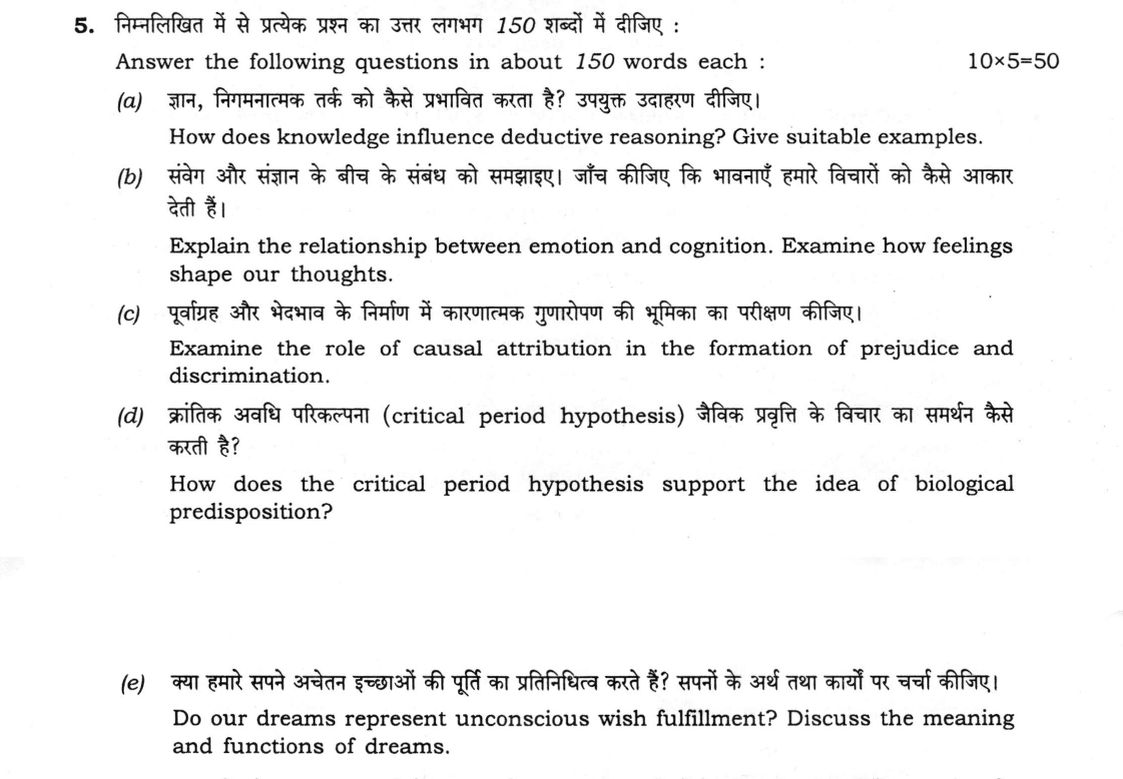
Answer the following questions in about 150 words each :
How does knowledge influence deductive reasoning? Give suitable examples. 10 marks
Explain the relationship between emotion and cognition. Examine how feelings shape our thoughts. 10 marks
Examine the role of causal attribution in the formation of prejudice and discrimination. 10 marks
How does the critical period hypothesis support the idea of biological predisposition? 10 marks
Do our dreams represent unconscious wish fulfillment? Discuss the meaning and functions of dreams. 10 marks
हिंदी में प्रश्न पढ़ें
निम्नलिखित में से प्रत्येक प्रश्न का उत्तर लगभग 150 शब्दों में दीजिए :
ज्ञान, निगमनात्मक तर्क को कैसे प्रभावित करता है? उपयुक्त उदाहरण दीजिए। (10 अंक)
संवेग और संज्ञान के बीच के संबंध को समझाइए। जाँच कीजिए कि भावनाएँ हमारे विचारों को कैसे आकार देती हैं। (10 अंक)
पूर्वाग्रह और भेदभाव के निर्माण में कारणात्मक गुणारोपण की भूमिका का परीक्षण कीजिए। (10 अंक)
क्रांतिक अवधि परिकल्पना (critical period hypothesis) जैविक प्रवृत्ति के विचार का समर्थन कैसे करती है? (10 अंक)
क्या हमारे सपने अचेतन इच्छाओं की पूर्ति का प्रतिनिधित्व करते हैं? सपनों के अर्थ तथा कार्यों पर चर्चा कीजिए। (10 अंक)
Model answer
Drafted with AI by UPSC Answer Check against this question's marking rubric, to the 150-word length. UPSC does not publish answers for Mains — this is one way to score well, not an official key. How we build rubrics and answers.
(a) How does knowledge influence deductive reasoning? Give suitable examples.
Deductive reasoning is formally content-independent, yet empirically, prior knowledge significantly influences performance. This influence operates in two directions: facilitation and distortion.
First, knowledge facilitates reasoning through thematic content. In the Wason selection task (1966), participants struggle with abstract rules but perform well with thematic versions. For example, the "drinking rule" (if you are drinking beer, you must be over 18) is solved more easily than an abstract card-matching task. This is explained by pragmatic reasoning schemas (Cheng and Holyoak, 1985) or social contract theory (Cosmides, 1989), where evolved knowledge of social exchange aids logic.
Second, knowledge distorts reasoning through belief bias. Evans, Barston, and Pollard (1983) demonstrated that people judge the validity of syllogisms based on the believability of the conclusion rather than logical form. For instance, a logically valid syllogism with an unbelievable conclusion is often rejected. This suggests that belief-driven Type 1 processing (intuitive) often overrides analytic Type 2 processing (logical), as proposed in dual-process theories (Evans and Stanovich, 2013). Thus, knowledge acts as both a scaffold and a bias in deductive tasks.
(b) Explain the relationship between emotion and cognition. Examine how feelings shape our thoughts.
The relationship between emotion and cognition is bidirectional and complex, involving a debate over which process is primary. While Lazarus (1991) argued that cognitive appraisal (primary and secondary) precedes emotion, Zajonc (1980) proposed affective primacy, suggesting that "preferences need no inferences." LeDoux’s model supports this with the "low road" (amygdala) processing threat faster than the "high road" (cortex). Schachter and Singer’s (1962) two-factor theory further links cognition and arousal, positing that we label physiological states based on cognitive context.
Feelings shape thought in several ways. In memory, mood-congruent memory (Bower, 1981) shows that individuals recall information consistent with their current mood. In decision-making, Damasio’s somatic marker hypothesis suggests that emotions guide choices; patients with ventromedial prefrontal damage fail the Iowa Gambling Task because they lack the "gut feelings" necessary for rational decision-making. Furthermore, Isen’s research indicates that positive affect enhances creative problem-solving by broadening attention, whereas negative affect narrows focus. Thus, feelings are not merely byproducts of thought but are integral to cognitive processing.
(c) Examine the role of causal attribution in the formation of prejudice and discrimination.
Causal attribution—the process of explaining the causes of behavior—plays a central role in generating prejudice (attitude) and discrimination (behavior). Heider (1958) distinguished between internal (dispositional) and external (situational) attributions. Prejudice is sustained by systematic biases in how these attributions are applied to in-group versus out-group members.
The Fundamental Attribution Error (Ross, 1977) leads people to overestimate dispositional factors for others. In the context of prejudice, this manifests as the Ultimate Attribution Error (Pettigrew, 1979), where out-group members' negative acts are attributed to their character, while positive acts are attributed to luck or special circumstances. Conversely, in-group members' failures are often attributed to situational factors. The Just-World Hypothesis (Lerner, 1980) further drives victim-blaming, where victims of misfortune are blamed to preserve the belief that the world is fair. These attributional distortions solidify negative stereotypes (attitudes) and justify discriminatory behaviors (actions) against out-groups. Remedies include attributional retraining and the jigsaw classroom, which encourage individuating information and reduce reliance on group-based causal explanations.
(d) How does the critical period hypothesis support the idea of biological predisposition?
The critical period hypothesis holds that certain behaviours are acquired normally only within a biologically fixed developmental window. Such windows support biological predisposition: learning is not a blank-slate process, because genetically timed maturation decides when experience can take effect.
Konrad Lorenz (1935) found that greylag goslings imprint on the first moving object seen within roughly a day of hatching; once the window closes, imprinting fails. Hubel and Wiesel showed that monocular deprivation in kittens permanently shifts ocular dominance, while the same deprivation in adult cats has little effect. Lenneberg (1967) proposed a critical period for language ending around puberty, consistent with Genie’s failure to master grammar, though her case is confounded by abuse. Biological preparedness (Seligman, 1970) and Garcia and Koelling’s (1966) taste-aversion findings show that species are also primed to learn particular associations.
Most human windows are better called sensitive periods: Romanian adoptees placed before about six months largely recovered, whereas later-adopted children showed more persistent deficits (Rutter and colleagues). Timing still reflects biological programming, though plasticity remains.
(e) Do our dreams represent unconscious wish fulfillment? Discuss the meaning and functions of dreams.
Sigmund Freud (1900) proposed in The Interpretation of Dreams that dreams represent unconscious wish fulfillment, where latent content (hidden desires) is disguised as manifest content through dream-work (condensation, displacement, symbolization and secondary revision). While this view highlights the symbolic nature of dreams, modern evidence suggests it is not the sole or primary function.
Alternative accounts focus on physiological and cognitive functions. The Activation-Synthesis Hypothesis (Hobson and McCarley, 1977) argues that dreams are the brain's attempt to make sense of random neural firing during REM sleep (identified by Aserinsky and Kleitman, 1953). Other theories link dreaming to memory consolidation, or to "reverse learning" that erases spurious neural associations (Crick and Mitchison, 1983). Revonsuo (2000) suggests a threat simulation function, where dreams rehearse dangerous scenarios for survival. Jung offered a compensatory view, suggesting dreams balance the psyche. Therefore, while dreams may contain elements of wish fulfillment, they likely serve broader functions in memory processing, emotional regulation, and cognitive maintenance.
How this answer will be evaluated
Evaluation rubric
Each sub-part is marked on its own, against the marks and word limit printed on the paper.
- (a) Show that deductive reasoning, though formally content-independent, is empirically affected by what the reasoner knows and believes - both facilitating (thematic and familiar content) and distorting (belief bias) - and support each claim with a named experimental paradigm and an example, as the question demands examples. 10 marks · 150 words
Must cover
- Wason selection task (1966/1968) and its thematic versions
- Belief bias - Evans, Barston and Pollard (1983)
- At least one concrete syllogism or rule as an example
- Pragmatic reasoning schemas (Cheng and Holyoak, 1985) or social contract theory (Cosmides, 1989)
- Mental models (Johnson-Laird) or dual-process theory
Loses marks
- Writing about inductive reasoning or problem solving instead of deduction
- Asserting that knowledge helps reasoning without acknowledging belief bias, or vice versa - the question needs both directions
- Giving no example at all, when the question explicitly asks for suitable examples
- Describing the Wason task incorrectly, e.g. saying most people solve the abstract version
- Confusing belief bias with confirmation bias - the former concerns judging validity by conclusion believability, the latter concerns seeking confirming evidence
Earns more
- Dual-process account - belief-driven Type 1 processing not overridden by analytic Type 2 processing (Evans and Stanovich, 2013) - or an equivalent account of why knowledge distorts
- Further knowledge-related errors such as the atmosphere effect (Woodworth and Sells, 1935), illicit conversion of premises, or the modus ponens versus modus tollens asymmetry
- (b) Two linked demands: explain the emotion-cognition relationship - showing it runs in both directions and naming the theoretical positions in the cognition-versus-affect primacy debate - and then examine specifically how feelings shape thought (memory, judgement, attention, creativity, decision making). 10 marks · 150 words
Must cover
- Schachter and Singer (1962) two-factor theory
- Lazarus - cognitive appraisal (primary and secondary)
- Zajonc (1980) affective primacy / 'preferences need no inferences'
- LeDoux - amygdala low road and high road
- Mood-congruent memory (Bower, 1981)
- Damasio's somatic marker hypothesis / Iowa Gambling Task
Loses marks
- Describing the classical theories of emotion (James-Lange, Cannon-Bard, Schachter-Singer) as a list without addressing the emotion-cognition relationship the question asks about
- Treating the relationship as one-way - cognition causes emotion - and never examining how feelings shape thought, which is the second, separately marked demand
- Reversing the Zajonc and Lazarus positions
- Misstating the Schachter-Singer design, e.g. claiming the arousal itself determined which emotion was felt
- Giving no empirical evidence at all, so the 'examine' directive is unmet
Earns more
- Feelings shaping creativity and decision making: Isen on positive affect and creative problem solving; Damasio's (1994) somatic marker hypothesis with ventromedial prefrontal patients failing the Iowa Gambling Task
- Contrast with non-cognitive classical theories (James-Lange, 1884-85; Cannon-Bard, 1927) and/or the role of cognitive reappraisal in emotion regulation
- (c) 'Examine the role of causal attribution' - show, with named attribution concepts and biases, how the way people explain the behaviour and outcomes of in-group and out-group members generates and sustains prejudice (an attitude) and discrimination (behaviour); a line on attribution-based remedies completes the answer. 10 marks · 150 words
Must cover
- Heider (1958) - internal versus external attribution
- Fundamental attribution error (Ross, 1977)
- Ultimate attribution error (Pettigrew, 1979)
- Just-world hypothesis (Lerner)
- Prejudice as attitude versus discrimination as behaviour (Allport, 1954)
- At least one remedy (contact, superordinate goals, jigsaw classroom, attributional retraining)
Loses marks
- Writing a general essay on prejudice - its sources, types and reduction - without making attribution the explanatory mechanism, which is what the question asks
- Describing attribution theories at length without ever applying them to prejudice or discrimination
- Failing to distinguish prejudice (attitude) from discrimination (behaviour)
- Omitting the ultimate attribution error, the single concept that most directly answers the question
- Confusing the self-serving bias (about oneself) with the group-serving or ultimate attribution error (about one's group versus others)
Earns more
- Just-world belief (Lerner, 1980) and victim-blaming; supporting mechanisms such as illusory correlation (Hamilton and Gifford, 1976), attributional ambiguity (Crocker and Major, 1989) or stereotype threat (Steele and Aronson, 1995)
- The attitude-to-behaviour link and attribution-based remedies: attributional retraining, individuating information, Allport's contact conditions, Sherif's superordinate goals, the jigsaw classroom
- (d) Define the critical period hypothesis, and show with evidence how the existence of time-limited windows for acquiring particular behaviours argues that organisms are biologically prepared - genetically pre-programmed - to learn certain things at certain times, rather than being blank slates shaped only by experience. 10 marks · 150 words
Must cover
- Critical period versus sensitive period
- Konrad Lorenz, imprinting in greylag geese (1935)
- Hubel and Wiesel, monocular deprivation, ocular dominance
- Lenneberg (1967) critical period for language; Genie
- Biological preparedness (Seligman, 1970) / Garcia and Koelling (1966)
- Bowlby's attachment sensitive period or the Romanian adoptee studies
Loses marks
- Describing imprinting without ever drawing the inference about biological predisposition, which is the actual question
- Attributing imprinting to Harlow or to Tinbergen rather than Lorenz, or dating it to the wrong decade
- Giving the imprinting window as days or weeks rather than hours after hatching
- Citing only Genie, a single confounded case, as if it settled the language claim
- Treating every developmental window as absolutely critical and irreversible, ignoring the evidence for plasticity and partial recovery
- Confusing a critical period with Piaget's stages or Erikson's psychosocial crises
Earns more
- Qualification: most human windows are sensitive rather than absolutely critical; plasticity, recovery and the confounding of deprivation in case studies
- (e) Take a reasoned position on the Freudian wish-fulfilment claim - stating it accurately and evaluating it against the evidence - and then set out the meaning and the proposed functions of dreaming across the major alternative accounts. 10 marks · 150 words
Must cover
- Freud, The Interpretation of Dreams (1900); wish fulfilment
- Manifest and latent content; dream-work (condensation, displacement, symbolisation, secondary revision)
- REM sleep - Aserinsky and Kleitman (1953)
- Activation-synthesis hypothesis - Hobson and McCarley (1977)
- At least one further function: memory consolidation, reverse learning (Crick and Mitchison, 1983), threat simulation (Revonsuo, 2000) or problem solving
- Jung's compensatory/archetypal view
Loses marks
- Presenting Freud's theory as established fact and offering no evaluation, when the question is posed as a question
- Confusing manifest with latent content
- Attributing the discovery of REM sleep to Freud, Hobson or Dement alone rather than Aserinsky and Kleitman (1953)
- Stating that dreaming occurs only in REM sleep
- Describing the stages of sleep at length instead of the meaning and functions of dreams
- Offering only one theory, when the question asks for the functions of dreams in the plural
Earns more
- The sleep-physiological context: REM sleep (Aserinsky and Kleitman, 1953), about 90-minute cycles and 20-25 per cent of adult sleep, Dement and Kleitman's (1957) REM-dream association, and the fact that dreaming also occurs in NREM
- Other proposed functions: memory consolidation, Crick and Mitchison's (1983) reverse learning, Revonsuo's (2000) threat simulation, problem-solving and emotional regulation, the continuity hypothesis, and Jung's compensatory/archetypal reading
What "How" is asking you to do
Set out the route by which the outcome comes about, step by step. Many how stems ask how one thing affects another, and there the channel of transmission is precisely what is being marked.
Structure that answers it
Starting condition → step → step → outcome reached → the conditions the route depends on
Where marks are lost
Answering why it happens instead of how, the commonest single misread in the paper. An answer full of causes and significance that never traces the mechanism has answered a different question.
Practice this exact question
Write your answer and it is marked point by point against the model answer above — what you covered, what you missed, what you got wrong.
Evaluate my answer →More from Psychology 2026 Paper I
- Q2 (a) Critically examine the top-down and bottom-up processing in perception. How can we ma…
- Q3 (a) Discuss various types of long-term memory. Explain how primacy and recency effect ill…
- Q4 (a) Explain how learning takes place through classical conditioning. Discuss the role of…
- Q5 Answer the following questions in about 150 words each : (a) How does knowledge influence…
- Q6 (a) What do you mean by defense mechanism? Distinguish between healthy and unhealthy defe…
- Q7 (a) Discuss the nature and functions of attitudes and values with reference to developmen…
- Q8 (a) Why do the people in almost every culture use psychoactive drugs? Discuss the effects…