Paper I — Q8
(a) Why do the people in almost every culture use psychoactive drugs? Discuss the effects of various stimulants and depressants…
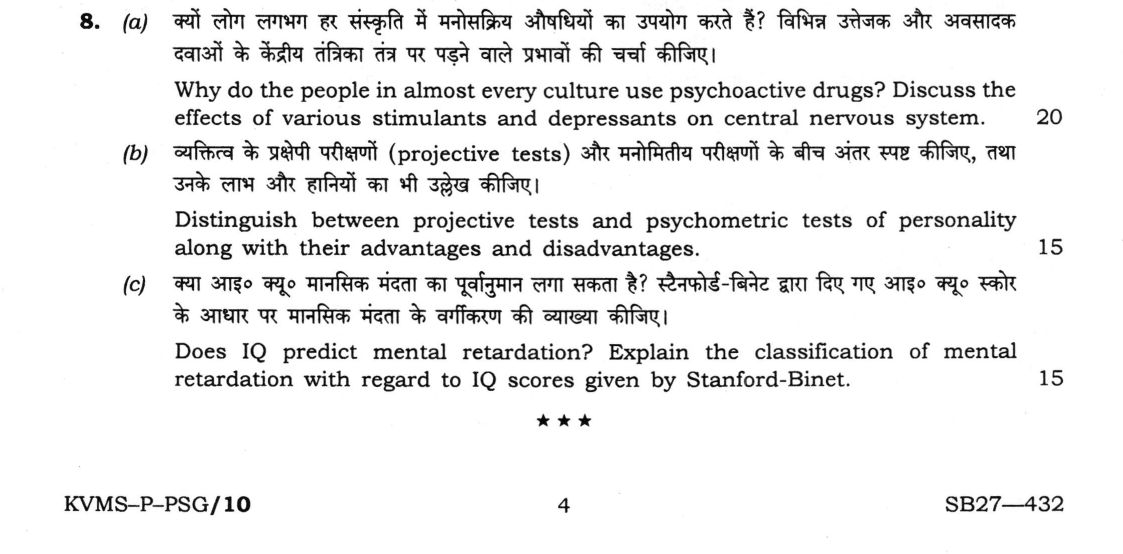
Why do the people in almost every culture use psychoactive drugs? Discuss the effects of various stimulants and depressants on central nervous system. 20 marks
Distinguish between projective tests and psychometric tests of personality along with their advantages and disadvantages. 15 marks
Does IQ predict mental retardation? Explain the classification of mental retardation with regard to IQ scores given by Stanford-Binet. 15 marks
हिंदी में प्रश्न पढ़ें
क्यों लोग लगभग हर संस्कृति में मनोसक्रिय औषधियों का उपयोग करते हैं? विभिन्न उत्तेजक और अवसादक दवाओं के केंद्रीय तंत्रिका तंत्र पर पड़ने वाले प्रभावों की चर्चा कीजिए। (20 अंक)
व्यक्तित्व के प्रक्षेपी परीक्षणों (projective tests) और मनोमितीय परीक्षणों के बीच अंतर स्पष्ट कीजिए, तथा उनके लाभ और हानियों का भी उल्लेख कीजिए। (15 अंक)
क्या आई० क्यू० मानसिक मंदता का पूर्वानुमान लगा सकता है? स्टैनफोर्ड-बिनेट द्वारा दिए गए आई० क्यू० स्कोर के आधार पर मानसिक मंदता के वर्गीकरण की व्याख्या कीजिए। (15 अंक)
Model answer
Drafted with AI by UPSC Answer Check against this question's marking rubric, to the expected length. UPSC does not publish answers for Mains — this is one way to score well, not an official key. How we build rubrics and answers.
(a) Why psychoactive drug use is near-universal; CNS effects of stimulants and depressants
Psychoactive drug use appears in almost every culture because it serves ritual, social, personal and neurochemical ends. Ritually, peyote in the Native American Church, wine in the Christian Eucharist and bhang at Holi mark sacred or festive occasions; socially, alcohol, tobacco and caffeine ease bonding and hospitality. Individually, people use drugs for pleasure, curiosity, coping with stress or pain, and self-medication. Neurochemically, almost all such drugs increase dopamine in the mesolimbic reward pathway, from the ventral tegmental area (VTA) to the nucleus accumbens, producing euphoria that reinforces use.
Stimulants increase CNS activity. Cocaine blocks the reuptake of dopamine and noradrenaline, amphetamine also promotes their release, nicotine stimulates nicotinic acetylcholine receptors, and caffeine blocks adenosine receptors. Short-term effects are alertness, energy, raised heart rate and reduced appetite; heavy amphetamine or cocaine use can cause a psychosis resembling paranoid schizophrenia, cardiovascular strain and a post-use “crash”.
Depressants such as alcohol, barbiturates and benzodiazepines slow CNS activity by enhancing GABA-A receptor function, producing relaxation, sedation and impaired coordination and memory. Opioids (morphine, heroin), often treated as a separate narcotic class, act on µ-opioid receptors to relieve pain. Overdose of opioids or barbiturates, especially with alcohol, can cause fatal respiratory depression, and alcohol withdrawal can trigger seizures and delirium tremens.
Use is maintained by tolerance, physical and psychological dependence and withdrawal: the drug is taken to relieve withdrawal distress (negative reinforcement), the cycle captured by DSM-5 substance use disorder.
(b) Projective versus psychometric personality tests
Personality assessment is divided into projective and psychometric (objective) tests, which differ in stimulus, response format, and theoretical basis.
Projective tests are based on the projective hypothesis (L. K. Frank, 1939), which suggests that ambiguous stimuli allow individuals to project their unconscious conflicts. Examples include the Rorschach Inkblot Test (1921), which uses ten blots, and the Thematic Apperception Test (TAT) (Morgan and Murray, 1935). Lindzey (1959) classified them as association, construction, completion, choice or ordering, and expressive techniques.
- Advantages: They provide rich, qualitative data about unconscious motives and are difficult to "fake" because the responses are open-ended.
- Disadvantages: They suffer from low reliability and validity, and scoring is often subjective and time-consuming.
Psychometric tests (e.g., MMPI, 16PF, NEO-PI-R) use standardized, self-report formats. The MMPI (Hathaway and McKinley, 1943) is a prime example, utilizing L, F, and K validity scales to detect faking or social desirability response sets.
- Advantages: They are highly reliable, standardized, and can be administered and scored quickly using objective norms.
- Disadvantages: They are limited by the respondent's self-awareness and are susceptible to faking, which is why validity scales are essential.
In practice, these tests are complementary: objective tests provide a broad, reliable screen, while projective tests offer a deeper exploration of specific psychological dynamics.
(c) IQ and the classification of mental retardation
IQ is a necessary but not sufficient criterion for diagnosing intellectual disability (formerly mental retardation). A diagnosis requires three criteria: (1) significant limitations in intellectual functioning (IQ), (2) significant deficits in adaptive behaviour (conceptual, social, and practical skills), and (3) onset during the developmental period.
Terman’s 1916 Stanford-Binet revision of Binet and Simon’s 1905 scale introduced the ratio IQ = (Mental Age / Chronological Age) × 100. Later editions adopted a deviation IQ with a standard deviation (SD) of 16; the SB5 (2003), like the Wechsler scales, uses 15.
Classification by IQ Score:
- Mild (Educable): 50-55 to 70. This accounts for approximately 85% of cases.
- Moderate (Trainable): 35-40 to 50-55.
- Severe: 20-25 to 35-40.
- Profound: Below 20-25.
On the older SD-16 Stanford-Binet, the same cut-offs (two to five SDs below the mean) fall at about 52–67 (mild), 36–51 (moderate), 20–35 (severe) and below 20 (profound).
While IQ predicts school achievement and support needs, it does not define the condition alone. Modern frameworks like the DSM-5 (2013) emphasize adaptive functioning for severity levels. Furthermore, the standard error of measurement (SEM) and the Flynn effect (the secular rise in IQ scores) mean that a single cut-off score cannot be the sole basis for a diagnosis. In India, the Rights of Persons with Disabilities Act, 2016 lists intellectual disability among the specified disabilities.
How this answer will be evaluated
Evaluation rubric
Each sub-part is marked on its own, against the marks and word limit printed on the paper.
- (a) Two demands: (i) explain the near-universality of psychoactive drug use across cultures - the motivational, ritual, social and neurochemical reasons; (ii) discuss the CNS effects of stimulants and of depressants, each class named with its members, mechanisms and short- and long-term consequences. 20 marks
Must cover
- Psychoactive drug; mesolimbic dopamine reward pathway (VTA to nucleus accumbens)
- Tolerance, dependence, withdrawal
- Stimulants: caffeine, nicotine, amphetamine/methamphetamine, cocaine
- Depressants: alcohol, barbiturates, benzodiazepines; opioids (morphine, heroin) as narcotic analgesics
- GABA-A facilitation by alcohol, barbiturates and benzodiazepines
- Amphetamine psychosis resembling paranoid schizophrenia
- Respiratory depression / delirium tremens
- A ritual or cultural example of drug use
Loses marks
- Misclassifying drugs - calling cocaine or nicotine a depressant, or alcohol a stimulant because of its initial disinhibiting effect
- Answering only the pharmacology and skipping the 'why in almost every culture' question, which carries about a third of the marks
- Describing hallucinogens and cannabis at length when the question specifies stimulants and depressants
- Giving no mechanism of action, so the answer lists effects without explaining them
- Moralising about drug abuse instead of analysing CNS effects
- Omitting the lethal risks - respiratory depression in opioid and barbiturate overdose, and seizures or delirium tremens in alcohol withdrawal
Earns more
- The maintenance cycle: tolerance, physical and psychological dependence, withdrawal, and negative reinforcement through relief of withdrawal (DSM-5 substance use disorder)
- (b) Distinguish projective from psychometric (objective, self-report) personality tests on stimulus, response format, scoring, theoretical assumption and purpose, naming real tests of each kind, and state the advantages and disadvantages of each - which the question explicitly requires. 15 marks
Must cover
- Projective hypothesis / L. K. Frank (1939)
- Rorschach Inkblot Test (1921) - ten blots
- Thematic Apperception Test - Morgan and Murray (1935)
- MMPI (Hathaway and McKinley, 1943) with L, F and K validity scales
- 16PF (Cattell) / EPQ (Eysenck) / NEO-PI-R (Big Five)
- Reliability, validity, norms, standardisation
- Faking and social desirability response set
Loses marks
- Listing the two kinds of test without ever giving the advantages and disadvantages, which the question explicitly requires and which carry a third of the marks
- Getting the Rorschach's number of cards wrong or confusing it with the TAT
- Classifying the MMPI or 16PF as projective, or the sentence completion test as objective
- Claiming projective tests have high validity, or that objective tests are immune to faking - the MMPI needs validity scales precisely because they are not
- Confusing 'objective test' in this technical sense with an objective-type examination of multiple-choice questions
- Omitting the classification of projective techniques into association, construction, completion, choice/ordering and expressive types (Lindzey, 1959)
- (c) Two demands: (i) evaluate whether IQ alone predicts or diagnoses intellectual disability - a qualified answer is expected, because adaptive behaviour and age of onset are equally criterial; (ii) set out the classification of mental retardation by IQ score in the Stanford-Binet tradition, with the bands correctly stated. 15 marks
Must cover
- Intellectual functioning AND adaptive behaviour AND onset in the developmental period
- IQ = (mental age / chronological age) x 100; Terman's Stanford revision, 1916; Binet and Simon, 1905
- Stanford-Binet SD of 16 versus Wechsler SD of 15
- Mild 50-55 to 70 (educable); Moderate 35-40 to 50-55 (trainable); Severe 20-25 to 35-40; Profound below 20-25
- Approximately 85 per cent of cases are mild
- Standard error of measurement / Flynn effect
- DSM-5 (2013) severity based on adaptive functioning
Loses marks
- Answering a flat 'yes' - that IQ predicts and defines intellectual disability - without the adaptive-behaviour and developmental-onset criteria
- Getting the bands wrong, most commonly by placing the mild-moderate boundary at 60 or setting the overall cut-off at 80
- Confusing the Stanford-Binet standard deviation of 16 with the Wechsler value of 15, or giving no standard deviation at all
- Using the obsolete and offensive terms moron, imbecile and idiot as if they were current classifications rather than historical ones
- Omitting the proportions - that roughly 85 per cent of cases are mild is a standard mark-earning detail
- Ignoring measurement error and the Flynn effect, which are precisely why a single cut-off score cannot be decisive
Earns more
- What IQ does predict, plus the modern shift: substantial correlation with school achievement and support needs; DSM-5 (2013) renaming the condition intellectual disability / intellectual developmental disorder and basing severity on adaptive functioning rather than IQ bands; the Indian Rights of Persons with Disabilities Act, 2016, as the statutory context
What "Discuss" is asking you to do
Lay the issue out from more than one side — how it arose, what is claimed for it, what is held against it, and where it now stands. UPSC attaches discuss to broad topics with several live dimensions, so coverage of the dimensions earns more than the strength of your opinion.
Structure that answers it
Set the issue up → the case as it is made → the case against → the dimension both sides leave out → where the balance now lies
Where marks are lost
Listing facts with no thread between them, or arguing one side throughout and calling it a discussion.
Practice this exact question
Write your answer and it is marked point by point against the model answer above — what you covered, what you missed, what you got wrong.
Evaluate my answer →More from Psychology 2026 Paper I
- Q5 Answer the following questions in about 150 words each : (a) How does knowledge influence…
- Q6 (a) What do you mean by defense mechanism? Distinguish between healthy and unhealthy defe…
- Q7 (a) Discuss the nature and functions of attitudes and values with reference to developmen…
- Q8 (a) Why do the people in almost every culture use psychoactive drugs? Discuss the effects…