Paper I — Q7
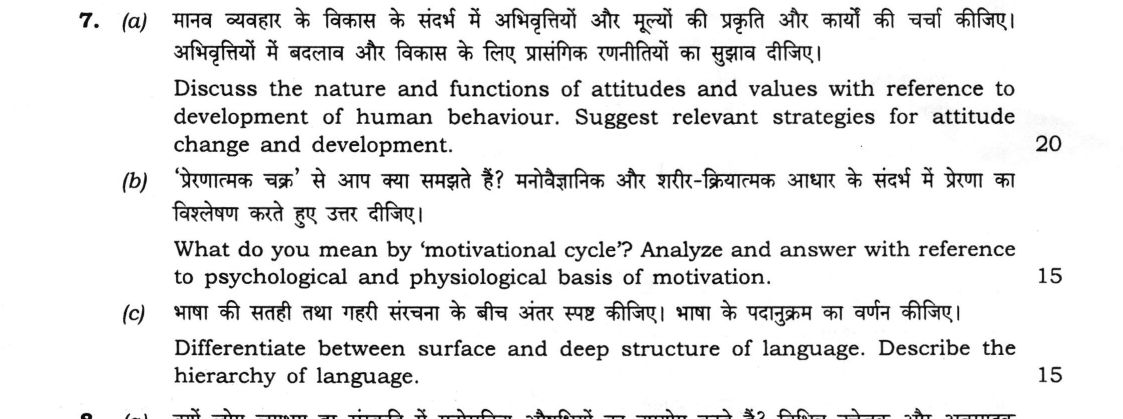
(a) Discuss the nature and functions of attitudes and values with reference to development of human behaviour. Suggest relevant…
Discuss the nature and functions of attitudes and values with reference to development of human behaviour. Suggest relevant strategies for attitude change and development. 20 marks
What do you mean by 'motivational cycle'? Analyze and answer with reference to psychological and physiological basis of motivation. 15 marks
Differentiate between surface and deep structure of language. Describe the hierarchy of language. 15 marks
हिंदी में प्रश्न पढ़ें
मानव व्यवहार के विकास के संदर्भ में अभिवृत्तियों और मूल्यों की प्रकृति और कार्यों की चर्चा कीजिए। अभिवृत्तियों में बदलाव और विकास के लिए प्रासंगिक रणनीतियों का सुझाव दीजिए। (20 अंक)
'प्रेरणात्मक चक्र' से आप क्या समझते हैं? मनोवैज्ञानिक और शारीर-क्रियात्मक आधार के संदर्भ में प्रेरणा का विश्लेषण करते हुए उत्तर दीजिए। (15 अंक)
भाषा की सतही तथा गहरी संरचना के बीच अंतर स्पष्ट कीजिए। भाषा के पदानुक्रम का वर्णन कीजिए। (15 अंक)
Model answer
Drafted with AI by UPSC Answer Check against this question's marking rubric, to the expected length. UPSC does not publish answers for Mains — this is one way to score well, not an official key. How we build rubrics and answers.
(a) Attitudes and values: nature, functions and strategies for change
Attitudes and values are distinct but related constructs. Allport (1935) defined an attitude as a mental and neural state of readiness, organized through experience, exerting a directive or dynamic influence on the individual’s response to all objects and situations with which it is related. It is typically structured according to the ABC model: the Affective component (feelings), the Cognitive component (beliefs), and the Behavioural component (tendencies to act). In contrast, values are more general, enduring, and normative. Rokeach (1973) distinguishes between terminal values (end-states of existence, such as "wisdom") and instrumental values (modes of conduct, such as "ambitious"). While attitudes are specific to particular objects or issues, values are broad principles that guide the formation of attitudes.
Both are acquired through classical and operant conditioning, observational learning and socialisation by family, peers, school and media. Once formed, they serve several functions identified by Katz (1960): knowledge (organizing the world), instrumental/adjustive (gaining social approval), ego-defensive (protecting self-image), and value-expressive (expressing self-concept). However, the link between attitude and behaviour is often weak, as demonstrated by LaPiere (1934). This "attitude-behaviour gap" is addressed by the Theory of Planned Behaviour (Ajzen, 1991), which posits that behaviour is a function of attitude, subjective norms, and perceived behavioural control.
Strategies for attitude change are grounded in the Elaboration Likelihood Model (Petty and Cacioppo, 1986). The central route involves high-effort processing of logical arguments, leading to durable change, while the peripheral route relies on cues like source attractiveness. Cognitive Dissonance (Festinger, 1957) is another powerful mechanism; Festinger and Carlsmith (1959) showed that individuals paid only $1 to perform a boring task shifted their attitudes more than those paid $20, as the $1 group had insufficient external justification for their behaviour. Group-level strategies include contact and superordinate goals to reduce intergroup prejudice.
(b) The motivational cycle; physiological and psychological bases
The motivational cycle is a sequence in which a physiological or psychological need creates a state of tension, the drive, which energises goal-directed behaviour toward an incentive (goal). Reaching the goal reduces the need, completing the cycle until the need recurs; hunger, food-seeking, eating and satiety illustrate it.
The physiological basis rests on homeostasis (Cannon), the body’s maintenance of internal stability. Drive-reduction theory (Hull, 1943) holds that biological needs create drives that motivate behaviour. Classically, the lateral hypothalamus (LH) was termed a feeding centre, since lesions cause aphagia, and the ventromedial hypothalamus (VMH) a satiety centre, since lesions cause hyperphagia; these labels are now considered oversimplified. Olds and Milner’s (1954) discovery of intracranial self-stimulation revealed brain reward circuits, later linked to mesolimbic dopamine and the nucleus accumbens.
The psychological basis includes Maslow’s hierarchy of needs, from physiological to self-actualisation needs, and McClelland’s need for achievement (n-Ach). Self-determination theory (Deci and Ryan, 1985) stresses needs for autonomy, competence and relatedness. Intrinsic motivation (doing a task for its own sake) differs from extrinsic motivation (for a reward), and the overjustification effect (Lepper, Greene and Nisbett, 1973) shows that expected rewards can undermine intrinsic interest.
Critically, drive reduction cannot explain stimulation-seeking. Curiosity and exploration persist when physiological needs are met, and arousal theory, consistent with the Yerkes-Dodson law (1908) inverted U between arousal and performance, proposes an optimal level of arousal rather than zero tension.
(c) Surface and deep structure; the hierarchy of language
In transformational generative grammar (Chomsky, 1957, 1965), language is analyzed through two levels: deep structure and surface structure. Deep structure represents the underlying semantic meaning and logical relationships of a sentence, while surface structure is the actual spoken or written form. Transformational rules convert deep structure into surface structure. For example, "The boy kicked the ball" and "The ball was kicked by the boy" have the same deep structure (meaning) but different surface structures. Conversely, the ambiguous sentence "Flying planes can be dangerous" has two different deep structures: one where the act of flying planes is dangerous, and another where planes that are in the air are dangerous.
The hierarchy of language describes the levels of linguistic organization:
- Phoneme: The smallest unit of sound (e.g., /p/ in "pat").
- Morpheme: The smallest unit of meaning. These can be free (stand alone, e.g., "cat") or bound (must attach, e.g., "-s" in "cats").
- Word: A combination of morphemes.
- Phrase: A group of words (e.g., "the big cat").
- Sentence: A complete thought with a subject and predicate.
- Discourse: Language used in context, involving multiple sentences.
Each level corresponds to a specific area of linguistic analysis: phonology (sounds), morphology (word structure), syntax (sentence structure), semantics (meaning), and pragmatics (context). Chomsky’s work demonstrated that syntax is autonomous from semantics, famously illustrated by the sentence "Colorless green ideas sleep furiously," which is grammatically correct despite being semantically nonsensical.
How this answer will be evaluated
Evaluation rubric
Each sub-part is marked on its own, against the marks and word limit printed on the paper.
- (a) Three demands, all marked: (i) the nature of attitudes and values - their definition, structure and distinction from each other; (ii) their FUNCTIONS with reference to the development of human behaviour; (iii) concrete strategies for attitude change and development, grounded in theory. 20 marks
Must cover
- Allport's (1935) definition of attitude
- ABC / tricomponent model
- Rokeach (1973) terminal and instrumental values; or Schwartz's (1992) ten values
- Katz (1960): knowledge, instrumental/adjustive, ego-defensive, value-expressive functions
- LaPiere (1934) and the attitude-behaviour gap; theory of planned behaviour (Ajzen, 1991)
- Elaboration Likelihood Model (Petty and Cacioppo, 1986) - central and peripheral routes
- Cognitive dissonance (Festinger, 1957; Festinger and Carlsmith, 1959)
- At least one group-level strategy (contact, superordinate goals, jigsaw classroom, group discussion)
Loses marks
- Treating attitudes and values as synonyms and never stating how they differ in generality, number and normative force
- Describing the components of attitudes but omitting Katz's functions, which the question names explicitly
- Listing persuasion techniques without any theoretical grounding, or offering only 'education and awareness' as the strategy
- Ignoring the attitude-behaviour gap and the conditions under which attitudes actually predict behaviour
- Confusing the central and peripheral routes of the ELM, or claiming peripheral-route change is the more durable
- Misreporting the Festinger and Carlsmith result - it was the one-dollar group, not the twenty-dollar group, that shifted its attitude most
Earns more
- Role in the development of behaviour: acquisition through conditioning, reinforcement, modelling, mere exposure and socialisation; the imperfect attitude-behaviour link (LaPiere, 1934) resolved by the theory of planned behaviour (Ajzen, 1991) with attitude, subjective norm and perceived behavioural control
- (b) Define and trace the motivational cycle stage by stage, then analyse motivation on both the bases named - physiological (homeostasis, hypothalamic and neurochemical mechanisms) and psychological (learned, cognitive and social motives) - showing how each maps onto the cycle. 15 marks
Must cover
- Need - drive - goal-directed behaviour - goal/incentive - need reduction (the cycle)
- Homeostasis (Cannon); drive-reduction theory (Hull, 1943)
- Lateral hypothalamus (feeding) and ventromedial hypothalamus (satiety); aphagia and hyperphagia
- Maslow's hierarchy of needs; Murray / McClelland's n-Ach
- Olds and Milner (1954) intracranial self-stimulation / dopaminergic reward pathway
- Yerkes-Dodson law (1908) / curiosity and exploration as counter-evidence to drive reduction
- Intrinsic versus extrinsic motivation
Loses marks
- Describing Maslow's hierarchy as the entire answer and never setting out the stages of the motivational cycle
- Reversing the hypothalamic nuclei - stating that a lateral hypothalamic lesion causes overeating and a ventromedial lesion causes starvation
- Covering only the physiological basis and ignoring the psychological basis, or vice versa, when the question names both
- Treating drive and need as identical, and incentive as irrelevant
- Offering no critique of drive-reduction theory, so the 'analyze' directive is unmet
- Confusing the Yerkes-Dodson inverted U with a linear arousal-performance relation
Earns more
- Further physiological mechanisms: osmometric and volumetric thirst with hypothalamic osmoreceptors and angiotensin II, and the dopaminergic reward circuit of the medial forebrain bundle and nucleus accumbens demonstrated by Olds and Milner's (1954) intracranial self-stimulation
- Cognitive accounts of motivation: self-efficacy (Bandura, 1977), self-determination theory's autonomy, competence and relatedness (Deci and Ryan, 1985), intrinsic versus extrinsic motivation and the overjustification effect (Lepper, Greene and Nisbett, 1973), goal setting or expectancy-value
- (c) Two demands: (i) differentiate the surface structure from the deep structure of language in Chomsky's transformational generative grammar, with disambiguating examples; (ii) describe the hierarchy of language - the levels from phoneme upward to discourse, with the corresponding levels of linguistic analysis. 15 marks
Must cover
- Noam Chomsky; transformational generative grammar; Syntactic Structures (1957) / Aspects (1965)
- Deep structure = meaning; surface structure = actual form; transformational rules
- An ambiguous sentence with two deep structures and an active-passive paraphrase pair
- Phoneme, morpheme, word, phrase, sentence, discourse - in order
- Free versus bound morphemes
- Phonology, morphology, syntax, semantics, pragmatics
Loses marks
- Reversing the definitions - calling the spoken form the deep structure or meaning the surface structure
- Giving only one kind of example, usually the active-passive pair, and omitting the ambiguity case that most clearly requires the deep-structure notion
- Getting the hierarchy out of order, most often placing morpheme below phoneme
- Defining a phoneme as a letter of the alphabet, or a morpheme as a syllable
- Answering only one of the two demands - the deep/surface contrast or the hierarchy - when both are separately marked
- Attributing transformational grammar to Skinner, Whorf or Piaget
Earns more
- Supporting evidence and context: 'Colorless green ideas sleep furiously' showing syntax is autonomous of semantics; retention of gist/deep structure and loss of surface wording (Sachs, 1967); universal grammar and the LAD; the later replacement of the deep/surface terminology in the Minimalist Program
What "Discuss" is asking you to do
Lay the issue out from more than one side — how it arose, what is claimed for it, what is held against it, and where it now stands. UPSC attaches discuss to broad topics with several live dimensions, so coverage of the dimensions earns more than the strength of your opinion.
Structure that answers it
Set the issue up → the case as it is made → the case against → the dimension both sides leave out → where the balance now lies
Where marks are lost
Listing facts with no thread between them, or arguing one side throughout and calling it a discussion.
Practice this exact question
Write your answer and it is marked point by point against the model answer above — what you covered, what you missed, what you got wrong.
Evaluate my answer →More from Psychology 2026 Paper I
- Q4 (a) Explain how learning takes place through classical conditioning. Discuss the role of…
- Q5 Answer the following questions in about 150 words each : (a) How does knowledge influence…
- Q6 (a) What do you mean by defense mechanism? Distinguish between healthy and unhealthy defe…
- Q7 (a) Discuss the nature and functions of attitudes and values with reference to developmen…
- Q8 (a) Why do the people in almost every culture use psychoactive drugs? Discuss the effects…