Paper I — Q6
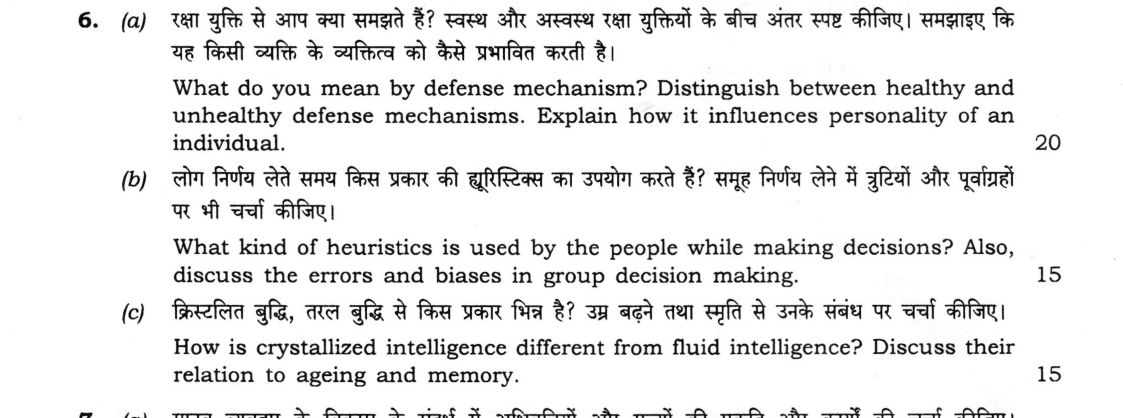
(a) What do you mean by defense mechanism? Distinguish between healthy and unhealthy defense mechanisms. Explain how it…
What do you mean by defense mechanism? Distinguish between healthy and unhealthy defense mechanisms. Explain how it influences personality of an individual. 20 marks
What kind of heuristics is used by the people while making decisions? Also, discuss the errors and biases in group decision making. 15 marks
How is crystallized intelligence different from fluid intelligence? Discuss their relation to ageing and memory. 15 marks
हिंदी में प्रश्न पढ़ें
रक्षा युक्ति से आप क्या समझते हैं? स्वस्थ और अस्वस्थ रक्षा युक्तियों के बीच अंतर स्पष्ट कीजिए। समझाइए कि यह किसी व्यक्ति के व्यक्तित्व को कैसे प्रभावित करती है। (20 अंक)
लोग निर्णय लेते समय किस प्रकार की ह्यूरिस्टिक्स का उपयोग करते हैं? समूह निर्णय लेने में त्रुटियों और पूर्वाग्रहों पर भी चर्चा कीजिए। (15 अंक)
क्रिस्टलित बुद्धि, तरल बुद्धि से किस प्रकार भिन्न है? उम्र बढ़ने तथा स्मृति से उनके संबंध पर चर्चा कीजिए। (15 अंक)
Model answer
Drafted with AI by UPSC Answer Check against this question's marking rubric, to the expected length. UPSC does not publish answers for Mains — this is one way to score well, not an official key. How we build rubrics and answers.
(a) Defence mechanisms: healthy versus unhealthy, and personality
Defense mechanisms are unconscious psychological strategies employed by the ego to manage anxiety and internal conflicts arising from the friction between the id, superego, and reality. While Sigmund Freud introduced the concept, it was Anna Freud who systematically catalogued them in The Ego and the Mechanisms of Defence (1936). These mechanisms are universal and generally adaptive; however, their healthiness is determined by their level of maturity and flexibility.
Vaillant’s hierarchy distinguishes these mechanisms into four levels: pathological, immature, neurotic, and mature.
- Unhealthy (Immature/Neurotic) Defences: These are rigid and maladaptive. Examples include denial (refusing to accept reality), projection (attributing one's own unacceptable feelings to others), repression (pushing thoughts from consciousness), displacement (redirecting emotions to a safer target), reaction formation (expressing the opposite impulse), rationalisation (plausible but false justification) and regression (reverting to childlike behaviour).
- Healthy (Mature) Defences: These are flexible and promote social functioning. Examples include sublimation (channeling impulses into creative or productive outlets), humour (finding amusement in stress), suppression (the conscious, deliberate postponement of a thought), anticipation (realistic planning for future discomfort) and altruism (finding satisfaction in helping others).
The influence of these mechanisms on personality is profound. In the normal range, habitual defensive styles consolidate into character traits (Reich’s "character armour"), shaping an individual's vocation and moral style. For instance, a person who habitually uses sublimation may develop a highly creative personality. In the pathological range, rigid over-reliance on a single primitive defence leads to specific personality structures; for example, an exclusive reliance on projection is characteristic of the paranoid personality, while splitting is central to borderline personality patterns. Because defences are unconscious, they are hard to measure or falsify, though instruments such as the Defense Style Questionnaire attempt it.
(b) Decision heuristics; errors and biases in group decisions
Heuristics are mental shortcuts that allow for rapid decision-making under conditions of bounded rationality, a concept introduced by Herbert Simon (satisficing). Tversky and Kahneman (1974) identified several key heuristics used in individual decision-making:
- Representativeness: Judging probability by resemblance to a prototype, often leading to base-rate neglect and the conjunction fallacy (the Linda problem).
- Availability: Judging frequency by the ease with which examples come to mind, which can be skewed by recent or vivid events.
- Anchoring and Adjustment: Relying too heavily on an initial piece of information (the anchor) when making estimates.
- Framing Effect: As shown in the Asian disease problem (1981), people make different choices depending on whether a problem is framed in terms of gains or losses, a core tenet of prospect theory (1979).
Group decision-making introduces unique errors and biases:
- Groupthink (Janis, 1972): A syndrome where the desire for harmony leads to irrational decisions. Symptoms include the illusion of invulnerability, collective rationalization, and self-censorship of dissenting views.
- Group Polarisation (Risky Shift): The tendency for group decisions to be more extreme than the initial inclinations of individual members.
- Shared-information bias: Groups tend to focus on information everyone already knows rather than unique information held by individuals.
- Social loafing: A reduction in individual effort when working in a group.
Remedies for these errors include appointing a devil’s advocate, using the Delphi technique for independent input, and holding a "second-chance" meeting to allow for reconsideration.
(c) Crystallized versus fluid intelligence; ageing and memory
Fluid intelligence (Gf) and crystallized intelligence (Gc) are the two primary factors of intelligence in the Horn and Cattell Gf-Gc theory, later absorbed into the Cattell-Horn-Carroll (CHC) model built on Carroll’s (1993) three-stratum theory. Fluid intelligence refers to the ability to reason and solve novel problems independent of acquired knowledge; it is measured by culture-fair tests like Raven's Progressive Matrices and Cattell’s Culture Fair Test. Crystallized intelligence refers to the accumulation of knowledge, vocabulary, and skills acquired through experience; it is measured by verbal subtests such as those in the WAIS.
The investment hypothesis suggests that Gf is the "fuel" that is invested into learning, which then becomes Gc.
Relation to Ageing and Memory:
- Fluid Intelligence: Gf is dependent on working-memory capacity and processing speed (Kyllonen and Christal, 1990; Salthouse, 1996). It typically peaks in early adulthood and declines steadily with age as neural processing slows.
- Crystallized Intelligence: Gc is supported by semantic and procedural memory. It is generally maintained or even increases throughout the lifespan as individuals continue to acquire knowledge.
Schaie’s Seattle Longitudinal Study provided evidence for these trajectories. It is important to note that cross-sectional data can exaggerate the decline of Gf due to cohort effects (differences in education and environment between generations), whereas longitudinal studies provide a more accurate picture of individual developmental change.
How this answer will be evaluated
Evaluation rubric
Each sub-part is marked on its own, against the marks and word limit printed on the paper.
- (a) Three demands, all marked: (i) define defence mechanisms within Freudian ego psychology; (ii) distinguish healthy (mature/adaptive) from unhealthy (immature/maladaptive) mechanisms, ideally using Vaillant's hierarchy, with examples of each; (iii) explain how habitual defensive style shapes personality. 20 marks
Must cover
- Sigmund Freud; Anna Freud, The Ego and the Mechanisms of Defence (1936)
- Ego, id, superego; anxiety as the trigger
- Repression, denial, projection, reaction formation, rationalisation, displacement, regression, sublimation
- Vaillant's hierarchy: pathological, immature, neurotic, mature levels
- Mature defences: sublimation, altruism, suppression, anticipation, humour
- Rigidity and excess as the marker of pathology
Loses marks
- Listing twelve defence mechanisms with definitions and never addressing the healthy-unhealthy distinction or the effect on personality, which together carry more than half the marks
- Calling every defence mechanism pathological - defences are normal and universal; only rigid, exclusive reliance is maladaptive
- Confusing projection with displacement, or reaction formation with rationalisation
- Treating suppression and repression as the same thing - suppression is conscious and deliberate and is classed as mature
- Giving no example for any mechanism, which makes the distinctions unassessable
- Attributing the systematic catalogue of defences to Sigmund rather than Anna Freud
Earns more
- Influence on personality in the normal range: habitual defences consolidate into traits and character (Freud's anal character, Reich's character armour), shaping vocation, creativity and moral style
- Influence on personality in the pathological range: rigid over-reliance on a single primitive defence - projection in paranoid, splitting in borderline, denial in addiction, acting out in antisocial patterns - plus an evaluative note on measurability and falsifiability
- (b) Two separately marked parts: (i) the heuristics people use in individual decision making, named and illustrated; (ii) the errors and biases specific to GROUP decision making. An answer confined to individual heuristics answers only half the question. 15 marks
Must cover
- Tversky and Kahneman (1974); bounded rationality / satisficing (Simon)
- Representativeness, availability, anchoring and adjustment
- Conjunction fallacy / Linda problem; base-rate neglect
- Framing effect (Asian disease problem, 1981) or prospect theory (1979)
- Groupthink (Janis) and at least three symptoms
- Group polarisation / risky shift
- Social loafing or the shared-information bias
Loses marks
- Writing only about individual heuristics and ignoring group decision making, which carries roughly half the marks
- Naming the three main heuristics without giving the specific error each produces, so the 'errors and biases' demand is unmet
- Confusing representativeness with availability - the first is judgement by resemblance, the second by ease of recall
- Treating groupthink as a synonym for conformity or for group polarisation rather than as Janis's specific syndrome with its own antecedents and symptoms
- Attributing the heuristics-and-biases programme to Gigerenzer, who is its principal critic, rather than to Tversky and Kahneman
- Offering no remedies, when the topic invites at least a line on them
Earns more
- Remedies for group decision error: devil's advocate, impartial leader, independent subgroups, outside experts, Delphi or nominal group technique, second-chance meeting
- (c) Two demands: (i) differentiate crystallised from fluid intelligence on definition, content, measurement and theoretical origin; (ii) discuss how each relates to ageing and to memory - the developmental trajectories and the memory systems each depends on. 15 marks
Must cover
- Raymond B. Cattell; Horn and Cattell Gf-Gc theory; CHC / Carroll's three-stratum model
- Gf - novel reasoning, culture-fair; Raven's Progressive Matrices / Culture Fair Test
- Gc - acquired knowledge, vocabulary; investment hypothesis
- Gf peaks early and declines with age; Gc is maintained or increases
- Working-memory capacity and processing speed as the basis of Gf (Kyllonen and Christal, 1990; Salthouse, 1996)
- Semantic and procedural memory as the substrate of Gc
- Schaie's Seattle Longitudinal Study / cross-sectional versus longitudinal caution
Loses marks
- Reversing the two - describing vocabulary and general knowledge as fluid, or novel reasoning as crystallised
- Ignoring the second half of the question and never linking either construct to ageing or to memory systems
- Claiming both decline equally with age, or that crystallised intelligence declines from middle age
- Attributing the distinction to Spearman, Thurstone or Guilford rather than to Cattell and Horn
- Failing to note that cross-sectional data exaggerate age decline through cohort effects
- Describing Gf and Gc without naming a single test for either
Earns more
- Measurement contrast with named instruments: Raven's Progressive Matrices and Cattell's Culture Fair Test for Gf; vocabulary, information and comprehension subtests (WAIS Verbal Comprehension) for Gc; the 'hold' versus 'don't hold' distinction
What "Distinguish" is asking you to do
Name the property that separates the items and say which side holds it. Distinguish is marked exactly as differentiate is, with no difference in expectation, but its stems more often line up three terms rather than two — gender equality, gender equity and empowerment — and every pair in the set has to be separated.
Structure that answers it
The category they all sit in → the property dividing the first pair → the second pair → the third → why the boundary matters in practice
Where marks are lost
Separating the two obviously different items and leaving the middle term unplaced. A description of each side from which the line must be inferred is marked as description, not as a distinction.
Practice this exact question
Write your answer and it is marked point by point against the model answer above — what you covered, what you missed, what you got wrong.
Evaluate my answer →More from Psychology 2026 Paper I
- Q3 (a) Discuss various types of long-term memory. Explain how primacy and recency effect ill…
- Q4 (a) Explain how learning takes place through classical conditioning. Discuss the role of…
- Q5 Answer the following questions in about 150 words each : (a) How does knowledge influence…
- Q6 (a) What do you mean by defense mechanism? Distinguish between healthy and unhealthy defe…
- Q7 (a) Discuss the nature and functions of attitudes and values with reference to developmen…
- Q8 (a) Why do the people in almost every culture use psychoactive drugs? Discuss the effects…