Paper I — Q3
(a) Discuss various types of long-term memory. Explain how primacy and recency effect illustrate the serial position effect in…
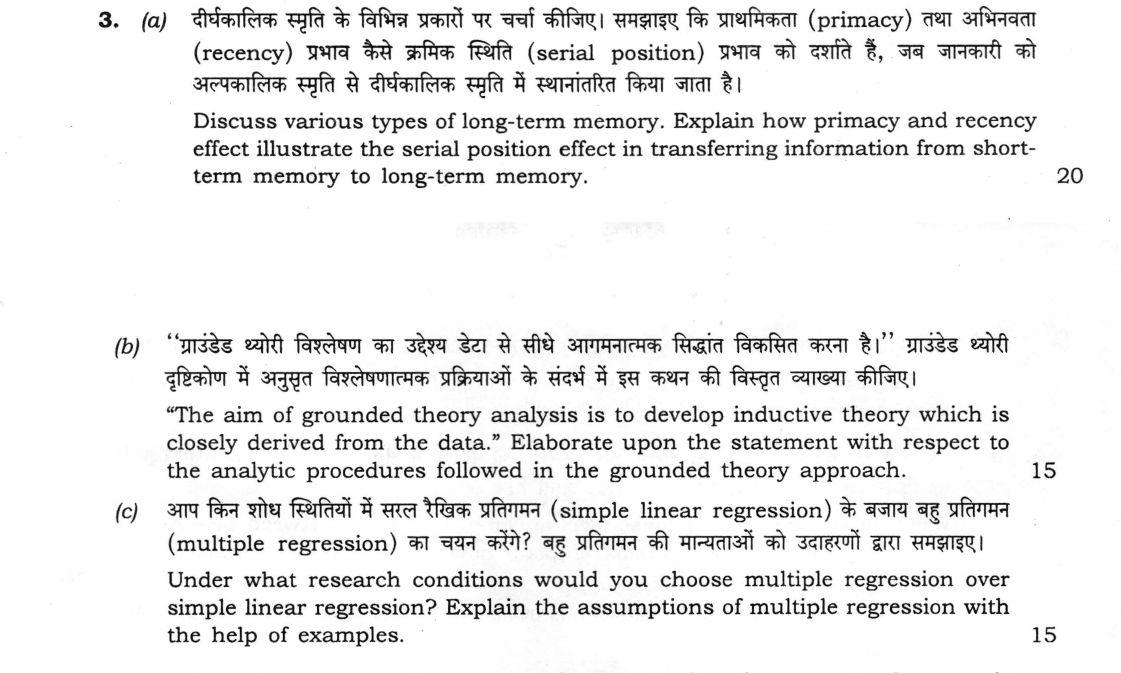
Discuss various types of long-term memory. Explain how primacy and recency effect illustrate the serial position effect in transferring information from short-term memory to long-term memory. 20 marks
“The aim of grounded theory analysis is to develop inductive theory which is closely derived from the data.” Elaborate upon the statement with respect to the analytic procedures followed in the grounded theory approach. 15 marks
Under what research conditions would you choose multiple regression over simple linear regression? Explain the assumptions of multiple regression with the help of examples. 15 marks
हिंदी में प्रश्न पढ़ें
दीर्घकालिक स्मृति के विभिन्न प्रकारों पर चर्चा कीजिए। समझाइए कि प्राथमिकता (primacy) तथा अभिनवता (recency) प्रभाव कैसे क्रमिक स्थिति (serial position) प्रभाव को दर्शाते हैं, जब जानकारी को अल्पकालिक स्मृति से दीर्घकालिक स्मृति में स्थानांतरित किया जाता है। (20 अंक)
“ग्राउंडेड थ्योरी विश्लेषण का उद्देश्य डेटा से सीधे आगमनात्मक सिद्धांत विकसित करना है।” ग्राउंडेड थ्योरी दृष्टिकोण में अनुसृत विश्लेषणात्मक प्रक्रियाओं के संदर्भ में इस कथन की विस्तृत व्याख्या कीजिए। (15 अंक)
आप किन शोध स्थितियों में सरल रैखिक प्रतिगमन (simple linear regression) के बजाय बहु प्रतिगमन (multiple regression) का चयन करेंगे? बहु प्रतिगमन की मान्यताओं को उदाहरणों द्वारा समझाइए। (15 अंक)
Model answer
Drafted with AI by UPSC Answer Check against this question's marking rubric, to the expected length. UPSC does not publish answers for Mains — this is one way to score well, not an official key. How we build rubrics and answers.
(a) Types of long-term memory and the serial position effect
Following Squire’s taxonomy, long-term memory (LTM) is broadly classified into declarative (explicit) and non-declarative (implicit) systems. Declarative memory, which involves conscious recollection, is further divided into episodic memory (personal experiences in time and space, as proposed by Tulving, 1972) and semantic memory (general world knowledge). Non-declarative memory includes procedural memory (skills), priming, and conditioning. The dissociation of these systems is evidenced by Patient H.M. (Scoville and Milner, 1957), who suffered dense anterograde amnesia for declarative material but retained the ability to learn procedural tasks like mirror drawing.
The serial position effect, first noted by Ebbinghaus and classically demonstrated by Murdock (1962), illustrates the transfer of information from short-term memory (STM) to LTM. It consists of two limbs: the primacy effect (better recall of initial items) and the recency effect (better recall of final items). Glanzer and Cunitz (1966) provided experimental evidence for the mechanism of this transfer. They found that a 30-second filled delay abolished the recency effect but left the primacy effect intact. This indicates that recency is a function of the temporary storage in STM, whereas primacy reflects the successful transfer of information into LTM. This transfer is driven by rehearsal; items at the beginning of a list receive more rehearsal (Rundus, 1971), allowing them to be consolidated into long-term storage, while later items remain in the fragile STM buffer.
(b) Analytic procedures of grounded theory
The aim of grounded theory, as established by Glaser and Strauss in The Discovery of Grounded Theory (1967), is to develop inductive theory that is closely derived from the data. This is achieved through specific analytic procedures that ensure the theory is grounded in empirical reality rather than imposed by the researcher.
The process begins with open coding, where data are broken down into discrete concepts. This is followed by the constant comparative method, where each new piece of data is compared with existing codes to refine categories. The researcher then moves to axial coding, which links categories to their properties and sub-categories, and finally to selective coding, where a core category is identified that integrates all other categories. Throughout this process, theoretical sampling is used—data collection is guided by emerging concepts rather than a fixed sample. Memo writing serves as the bridge between coding and theory, allowing the researcher to document the logic of the analysis. The process continues until theoretical saturation is reached, where no new properties emerge. Strauss and Corbin (1990) formalized these steps, though Glaser (1992) objected that their axial-coding paradigm forces data into preset categories; Charmaz (2006) offers a constructivist version that acknowledges the researcher's role. These procedures ensure that the resulting theory is a product of the data itself.
(c) Choosing multiple regression; its assumptions
Simple linear regression predicts a criterion (Y) from one predictor. Multiple regression is chosen when behaviour is multiply determined and the researcher needs to (i) predict Y from two or more predictors simultaneously, (ii) estimate each predictor’s unique contribution while holding the others constant, (iii) control confounding variables statistically, or (iv) test incremental validity by entering a new predictor hierarchically and examining the change in R². For example, student achievement (Y) may be predicted from IQ, study hours and socioeconomic status (SES).
The model is Y = b0 + b1X1 + b2X2 + ... + bkXk + e, where each b is a partial regression coefficient; the squared semi-partial (part) correlation gives a predictor’s unique share of variance. Fit is judged by R² and, when comparing models with different numbers of predictors, adjusted R². Assumptions:
- Linearity: each predictor relates linearly to Y; if achievement stops rising beyond six study hours, the relation is curvilinear.
- Independence of errors: residuals are uncorrelated (serial correlation is checked with the Durbin-Watson statistic); students nested in the same classroom may violate it.
- Homoscedasticity: residual variance is constant; errors that widen for high-SES students violate it.
- Normality of residuals: residuals, not predictors, should be approximately normal.
- No multicollinearity: predictors should not be highly intercorrelated (e.g. IQ and a verbal-aptitude score); VIF above 10 or tolerance below 0.10 signals a problem.
- No influential outliers: cases with standardised residuals beyond ±3 or a large Cook’s distance distort the estimates.
How this answer will be evaluated
Evaluation rubric
Each sub-part is marked on its own, against the marks and word limit printed on the paper.
- (a) Two connected demands: (i) discuss the types of long-term memory (declarative/explicit versus non-declarative/implicit, with their sub-types), and (ii) explain how the primacy and recency effects together constitute the serial position effect and what that reveals about the transfer of information from short-term to long-term memory. The second part must include the experimental evidence. 20 marks
Must cover
- Declarative/explicit versus non-declarative/implicit (Squire's taxonomy)
- Episodic memory - Tulving (1972)
- Semantic memory
- Procedural memory / priming / conditioning
- Patient H.M. (Scoville and Milner, 1957)
- Serial position effect - primacy and recency; Murdock (1962)
- Glanzer and Cunitz (1966), 30-second filled delay abolishes recency
- Rehearsal as the mechanism of STM-to-LTM transfer
Loses marks
- Listing types of long-term memory but never linking primacy to LTM and recency to STM, which is the whole point of the second half
- Attributing the episodic/semantic distinction to Atkinson and Shiffrin or to Baddeley instead of Tulving (1972)
- Reversing the Glanzer and Cunitz result - claiming the delay wipes out primacy rather than recency
- Describing sensory memory and short-term memory at length when only long-term types were asked for
- Treating primacy and recency as separate phenomena rather than as the two limbs of one serial position curve
- Omitting non-declarative memory entirely and equating LTM with episodic plus semantic memory
Earns more
- Neuropsychological evidence for the dissociation, especially patient H.M. (surgery 1953; Scoville and Milner, 1957) - dense anterograde amnesia for declarative material with intact mirror-drawing procedural learning
- (b) 'Elaborate upon the statement with respect to the analytic procedures' - the marks lie in describing grounded theory's actual procedures (coding stages, constant comparison, theoretical sampling, memoing, saturation, core category) and showing HOW each keeps the emerging theory inductively grounded in the data rather than imposed on it. 15 marks
Must cover
- Glaser and Strauss, The Discovery of Grounded Theory, 1967
- Open coding, axial coding, selective coding
- Constant comparative method
- Theoretical sampling
- Theoretical saturation
- Core category
- Memo writing
- Strauss and Corbin (1990) / Charmaz (2006) constructivist version
Loses marks
- Writing a general essay on qualitative research or on thematic/content analysis instead of grounded theory's own named procedures
- Naming the three coding stages without explaining what each does to the data, so the link to the inductive claim is never made
- Confusing theoretical sampling with purposive or quota sampling fixed in advance, and saturation with simply reaching a target sample size
- Omitting the constant comparative method, which is the analytic device the question is really pointing at
- Attributing grounded theory to a single author, or dating The Discovery of Grounded Theory outside 1967
- Offering no critical note, so the 'elaborate' directive is met only descriptively
Earns more
- Memo writing and diagramming as the bridge from codes to theory, plus the quality criteria of fit, work, relevance and modifiability
- Critical evaluation: the Glaser (1992) objection that Strauss and Corbin's paradigm model forces data; Charmaz's (2006) constructivist grounded theory; the impossibility of a presuppositionless researcher
- (c) Two parts: (i) specify the research conditions under which multiple regression is preferred to simple linear regression, and (ii) explain each assumption of multiple regression with an illustrative example. Both the choice-criteria and the assumptions-with-examples must appear. 15 marks
Must cover
- Y = b0 + b1X1 + b2X2 + ... + bkXk + e
- R-squared and adjusted R-squared; change in R-squared / incremental validity
- Partial and semi-partial (part) correlation
- Linearity, independence of errors, homoscedasticity, normality of residuals, no multicollinearity
- VIF above 10 / tolerance below 0.10
- Durbin-Watson; Cook's distance
- At least one worked psychological example (e.g. achievement predicted from IQ, study hours, SES, anxiety)
Loses marks
- Describing what multiple regression is without ever stating the research conditions that make it the preferred choice - the first half of the question
- Listing assumptions as bare labels with no example and no diagnostic statistic, when the question explicitly asks for explanation 'with the help of examples'
- Stating that the predictors themselves must be normally distributed - the normality assumption concerns the residuals
- Confusing multicollinearity with correlation between predictor and criterion, which is desirable, not a violation
- Claiming R-squared alone should guide model choice, ignoring that R-squared cannot decrease when predictors are added and that adjusted R-squared or cross-validation is required
- Confusing multiple regression with multivariate regression (several criteria) or with multiple correlation
Earns more
- No influential outliers (standardised residual beyond about plus or minus 3, Cook's distance), reliable measurement of predictors, and an adequate case-to-predictor ratio
What "Illustrate" is asking you to do
Carry the point with concrete cases rather than assert it, so the examples do the work of proving it. In the technical papers illustrate is often literal — a labelled diagram, a map, a graph — and an answer without the figure has not complied with the instruction.
Structure that answers it
The point stated → example 1 with the feature it demonstrates → example 2 → example 3 or the required diagram → what the set of examples establishes
Where marks are lost
Examples named and then abandoned. A case listed without the sentence showing what it demonstrates is marked as recall of information, not as illustration.
Practice this exact question
Write your answer and it is marked point by point against the model answer above — what you covered, what you missed, what you got wrong.
Evaluate my answer →More from Psychology 2026 Paper I
- Q1 Answer the following questions in about 150 words each : (a) Discuss various applications…
- Q2 (a) Critically examine the top-down and bottom-up processing in perception. How can we ma…
- Q3 (a) Discuss various types of long-term memory. Explain how primacy and recency effect ill…
- Q4 (a) Explain how learning takes place through classical conditioning. Discuss the role of…
- Q5 Answer the following questions in about 150 words each : (a) How does knowledge influence…
- Q6 (a) What do you mean by defense mechanism? Distinguish between healthy and unhealthy defe…