Paper I — Q4
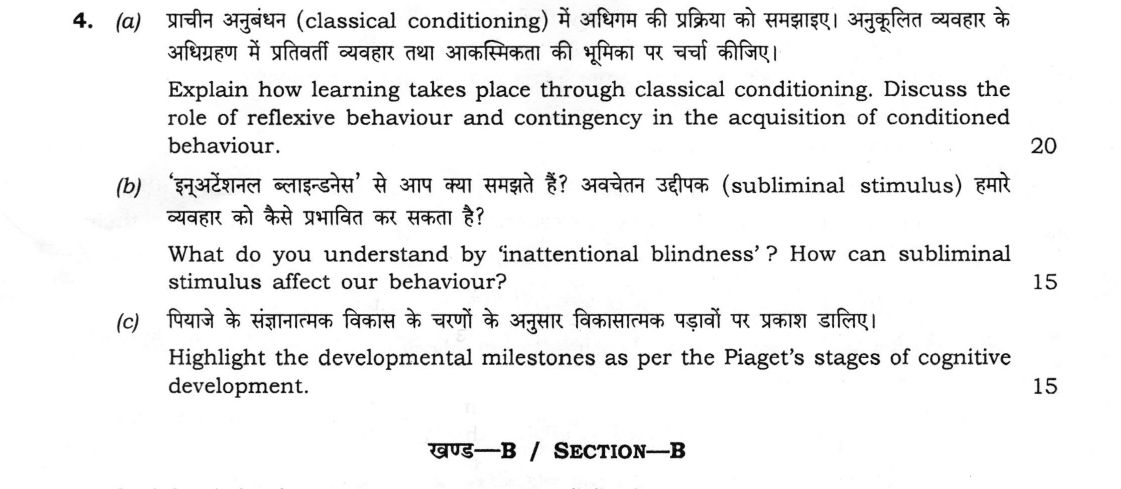
(a) Explain how learning takes place through classical conditioning. Discuss the role of reflexive behaviour and contingency in…
Explain how learning takes place through classical conditioning. Discuss the role of reflexive behaviour and contingency in the acquisition of conditioned behaviour. 20 marks
What do you understand by 'inattentional blindness'? How can subliminal stimulus affect our behaviour? 15 marks
Highlight the developmental milestones as per the Piaget's stages of cognitive development. 15 marks
हिंदी में प्रश्न पढ़ें
प्राचीन अनुबंधन (classical conditioning) में अधिगम की प्रक्रिया को समझाइए। अनुकूलित व्यवहार के अधिग्रहण में प्रतिवर्ती व्यवहार तथा आकस्मिकता की भूमिका पर चर्चा कीजिए। (20 अंक)
'इन्अटेंशनल ब्लाइंडनेस' से आप क्या समझते हैं? अवचेतन उद्दीपक (subliminal stimulus) हमारे व्यवहार को कैसे प्रभावित कर सकता है? (15 अंक)
पियाजे के संज्ञानात्मक विकास के चरणों के अनुसार विकासात्मक पड़ावों पर प्रकाश डालिए। (15 अंक)
Model answer
Drafted with AI by UPSC Answer Check against this question's marking rubric, to the expected length. UPSC does not publish answers for Mains — this is one way to score well, not an official key. How we build rubrics and answers.
(a) Learning through classical conditioning: role of reflexes and contingency
Classical conditioning is associative learning in which a neutral stimulus acquires the power to elicit a response by being paired with a biologically significant stimulus. In Ivan Pavlov’s paradigm, a bell (conditioned stimulus, CS) is paired with food (unconditioned stimulus, UCS), which naturally elicits salivation (unconditioned response, UCR). After repeated pairings the bell alone elicits salivation (conditioned response, CR). The process shows acquisition, extinction (the CR weakens when the CS is presented without the UCS), spontaneous recovery after rest, generalisation to similar stimuli, discrimination between stimuli, and higher-order conditioning, in which a new stimulus is paired with an established CS. Short-delay forward pairing is optimal; backward conditioning is weakest.
Reflexive behaviour is the raw material of classical conditioning. It consists of respondent, elicited behaviours such as salivation, eye-blink or fear, which are automatic and involuntary, unlike emitted operant behaviour controlled by its consequences. Conditioning does not create new responses; it transfers control of an existing reflex to a new stimulus.
Contingency, the degree to which the CS predicts the UCS, drives acquisition more than mere contiguity (closeness in time). Rescorla (1966, 1968) showed that when the UCS was as likely without the CS as with it (the truly random control), little conditioning occurred despite many pairings. Kamin’s (1968) blocking effect, in which a CS added to an already-predictive CS acquires little conditioning, and the Rescorla-Wagner model (1972), in which learning is proportional to prediction error, confirm that the CS must carry new information about the UCS.
Watson and Rayner’s (1920) Little Albert study showed conditioned fear in a human infant, and Garcia and Koelling’s (1966) taste-aversion work showed biological preparedness (Seligman, 1970).
(b) Inattentional blindness and subliminal stimuli
Inattentional blindness is the failure to notice an unexpected, even salient, object in plain view because attention is engaged elsewhere; Mack and Rock (1998) named and systematically studied it. In Simons and Chabris’s (1999) “invisible gorilla” study, about half the participants counting basketball passes failed to see a person in a gorilla suit walk through the scene. It differs from change blindness (Simons and Levin, 1998), the failure to detect a change between two views of a scene. Its significance is that attention appears necessary for conscious perception, with consequences for driving, radiology and eyewitness testimony.
A subliminal stimulus is presented below the absolute threshold (limen) of conscious awareness. Its power is often overstated. Vicary’s 1957 claim that flashed messages to “eat popcorn” and “drink Coca-Cola” raised cinema sales was later admitted to be fabricated and has never been replicated, and Greenwald et al. (1991) found that subliminal self-help tapes did not improve self-esteem or memory beyond expectation effects.
Subliminal input can nevertheless bias behaviour subtly. Kunst-Wilson and Zajonc (1980) showed that subliminally exposed shapes were preferred even when they could not be recognised, a subliminal form of Zajonc’s (1968) mere-exposure effect. Masked semantic and affective priming speeds or biases responses to later targets. Thus subliminal stimuli cannot compel complex acts such as buying or voting, but can briefly shape preferences and reactions.
(c) Developmental milestones in Piaget’s stages
Jean Piaget held that children construct knowledge through four invariant, qualitatively distinct stages, driven by schemas (mental structures), assimilation (fitting new information into existing schemas), accommodation (modifying schemas) and equilibration (the drive toward balance).
- Sensorimotor (0–2 years): the infant knows the world through sensing and acting. The key milestone is object permanence, the understanding that objects exist when out of sight; the A-not-B error (searching at an old hiding place A after seeing the object moved to B) marks its incomplete form. Deferred imitation and early symbols appear by the end of the stage.
- Preoperational (2–7 years): symbolic function emerges in language and pretend play. Thinking is egocentric, shown by the three-mountain task, and centred, so the child fails conservation, believing that water poured into a taller glass has increased.
- Concrete operational (7–11 years): logical operations on concrete objects appear: conservation, reversibility, decentration, class inclusion, seriation and transitivity. Horizontal décalage means forms of conservation are mastered in sequence, number before mass, weight and volume.
- Formal operational (11 years onward): abstract, hypothetico-deductive reasoning emerges; in the pendulum problem the adolescent varies one factor at a time and finds that only string length determines the rate of swing.
Evaluation: Baillargeon’s studies suggest object permanence appears earlier; Hughes’s (1975) policeman-doll task and Donaldson’s (1978) “human sense” critique show less egocentrism in meaningful tasks; formal operations are not universal, and Vygotsky stressed social and cultural mediation.
How this answer will be evaluated
Evaluation rubric
Each sub-part is marked on its own, against the marks and word limit printed on the paper.
- (a) Explain the mechanism of classical conditioning (Pavlov's paradigm and its phenomena), then discuss two specified determinants of acquisition: reflexive (respondent, elicited) behaviour as the raw material on which conditioning operates, and contingency - the CS's predictiveness of the UCS - as distinct from mere contiguity. 20 marks
Must cover
- Ivan Pavlov; UCS, UCR, CS, CR
- Acquisition, extinction, spontaneous recovery, generalisation, discrimination, higher-order conditioning
- Short-delay forward pairing is optimal; backward conditioning is weakest
- Respondent/elicited reflexive behaviour versus emitted operant behaviour
- Rescorla (1966/1968) contingency and the truly random control
- Kamin's blocking effect (1968) and the Rescorla-Wagner model (1972)
- Watson and Rayner, Little Albert, 1920
- Garcia and Koelling (1966) taste aversion / Seligman's preparedness (1970)
Loses marks
- Describing Pavlov's experiment and the standard phenomena but ignoring the two elements the question specifically names - reflexive behaviour and contingency - which carry nearly half the marks
- Treating contiguity and contingency as synonyms, and so missing Rescorla's central finding
- Mixing operant examples into the classical account (reinforcement schedules, Skinner box lever pressing, rewards)
- Reversing the labels, e.g. calling the bell the UCS or salivation to food the CR
- Stating that backward conditioning works as well as forward conditioning
- Saying Pavlov received the Nobel Prize for classical conditioning - the 1904 Prize was for his work on the physiology of digestion
Earns more
- Human and biological extensions: Watson and Rayner's Little Albert (1920) and its applied use in systematic desensitisation and aversion therapy; biological preparedness from Garcia and Koelling's (1966) taste-aversion work and Seligman (1970)
- (b) Two parts: (i) define and illustrate inattentional blindness with its classic demonstration and its theoretical significance for attention; (ii) explain what a subliminal stimulus is and how far it can influence behaviour, with the evidence - including the negative and disputed evidence. 15 marks
Must cover
- Inattentional blindness - Mack and Rock (1998)
- Simons and Chabris (1999) invisible gorilla
- Change blindness (Simons and Levin, 1998)
- Subliminal = below the absolute threshold / limen
- Kunst-Wilson and Zajonc (1980) subliminal mere exposure / Zajonc (1968)
- Vicary's 1957 subliminal advertising claim - fabricated, never replicated
- Greenwald et al. (1991) subliminal self-help tapes
Loses marks
- Confusing inattentional blindness with change blindness - the first is failure to notice an unexpected object present in the scene, the second is failure to detect a change between two views
- Answering only the first half and treating subliminal perception in a sentence, or the reverse
- Presenting Vicary's 1957 popcorn study as established evidence for subliminal advertising, when he later admitted the data were fabricated
- Confusing subliminal (below threshold) with unconscious in the Freudian sense, or with simply unattended supraliminal stimuli
- Overclaiming that subliminal messages can make people buy products or vote a particular way, with no acknowledgement of the negative evidence
- Omitting any named study, leaving both halves as definitions
Earns more
- Related phenomena and applications: change blindness (Simons and Levin, 1998), attentional blink, and real-world consequences in driving, radiology (Drew, Vo and Wolfe, 2013) and eyewitness testimony
- Evidence that subliminal input can bias behaviour: subliminal mere exposure raising liking without recognition (Kunst-Wilson and Zajonc, 1980; Zajonc, 1968), masked semantic and affective priming
- (c) 'Highlight the developmental milestones as per Piaget's stages' - set out all four stages with their age ranges and, for each, the specific cognitive attainments and characteristic limitations that mark it. The organising concepts (schema, assimilation, accommodation, equilibration) frame the answer; a brief evaluation strengthens it. 15 marks
Must cover
- Sensorimotor, preoperational, concrete operational, formal operational with age ranges
- Object permanence; A-not-B error
- Egocentrism and the three-mountain task
- Conservation, reversibility, decentration, class inclusion, seriation, transitivity
- Horizontal decalage
- Hypothetico-deductive reasoning; the pendulum problem
- Schema, assimilation, accommodation, equilibration
Loses marks
- Getting the stage order or the age bands wrong, especially placing conservation in the preoperational stage
- Naming the stages without any milestone content, so the answer is a list of labels
- Confusing conservation with object permanence, or egocentrism with selfishness
- Omitting horizontal decalage, which is the standard mark-earning detail for concrete operations
- Attributing the three-mountain task or the pendulum problem to the wrong stage
- Spending the whole answer on criticism at the cost of the milestones actually asked for
Earns more
- The organising mechanisms: schema, assimilation, accommodation, equilibration, and the claim that the stage sequence is invariant and qualitative
- Critical evaluation: Piaget underestimated infants (Baillargeon), Hughes's (1975) policeman doll task and Donaldson's 'human sense' critique, non-universality of formal operations, and Vygotsky's sociocultural alternative
What "Discuss" is asking you to do
Lay the issue out from more than one side — how it arose, what is claimed for it, what is held against it, and where it now stands. UPSC attaches discuss to broad topics with several live dimensions, so coverage of the dimensions earns more than the strength of your opinion.
Structure that answers it
Set the issue up → the case as it is made → the case against → the dimension both sides leave out → where the balance now lies
Where marks are lost
Listing facts with no thread between them, or arguing one side throughout and calling it a discussion.
Practice this exact question
Write your answer and it is marked point by point against the model answer above — what you covered, what you missed, what you got wrong.
Evaluate my answer →More from Psychology 2026 Paper I
- Q1 Answer the following questions in about 150 words each : (a) Discuss various applications…
- Q2 (a) Critically examine the top-down and bottom-up processing in perception. How can we ma…
- Q3 (a) Discuss various types of long-term memory. Explain how primacy and recency effect ill…
- Q4 (a) Explain how learning takes place through classical conditioning. Discuss the role of…
- Q5 Answer the following questions in about 150 words each : (a) How does knowledge influence…
- Q6 (a) What do you mean by defense mechanism? Distinguish between healthy and unhealthy defe…
- Q7 (a) Discuss the nature and functions of attitudes and values with reference to developmen…