Paper II — Q1
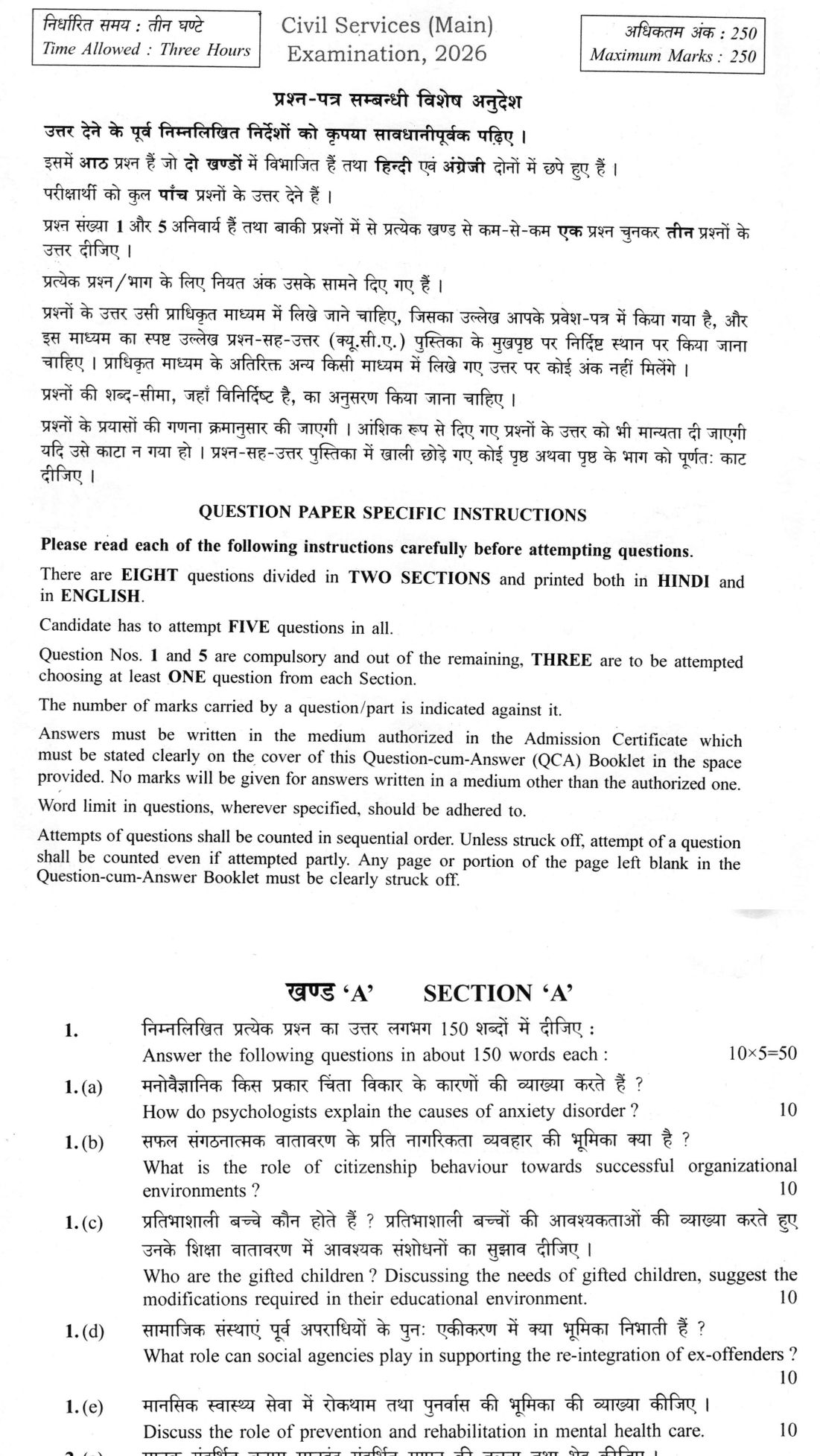
(a) How do psychologists explain the causes of anxiety disorder ? (10 marks) (b) What is the role of citizenship behaviour…
How do psychologists explain the causes of anxiety disorder ? 10 marks
What is the role of citizenship behaviour towards successful organizational environments ? 10 marks
Who are the gifted children ? Discussing the needs of gifted children, suggest the modifications required in their educational environment. 10 marks
What role can social agencies play in supporting the re-integration of ex-offenders ? 10 marks
Discuss the role of prevention and rehabilitation in mental health care. 10 marks
हिंदी में प्रश्न पढ़ें
मनोवैज्ञानिक किस प्रकार चिंता विकार के कारणों की व्याख्या करते हैं ? (10 अंक)
सफल संगठनात्मक वातावरण के प्रति नागरिकता व्यवहार की भूमिका क्या है ? (10 अंक)
प्रतिभाशाली बच्चे कौन होते हैं ? प्रतिभाशाली बच्चों की आवश्यकताओं की व्याख्या करते हुए उनके शिक्षा वातावरण में आवश्यक संशोधनों का सुझाव दीजिए । (10 अंक)
सामाजिक संस्थाएं पूर्व अपराधियों के पुन: एकीकरण में क्या भूमिका निभाती हैं ? (10 अंक)
मानसिक स्वास्थ्य सेवा में रोकथाम तथा पुनर्वास की भूमिका की व्याख्या कीजिए । (10 अंक)
Model answer
Drafted with AI by UPSC Answer Check against this question's marking rubric, to the expected length. UPSC does not publish answers for Mains — this is one way to score well, not an official key. How we build rubrics and answers.
(a) How do psychologists explain the causes of anxiety disorder?
Psychologists explain anxiety disorders (DSM-5-TR; ICD-11 “anxiety or fear-related disorders”), such as panic, generalised anxiety and phobias, through competing and complementary models. Biologically, dysfunction in the GABA-benzodiazepine system and hyperactivity of the amygdala and locus coeruleus are key mechanisms, with Kagan’s concept of behavioural inhibition identifying a temperamental vulnerability. Psychodynamically, Freud’s signal-anxiety theory (1926) posits that the ego signals danger to mobilise defences, while Bowlby links separation anxiety to attachment disruptions. Behavioural models rely on Watson and Rayner’s (1920) Little Albert study for classical conditioning, Mowrer’s (1947) two-factor theory for the maintenance of fear, and Seligman’s (1971) preparedness theory. Cognitively, Beck’s danger schemas and Clark’s (1986) model of catastrophic misinterpretation of bodily sensations explain panic. These are integrated by Barlow’s triple vulnerability model, which frames anxiety as a diathesis-stress response. In India, the NMHS (2015-16) identifies these as common disorders, highlighting the role of socio-cultural stressors.
(b) What is the role of citizenship behaviour towards successful organizational environments?
Organizational Citizenship Behaviour (OCB), defined by Dennis Organ (1988) as discretionary acts not formally recognized by the reward system, is a critical driver of organizational success. It comprises five dimensions: altruism, conscientiousness, sportsmanship, courtesy, and civic virtue. Williams and Anderson (1991) group these into OCB-I (towards individuals) and OCB-O (towards the organisation). OCB functions as a causal mechanism for a successful environment by enhancing unit-level performance and fostering a cooperative climate; meta-analyses by Podsakoff and colleagues link OCB to unit productivity, efficiency and customer satisfaction. Its antecedents, which management can cultivate, include organizational justice, perceived organizational support (POS), and high-quality leader-member exchange (LMX). However, the role of OCB is not purely positive; it has a "dark side" involving citizenship pressure, role overload, and impression-management motives. In the Indian context, the boundary between OCB and in-role duty is often blurred due to collectivist cultural norms, which can lead to exploitation of discretionary effort.
(c) Who are the gifted children? Discussing the needs of gifted children, suggest the modifications required in their educational environment.
Gifted children are traditionally identified by Terman (IQ 140+) or through the Marland Report’s (1972) six domains, including creativity and leadership. Renzulli’s three-ring conception emphasizes the intersection of above-average ability, creativity, and task commitment, while Gagné’s DMGT separates natural gifts from developed talents. Their distinctive needs include managing asynchronous development (Columbus Group, 1991), where cognitive maturity outpaces emotional maturity, and addressing the "twice-exceptional" (2e) learner who may have co-occurring learning disabilities. To support them, the educational environment requires concrete modifications such as curriculum compacting, subject acceleration, the Schoolwide Enrichment Model (Enrichment Triad) and differentiated instruction (Tomlinson). In India, the NEP 2020 explicitly recognizes gifted students, and institutions like Jawahar Navodaya Vidyalayas provide residential support. However, identification often suffers from language and socio-economic bias, necessitating culturally sensitive assessment to ensure equity.
(d) What role can social agencies play in supporting the re-integration of ex-offenders?
Social agencies are essential for re-integration, which is hindered by Goffman’s "spoiled identity" and by labelling that produces secondary deviance (Lemert; Becker). Agencies provide the "redemption scripts" (Maruna) and "turning points" (Sampson and Laub) necessary for desistance. In India, the Probation of Offenders Act, 1958, and after-care homes provide the structural framework for supervision and support. Prayas (TISS, Mumbai) works with released prisoners, and the Model Prisons and Correctional Services Act, 2023, circulated by the Home Ministry for state adoption, stresses after-care. NGOs and community bodies offer vocational training and placement, which are critical for breaking the cycle of recidivism. Theoretical frameworks like the Risk-Need-Responsivity (RNR) model (Andrews and Bonta) and the Good Lives Model (Ward) guide these interventions. However, the efficacy of these agencies is often limited by thin after-care resources and persistent employer prejudice, which can negate the psychological progress made during incarceration.
(e) Discuss the role of prevention and rehabilitation in mental health care.
Mental health care relies on a dual strategy of prevention and rehabilitation. Prevention, following Caplan’s (1964) levels (primary, secondary, tertiary) and the IOM’s universal (life-skills training), selective, and indicated categories, includes interventions aimed at reducing the incidence of disorders. Rehabilitation focuses on psychosocial recovery through social skills training, cognitive remediation, family psychoeducation, supported employment, halfway homes and Assertive Community Treatment (Stein and Test, 1980). In India, the National Mental Health Programme (NMHP) and the Mental Healthcare Act, 2017 and the RPwD Act, 2016 provide the policy framework, while initiatives like Tele-MANAS and the District Mental Health Programmes (DMHP) aim to bridge the 70–90% treatment gap. Despite these efforts, the specialist shortage remains a significant barrier. An effective system must integrate these components to move from a purely curative model to one that emphasizes long-term community-based recovery and the reduction of societal stigma.
How this answer will be evaluated
Evaluation rubric
Each sub-part is marked on its own, against the marks and word limit printed on the paper.
- (a) 'How do psychologists explain' asks for the competing aetiological models of anxiety disorders, not a description of symptoms; the answer must set out biological, psychodynamic, behavioural/learning, cognitive and socio-cultural explanations and close with an integrative diathesis-stress position. 10 marks
Must cover
- DSM-5-TR anxiety disorders class (GAD, panic disorder, agoraphobia, specific phobia, social anxiety disorder, separation anxiety disorder, selective mutism)
- ICD-11 'anxiety or fear-related disorders'
- GABA-benzodiazepine system; amygdala; locus coeruleus
- Kagan - behavioural inhibition
- Freud - signal anxiety (1926)
- Watson and Rayner - Little Albert (1920)
- Mowrer - two-factor theory (1947)
- Seligman - preparedness (1971)
- Beck - danger schemas; Clark (1986) - catastrophic misinterpretation in panic
- Barlow - triple vulnerability / diathesis-stress
Loses marks
- Describing symptoms and subtypes of anxiety disorders at length instead of answering 'causes'
- Treating OCD and PTSD as anxiety disorders without noting that DSM-5/DSM-5-TR reclassified them into Obsessive-Compulsive and Related Disorders and Trauma- and Stressor-Related Disorders
- Naming schools ('behavioural', 'cognitive') without a single named theorist, study or mechanism
- Confusing Mowrer's two-factor theory with simple classical conditioning, or attributing preparedness to Rachman instead of Seligman
- Offering only one perspective and omitting the integrative biopsychosocial/diathesis-stress conclusion
Earns more
- Psychodynamic explanation: Freud's realistic, neurotic and moral anxiety and the later signal-anxiety theory (Inhibitions, Symptoms and Anxiety, 1926) in which the ego signals danger and mobilises defences; symptoms as compromise formations; Bowlby's attachment-based separation anxiety
- Cognitive and integrative explanation: Beck's danger schemas and threat bias, Clark's (1986) cognitive model of panic (catastrophic misinterpretation of benign bodily sensations), Borkovec's avoidance theory of worry in GAD, anxiety sensitivity (Reiss and McNally); integration through Barlow's triple vulnerability model or a diathesis-stress account, plus socio-cultural stressors and Indian epidemiology (NMHS 2015-16, NIMHANS, shows neurotic and stress-related disorders among the commonest, current prevalence of the order of 3-4%)
- (b) Requires the concept of organizational citizenship behaviour (OCB) to be defined and its dimensions named, and then its causal role in producing a 'successful organizational environment' to be established - antecedents, unit-level outcomes and a brief critical note on its dark side. 10 marks
Must cover
- Dennis Organ (1988) - definition of OCB; 'good soldier syndrome'
- Five dimensions: altruism, conscientiousness, sportsmanship, courtesy, civic virtue
- Smith, Organ and Near (1983) - altruism and generalized compliance
- Williams and Anderson (1991) - OCB-I and OCB-O
- Contextual performance (Borman and Motowidlo, 1993)
- Organizational justice / perceived organizational support as antecedents
- Podsakoff et al. - OCB and unit-level performance
- Citizenship pressure / compulsory citizenship behaviour as the dark side
Loses marks
- Reducing OCB to 'being a good employee' or to job satisfaction without Organ's discretionary, non-rewarded criterion
- Listing fewer than the five dimensions, or inventing dimensions such as 'loyalty' and 'obedience' without attributing them to a different taxonomy
- Describing antecedents only and never answering the actual question - the role of OCB in creating a successful environment
- Giving no critical edge (no mention of citizenship pressure, impression management or the erosion of voluntariness)
- Confusing OCB with counterproductive work behaviour's opposite, or with organizational commitment (an attitude, not a behaviour)
Earns more
- Antecedents that management can manipulate: job satisfaction and organizational commitment, organizational justice especially procedural fairness (Moorman), perceived organizational support and the norm of reciprocity (Eisenberger), high-quality leader-member exchange, transformational leadership, and dispositional conscientiousness/agreeableness
- Critical/dark side and context: citizenship pressure, role overload, work-family conflict and 'compulsory citizenship behaviour'; impression-management motives (Bolino); the risk of appraisal bias when discretionary acts are informally rewarded; and cultural variation - in collectivist Indian workplaces much helping is seen as in-role duty rather than discretionary, so the boundary shifts
- (c) Three explicit tasks: (i) define/identify gifted children, (ii) discuss their distinctive needs, and (iii) suggest concrete modifications to the educational environment. All three must appear; a purely definitional answer cannot pass. 10 marks
Must cover
- Terman - IQ 140+, Genetic Studies of Genius (1921)
- Marland Report (1972) - six domains of giftedness
- Renzulli - three-ring conception; Enrichment Triad / Schoolwide Enrichment Model
- Gagne - DMGT (gifts vs talents)
- Asynchronous development (Columbus Group, 1991)
- Twice-exceptional (2e) learners
- Acceleration (grade skipping, early entry, subject acceleration) and curriculum compacting
- Differentiated instruction (Tomlinson)
- NEP 2020 recognition of gifted children; Jawahar Navodaya Vidyalayas
Loses marks
- Equating giftedness with a high IQ alone and ignoring creativity, task commitment and non-academic domains
- Answering only 'who are gifted children' and skipping the needs or the educational modifications - the question explicitly asks for both
- Offering vague prescriptions ('give them extra work', 'keep them motivated') instead of named strategies such as curriculum compacting, the Enrichment Triad or subject acceleration
- Assuming gifted children need no support because they 'will manage anyway', thereby missing underachievement, perfectionism and the twice-exceptional child
- Confusing enrichment with acceleration, or presenting ability grouping as the only option
Earns more
- Structural and human-resource modifications plus the Indian frame: cluster/ability grouping and pull-out programmes, mentorship and independent study, open access to laboratories, libraries and Olympiad training, affective counselling for perfectionism and underachievement, and trained teachers; Indian provisions include NEP 2020's explicit recognition of gifted students and students with special talents (topic-centred clubs, olympiads and enriched activities), residential Jawahar Navodaya Vidyalayas for talented rural children, and the NCERT talent-search tradition (NTSE, currently suspended); note the equity problem that language and socio-economic bias in identification hides gifted children from disadvantaged and rural groups
- (d) Asks specifically what social agencies - probation and after-care services, NGOs, community and employer bodies - can do to re-integrate released offenders; the answer must state the psychological barriers to re-entry, the theory that justifies agency intervention, and concrete functional roles with Indian examples. 10 marks
Must cover
- Goffman - stigma/spoiled identity; Lemert and Becker - labelling and secondary deviance
- Maruna (2001) - Making Good, redemption scripts (desistance)
- Sampson and Laub - age-graded informal social control (employment, marriage as turning points)
- Good Lives Model (Ward and Maruna); Risk-Need-Responsivity (Andrews and Bonta)
- Probation of Offenders Act, 1958; probation and parole supervision
- After-care homes / halfway houses; vocational training and placement
- Prayas (TISS, Mumbai); Tihar Jail reforms including Vipassana
- Model Prison Manual 2016 / Model Prisons and Correctional Services Act, 2023
- Mulla Committee on Jail Reforms (1980-83)
Loses marks
- Writing a general essay on prison reform or on the causes of crime instead of on post-release re-integration by social agencies
- Listing agencies with no psychological content - no stigma, labelling, desistance or identity-reconstruction theory
- Confusing probation (a community sentence instead of imprisonment) with parole (conditional release from a sentence being served) and with after-care
- Giving no Indian example or statute, making the answer generic and unplaceable
- Ignoring the community side - victim and neighbourhood attitudes, employer prejudice - and treating re-integration as purely offender-directed
Earns more
- Indian examples and the policy framework: Prayas, the TISS field-action project in Mumbai working with prisoners and released offenders; Tihar Jail's reform programme (Vipassana meditation, education and the TJ's/Tihar-brand prison industry providing skills and wages); the Model Prison Manual 2016 and the Model Prisons and Correctional Services Act, 2023 circulated by the Ministry of Home Affairs for state adoption, both of which emphasise after-care and rehabilitation; and the Mulla Committee (All India Committee on Jail Reforms, 1980-83) recommendation of a national policy on prisons with after-care services
- Evaluates limits and the way forward: thin and unevenly distributed after-care infrastructure, dependence on a few NGOs, employer prejudice and police verification requirements, no systematic recidivism tracking; hence the need for restorative-justice practices, community sensitisation and anti-stigma campaigns, peer mentoring by successfully reintegrated ex-offenders, and follow-up evaluation
- (e) 'Discuss the role of' requires both halves to be developed - prevention (at all three levels) and rehabilitation (psychosocial) - showing how each contributes to mental health care, with Indian programmes and a brief evaluative judgement. 10 marks
Must cover
- Caplan (1964) - primary, secondary, tertiary prevention
- Gordon (1983)/IOM (1994) - universal, selective, indicated prevention
- Life-skills education (WHO ten core skills)
- Psychosocial rehabilitation: social skills training, cognitive remediation, family psychoeducation, vocational rehabilitation/supported employment, halfway homes
- Assertive Community Treatment (Stein and Test, 1980)
- National Mental Health Programme 1982; District Mental Health Programme 1996 (Bellary model)
- Mental Healthcare Act, 2017; Rights of Persons with Disabilities Act, 2016
- Tele-MANAS (2022); NMHS 2015-16 treatment gap
- Sangath MANAS trial (Patel et al., Lancet, 2010)
Loses marks
- Mixing up Caplan's tertiary prevention with rehabilitation as a whole, or misdefining secondary prevention as 'treatment of chronic cases'
- Confusing Caplan's three levels with Gordon's universal-selective-indicated scheme and presenting them as the same taxonomy
- Discussing only prevention or only rehabilitation when the question asks for both
- Naming no Indian programme or statute, or citing the Mental Health Act, 1987, which has been repealed by the Mental Healthcare Act, 2017
- Listing rehabilitation as merely 'giving medicines and rest' instead of naming psychosocial techniques such as social skills training, cognitive remediation or supported employment
Earns more
- The Indian architecture: the National Mental Health Programme (1982) and the District Mental Health Programme (1996) built on the Bellary model developed at NIMHANS; the Mental Healthcare Act, 2017 - right to access mental healthcare, advance directive, nominated representative, Mental Health Review Boards, and section 115 which effectively decriminalised attempted suicide; the Rights of Persons with Disabilities Act, 2016, which lists mental illness as a specified disability with benchmark provisions; and the National Mental Health Survey 2015-16, which documented a treatment gap of roughly 70-90% for most disorders
- Evaluative judgement with evidence: prevention and community rehabilitation are cost-effective and scalable through task-shifting - Sangath's MANAS trial in Goa (Patel and colleagues, Lancet, 2010) showed lay health counsellor-led collaborative stepped care improved outcomes for common mental disorders in primary care; other models include SCARF (Chennai), The Banyan, Ashadeep and VISHRAM (Vidarbha); constraints are severe specialist shortage (roughly 0.3-0.75 psychiatrists per 100,000, estimates vary), low DMHP coverage and fund utilisation, stigma and family burden
What "Explain" is asking you to do
Make the working of something clear — what sets it off, what follows from what, and what it produces. Explain is the Commission's mechanism word: it dominates the technical papers and the “explain why” stems, where the marks sit in the causal chain and not in the label.
Structure that answers it
State what it is → the initiating condition → the chain of cause, step by step → an instance where it plays out → what the chain produces
Where marks are lost
Describing what something looks like instead of why it works that way. Naming the stages without linking them reads as description too.
Practice this exact question
Write your answer and it is marked point by point against the model answer above — what you covered, what you missed, what you got wrong.
Evaluate my answer →More from Psychology 2026 Paper II
- Q1 (a) How do psychologists explain the causes of anxiety disorder ? (10 marks) (b) What is…
- Q2 (a) Compare and contrast Norm referenced vs criterion referenced measurement. (15 marks)…
- Q3 (a) Compare and contrast psychodynamic, behavioural and cognitive therapies. Which is mor…
- Q4 (a) What do you understand by Individual Differences ? Comment on the major methodologica…