Paper II — Q4
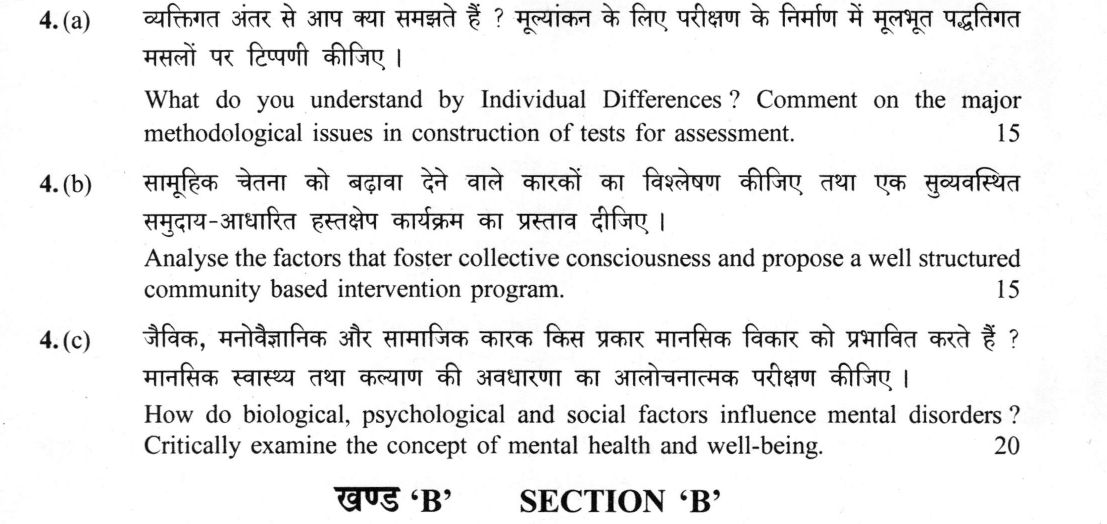
(a) What do you understand by Individual Differences ? Comment on the major methodological issues in construction of tests for…
What do you understand by Individual Differences ? Comment on the major methodological issues in construction of tests for assessment. 15 marks
Analyse the factors that foster collective consciousness and propose a well structured community based intervention program. 15 marks
How do biological, psychological and social factors influence mental disorders ? Critically examine the concept of mental health and well-being. 20 marks
हिंदी में प्रश्न पढ़ें
व्यक्तिगत अंतर से आप क्या समझते हैं ? मूल्यांकन के लिए परीक्षण के निर्माण में मूलभूत पद्धतिगत मसलों पर टिप्पणी कीजिए । (15 अंक)
सामूहिक चेतना को बढ़ावा देने वाले कारकों का विश्लेषण कीजिए तथा एक सुव्यवस्थित समुदाय-आधारित हस्तक्षेप कार्यक्रम का प्रस्ताव दीजिए । (15 अंक)
जैविक, मनोवैज्ञानिक और सामाजिक कारक किस प्रकार मानसिक विकार को प्रभावित करते हैं ? मानसिक स्वास्थ्य तथा कल्याण की अवधारणा का आलोचनात्मक परीक्षण कीजिए । (20 अंक)
Model answer
Drafted with AI by UPSC Answer Check against this question's marking rubric, to the expected length. UPSC does not publish answers for Mains — this is one way to score well, not an official key. How we build rubrics and answers.
(a) Individual differences and methodological issues in test construction
Individual differences refer to the stable and systematic variations among people in their cognitive, affective, and behavioral characteristics. The scientific study of these differences was initiated by Francis Galton (1884) and formalized by J. McK. Cattell (1890) and the Binet-Simon scale (1905), leading to the development of IQ (Stern, 1912) and large-scale assessments like the Army Alpha and Beta (1917). Constructing valid tests for these differences involves several methodological challenges.
First, item analysis is critical; items must be evaluated for difficulty, discrimination, and distractor effectiveness, often using Item Response Theory (IRT) and Differential Item Functioning (DIF) to ensure fairness. Second, reliability must be established through test-retest, parallel forms, or split-half methods (Spearman-Brown, Cronbach’s alpha), while accounting for the Standard Error of Measurement (SEM). Third, validity is a unified construct (Messick) requiring evidence of content, criterion, and construct validity, often assessed via the Campbell and Fiske (1959) multitrait-multimethod matrix.
Furthermore, norms must be derived from representative samples and periodically restandardized to account for the Flynn effect. Cross-cultural application requires more than translation; it demands conceptual and metric equivalence. Test bias must be distinguished from adverse impact. In India, local adaptations like Bhatia’s Battery (1955) and Malin’s Intelligence Scale are essential. Finally, researchers must manage response sets (social desirability, acquiescence) and adhere to ethical standards (RCI, AERA-APA-NCME) regarding informed consent and test security.
(b) Factors fostering collective consciousness; a community-based intervention programme
Collective consciousness, a concept introduced by Durkheim (1893), refers to the shared beliefs, values, and moral attitudes that unify a society. It is fostered by mechanical and organic solidarity, collective effervescence (1912), and the absence of anomie. Modern theories include Social Identity Theory (Tajfel and Turner, 1979), the psychological sense of community (McMillan and Chavis, 1986), and collective efficacy (Bandura; Sampson et al., 1997). These are supported by social capital (Putnam) and superordinate goals (Sherif, 1954).
A well-structured community-based intervention program should follow these stages:
- Entry and Rapport: Engage with the panchayat, ASHA workers, and local organizations.
- Participatory Needs Assessment: Use Focus Groups and Participatory Rural Appraisal (PRA) to establish a baseline for community sense and collective efficacy.
- Inclusive Committee: Form a representative body ensuring the inclusion of women, youth, and marginalized groups.
- Capacity Building: Train local peer leaders in communication and life skills.
- Intervention Activities: Implement superordinate projects (e.g., water or sanitation) that meet Allport’s conditions for optimal intergroup contact (equal status, common goals).
- Grievance Mechanisms: Establish conflict-resolution systems.
- Evaluation: Conduct endline measurement against a comparison community.
- Sustainability: Institutionalize the program within the panchayat.
Models like Kudumbashree and SEWA demonstrate this approach. However, the program must guard against the "dark side" of collective consciousness, such as conformity pressure or mob behavior, by promoting bridging social capital and protecting internal dissent.
(c) Biopsychosocial influences on mental disorders; the concept of mental health and well-being
Engel’s (1977) biopsychosocial model holds that disorders arise from interacting biological, psychological and social factors. Biological factors include heritability, dopamine dysregulation in psychosis and HPA-axis hyperactivity in depression. Psychological factors include Beck’s negative cognitive triad, the hopelessness reformulation of learned helplessness (Abramson, Seligman and Teasdale, 1978) and maladaptive coping. Social factors include adverse childhood experiences (Felitti et al., 1998), life events (Holmes and Rahe, 1967), Brown and Harris’s (1978) provoking agents and vulnerability factors in women’s depression, and high expressed emotion in families, which predicts relapse in schizophrenia (Vaughn and Leff, 1976).
These factors interact rather than add. Zubin and Spring’s (1977) vulnerability-stress model holds that a predisposition becomes illness under stress; Caspi et al.’s (2003) 5-HTTLPR × life-stress finding illustrated gene-environment interaction, though large replications have failed and it is now disputed. The link between poverty and disorder reflects both social causation and social drift, with drift more evident in schizophrenia.
The WHO defines mental health as a state of well-being in which a person realises their abilities, copes with normal stresses, works productively and contributes to the community. Jahoda (1958) proposed positive criteria; Diener’s hedonic subjective well-being contrasts with Ryff’s eudaimonic psychological well-being; and Keyes’s two-continua model shows that the absence of illness is not flourishing. Critically, the WHO ideal is near-utopian, its productivity criterion disadvantages the disabled and elderly, and its emphasis on autonomy reflects Western individualism rather than the relational Indian self. Szasz (1961) and labelling theorists challenge medicalisation, while Wakefield’s harmful-dysfunction analysis seeks a principled boundary of disorder. India’s Mental Healthcare Act, 2017 adopts a rights-based view, including a right to access mental healthcare.
How this answer will be evaluated
Evaluation rubric
Each sub-part is marked on its own, against the marks and word limit printed on the paper.
- (a) Two parts: explain the concept and scope of individual differences, then 'comment on' - i.e. identify and evaluate - the major methodological problems that arise when tests are constructed to assess those differences. The second part carries the greater weight. 15 marks
Must cover
- Galton (1884 anthropometric laboratory); J. McK. Cattell (1890, 'mental tests'); Binet-Simon (1905); Stern's IQ (1912); Terman's Stanford-Binet (1916); Army Alpha and Beta (1917)
- Item difficulty, discrimination, distractor analysis; item response theory; differential item functioning
- Reliability: test-retest, parallel forms, split-half with Spearman-Brown, KR-20/Cronbach's alpha; standard error of measurement
- Validity: content, criterion (concurrent/predictive), construct; Campbell and Fiske (1959) multitrait-multimethod matrix; Messick's unified construct validity
- Norms, representative standardisation sample, derived scores; Flynn effect and restandardisation
- Translation-back-translation and conceptual/linguistic/metric equivalence; test bias vs adverse impact; culture-fair tests (Raven's Progressive Matrices, Cattell's Culture Fair Test)
- Indian adaptations: Bhatia's Battery (1955), Malin's Intelligence Scale for Indian Children, Indian Vineland Social Maturity Scale
- Social desirability (Crowne-Marlowe), acquiescence, faking, lie scales
- Ethics: informed consent, confidentiality, qualified users, test security
Loses marks
- Spending most of the answer on the concept of individual differences and only a line or two on methodological issues, when 'comment on' the issues is the weightier demand
- Listing types of reliability and validity as definitions without saying what methodological problem each addresses
- Confusing test bias with a genuine mean group difference, or with adverse impact
- Treating translation as sufficient for cross-cultural adaptation and ignoring conceptual and metric equivalence
- Omitting norms and standardisation, or claiming norms are permanent despite the Flynn effect
- Ignoring response sets and the ethics of test use, both explicitly methodological problems in assessment
Earns more
- Standardisation, norms and cultural adaptation issues: norms must rest on a large, representative and clearly described sample, with appropriate age, grade, sex or occupational subgroup norms and derived scores (percentiles, z, T, stanine, deviation IQ); norms age and require periodic restandardisation, as the Flynn effect demonstrates for intelligence tests; cross-cultural use demands translation and independent back-translation and evidence of conceptual, linguistic and metric (measurement) equivalence rather than literal translation; test bias must be distinguished from genuine group difference and from adverse impact, and examined through differential item functioning and differential prediction; culture-fair and culture-reduced instruments such as Raven's Progressive Matrices and Cattell's Culture Fair Test reduce but do not eliminate the problem; India's dependence on Western instruments makes local adaptation essential, as in Bhatia's Battery of Performance Tests of Intelligence (1955) for illiterate and rural testees, Malin's Intelligence Scale for Indian Children, the Indian adaptation of the Vineland Social Maturity Scale and Pramila Pathak's adaptation of the Draw-a-Man test
- Response sets, administration and ethical issues: self-report tests are vulnerable to acquiescence, extreme and midpoint responding, and above all social desirability (measured by the Crowne-Marlowe scale), faking good in selection and faking bad or malingering in compensation settings, countered by lie and validity scales, balanced keying, forced-choice and ipsative formats, subtle items and warnings; performance tests are affected by standardisation of instructions and timing, examiner and rapport effects, test anxiety, fatigue and length, and coaching or practice effects; and ethically a test requires informed consent, confidentiality, qualified users, test security, feedback to the testee, and protection against misuse for labelling, denial of opportunity or stereotype confirmation - obligations codified by the RCI in India and by the AERA-APA-NCME Standards for Educational and Psychological Testing
- (b) Two linked tasks: 'analyse' the factors that foster collective consciousness, and then 'propose' a concrete, well-structured community-based intervention programme with identifiable stages. A proposal that is merely a list of good intentions will not satisfy the second demand. 15 marks
Must cover
- Durkheim - conscience collective (1893); mechanical and organic solidarity; collective effervescence (1912); anomie
- Social identity theory (Tajfel and Turner, 1979); self-categorization theory
- McMillan and Chavis (1986) - psychological sense of community
- Collective efficacy (Bandura; Sampson, Raudenbush and Earls, 1997)
- Putnam - bonding, bridging and linking social capital
- Sherif's Robbers Cave (1954) - superordinate goals; Allport's optimal conditions for contact
- Rappaport - empowerment theory; Bronfenbrenner's ecological levels; Freire's conscientisation; Lewin's action research
- Arnstein's ladder of participation
- Indian examples: Kudumbashree, SEWA, DAY-NRLM SHGs, Swachh Bharat community-led sanitation, Atmiyata/VISHRAM
- Baseline-endline evaluation with a comparison community
Loses marks
- Treating 'collective consciousness' loosely as public awareness or mass opinion and never citing Durkheim's technical concept
- Analysing only the factors that foster it and ignoring those that erode it, so the 'analysis' is one-sided
- Proposing a programme with no stages, no named stakeholders, no measurable outcome and no evaluation design - the question demands a well-structured programme
- Designing a top-down programme delivered to the community rather than with it, violating participation and empowerment principles
- Giving no Indian example and no theoretical anchor for the design (empowerment, ecological levels, action research)
- Ignoring the dark side - deindividuation, conformity and intergroup hostility that intense collective identity can produce
Earns more
- The proposed programme set out in identifiable stages: (1) community entry and rapport-building through the panchayat or ward committee, schools, anganwadi and ASHA workers, self-help groups, religious and youth organisations; (2) participatory needs assessment and asset mapping using focus groups, transect walks and participatory rural appraisal, with baseline measurement on a sense-of-community and collective-efficacy scale; (3) constitution of a representative community committee with mandatory inclusion of women, youth and marginalised castes and groups; (4) selection and training of local volunteers and peer leaders in communication, life skills and referral; (5) activities - regular community meetings and shared festivals and shramdaan; structured intergroup contact meeting Allport's optimal conditions of equal status, common goals, cooperation and institutional support; a superordinate community project such as water, sanitation, a school or a common resource; awareness and life-skills sessions; and linkage of households to entitlements and services; (6) conflict-resolution and grievance mechanisms; (7) monitoring and evaluation with endline measurement against a comparison community and process indicators of participation; (8) exit planning for sustainability through local ownership, a revolving fund and institutionalisation within the panchayat
- Indian illustrations and the critical caution: working models include Kudumbashree's neighbourhood groups and community development societies in Kerala, SEWA's collectivisation of informal women workers (Ela Bhatt, 1972), self-help groups under DAY-NRLM, community-led total sanitation under the Swachh Bharat Mission, and community mental-health mobilisation in Atmiyata (Gujarat) and VISHRAM (Vidarbha); the caution is that collective consciousness has a dark side - strong ingroup identification can produce deindividuation and mob behaviour, conformity pressure, suppression of dissent and intergroup hostility - so the programme must build bridging and linking capital across communities, protect internal dissent and minority voice, and be evaluated for unintended exclusionary effects
- (c) Two demands: explain how biological, psychological and social factors each influence mental disorders and how they interact; and 'critically examine' - i.e. state and then interrogate - the concepts of mental health and well-being, exposing the limits of standard definitions. 20 marks
Must cover
- Engel (1977) - biopsychosocial model; Zubin and Spring (1977) - vulnerability-stress
- Genetic heritability evidence for schizophrenia and depression; dopamine hypothesis; HPA axis
- Beck's cognitive triad; hopelessness/learned helplessness reformulation (Abramson, Seligman and Teasdale, 1978); ACEs (Felitti et al., 1998)
- Brown and Harris (1978) - provoking agents and vulnerability factors; expressed emotion (Vaughn and Leff, 1976); Holmes and Rahe (1967)
- Social causation vs social drift/selection
- Caspi et al. (2003) gene-environment interaction - noting that replication is disputed
- WHO definition of mental health; Jahoda's (1958) six criteria
- Diener's subjective well-being (hedonic) vs Ryff's six-factor psychological well-being (eudaimonic)
- Keyes - flourishing/languishing and the two-continua model
- Szasz (1961) Myth of Mental Illness; Wakefield's harmful dysfunction; labelling/medicalisation critique
- Mental Healthcare Act, 2017 (rights-based turn)
Loses marks
- Listing the three sets of factors additively and never showing interaction - no diathesis-stress, no gene-environment interaction, no causation-versus-drift discussion
- Describing factors with no named study or theorist, so nothing is checkable
- Reproducing the WHO definition and stopping there, when the question says 'critically examine'
- Confusing hedonic with eudaimonic well-being, or attributing Ryff's six dimensions to Jahoda (whose six criteria are different and earlier)
- Asserting the 5-HTTLPR gene-environment interaction as established fact when large replications have failed - the question rewards noting that it is disputed
- Ignoring the cultural critique and the Indian conception of well-being, and treating the Western individualistic model as universal
- Equating mental health with the absence of mental illness despite Keyes's two-continua evidence
Earns more
- Interaction rather than addition: Engel's (1977) biopsychosocial model; Zubin and Spring's (1977) vulnerability-stress model of schizophrenia; the diathesis-stress principle generally; measured gene-environment interaction, of which Caspi and colleagues' (2003) 5-HTTLPR by life-events finding for depression and their MAOA by maltreatment finding (2002) are the classic examples, though large replication attempts have failed and the candidate-gene interaction literature is now regarded as disputed; epigenetic mediation; and the social causation versus social selection/drift debate over the inverse relation between socio-economic status and psychosis, with evidence pointing to drift for schizophrenia and causation for depression, particularly among women
- The concept of mental health and well-being stated with models: WHO defines mental health as a state of well-being in which a person realises his or her abilities, copes with the normal stresses of life, works productively and contributes to the community - not merely the absence of disorder; Jahoda's (1958) six criteria of positive mental health (positive attitudes toward the self, growth and self-actualisation, integration, autonomy, accurate perception of reality and environmental mastery); the hedonic tradition of subjective well-being (Diener - life satisfaction plus positive minus negative affect) contrasted with the eudaimonic tradition of Ryff's six-factor psychological well-being (autonomy, environmental mastery, personal growth, positive relations with others, purpose in life, self-acceptance); Keyes's mental health continuum of flourishing, moderate mental health and languishing, and his two-continua model in which mental health and mental illness are correlated but distinct dimensions; Seligman's PERMA; and Antonovsky's salutogenesis and sense of coherence
- The critical examination: the WHO definition is idealised and near-utopian, so that few would qualify as mentally healthy, and treats well-being as a state rather than a fluctuating process; its productivity and contribution criteria are economically and culturally loaded and disadvantage the unemployed, disabled and elderly; its emphasis on autonomy and self-actualisation reflects a Western individualistic conception of the person that sits awkwardly with the relational, duty-based Indian self and with indigenous conceptions such as the triguna scheme, the Gita's sthitaprajna and the notion of ananda; positive-psychology framings risk a 'tyranny of positivity' that pathologises legitimate distress and individualises problems that are structural, while hedonic adaptation and the Easterlin paradox undercut simple happiness metrics; the boundary of disorder itself is contested - statistical, sociocultural, ideal-mental-health and distress-dysfunction criteria give different answers, Wakefield's harmful dysfunction analysis attempts a resolution, Szasz's Myth of Mental Illness (1961), Rosenhan's 1973 study (itself now questioned), labelling theory and Foucault's critique challenge medicalisation and diagnostic inflation, and Summerfield has criticised global mental health for exporting Western categories; against this, Keyes's evidence that the absence of illness is not the presence of health, and the rights-based turn in India's Mental Healthcare Act, 2017 with its statutory right to access mental healthcare, show why a positive, socially embedded and culturally plural conception of mental health remains necessary
What "Comment" is asking you to do
Take a position on the statement and support it. Comment usually attaches to a quoted line in the short slots, so the reasoning must be compressed — an opening view, a few load-bearing reasons, and the limit of the claim.
Structure that answers it
Unpack what the statement asserts → your stance → two or three supporting reasons → the qualification that limits it
Where marks are lost
Neutral summary; a comment without a stance has not answered. Equally costly is accepting the quoted line wholesale and never testing where it fails.
Practice this exact question
Write your answer and it is marked point by point against the model answer above — what you covered, what you missed, what you got wrong.
Evaluate my answer →More from Psychology 2026 Paper II
- Q1 (a) How do psychologists explain the causes of anxiety disorder ? (10 marks) (b) What is…
- Q2 (a) Compare and contrast Norm referenced vs criterion referenced measurement. (15 marks)…
- Q3 (a) Compare and contrast psychodynamic, behavioural and cognitive therapies. Which is mor…
- Q4 (a) What do you understand by Individual Differences ? Comment on the major methodologica…
- Q5 Answer the following questions in about 150 words each : (a) Suggest measures to overcome…
- Q6 (a) What are the consequences of facing deprivation in early childhood ? (15 marks) (b) D…
- Q7 (a) Clarifying the conceptual model of team cohesion, enumerate the antecedent factors th…