Paper II — Q7
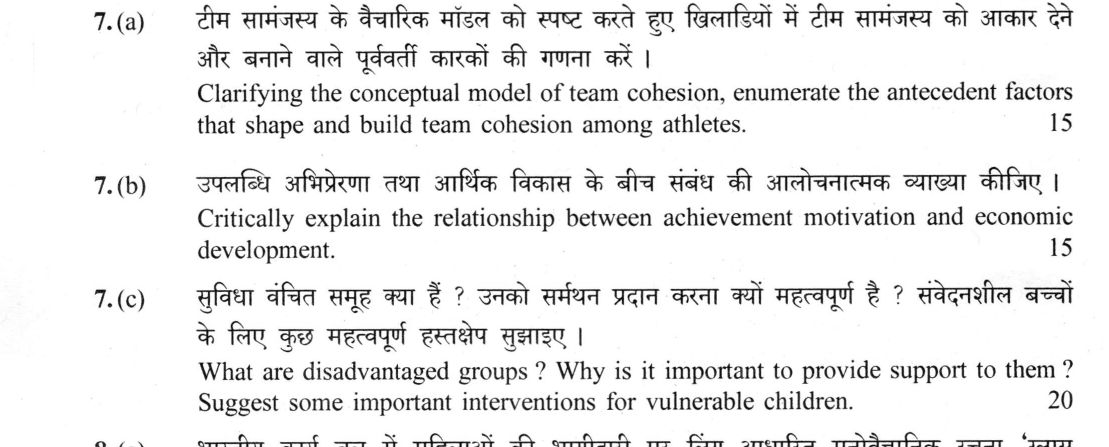
(a) Clarifying the conceptual model of team cohesion, enumerate the antecedent factors that shape and build team cohesion among…
Clarifying the conceptual model of team cohesion, enumerate the antecedent factors that shape and build team cohesion among athletes. 15 marks
Critically explain the relationship between achievement motivation and economic development. 15 marks
What are disadvantaged groups ? Why is it important to provide support to them ? Suggest some important interventions for vulnerable children. 20 marks
हिंदी में प्रश्न पढ़ें
टीम सामंजस्य के वैचारिक मॉडल को स्पष्ट करते हुए खिलाड़ियों में टीम सामंजस्य को आकार देने और बनाने वाले पूर्वर्ती कारकों की गणना करें । (15 अंक)
उपलब्धि अभिप्रेरणा तथा आर्थिक विकास के बीच संबंध की आलोचनात्मक व्याख्या कीजिए । (15 अंक)
सुविधा वंचित समूह क्या हैं ? उनको समर्थन प्रदान करना क्यों महत्वपूर्ण है ? संवेदनशील बच्चों के लिए कुछ महत्वपूर्ण हस्तक्षेप सुझाइए । (20 अंक)
Model answer
Drafted with AI by UPSC Answer Check against this question's marking rubric, to the expected length. UPSC does not publish answers for Mains — this is one way to score well, not an official key. How we build rubrics and answers.
(a) Team cohesion in sport: conceptual model and antecedents (15 marks)
Team cohesion is a dynamic process reflected in a group's tendency to stick together and stay united in pursuit of its goals and the satisfaction of members' emotional needs (Carron). Carron's conceptual model treats cohesion as multidimensional: task cohesion (commitment to shared goals) and social cohesion (liking and bonds), each viewed through the individual's attraction to the group (ATG) and the group's integration (GI); this is measured by the Group Environment Questionnaire. The model links antecedents to cohesion and cohesion to consequences for performance and for the group (satisfaction, adherence, stability).
Antecedents fall into four categories:
- Environmental factors: group size (smaller teams are more cohesive), contractual or eligibility norms, organisational orientation, and physical proximity.
- Personal factors: similarity of members in background and attitudes, satisfaction, individual motives and orientation, and gender and age.
- Leadership factors: coach's style and behaviour, the coach-athlete and athlete-athlete relationships, and participative decision-making.
- Team factors: task type (interdependent tasks such as basketball need more cohesion), desire for group success, team norms and productivity norms, role clarity, team stability, shared success and ability, and initial group position.
Cohesion can be built by clear roles, team goals, distinctive group identity, joint social activities and team-building, and by having captains and coaches encourage open communication.
(b) Achievement motivation and economic development (15 marks)
McClelland's The Achieving Society (1961) argued that societies with a high need for achievement (n-Ach), the desire to excel and take moderate, calculated risks, produce more entrepreneurs and grow faster. Using content analysis of folk tales, literature and children's readers, he linked high n-Ach scores to earlier economic growth in ancient Greece, medieval Spain and modern nations; a 1925 measure in readers predicted later electricity-output growth. He traced n-Ach to child-rearing that stresses independence and mastery, and, following Weber, to the Protestant ethic. McClelland's own Kakinada (Andhra Pradesh) experiments raised entrepreneurial activity through achievement-motivation training.
Critique: the causal direction is uncertain, since growth and prosperity may themselves generate achievement values; TAT-type measurement is subjective and culture-bound; the theory is individualistic and Western, and collectivist societies such as East Asia achieve growth through group-oriented motives; and structural factors such as institutions, capital, resources, infrastructure, education and colonial history are ignored. Growth also needs opportunity, so motivation alone is not sufficient. Overall, n-Ach is a helpful contributing factor, best studied alongside structural conditions, and it can be trained.
(c) Disadvantaged groups, the need for support and interventions for vulnerable children (20 marks)
Disadvantaged groups are sections of society that, through poverty, caste, tribe, gender, disability, minority or migrant status or a hostile environment, have restricted access to resources, education, health and social participation. In India they include Scheduled Castes and Tribes, the economically poor, girls, children with disabilities, child labourers, street and slum children, migrants, and transgender persons.
Support is important for several reasons. Disadvantage traps people in a cycle of poverty across generations, and early deprivation harms cognition, motivation and self-concept, so intervention brings the highest returns. Equal opportunity is a constitutional value: Article 15(4) permits special provisions, Article 46 directs the State to promote the educational and economic interests of weaker sections, Article 21A and the RTE Act 2009, which reserves 25% of seats in private schools for disadvantaged children, secure schooling. A society loses talent and cohesion if groups are excluded, and prejudice and stereotype threat lower self-esteem and aspiration.
Interventions for vulnerable children:
- Early stimulation and nutrition, through ICDS and pre-school enrichment (Head Start type programmes), and PM POSHAN mid-day meals.
- Compensatory and remedial education, bridge courses for dropouts and inclusive classrooms, with scholarships.
- Psychological interventions: attribution retraining and a growth mindset (Dweck), self-esteem building, mentoring and role models, counselling and social-skills training.
- Parent and community programmes to support parenting and change attitudes.
- Protective measures: Mission Vatsalya (child protection), the Juvenile Justice Act 2015, POCSO Act 2012 and Childline 1098.
- Sensitising teachers to reduce labelling and bias.
How this answer will be evaluated
Evaluation rubric
Each sub-part is marked on its own, against the marks and word limit printed on the paper.
- (a) Clarify the conceptual model of team cohesion and enumerate the antecedent factors shaping team cohesion among athletes (15). 15 marks
Must cover
- Definition and dimensions: task and social cohesion; ATG and GI (Carron; GEQ)
- Environmental factors
- Personal and leadership factors
- Team factors, and the link to consequences for performance and the group
Loses marks
- Listing antecedents without the model.
- Confusing cohesion with mere friendship.
- Missing any one of the four antecedent categories.
Earns more
- Practical ways to build cohesion.
- Examples from named sports.
Extra mark
- Note that the cohesion-performance link is reciprocal
- (b) Critically explain the relationship between achievement motivation and economic development (15). 15 marks
Must cover
- McClelland's thesis (n-Ach of society predicts growth) and its evidence (content analysis, 1925 readers, Weber)
- Kakinada training experiment or n-Ach training
- Critique: causal direction, TAT measurement, Western individualism
- Structural factors ignored; balanced conclusion
Loses marks
- Only exposition with no critique.
- Confusing n-Ach with n-Aff or n-Power.
- Asserting that motivation alone explains growth.
Earns more
- Collectivist-society counter-example.
- Explanation of how n-Ach arises (child rearing).
Extra mark
- Indian entrepreneurship data or later studies
- (c) What are disadvantaged groups; why is support to them important; suggest important interventions for vulnerable children (20). 20 marks
Must cover
- Definition with Indian examples (SC/ST, poor, disabled, girls, child labourers)
- Reasons for support: cycle of poverty, early deprivation, equal opportunity, constitutional provisions (Articles 15(4), 46, 21A; RTE)
- Early stimulation, nutrition and compensatory education (ICDS, PM POSHAN, bridge courses)
- Psychological interventions: growth mindset, attribution retraining, mentoring, counselling and parent programmes
- Protective measures (Mission Vatsalya, JJ Act 2015, POCSO)
Loses marks
- Only sociological definitions with no psychological interventions.
- Wrong constitutional article or Act year.
- Deficit-model language that blames disadvantaged groups.
Earns more
- Each of the three sub-demands answered separately.
- Link between interventions and psychological mechanisms (self-esteem, stereotype threat).
Extra mark
- Teacher sensitisation and community mobilisation
What "Enumerate" is asking you to do
Produce the complete set of items asked for, countable and correctly named. The examiner marks against a checklist, so a missing item costs and an elaborated one gains nothing — where discussion is wanted the stem asks for it as a separate sub-part.
Structure that answers it
One line naming the basis on which the set is drawn → items numbered, each in a phrase or a single line → the discussion sub-part taken up separately, after the list is complete
Where marks are lost
Treating it as an essay. Six items named in six lines score better than three items explained at length.
Practice this exact question
Write your answer and it is marked point by point against the model answer above — what you covered, what you missed, what you got wrong.
Evaluate my answer →More from Psychology 2026 Paper II
- Q4 (a) What do you understand by Individual Differences ? Comment on the major methodologica…
- Q5 Answer the following questions in about 150 words each : (a) Suggest measures to overcome…
- Q6 (a) What are the consequences of facing deprivation in early childhood ? (15 marks) (b) D…
- Q7 (a) Clarifying the conceptual model of team cohesion, enumerate the antecedent factors th…
- Q8 (a) Analyse the impact of gender based psychological construct, ‘Glass ceiling’, on women…