Paper II — Q8
(a) Analyse the impact of gender based psychological construct, ‘Glass ceiling’, on women’s participation in Indian work force…
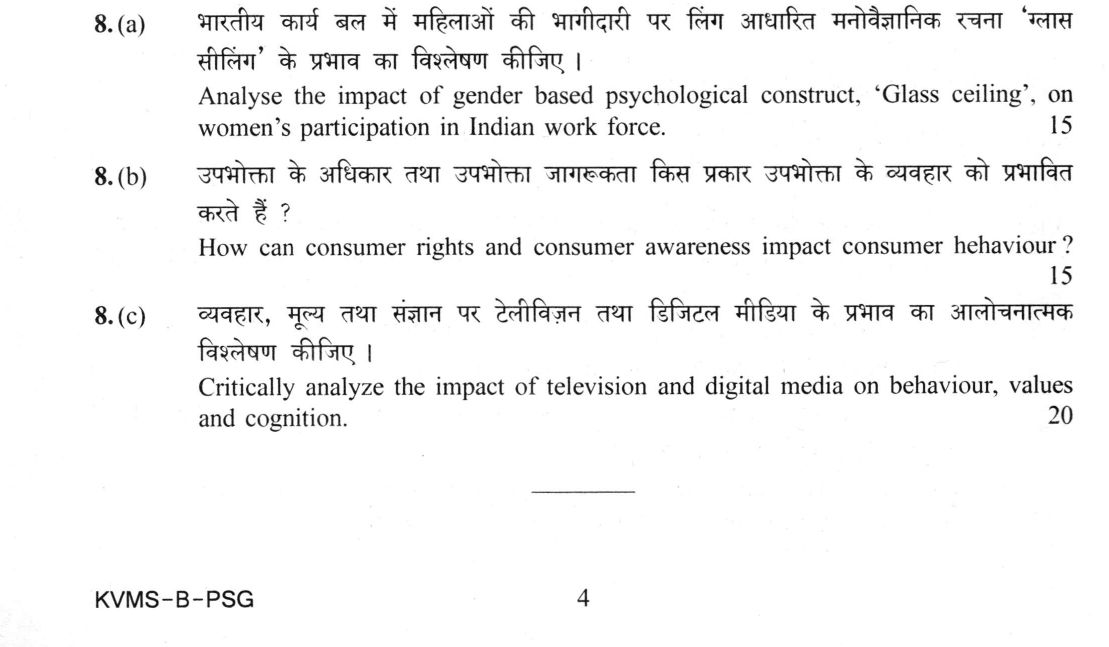
Analyse the impact of gender based psychological construct, ‘Glass ceiling’, on women’s participation in Indian work force. 15 marks
How can consumer rights and consumer awareness impact consumer behaviour ? 15 marks
Critically analyze the impact of television and digital media on behaviour, values and cognition. 20 marks
हिंदी में प्रश्न पढ़ें
भारतीय कार्य बल में महिलाओं की भागीदारी पर लिंग आधारित मनोवैज्ञानिक रचना ‘ग्लास सीलिंग’ के प्रभाव का विश्लेषण कीजिए । (15 अंक)
उपभोक्ता के अधिकार तथा उपभोक्ता जागरूकता किस प्रकार उपभोक्ता के व्यवहार को प्रभावित करते हैं ? (15 अंक)
व्यवहार, मूल्य तथा संज्ञान पर टेलीविज़न तथा डिजिटल मीडिया के प्रभाव का आलोचनात्मक विश्लेषण कीजिए । (20 अंक)
Model answer
Drafted with AI by UPSC Answer Check against this question's marking rubric, to the expected length. UPSC does not publish answers for Mains — this is one way to score well, not an official key. How we build rubrics and answers.
(a) Glass ceiling and women in the Indian workforce (15 marks)
The "glass ceiling" is an invisible but real barrier, built from attitudes and organisational practice, that keeps qualified women from rising beyond a certain level. The term entered wide use in 1986 and was studied by the US Glass Ceiling Commission (1991).
Psychological roots: gender stereotypes ("think manager, think male", Schein) and role congruity (Eagly and Karau), whereby leadership is judged as incompatible with the feminine role, so assertive women are penalised as unlikeable. Kanter's tokenism describes the pressure on the few women in senior ranks, while stereotype threat, impostor feelings and lowered self-efficacy erode aspiration. Women often absorb internalised gender roles, the double burden of paid work and care, and the "glass cliff" (Ryan and Haslam), by which women get risky leadership posts. Exclusion from male-dominated informal networks and weak mentoring block sponsorship.
Impact in India: women's labour force participation rate is low by global standards, although PLFS has shown a rise to about 41% in 2023-24, largely from rural self-employment and unpaid family work. Women are concentrated in low-paid and informal jobs ("sticky floor"), the leaky pipeline loses mid-career women at marriage and motherhood, and they are under-represented in senior management and boards, with a persistent gender pay gap. The costs are lost talent, lower aspiration and psychological strain.
Remedies: mentoring and sponsorship; gender-neutral selection; flexible work and childcare; the Maternity Benefit (Amendment) Act 2017 (26 weeks) and crèche norms; the POSH Act 2013; and the Companies Act 2013 requirement of at least one woman director in specified companies.
(b) How consumer rights and awareness shape consumer behaviour (15 marks)
Consumer rights under the Consumer Protection Act 2019 are the rights to safety, to be informed, to choose, to be heard, to seek redress and to consumer education. Awareness is knowledge of these rights, of product information and of redress channels such as the CCPA and consumer commissions.
Effects on behaviour: awareness moves buying from impulsive, heuristic choice to informed decision-making; consumers read labels, compare prices and quality, check standards marks (BIS, Agmark, FSSAI) and demand bills. Knowledge of persuasion tactics (the persuasion knowledge model of Friestad and Wright) makes people more sceptical of advertising, misleading claims and dark patterns. Perceived control and self-efficacy rise, so consumers are more likely to complain rather than suffer silently (Hirschman's exit-voice-loyalty), to seek redress and to switch brands after poor service. Trust increases when rights are enforced, which encourages e-commerce and formal-market participation. It also makes purchasing more sustainable and ethical, and pressures firms towards better quality, safety and honest advertising, as a market feedback loop. Unaware consumers, by contrast, are more susceptible to fraud, peer pressure and false claims. Limits include attitude-behaviour gaps and the cost and delay of redress.
(c) Impact of television and digital media on behaviour, values and cognition (20 marks)
Behaviour: Bandura's Bobo-doll studies showed that children imitate filmed aggression, and longitudinal work (Huesmann) links early violent viewing to later aggression; Williams's Notel study found aggression rose after television arrived in a Canadian town. Meta-analyses of violent video games (Anderson and Bushman) find small effects on aggressive cognition and behaviour, contested by others (Ferguson). Media can equally model prosocial behaviour: Sesame Street improved school readiness, and the Indian serial Hum Log (1984) shifted attitudes on gender and family planning, an entertainment-education success (Singhal and Rogers). Social media adds social comparison, cyberbullying and compulsive use.
Values: Gerbner's cultivation theory says heavy viewers come to see the world as more violent and dangerous (mean-world syndrome), and media promote consumerism, materialism and gender and body-image stereotypes; they can also spread tolerance and awareness. Algorithmic feeds and echo chambers polarise attitudes and spread misinformation.
Cognition: heavy screen time in early childhood is associated with delayed language and attention difficulties (the video deficit effect), shallow processing and reduced deep reading; multitasking weakens memory, but interactive educational media and games can improve visuospatial skills and learning.
Critical evaluation: most evidence is correlational, so causation may be reverse (aggressive children choose violent media) or driven by third factors such as family; effects are generally small and moderated by age, content, duration, parental mediation and media literacy; uses-and-gratifications theory stresses active audiences. Balanced conclusion: media are neither uniformly harmful nor benign, and quality, context and literacy determine impact.
How this answer will be evaluated
Evaluation rubric
Each sub-part is marked on its own, against the marks and word limit printed on the paper.
- (a) Analyse the impact of the gender-based construct 'glass ceiling' on women's participation in the Indian workforce (15). 15 marks
Must cover
- Definition of glass ceiling as invisible attitudinal and organisational barrier
- Psychological roots: stereotypes, role congruity, tokenism, stereotype threat or impostor feelings
- Impact on Indian participation: low FLFPR, sticky floor, leaky pipeline, senior-level under-representation, pay gap
- Remedies with Indian anchors (mentoring, Maternity Benefit Amendment 2017, POSH 2013, Companies Act 2013)
Loses marks
- Purely sociological narrative with no psychological construct.
- Wrong statutory year or leave duration.
- Equating low participation only with lack of qualification.
Earns more
- Concepts such as glass cliff or queen bee.
- Recent PLFS participation trend with the caveat about its composition.
Extra mark
- Cultural and family factors specific to India
- (b) How can consumer rights and consumer awareness impact consumer behaviour (15). 15 marks
Must cover
- Consumer rights under the Consumer Protection Act 2019 (six rights)
- Awareness leads to informed decisions, label reading, comparison and standard-mark checks
- Psychological mechanisms: persuasion knowledge, self-efficacy or perceived control, complaint behaviour (exit-voice-loyalty)
- Market and societal effects: trust, pressure on firms; limits
Loses marks
- Listing rights only with no link to behaviour.
- Obsolete Act (1986) presented as current.
- Ignoring awareness and treating rights as purely legal.
Earns more
- Role of the CCPA and redress bodies.
- Dark patterns and false advertising.
Extra mark
- Attitude-behaviour gap
- (c) Critically analyse the impact of television and digital media on behaviour, values and cognition (20). 20 marks
Must cover
- Behaviour: Bandura, Huesmann or other named evidence; prosocial modelling (Hum Log, Sesame Street)
- Values: cultivation theory, consumerism, stereotypes, polarisation and misinformation
- Cognition: attention, language, deep reading, multitasking; potential benefits
- Critical evaluation: correlational limits, reverse causation, moderators, balanced conclusion
Loses marks
- One-sided harm narrative without evaluation.
- Naming theories without evidence.
- Treating correlation as proof of causation.
Earns more
- Digital-specific issues (social comparison, echo chambers).
- Uses-and-gratifications or media literacy as counterpoint.
Extra mark
- Contested findings on video games
What "Construct" is asking you to do
Build the required object — a velocity diagram, a sequential test, a control chart, a geometrical figure — step by step, so the sequence is visible on the page. The steps are marked, not only the finished thing.
Structure that answers it
Data and requirement → scale or basis chosen, stated → construction steps in order → the finished construction, labelled → quantities read off, or the result it yields
Where marks are lost
A diagram drawn without a stated scale, so nothing can be scaled off it and the quantities that follow lose their support. In statistics, writing down the procedure without fixing its defining constants — stopping bounds in terms of the two error probabilities, or the control limits — leaves it unmarkable.
Practice this exact question
Write your answer and it is marked point by point against the model answer above — what you covered, what you missed, what you got wrong.
Evaluate my answer →More from Psychology 2026 Paper II
- Q5 Answer the following questions in about 150 words each : (a) Suggest measures to overcome…
- Q6 (a) What are the consequences of facing deprivation in early childhood ? (15 marks) (b) D…
- Q7 (a) Clarifying the conceptual model of team cohesion, enumerate the antecedent factors th…
- Q8 (a) Analyse the impact of gender based psychological construct, ‘Glass ceiling’, on women…