Paper II — Q5
(a) Suggest measures to overcome social conflicts and communal tensions using psychological principles. (10 marks) (b) Examine…
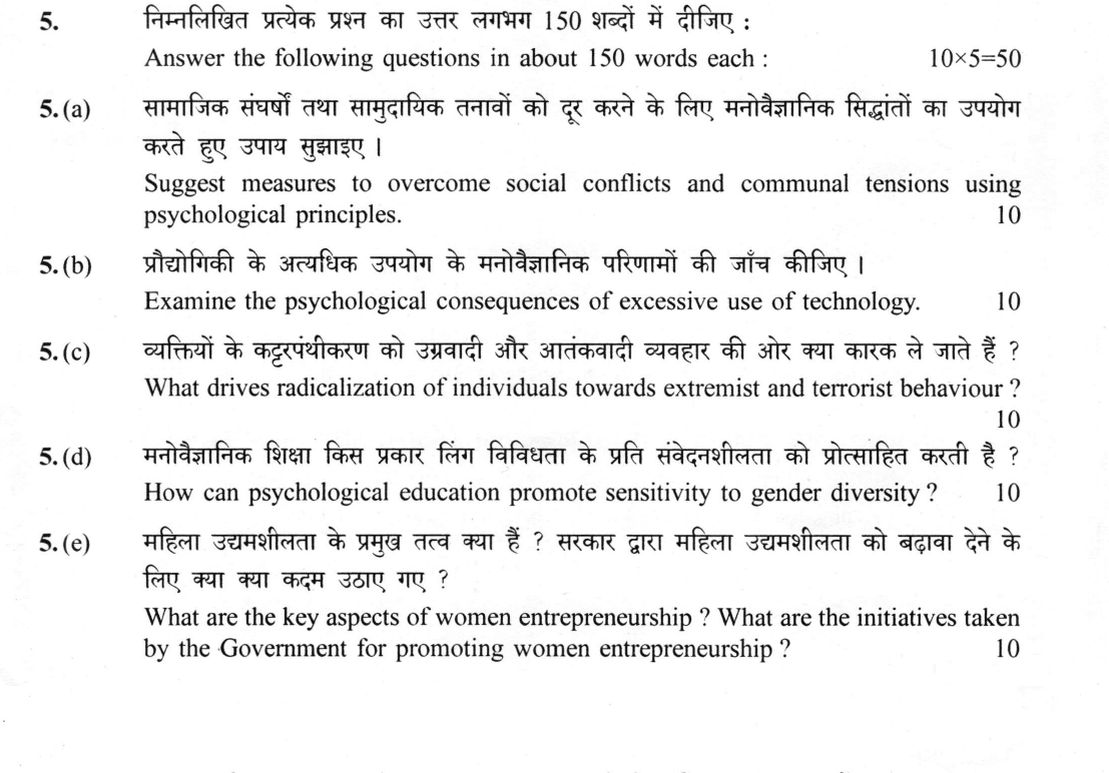
Answer the following questions in about 150 words each :
Suggest measures to overcome social conflicts and communal tensions using psychological principles. 10 marks
Examine the psychological consequences of excessive use of technology. 10 marks
What drives radicalization of individuals towards extremist and terrorist behaviour ? 10 marks
How can psychological education promote sensitivity to gender diversity ? 10 marks
What are the key aspects of women entrepreneurship ? What are the initiatives taken by the Government for promoting women entrepreneurship ? 10 marks
हिंदी में प्रश्न पढ़ें
निम्नलिखित प्रत्येक प्रश्न का उत्तर लगभग 150 शब्दों में दीजिए :
सामाजिक संघर्षों तथा सामुदायिक तनावों को दूर करने के लिए मनोवैज्ञानिक सिद्धांतों का उपयोग करते हुए उपाय सुझाइए । (10 अंक)
प्रौद्योगिकी के अत्यधिक उपयोग के मनोवैज्ञानिक परिणामों की जाँच कीजिए । (10 अंक)
व्यक्तियों के कट्टरपंथीकरण को उग्रवादी और आतंकवादी व्यवहार की ओर क्या कारक ले जाते हैं ? (10 अंक)
मनोवैज्ञानिक शिक्षा किस प्रकार लिंग विविधता के प्रति संवेदनशीलता को प्रोत्साहित करती है ? (10 अंक)
महिला उद्यमशीलता के प्रमुख तत्व क्या हैं ? सरकार द्वारा महिला उद्यमशीलता को बढ़ावा देने के लिए क्या क्या कदम उठाए गए ? (10 अंक)
Model answer
Drafted with AI by UPSC Answer Check against this question's marking rubric, to the 150-word length. UPSC does not publish answers for Mains — this is one way to score well, not an official key. How we build rubrics and answers.
(a) Overcoming social conflict and communal tension (10 marks)
Measures should target the psychology of intergroup hostility. Sherif's Robbers Cave study showed that competition breeds conflict and that superordinate goals needing joint effort, such as disaster relief or common civic tasks, reduce it. Allport's contact hypothesis holds that contact lowers prejudice when groups have equal status, common goals, cooperation and institutional support; Pettigrew and Tropp's meta-analysis of over 500 studies confirmed this, and Aronson's jigsaw classroom applies it in schools. Gaertner and Dovidio's common ingroup identity model recasts "us and them" as a shared "we", ideally while keeping subgroup identity intact. Extended contact through friends' cross-group friendships, perspective-taking and empathy training, and counter-stereotypic role models weaken bias. Varshney's study of Indian cities found that everyday and associational links across communities, such as joint trade bodies, kept cities peaceful; mohalla peace committees and rumour control build on this. Finally, Osgood's GRIT, graduated and reciprocated conciliatory steps, de-escalates mistrust.
(b) Psychological consequences of excessive technology use (10 marks)
Excessive use affects several domains. Cognitively, constant notifications and media multitasking fragment attention, weaken deep reading and memory consolidation, and encourage reliance on devices as external memory (the "Google effect"). Emotionally, heavy social-media use is linked to anxiety, low mood, fear of missing out and unfavourable social comparison; late-night screen use disturbs sleep, which worsens mood and concentration. Socially, it can produce loneliness despite constant connection, "phubbing", cyberbullying, echo chambers and polarisation. Behaviourally, variable-ratio rewards (likes, scrolls, loot boxes) sustain compulsive checking; gaming disorder is recognised in ICD-11, and nomophobia and problematic smartphone use are widely studied. Children face effects on attention, language and physical activity. The evidence on average effects is mixed and modest, with vulnerable users affected most, so remedies are digital literacy, screen-time limits, digital detox, and offline activity and support.
(c) What drives radicalisation towards extremism and terrorism (10 marks)
No single profile or cause exists; radicalisation is a process in which individual, group and social factors interact. Grievance and relative deprivation, injustice, humiliation and identity threat create vulnerability. Kruglanski's 3N model shows the quest for significance (need), an ideological justification (narrative) and a group that rewards commitment (network). Moghaddam's staircase describes narrowing perception of options, moral disengagement and finally acceptance of violence. Social identity and uncertainty-identity theories explain how insecure people attach to strong groups; group polarisation and isolation from moderating views push positions to extremes; dehumanisation and Bandura's moral disengagement make harming outsiders possible. Recruiters exploit personal crises, peer bonds and kinship networks, and online echo chambers speed the process. McCauley and Moskalenko separate opinion radicalisation from action radicalisation, since most who hold extreme beliefs do not act. Prevention therefore combines grievance redress, counter-narratives and deradicalisation programmes.
(d) Psychological education and sensitivity to gender diversity (10 marks)
Psychological education can change how people think and feel about gender. It explains that gender is learned through social learning and gender schema (Bem), so stereotypes are not natural; it exposes implicit bias and stereotype threat and teaches perspective-taking and empathy. Distinguishing sex, gender identity, expression and orientation removes myths, with evidence that variations are natural and not disorders. Contact with diverse individuals, role-play and reflective discussion reduce prejudice, following the contact hypothesis. Teacher and counsellor training in affirmative practice supports students who face bullying and stigma. In India, NALSA v. Union of India (2014) recognised transgender persons as a third gender, Navtej Singh Johar (2018) decriminalised consensual same-sex conduct and the Transgender Persons (Protection of Rights) Act, 2019 addresses rights; education should link these to real life. Inclusive curricula and language, anti-bullying policy and gender-neutral facilities complete the effort.
(e) Women entrepreneurship: key aspects and government initiatives (10 marks)
Key aspects: a women's enterprise is one owned and controlled by women, with at least 51% of capital under the MSME framework. Psychologically, achievement motivation (McClelland), self-efficacy (Bandura), internal locus of control, risk-taking and resilience drive success, with push motives (need for income) and pull motives (independence). Barriers include limited finance and collateral, restricted mobility and networks, work-family conflict, gender stereotypes and fear of failure. Government initiatives: Mudra loans (2015), most of whose borrowers are women; Stand-Up India (2016), bank loans of ₹10 lakh-₹1 crore to at least one woman and one SC/ST borrower per branch; PMEGP with a higher subsidy for women; TREAD (1998) for training and credit support; Mahila e-Haat, a web marketing platform; NITI Aayog's Women Entrepreneurship Platform (2018); DAY-NRLM self-help groups and the Lakhpati Didi drive; and CGTMSE collateral-free credit guarantees.
How this answer will be evaluated
Evaluation rubric
Each sub-part is marked on its own, against the marks and word limit printed on the paper.
- (a) Suggest measures to overcome social conflict and communal tension using psychological principles (10, about 150 words). 10 marks · 150 words
Must cover
- Sherif: superordinate goals reduce competition-driven conflict
- Allport's contact hypothesis with its conditions (equal status, common goals, cooperation, institutional support)
- Common ingroup identity or jigsaw classroom as applied measure
- At least one India-linked measure (Varshney's civic engagement, mohalla committees, rumour control)
Loses marks
- Descriptive account of causes of conflict without any measures.
- Naming theories without saying how they translate into action.
- Purely legal or policing measures with no psychological principle.
Earns more
- Extended contact, empathy and perspective-taking, counter-stereotypic role models.
- Osgood's GRIT or another de-escalation strategy.
Extra mark
- Pettigrew-Tropp meta-analysis; dual identity
- (b) Examine the psychological consequences of excessive technology use (10, about 150 words). 10 marks · 150 words
Must cover
- Cognitive effects: attention fragmentation, multitasking, memory and deep reading
- Emotional effects: anxiety, low mood, FoMO, social comparison, sleep disruption
- Social and behavioural effects: loneliness, cyberbullying, echo chambers, compulsive use or gaming disorder
- Balanced evidence and a remedy (digital literacy, limits, detox)
Loses marks
- Only benefits of technology, or purely moralising tone.
- A list of harms with no psychological explanation.
- Claiming a single causal effect as settled.
Earns more
- Reinforcement mechanism (variable-ratio rewards) and named terms such as nomophobia or phubbing.
- Special mention of children and adolescents.
Extra mark
- Mention that effect sizes are modest and vulnerable groups are most affected
- (c) What drives radicalisation towards extremist and terrorist behaviour (10, about 150 words). 10 marks · 150 words
Must cover
- Process view: no single profile; individual, group and social factors interact
- Grievance, relative deprivation, identity threat and search for significance
- A named model (Kruglanski 3N, Moghaddam staircase, or McCauley-Moskalenko)
- Group and online dynamics: polarisation, dehumanisation or moral disengagement, recruitment networks
Loses marks
- Attributing extremism to one religion, region or mental illness.
- Describing terrorist acts without any psychological driver.
- Neglecting the role of groups and networks.
Earns more
- Distinguishing opinion from action radicalisation.
- Prevention through grievance redress, counter-narrative and deradicalisation.
Extra mark
- Uncertainty-identity theory or Bandura's moral disengagement
- (d) How can psychological education promote sensitivity to gender diversity (10, about 150 words). 10 marks · 150 words
Must cover
- Gender as learned: social learning, gender schema; stereotypes not natural
- Distinguishing sex, gender identity, expression and orientation; diversity is not disorder
- Techniques: implicit-bias awareness, perspective-taking, contact, discussion
- India-linked anchors: NALSA (2014), Navtej Johar (2018), Transgender Persons Act 2019, and inclusive curricula and teacher training
Loses marks
- Discussing only women's issues and missing gender diversity.
- Legal facts without any psychological mechanism.
- Incorrect year or holding of a cited case.
Earns more
- Stereotype threat, anti-bullying policy and affirmative counselling.
- Contact hypothesis and role-play used correctly.
Extra mark
- Inclusive language and gender-neutral facilities
- (e) What are the key aspects of women entrepreneurship, and what initiatives has the Government taken to promote it (10, about 150 words). 10 marks · 150 words
Must cover
- Meaning: enterprise owned and controlled by women (at least 51% capital) and psychological aspects (achievement motivation, self-efficacy, locus of control)
- Barriers: finance and collateral, mobility, work-family conflict, stereotypes
- Government schemes: Mudra, Stand-Up India, PMEGP, TREAD or Mahila e-Haat
- Support ecosystem: WEP (NITI Aayog), DAY-NRLM SHGs or Lakhpati Didi, CGTMSE
Loses marks
- Only schemes without any key aspects, or the reverse.
- Wrong loan limits or year for Stand-Up India or Mudra.
- Generic empowerment talk with no entrepreneurship content.
Earns more
- Push and pull motivation.
- Correct details of at least two schemes (year, loan size, target group).
Extra mark
- Assessment of gaps between schemes and reach
What "Suggest" is asking you to do
Propose measures that attach to the causes the question has just had you identify. Each should name who acts, on what, and why it would work; a measure with no actor behind it is a wish rather than a suggestion.
Structure that answers it
The problem in one line → measure 1 with the cause it addresses → measure 2 → measure 3 → how it would be implemented and what it requires
Where marks are lost
Prescriptions that would fit any question on any subject — awareness campaigns, capacity building, better coordination. The examiner checks whether each measure is traceable to a cause the answer itself named.
Practice this exact question
Write your answer and it is marked point by point against the model answer above — what you covered, what you missed, what you got wrong.
Evaluate my answer →More from Psychology 2026 Paper II
- Q2 (a) Compare and contrast Norm referenced vs criterion referenced measurement. (15 marks)…
- Q3 (a) Compare and contrast psychodynamic, behavioural and cognitive therapies. Which is mor…
- Q4 (a) What do you understand by Individual Differences ? Comment on the major methodologica…
- Q5 Answer the following questions in about 150 words each : (a) Suggest measures to overcome…
- Q6 (a) What are the consequences of facing deprivation in early childhood ? (15 marks) (b) D…
- Q7 (a) Clarifying the conceptual model of team cohesion, enumerate the antecedent factors th…
- Q8 (a) Analyse the impact of gender based psychological construct, ‘Glass ceiling’, on women…