Paper II — Q2
(a) Compare and contrast Norm referenced vs criterion referenced measurement. (15 marks) (b) “Therapeutic approaches must be…
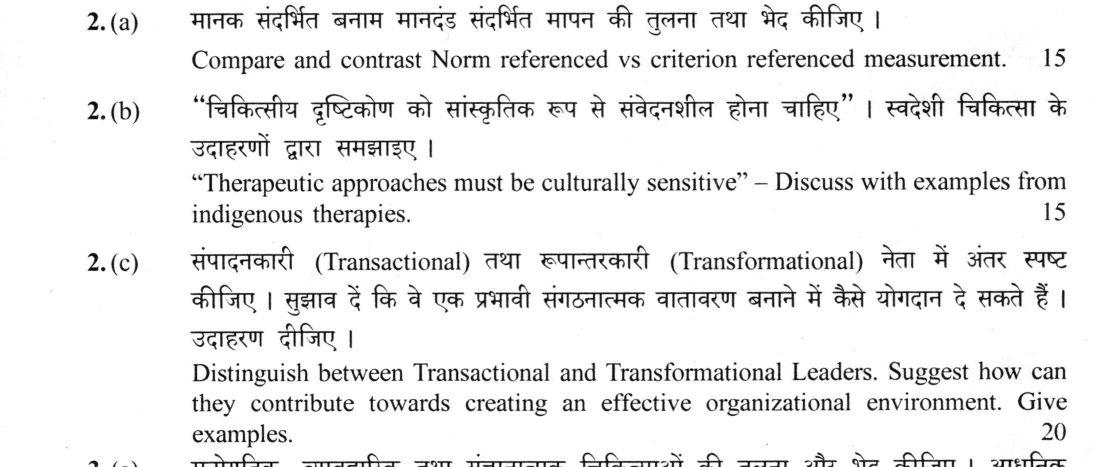
Compare and contrast Norm referenced vs criterion referenced measurement. 15 marks
“Therapeutic approaches must be culturally sensitive” – Discuss with examples from indigenous therapies. 15 marks
Distinguish between Transactional and Transformational Leaders. Suggest how can they contribute towards creating an effective organizational environment. Give examples. 20 marks
हिंदी में प्रश्न पढ़ें
मानक संदर्भित बनाम मानदंड संदर्भित मापन की तुलना तथा भेद कीजिए । (15 अंक)
“चिकित्सीय दृष्टिकोण को सांस्कृतिक रूप से संवेदनशील होना चाहिए” । स्वदेशी चिकित्सा के उदाहरणों द्वारा समझाइए । (15 अंक)
संपादनकारी (Transactional) तथा रूपान्तरकारी (Transformational) नेता में अंतर स्पष्ट कीजिए । सुझाव दें कि वे एक प्रभावी संगठनात्मक वातावरण बनाने में कैसे योगदान दे सकते हैं । उदाहरण दीजिए । (20 अंक)
Model answer
Drafted with AI by UPSC Answer Check against this question's marking rubric, to the expected length. UPSC does not publish answers for Mains — this is one way to score well, not an official key. How we build rubrics and answers.
(a) Norm-referenced versus criterion-referenced measurement
Norm-referenced (NRT) and criterion-referenced (CRT) measurement are two frames of reference for interpreting a score; Robert Glaser (1963) coined the term criterion-referenced to contrast them.
Similarities: both rest on the psychometric principles of reliability and validity, use standardised administration and scoring, and can even use the same items, since the difference lies in how a score is interpreted.
Differences:
- Purpose and interpretation: NRT ranks a person against a norm group, reporting percentile ranks, z, T or stanine scores and deviation IQs. CRT compares performance with a defined domain and cut-score, reporting mastery or non-mastery.
- Item selection: NRT retains items of moderate difficulty (p near 0.50) and high discrimination to spread scores; CRT retains items that represent the domain and are instructionally sensitive.
- Reliability and validity: NRT uses internal consistency (KR-20, Cronbach’s alpha) and test-retest reliability, with criterion and construct validity. Because CRT scores have restricted variance, classical coefficients are deflated (Popham and Husek, 1969); reliability is reported as decision consistency (Cohen’s kappa, Livingston’s coefficient), content validity is paramount, and the cut-score is set by Angoff, Ebel, Nedelsky or bookmark methods.
- Use: NRT suits competitive selection (UPSC Civil Services, JEE, GRE); CRT suits Bloom’s mastery learning, licensure, driving tests, the National Achievement Survey and the competency-based assessment of NEP 2020 through PARAKH.
The two are complementary: NRT shows relative standing, CRT absolute competence, and many systems now report both.
(b) Culturally sensitive therapy: examples from indigenous therapies
Therapy must be culturally sensitive because culture shapes idioms of distress, explanatory models and the therapeutic relationship; applying Western categories unchanged is an “imposed etic” (Berry). Kleinman (1980) showed that patients and healers hold distinct explanatory models of illness, and DSM-5 (retained in DSM-5-TR) replaced “culture-bound syndromes” with “cultural concepts of distress” and introduced the Cultural Formulation Interview. In India distress is often voiced somatically (“gas”, “heat”), as dhat syndrome (distress attributed to semen loss) or as possession states.
Examples:
- Ayurveda and yoga: the Charaka Samhita distinguishes sattvavajaya (mind-control), daivavyapashraya (spiritual) and yuktivyapashraya (rational) therapy. Sudarshan Kriya Yoga benefited melancholic depression (Janakiramaiah et al., 2000), and yoga as an add-on improved outcomes in schizophrenia (Duraiswamy et al., 2007).
- Temple healing: Raguram et al. (BMJ, 2002) reported reduced symptom scores among people with psychosis staying at the Muthuswamy temple in Tamil Nadu, attributing this to its supportive, non-threatening environment.
- Relational models: Neki (1973) proposed the guru-chela relationship as a therapeutic paradigm, and Kakar (1982) analysed healers who act as moral and spiritual guides.
- Two-way traffic: mindfulness-based therapies such as MBCT and the mindfulness module of DBT adapt Buddhist meditation.
Sensitivity is not uncritical endorsement. In the Erwadi tragedy (2001), mentally ill people chained at an unregulated dargah shelter died in a fire. Indigenous practices must therefore be integrated with evidence-based, rights-respecting care under the Mental Healthcare Act, 2017.
(c) Transactional versus transformational leaders; building an effective organisation
James MacGregor Burns (1978) distinguished transactional from transforming leadership; Bernard Bass (1985) renamed the latter transformational, measured both with the Multifactor Leadership Questionnaire (MLQ) and, with Avolio, placed them in the Full Range Leadership Model running from laissez-faire to transformational.
Distinction:
- Transactional leaders work through exchange: contingent reward (clear rewards for agreed performance) and management by exception, either active (monitoring for deviations) or passive (intervening only when problems arise). They keep the organisation efficient and predictable.
- Transformational leaders raise followers’ motivation and morality through the four I’s: idealised influence (role modelling), inspirational motivation (a compelling vision), intellectual stimulation (challenging assumptions) and individualised consideration (mentoring). They change goals and identity, not only behaviour.
- Bass’s augmentation effect holds that transformational leadership adds to, rather than replaces, a transactional base.
Contribution to an effective environment: transactional practices supply role clarity, fair performance metrics and reward systems, which build trust and efficiency. Transformational practices supply shared vision, innovation, commitment and organisational citizenship, which help organisations adapt. Effective organisations combine both, while guarding against pseudo-transformational leaders who use charisma for self-serving ends (Bass and Steidlmeier, 1999).
Examples:
- A software project manager who ties bonuses to sprint deadlines uses contingent reward.
- E. Sreedharan led the Delhi Metro with a clear public-service vision (transformational) while enforcing strict deadlines and accountability (transactional).
- J. B. P. Sinha’s nurturant-task leader, suited to Indian organisations, nurtures subordinates on condition that they work hard, blending the two styles.
How this answer will be evaluated
Evaluation rubric
Each sub-part is marked on its own, against the marks and word limit printed on the paper.
- (a) 'Compare and contrast' demands a two-way treatment: the shared features of norm-referenced and criterion-referenced measurement and then their systematic differences on purpose, score interpretation, item selection, reliability/validity evidence and use, ending with a judgement on complementarity. 15 marks
Must cover
- Robert Glaser (1963) - criterion-referenced measurement
- Percentile rank, z/T/stanine scores, deviation IQ (NRT reporting)
- Cut-score, mastery/non-mastery, domain specification (CRT reporting)
- Item difficulty p about 0.50 and discrimination for NRT; instructional sensitivity for CRT
- Popham and Husek (1969) - classical reliability indices inappropriate for CRT
- Decision consistency: Cohen's kappa, Livingston's coefficient
- Standard-setting methods: Angoff, Ebel, Nedelsky, bookmark
- Bloom's mastery learning
- Examples: UPSC CSE/JEE/GRE (NRT) vs licensure, driving test, NAS/ASER, NEP 2020 competency-based assessment/PARAKH (CRT)
Loses marks
- Treating the difference as one of item type or difficulty rather than of the frame of reference used to interpret a score
- Claiming that a criterion-referenced test cannot be reliable, instead of explaining that restricted variance makes classical coefficients inappropriate and decision-consistency indices are used
- Believing that the same items can never serve both purposes
- Calling any pass-mark examination criterion-referenced without a defined domain and a judgementally derived cut-score
- Writing two unconnected descriptions instead of a point-by-point comparison, or omitting the 'contrast' dimension of purpose, item selection and reliability altogether
- Giving no examples, or mislabelling a competitive selection examination as criterion-referenced
Earns more
- Psychometric evidence and standard setting contrasted: NRT reliability is estimated by internal consistency (KR-20, Cronbach's alpha), test-retest and parallel forms, and validity chiefly by criterion-related and construct evidence; for CRT, restricted score variance deflates classical coefficients (Popham and Husek, 1969), so reliability is reported as decision consistency or agreement - Cohen's kappa, Livingston's coefficient - and content validity is paramount; CRT additionally requires a defensible cut-score set by judgemental methods such as Angoff, Ebel, Nedelsky or the bookmark procedure
- Applications, relative merits and the complementary conclusion: NRT suits selection and competitive contexts (UPSC Civil Services Examination, JEE, NEET, GRE, standard aptitude and intelligence batteries) but tells nothing about absolute competence and is criticised for fostering competition and score inflation over norms that age; CRT suits mastery learning (Bloom), licensure and certification, driving tests, diagnostic remediation, learning-outcome surveys such as the National Achievement Survey and ASER, and the competency-based, outcome-referenced assessment envisaged by NEP 2020 and operationalised through PARAKH, but is only as good as its domain definition and cut-score, and cannot rank a group of uniformly high performers; hence the two are complementary and large systems now report both
- (b) A quotation-based question: establish why therapy must be culturally sensitive (culture shapes idioms of distress, explanatory models and the therapeutic relationship), then substantiate it with concrete indigenous therapies - Indian yoga/Ayurveda, religious and temple healing, and the guru-chela relational model - and end with a critical caution against uncritical endorsement. 15 marks
Must cover
- Emic-etic distinction; imposed etic
- Kleinman (1980) - explanatory models
- DSM-5-TR Cultural Formulation Interview; 'cultural concepts of distress' replacing 'culture-bound syndromes'
- Dhat syndrome; possession states; somatic idioms of distress
- Charaka Samhita - sattvavajaya chikitsa, daivavyapashraya, yuktivyapashraya; triguna
- Patanjali's ashtanga yoga; Vipassana
- Sudarshan Kriya Yoga in depression (Janakiramaiah, Gangadhar et al., 2000); yoga add-on in schizophrenia (Duraiswamy et al., 2007)
- Raguram et al., BMJ 2002 - temple healing, Muthuswamy temple, Tamil Nadu
- Sudhir Kakar - Shamans, Mystics and Doctors (1982)
- J. S. Neki (1973) - guru-chela relationship as a therapeutic paradigm
- MBCT/DBT mindfulness as secularised Buddhist practice
- Erwadi tragedy (2001) as the counter-caution; Mental Healthcare Act, 2017
Loses marks
- Asserting that therapy must be culturally sensitive without a single conceptual tool (emic-etic, explanatory models, cultural formulation) to justify it
- Giving no named indigenous therapy or only a vague reference to 'yoga and meditation' with no text, mechanism or study
- Romanticising folk healing and ignoring abusive practices such as chaining, exorcism and the Erwadi tragedy
- Treating culture as a fixed label, so that the client is stereotyped by community instead of assessed individually
- Using 'culture-bound syndrome' as current DSM terminology when DSM-5/DSM-5-TR replaced it with cultural concepts of distress
- Ignoring the two-way traffic in which Buddhist mindfulness became MBCT and DBT, and so presenting indigenous practice as merely pre-scientific
Earns more
- Illustrates Indian idioms and cultural concepts of distress and the culturally embedded self: dhat syndrome (distress attributed to semen loss), possession states and spirit idioms, somatic idioms such as 'tension', 'gas' and burning/heat sensations, karma and fate-based causal attributions, and a familial rather than autonomous self, so that confidentiality, individual autonomy and the family's role in decision-making all work differently (Sudhir Kakar's The Inner World, 1978; Durganand Sinha and Girishwar Misra on the indigenisation of Indian psychology)
- Adaptation in mainstream practice: culturally adapted CBT that reframes metaphors and homework; mindfulness-based therapies - MBSR, Segal, Williams and Teasdale's MBCT, and the mindfulness module of DBT - which are secularised Buddhist vipassana practice, showing traffic in both directions; task-shifted, idiom-sensitive delivery by lay counsellors in Sangath's MANAS trial in Goa (Patel and colleagues, Lancet, 2010) and the Healthy Activity Programme for depression; use of family as co-therapist rather than as an intrusion
- Critical caution, not uncritical endorsement: many folk practices are untested and some are abusive - the Erwadi dargah fire in Tamil Nadu in 2001, in which chained mentally ill residents died, led to Supreme Court intervention and regulation of unlicensed asylums; cultural sensitivity therefore means integration with evidence-based, rights-respecting care under the Mental Healthcare Act, 2017, not substitution for it, and requires guarding against stereotyping the client by culture instead of assessing the individual
- (c) Three explicit tasks: (i) distinguish transactional from transformational leaders, (ii) suggest how each contributes to an effective organizational environment, and (iii) give examples. The distinction must be drawn on named components of the Full Range Leadership Model, not on adjectives. 20 marks
Must cover
- James MacGregor Burns (1978) - transactional vs transforming leadership
- Bernard Bass (1985) - transformational leadership; MLQ; Full Range Leadership Model
- Four I's: idealized influence, inspirational motivation, intellectual stimulation, individualized consideration
- Contingent reward; active and passive management-by-exception; laissez-faire
- Bass's augmentation effect
- Pseudo-transformational leadership (Bass and Steidlmeier, 1999)
- J. B. P. Sinha - Nurturant-Task leader (Indian context)
- At least two concrete leader/practice examples
Loses marks
- Presenting the two as good versus bad leadership rather than as levels of one model, and omitting the augmentation effect
- Naming no components - writing 'transformational leaders inspire' instead of the four I's and contingent reward/management-by-exception
- Attributing the original distinction to Bass instead of Burns, or crediting the MLQ to Burns
- Skipping the 'give examples' instruction, or offering examples with no analysis of which behaviours make them transactional or transformational
- Ignoring the Indian/cultural dimension and the pseudo-transformational caution
- Answering only the 'distinguish' part and never suggesting how effective environments are built
Earns more
- Origin and definitions stated accurately: James MacGregor Burns (Leadership, 1978) distinguished transactional leadership, an exchange of valued things between leader and follower, from transforming leadership, in which leader and follower raise one another to higher levels of motivation and morality; Bernard Bass (Leadership and Performance Beyond Expectations, 1985) renamed it transformational, made it measurable through the Multifactor Leadership Questionnaire (MLQ), and embedded both in the Full Range Leadership Model running from laissez-faire through transactional to transformational
What "Compare and contrast" is asking you to do
Both halves, visibly separated, usually because the two are routinely conflated: similarities across the stated dimensions, then differences across those same dimensions. The longer form is an instruction that the differences must not be folded into the similarities.
Structure that answers it
Dimensions fixed → similarities across them → differences across them → why the pair gets confused and what in fact separates it
Where marks are lost
One half done in a page and the other in three lines. Marks are allotted to each half separately, so the weaker half is lost however strong the other is.
Practice this exact question
Write your answer and it is marked point by point against the model answer above — what you covered, what you missed, what you got wrong.
Evaluate my answer →More from Psychology 2026 Paper II
- Q1 (a) How do psychologists explain the causes of anxiety disorder ? (10 marks) (b) What is…
- Q2 (a) Compare and contrast Norm referenced vs criterion referenced measurement. (15 marks)…
- Q3 (a) Compare and contrast psychodynamic, behavioural and cognitive therapies. Which is mor…
- Q4 (a) What do you understand by Individual Differences ? Comment on the major methodologica…
- Q5 Answer the following questions in about 150 words each : (a) Suggest measures to overcome…