Paper II — Q3
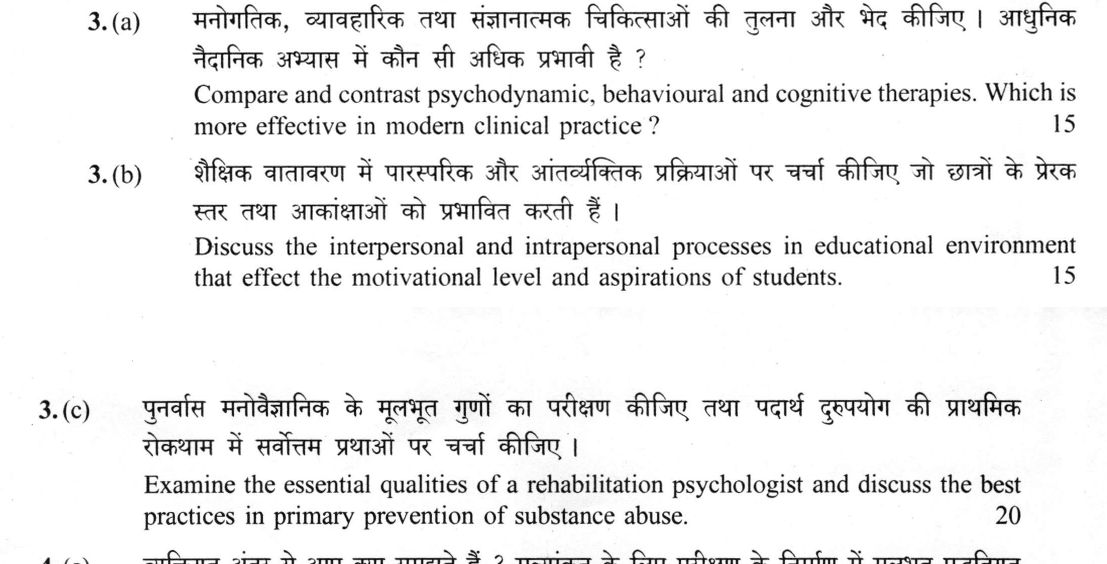
(a) Compare and contrast psychodynamic, behavioural and cognitive therapies. Which is more effective in modern clinical practice…
Compare and contrast psychodynamic, behavioural and cognitive therapies. Which is more effective in modern clinical practice ? 15 marks
Discuss the interpersonal and intrapersonal processes in educational environment that effect the motivational level and aspirations of students. 15 marks
Examine the essential qualities of a rehabilitation psychologist and discuss the best practices in primary prevention of substance abuse. 20 marks
हिंदी में प्रश्न पढ़ें
मनोगतिक, व्यावहारिक तथा संज्ञानात्मक चिकित्साओं की तुलना और भेद कीजिए । आधुनिक नैदानिक अभ्यास में कौन सी अधिक प्रभावी है ? (15 अंक)
शैक्षिक वातावरण में पारस्परिक और आंतर्व्यक्तिक प्रक्रियाओं पर चर्चा कीजिए जो छात्रों के प्रेरक स्तर तथा आकांक्षाओं को प्रभावित करती हैं । (15 अंक)
पुनर्वास मनोवैज्ञानिक के मूलभूत गुणों का परीक्षण कीजिए तथा पदार्थ दुरुपयोग की प्राथमिक रोकथाम में सर्वोत्तम प्रथाओं पर चर्चा कीजिए । (20 अंक)
Model answer
Drafted with AI by UPSC Answer Check against this question's marking rubric, to the expected length. UPSC does not publish answers for Mains — this is one way to score well, not an official key. How we build rubrics and answers.
(a) Psychodynamic, behavioural and cognitive therapies compared; which is more effective
The three major schools of psychotherapy differ fundamentally in their models of pathology, therapeutic goals, and techniques. Psychodynamic therapy posits that pathology stems from unconscious conflicts and early childhood experiences. Its primary goal is insight and personality change, achieved through techniques such as free association, interpretation, and the analysis of transference and resistance. In contrast, behavioural therapy views pathology as faulty learning. It aims for symptom removal using techniques like systematic desensitisation (Wolpe, 1958), exposure and response prevention (ERP), and token economies (Ayllon and Azrin, 1968). Cognitive therapy, meanwhile, identifies faulty cognition as the source of distress. It seeks cognitive restructuring through Beck’s cognitive triad, Ellis’s REBT (A-B-C model), and Meichenbaum’s stress inoculation training. The "third wave" of cognitive therapy further incorporates mindfulness and acceptance via MBCT, ACT, and DBT.
While the "Dodo bird verdict" (Rosenzweig, 1936; Luborsky et al., 1975) suggests that common factors like the therapeutic alliance drive efficacy across all modalities, modern clinical practice is guided by disorder-specific evidence. CBT is the established first-line treatment for depression and anxiety, while ERP remains the gold standard for OCD. However, psychodynamic therapy is not obsolete; Shedler (2010) has provided robust evidence for its efficacy. Consequently, modern practice is largely integrative and eclectic, often employing a stepped-care model where the most effective, evidence-based modality is selected for the specific clinical presentation.
(b) Interpersonal and intrapersonal processes shaping students’ motivation and aspiration
In the educational environment, student outcomes are shaped by two distinct levels of process: intrapersonal (internal) and interpersonal (relational). Intrapersonal processes include the learner’s self-efficacy (Bandura), attributional styles (Weiner), and mindset (Dweck). These internal appraisals directly influence the "level of aspiration"—a technical construct from Lewin, Dembo, Festinger, and Sears (1944)—where a student’s goal is set based on past performance and the goal-discrepancy score. Self-determination theory (Deci and Ryan, 1985) adds needs for autonomy, competence and relatedness, achievement-goal theory contrasts mastery with performance goals, and failure attributed to stable, uncontrollable causes breeds learned helplessness (Abramson, Seligman and Teasdale, 1978).
Interpersonal processes involve the social dynamics between the learner, teacher, and peers. The Pygmalion effect (Rosenthal and Jacobson, 1968) demonstrates how teacher expectancies become self-fulfilling prophecies, while cooperative learning structures like Jigsaw (Aronson, 1971) and STAD (Slavin) foster relatedness and competence. Conversely, stereotype threat (Steele and Aronson, 1995) and caste salience (Hoff and Pandey, 2006) can undermine motivation. Through reciprocal determinism, these interpersonal messages are internalised to shape the student’s motivational level.
To optimise these outcomes, educators should implement the TARGET structure (Epstein; Ames, 1992) (Task, Authority, Recognition, Grouping, Evaluation, Time) to create mastery-oriented climates. This includes using criterion-referenced and formative evaluation as envisaged in the NEP 2020, providing attribution retraining, and fostering a growth mindset. It is also essential to recognise that in deprived settings, low aspiration may be a rational response to structural constraints rather than a deficit of motivation.
(c) Qualities of a rehabilitation psychologist; primary prevention of substance abuse
A rehabilitation psychologist is a specialist who applies psychological principles to maximise the functioning, independence, and social participation of individuals with disabilities or chronic illnesses. This role is grounded in the ICF (WHO, 2001) biopsychosocial model, which shifts focus from impairment to activity and participation. Essential qualities include skill in functional and psychometric assessment (including disability certification), counselling for adjustment and family support, empathy without pity, cultural competence, advocacy, the ability to work within multidisciplinary teams, an understanding of community-based rehabilitation (CBR), and a commitment to the "value-change" model (Dembo, Leviton, and Wright). This involves helping clients overcome the "fundamental negative bias" (Beatrice Wright, 1983) by developing asset values and enlarging their scope of values. In India, this profession is regulated by the Rehabilitation Council of India (RCI, 1992) and operates under the RPwD Act, 2016.
Primary prevention of substance abuse aims to prevent the onset of use through universal, selective and indicated programmes (IOM, 1994) that reduce risk factors and strengthen protective ones (Hawkins and Catalano). Best practices include Botvin’s Life Skills Training, which builds social-influence resistance and psychological inoculation, and normative education to correct perceptions of peer use. Evidence-based programmes like the Strengthening Families Programme and the Good Behavior Game (Barrish et al.; Kellam) are highly effective. In India, this is supported by the COTPA, 2003, the NDPS Act, 1985, the National Action Plan for Drug Demand Reduction, the Nasha Mukt Bharat Abhiyaan (2020) and the toll-free de-addiction helpline 14446. It is critical to note that "scare tactics" and information-only programmes (like DARE) are ineffective. Effective prevention requires a combination of demand reduction, supply control, and community-based peer-led interventions.
How this answer will be evaluated
Evaluation rubric
Each sub-part is marked on its own, against the marks and word limit printed on the paper.
- (a) Two demands: a genuine three-way comparison and contrast of psychodynamic, behavioural and cognitive therapies on their model of pathology, goals, techniques and evidence; and an explicit, defended verdict on which is more effective in modern clinical practice. 15 marks
Must cover
- Free association, transference, resistance, interpretation, working through (psychodynamic)
- Wolpe - systematic desensitisation and reciprocal inhibition (1958); exposure and response prevention; token economy (Ayllon and Azrin, 1968)
- Beck - automatic thoughts, cognitive triad, schemas, collaborative empiricism; Ellis - REBT A-B-C; Meichenbaum - self-instructional/stress inoculation training
- Third wave: MBCT, ACT (Hayes), DBT (Linehan)
- Shedler (2010) - efficacy of psychodynamic psychotherapy
- Dodo bird verdict / common factors (Rosenzweig, 1936; Luborsky; Wampold)
- CBT as first-line for depression and anxiety; ERP for OCD
- Integrative/eclectic and stepped-care practice
Loses marks
- Describing the three therapies serially with no explicit comparison on shared dimensions
- Ducking the second question or answering it with 'all are equally effective' without engaging the Dodo bird debate and the disorder-specific evidence
- Confusing systematic desensitisation with flooding, or attributing REBT's A-B-C model to Beck and the cognitive triad to Ellis
- Treating behaviour therapy as obsolete when exposure remains the treatment of choice for phobias and OCD
- Omitting the third wave (MBCT, ACT, DBT) and so presenting cognitive therapy as frozen in 1976
- Claiming psychodynamic therapy has no evidence base, ignoring Shedler (2010) and the brief dynamic therapies
Earns more
- Explicit comparison across dimensions: locus of pathology (unconscious conflict vs faulty learning vs faulty cognition); unit of analysis (past vs present contingencies vs present appraisals); goal (insight and personality change vs symptom removal vs cognitive restructuring); therapist stance (neutral interpreter vs trainer/technician vs collaborative empirical partner); duration (long and open-ended vs short vs short and time-limited); structure and homework (little vs high vs high); measurability and manualisation (low vs high vs high); common ground - all rely on a therapeutic alliance, all are now available in brief and manualised forms, and behavioural and cognitive methods are used together in practice
- (b) Requires the classroom to be analysed at two levels - intrapersonal processes inside the learner and interpersonal processes between learner, teacher and peers - and both to be tied explicitly to two outcomes: motivational level and level of aspiration. 15 marks
Must cover
- Level of aspiration (Lewin, Dembo, Festinger and Sears, 1944)
- Bandura - self-efficacy and its four sources; reciprocal determinism
- Weiner - attribution theory (locus, stability, controllability)
- Learned helplessness (Seligman; Abramson, Seligman and Teasdale, 1978); Dweck - mindset and mastery vs helpless orientation
- Achievement goal theory (mastery/performance-approach/performance-avoidance)
- Deci and Ryan - self-determination theory (autonomy, competence, relatedness)
- Expectancy-value theory; McClelland's n-Ach
- Rosenthal and Jacobson (1968) - Pygmalion effect / self-fulfilling prophecy
- Cooperative learning: Jigsaw (Aronson, 1971), STAD (Slavin)
- Stereotype threat (Steele and Aronson, 1995); Hoff and Pandey (2006) caste salience study in India
- Vygotsky - zone of proximal development and scaffolding
Loses marks
- Not distinguishing interpersonal from intrapersonal, so the answer becomes an undifferentiated list of 'factors affecting motivation'
- Using 'level of aspiration' loosely instead of as Lewin's technical construct with its goal-discrepancy logic
- Naming theories without linking them to motivation or aspiration - e.g. describing self-efficacy but never saying it governs choice, effort and persistence
- Omitting the teacher expectancy/Pygmalion literature, the single most classroom-specific interpersonal process
- Treating extrinsic rewards as simply good, ignoring the undermining effect predicted by self-determination theory
- Offering no educational implications, leaving the analysis without application
Earns more
- Defines the two levels and the outcomes precisely: intrapersonal processes are the learner's beliefs, appraisals and self-regulatory activity; interpersonal processes are the expectancies, feedback, comparisons and relationships operating between the learner and teachers, peers and family; 'level of aspiration' is a technical term from Lewin, Dembo, Festinger and Sears (1944) - the goal a person sets on a task in the light of past performance, raised by success and lowered by failure, and mediated by the goal-discrepancy score
- Interaction and educational implications: Bandura's reciprocal determinism explains how repeated interpersonal messages are internalised as efficacy beliefs and aspirations; practical measures include attribution retraining, growth-mindset interventions, mastery-oriented climates using the TARGET structure (task, authority, recognition, grouping, evaluation, time), criterion-referenced and formative rather than comparative evaluation as envisaged in NEP 2020, cooperative rather than normative grading, realistic goal-setting with proximal sub-goals, identity-safe classrooms to defuse stereotype threat, and counselling that aligns aspiration with ability without lowering it; note that in deprived Indian settings low aspiration is often a rational response to structural constraint rather than a deficit of motivation
- (c) Two distinct halves of roughly equal weight: 'examine' the essential professional and personal qualities of a rehabilitation psychologist, and 'discuss' evidence-based best practices in the primary prevention - i.e. prevention of onset - of substance abuse. Both must be answered. 20 marks
Must cover
- ICF (WHO, 2001) biopsychosocial model of disability; Rehabilitation Council of India Act, 1992; RPwD Act, 2016
- Beatrice Wright (1983) - fundamental negative bias, insider-outsider distinction; Dembo, Leviton and Wright value-change (asset values, subordination of physique, containment of disability effects, enlargement of scope of values)
- Multidisciplinary teamwork; community-based rehabilitation
- Primary prevention vs secondary/tertiary; universal, selective, indicated (Gordon/IOM)
- Botvin's Life Skills Training; social-influence resistance and psychological inoculation; normative education
- Strengthening Families Programme; Good Behavior Game; Hawkins and Catalano risk/protective factor framework
- COTPA, 2003; NDPS Act, 1985
- Nasha Mukt Bharat Abhiyaan; NAPDDR; IRCAs; helpline 14446; NCERT-MoSJE Navchetna modules
- Ineffectiveness of scare tactics and information-only/DARE-type programmes
Loses marks
- Listing generic virtues ('patience, kindness, hard work') instead of examining role-specific competencies such as functional assessment, disability certification and multidisciplinary teamwork
- Confusing rehabilitation psychology with clinical psychology or with physiotherapy, and ignoring the ICF/participation framework
- Writing about de-addiction, detoxification and relapse prevention under 'primary prevention' - these are secondary and tertiary measures
- Recommending scare tactics, one-off awareness lectures or drug-testing drives as best practice, when evaluations show these are ineffective or counterproductive
- Naming no evidence-based programme (Life Skills Training, Strengthening Families, normative education) and no Indian scheme
- Answering only one of the two halves of the question
Earns more
- Frames the role: rehabilitation psychology applies psychological knowledge to maximise the functioning, independence and social participation of persons with disability, chronic illness or injury, working within WHO's International Classification of Functioning, Disability and Health (ICF, 2001), which shifts the focus from impairment to activity limitation, participation restriction and environmental barriers; in India the profession is regulated by the Rehabilitation Council of India under the RCI Act, 1992 (registration and CRR number), and operates under the Rights of Persons with Disabilities Act, 2016 and the National Trust Act, 1999, often through community-based rehabilitation
- Environmental, policy and Indian programmatic practice: demand reduction must be paired with supply and availability control - taxation and pricing, minimum legal age, restriction of outlets and hours, and the advertising ban, prohibition of sale to minors and smoke-free public places under the Cigarettes and Other Tobacco Products Act (COTPA), 2003, alongside the Narcotic Drugs and Psychotropic Substances Act, 1985; Indian programmes include the National Action Plan for Drug Demand Reduction (NAPDDR), the Nasha Mukt Bharat Abhiyaan launched in 2020 in the most substance-affected districts, Community Based Peer Led Interventions for children, Outreach and Drop-In Centres and Integrated Rehabilitation Centres for Addicts run with NGOs, the national toll-free de-addiction helpline (14446), and the NCERT-Ministry of Social Justice and Empowerment 'Navchetna' life-skills modules for schools; the scale of the problem is documented in the Magnitude of Substance Use in India survey (AIIMS-NDDTC for MoSJE, 2019), which found alcohol the commonest psychoactive substance at roughly 14.6% current use among those aged 10-75 and opioid use around 2%
- What does not work, and the evaluation requirement: fear arousal and scare tactics, graphic 'horror' films, information-only lectures and one-off awareness days produce little or no behaviour change and can arouse curiosity; unstructured testimonials by ex-users and peer-group counselling of high-risk youth together can produce iatrogenic deviancy training; the widely imitated DARE-type police-led didactic model performed poorly in controlled evaluations; hence programmes need baseline and follow-up outcome measurement of actual initiation rates, fidelity monitoring, and integration with early screening and brief intervention rather than standalone campaigns
What "Compare and contrast" is asking you to do
Both halves, visibly separated, usually because the two are routinely conflated: similarities across the stated dimensions, then differences across those same dimensions. The longer form is an instruction that the differences must not be folded into the similarities.
Structure that answers it
Dimensions fixed → similarities across them → differences across them → why the pair gets confused and what in fact separates it
Where marks are lost
One half done in a page and the other in three lines. Marks are allotted to each half separately, so the weaker half is lost however strong the other is.
Practice this exact question
Write your answer and it is marked point by point against the model answer above — what you covered, what you missed, what you got wrong.
Evaluate my answer →More from Psychology 2026 Paper II
- Q1 (a) How do psychologists explain the causes of anxiety disorder ? (10 marks) (b) What is…
- Q2 (a) Compare and contrast Norm referenced vs criterion referenced measurement. (15 marks)…
- Q3 (a) Compare and contrast psychodynamic, behavioural and cognitive therapies. Which is mor…
- Q4 (a) What do you understand by Individual Differences ? Comment on the major methodologica…
- Q5 Answer the following questions in about 150 words each : (a) Suggest measures to overcome…
- Q6 (a) What are the consequences of facing deprivation in early childhood ? (15 marks) (b) D…