Paper II — Q6
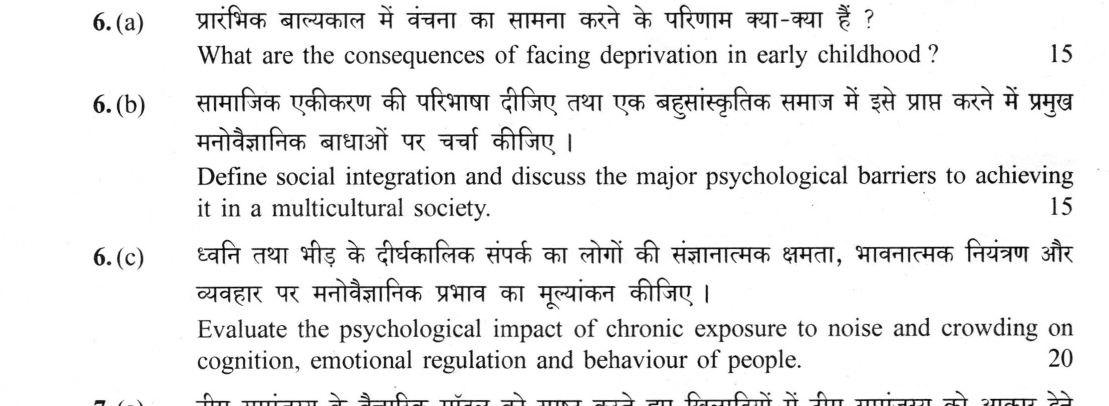
(a) What are the consequences of facing deprivation in early childhood ? (15 marks) (b) Define social integration and discuss…
What are the consequences of facing deprivation in early childhood ? 15 marks
Define social integration and discuss the major psychological barriers to achieving it in a multicultural society. 15 marks
Evaluate the psychological impact of chronic exposure to noise and crowding on cognition, emotional regulation and behaviour of people. 20 marks
हिंदी में प्रश्न पढ़ें
प्रारंभिक बाल्यकाल में वंचना का सामना करने के परिणाम क्या-क्या हैं ? (15 अंक)
सामाजिक एकीकरण की परिभाषा दीजिए तथा एक बहुसांस्कृतिक समाज में इसे प्राप्त करने में प्रमुख मनोवैज्ञानिक बाधाओं पर चर्चा कीजिए । (15 अंक)
ध्वनि तथा भीड़ के दीर्घकालिक संपर्क का लोगों की संज्ञानात्मक क्षमता, भावनात्मक नियंत्रण और व्यवहार पर मनोवैज्ञानिक प्रभाव का मूल्यांकन कीजिए । (20 अंक)
Model answer
Drafted with AI by UPSC Answer Check against this question's marking rubric, to the expected length. UPSC does not publish answers for Mains — this is one way to score well, not an official key. How we build rubrics and answers.
(a) Consequences of early-childhood deprivation (15 marks)
Deprivation means the lack of the stimulation, care and attachment that development needs; early childhood is a sensitive period, so its effects are large and often lasting.
Attachment and emotion: Bowlby's maternal-deprivation thesis and Spitz's work on hospitalism (anaclitic depression in infants in institutions) showed withdrawal, apathy and failure to thrive. Harlow's monkeys reared with cloth and wire surrogates showed that contact comfort, not feeding, builds attachment; isolated monkeys were fearful, aggressive and later poor parents. Institution-reared children show insecure or disorganised attachment, reactive attachment disorder and disinhibited social engagement, difficulty regulating emotion, and later higher rates of anxiety and depression.
Cognition and language: the Romanian orphan studies (the English and Romanian Adoptees study led by Rutter, and the Bucharest Early Intervention Project of Zeanah, Nelson and Fox) found lower IQ, delayed language and executive-function deficits, greatest after over six months to two years of institutional care; children moved early to good foster homes recovered most. Genie's case shows the difficulty of learning language after a long critical-period deprivation. Neural evidence shows reduced brain activity and volume and altered stress (HPA) regulation.
Social and behavioural: peer difficulty, hyperactivity, conduct problems and quasi-autistic patterns. Not every child is affected equally: Skeels and Dye's orphanage study showed that stimulation raised IQ, so resilience, early intervention, foster care and enrichment such as ICDS pre-school activity can reverse much of the damage.
(b) Social integration and its psychological barriers in a multicultural society (15 marks)
Social integration is the process by which individuals and groups from different cultural backgrounds participate fully and equally in the shared life of a society, while keeping their own identity. In Berry's acculturation model, integration means both maintaining one's heritage culture and engaging with the wider society; it differs from assimilation (giving up the heritage culture), separation (avoiding the wider society) and marginalisation (losing both).
Major psychological barriers:
- Stereotypes and prejudice: categorisation and ingroup favouritism (Tajfel's minimal-group studies) produce bias, and the ultimate attribution error explains outgroup failure as dispositional.
- Perceived threat: Stephan's integrated threat theory identifies realistic threat (jobs, safety), symbolic threat (values), intergroup anxiety and negative stereotypes as obstacles.
- Ethnocentrism and social dominance orientation, which justify hierarchy and reduce willingness to share resources.
- Social identity threat and acculturative stress in minority members, with stereotype threat and discrimination reducing trust and participation.
- Language and communication differences, and limited contact; segregated neighbourhoods and schools deny the conditions of Allport's contact hypothesis.
- Majority demand for assimilation, or its opposite, isolating multiculturalism.
Overcoming them needs equal-status contact, superordinate goals, a common ingroup identity that preserves subgroup identity, multicultural education and inclusive institutions. Constitutional guarantees of equality and cultural rights in India, in Articles 14, 15, 25 and 29-30, give the framework.
(c) Impact of chronic exposure to noise and crowding (20 marks)
Noise is unwanted sound; crowding is the subjective experience of too little space, distinct from density (Stokols). Chronic exposure matters because acute stressors are usually tolerated but continuous ones exhaust coping resources, and adaptation carries costs.
Cognition: children in flight-path schools near Los Angeles airport (Cohen) and in classrooms facing an elevated train in New York (Bronzaft and McCarthy) had poorer reading and attention; the Munich airport study (Hygge and colleagues) showed a fall in reading and long-term memory when the airport opened near a school and recovery when the old one closed. Noise impairs complex, attention-demanding tasks and speech perception. Crowding impairs complex task performance and increases cognitive fatigue.
Emotional regulation: noise raises arousal, stress hormones, blood pressure and irritability, and disturbs sleep. Glass and Singer showed that unpredictable, uncontrollable noise produces after-effects, lower frustration tolerance and learned helplessness, that predictability and perceived control reduce. Baum and Valins found that students in long-corridor, crowded dorms showed social withdrawal and helplessness. Calhoun's rat "behavioural sink" is suggestive but cannot be generalised to people.
Behaviour: noise lowers helping (Mathews and Canon) and can increase aggression in already angered people (Donnerstein and Wilson); crowding leads to withdrawal, poorer social relations, conflict and, in prisons, illness and violence (Paulus).
Evaluation: findings come mostly from correlational field work confounded with poverty and housing, and lab work with short exposures; effects are moderated by control, predictability, personality and culture (tolerance of density differs); and adaptation may hide costs. Remedies include acoustic design, planning and giving residents control; WHO guidelines recommend road-traffic noise below about 53 dB (Lden).
How this answer will be evaluated
Evaluation rubric
Each sub-part is marked on its own, against the marks and word limit printed on the paper.
- (a) Consequences of deprivation in early childhood (15). 15 marks
Must cover
- Sensitive period; attachment and emotional consequences (Bowlby, Spitz, Harlow)
- Cognitive and language consequences with evidence (Romanian orphan studies; Genie)
- Social and behavioural effects (peer problems, conduct, emotional regulation)
- Moderators and recovery: age at intervention, foster care, enrichment (Skeels and Dye)
Loses marks
- Confusing deprivation with abuse or poverty alone.
- Studies named without their findings.
- No mention of recovery or resilience.
Earns more
- Reactive attachment disorder or disinhibited engagement named.
- Neural or stress-system evidence.
Extra mark
- Indian programme link such as ICDS
- (b) Define social integration and discuss the major psychological barriers to it in a multicultural society (15). 15 marks
Must cover
- Definition of social integration (equal participation with identity retained)
- Distinction from assimilation, separation and marginalisation (Berry)
- Barriers: stereotypes and prejudice, perceived threat, ethnocentrism, social identity threat
- Ways forward: contact hypothesis, superordinate identity, multicultural education
Loses marks
- Confusing integration with assimilation.
- Only sociological or political barriers, no psychology.
- A biased or communal tone.
Earns more
- Integrated threat theory or minimal-group studies named.
- Acculturative stress and language barriers.
Extra mark
- Indian constitutional link (Articles 14, 15, 25, 29-30)
- (c) Evaluate the psychological impact of chronic exposure to noise and crowding on cognition, emotional regulation and behaviour (20). 20 marks
Must cover
- Definitions: noise, crowding versus density; why chronic exposure matters
- Cognition: reading, memory, attention with named studies (Cohen, Bronzaft, Hygge)
- Emotional regulation: arousal, stress, learned helplessness, control and predictability (Glass and Singer)
- Behaviour: helping, aggression, withdrawal, crowding studies (Baum and Valins; Paulus)
- Evaluation: correlational limits, moderators, adaptation costs
Loses marks
- Description without any evaluation.
- Treating noise and crowding as identical.
- Applying rat results directly to humans.
Earns more
- Both noise and crowding covered under all three heads.
- WHO noise guideline or design remedies.
Extra mark
- Cultural differences in density tolerance
What "Explain" is asking you to do
Make the working of something clear — what sets it off, what follows from what, and what it produces. Explain is the Commission's mechanism word: it dominates the technical papers and the “explain why” stems, where the marks sit in the causal chain and not in the label.
Structure that answers it
State what it is → the initiating condition → the chain of cause, step by step → an instance where it plays out → what the chain produces
Where marks are lost
Describing what something looks like instead of why it works that way. Naming the stages without linking them reads as description too.
Practice this exact question
Write your answer and it is marked point by point against the model answer above — what you covered, what you missed, what you got wrong.
Evaluate my answer →More from Psychology 2026 Paper II
- Q3 (a) Compare and contrast psychodynamic, behavioural and cognitive therapies. Which is mor…
- Q4 (a) What do you understand by Individual Differences ? Comment on the major methodologica…
- Q5 Answer the following questions in about 150 words each : (a) Suggest measures to overcome…
- Q6 (a) What are the consequences of facing deprivation in early childhood ? (15 marks) (b) D…
- Q7 (a) Clarifying the conceptual model of team cohesion, enumerate the antecedent factors th…
- Q8 (a) Analyse the impact of gender based psychological construct, ‘Glass ceiling’, on women…