Paper I — Q1
Answer the following in about 150 words each: (a) Public administration horizons have been expanding to cater to the complex…
Answer the following in about 150 words each:
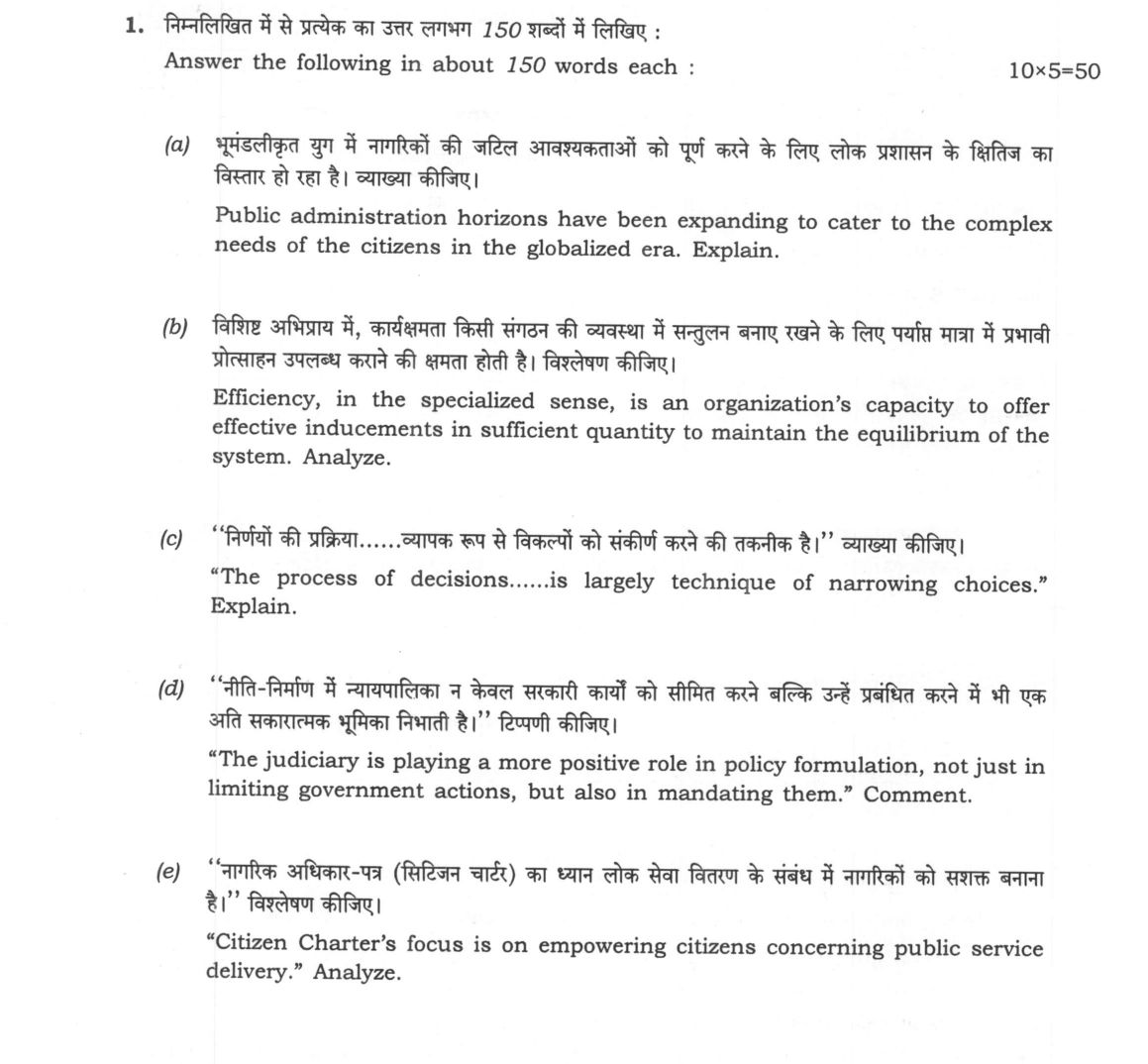
Public administration horizons have been expanding to cater to the complex needs of the citizens in the globalized era. Explain. 10 marks
Efficiency, in the specialized sense, is an organization's capacity to offer effective inducements in sufficient quantity to maintain the equilibrium of the system. Analyze. 10 marks
"The process of decisions......is largely technique of narrowing choices." Explain. 10 marks
"The judiciary is playing a more positive role in policy formulation, not just in limiting government actions, but also in mandating them." Comment. 10 marks
"Citizen Charter's focus is on empowering citizens concerning public service delivery." Analyze. 10 marks
हिंदी में प्रश्न पढ़ें
निम्नलिखित में से प्रत्येक का उत्तर लगभग 150 शब्दों में लिखिए :
भूमण्डलीकृत युग में नागरिकों की जटिल आवश्यकताओं को पूर्ण करने के लिए लोक प्रशासन के क्षितिज का विस्तार हो रहा है। व्याख्या कीजिए। (10 अंक)
विशिष्ट अभिप्राय में, कार्यक्षमता किसी संगठन की व्यवस्था में संतुलन बनाए रखने के लिए पर्याप्त मात्रा में प्रभावी प्रोत्साहन उपलब्ध कराने की क्षमता होती है। विश्लेषण कीजिए। (10 अंक)
"निर्णयों की प्रक्रिया......व्यापक रूप से विकल्पों को संकीर्ण करने की तकनीक है।" व्याख्या कीजिए। (10 अंक)
"नीति-निर्माण में न्यायपालिका न केवल सरकारी कार्यों को सीमित करने बल्कि उन्हें प्रबंधित करने में भी एक अति सकारात्मक भूमिका निभाती है।" टिप्पणी कीजिए। (10 अंक)
"नागरिक अधिकार-पत्र (सिटिजन चार्टर) का ध्यान लोक सेवा वितरण के संबंध में नागरिकों को सशक्त बनाना है।" विश्लेषण कीजिए। (10 अंक)
Model answer
Written by UPSC Answer Check against this question's marking rubric, to the 150-word length. UPSC does not publish answers for Mains — this is one way to score well, not an official key.
(a) The horizon of public administration has transcended the classical POSDCORB paradigm and Weberian bureaucratic insularity, evolving into New Public Governance to manage complex, interconnected challenges in a globalized era. Globalization has restructured the relationship between the state, market, and civil society, requiring administrative machinery to address wicked problems such as climate change adaptation, Sustainable Development Goals (SDGs), and cross-border public health crises. Driven by the New Public Management and subsequent digital governance doctrines, the administrative focus has shifted from procedural compliance to performance, equity, and citizen-centricity. In India, this transition is visible through integrated digital infrastructure such as the UMANG platform, Aadhaar-enabled Direct Benefit Transfers, and the Open Network for Digital Commerce (ONDC). These platforms convert bureaucratic silos into agile, collaborative ecosystems, ensuring that public administration proactively responds to the fast-evolving expectations and socioeconomic entitlements of an empowered, interconnected citizenry.
(b) Chester Barnard redefined efficiency in The Functions of the Executive, distinguishing it sharply from the classical engineering view of technical efficiency, which merely measures input-output ratios. For Barnard, organizational efficiency represents the capacity of an enterprise to offer effective inducements—material, social, and psychological—in sufficient measure to elicit the willing contributions of its participants. An organization survives only as long as it maintains a dynamic contribution-inducement equilibrium; individuals contribute their efforts only when perceived utilities exceed the personal sacrifices demanded. If an organization generates high technical output but fails to satisfy the personal motives of its members, the inducement-contribution balance collapses, leading to alienation, attrition, or dissolution. Therefore, specialized efficiency is fundamentally human and sociological, serving as the vital mechanism that sustains internal cooperation, aligns individual needs with collective objectives, and secures long-term institutional survival in a volatile environment.
(c) Herbert Simon argued that administrative decision-making is fundamentally a process of systematically narrowing the vast universe of theoretical possibilities down to a single actionable alternative. Classical economics assumes an omniscient "economic man" capable of optimizing outcomes by evaluating all possible alternatives and consequences. Simon refuted this through the concept of bounded rationality, demonstrating that human cognitive capacities, incomplete information, and temporal limitations prevent comprehensive optimization. Consequently, the "administrative man" relies on a satisficing strategy. The decision-making process narrows choices by applying organizational values, specialized standard operating procedures (SOPs), and sequential search heuristics. By filtering out non-feasible and sub-optimal options through incremental appraisals, the administrator progressively eliminates alternatives. Thus, decision-making becomes an exercise in narrowing choices down to an alternative that satisfies the minimum criteria of adequacy rather than exhaustively pursuing an elusive perfection.
(d) The Indian judiciary has progressively evolved from serving solely as a negative check on executive overreach to acting as a proactive formulator of public policy. Through Public Interest Litigation (PIL), relaxed locus standi, and epistolary jurisdiction, the higher courts routinely bridge legislative vacuums and administrative paralysis. Utilizing tools such as structural injunctions and the doctrine of continuing mandamus, the judiciary not only strikes down unlawful actions but also issues affirmative mandates that actively structure administrative policy. Exemplars include the Vishaka guidelines framing workplace safety policies, the PUCL (Right to Food) case institutionalizing the Mid-Day Meal Scheme, and the T.N. Godavarman orders establishing environmental governance frameworks like the CAMPA fund. While critics highlight the risk of judicial overreach and institutional friction, judicial policy mandates remain a crucial constitutional corrective to bureaucratic inertia, ensuring the progressive realization of socioeconomic fundamental rights under Article 21.
(e) The Citizen’s Charter initiative, launched in India by the Department of Administrative Reforms and Public Grievances (DARPG) in 1997, marks a paradigm shift in public delivery by transforming citizens from passive recipients of state largesse into sovereign claimants of standardized public services. Grounded in the principles of quality, transparency, choice, and accountability, the charter acts as a social contract detailing service commitments, precise timeframes, and formal grievance redressal mechanisms. This framework has evolved into institutional innovations like the Sevottam Model and state-level Right to Public Services (RTPS) Acts, which attach statutory penal liabilities to bureaucratic delays. However, the charter’s operational efficacy has often been undermined by generic phrasing, lack of legal enforceability, and low citizen awareness. To achieve substantive citizen empowerment, administrations must move toward dynamically updated, legally enforceable digital charters integrated directly with automated grievance escalation systems.
What "Explain" is asking you to do
Make the working of something clear — what sets it off, what follows from what, and what it produces. Explain is the Commission's mechanism word: it dominates the technical papers and the “explain why” stems, where the marks sit in the causal chain and not in the label.
Structure that answers it
State what it is → the initiating condition → the chain of cause, step by step → an instance where it plays out → what the chain produces
Where marks are lost
Describing what something looks like instead of why it works that way. Naming the stages without linking them reads as description too.
How this answer will be evaluated
Approach
Framework: Concept > Thinker > Indian institutional application > Reform. (a) explain: definition/context > points in order > small example > short close | (b) analyse: intro > causes > effects > stakeholders/linkages > way forward | (c) explain: definition/context > points in order > small example > short close | (d) comment: context > arguments both sides > judgment > close | (e) analyse: intro > causes > effects > stakeholders/linkages > way forward Full marks: All 4 musts + 2+ credits + 1 bonus per part, precise Indian anchors
Key points expected
- Define 'expanding horizons' in public administration
- Identify 2-3 complex needs of globalized era
- Link expansion to specific administrative functions
- Provide one Indian administrative instance
- Define 'efficiency' in specialized sense
- Explain 'effective inducements' concept
- Analyze 'sufficient quantity' requirement
- Connect to 'system equilibrium' maintenance
Evaluation rubric
Each sub-part is marked on its own, against the marks and word limit printed on the paper.
- (a) Definition of expanding horizons > points in order > small example > short close · 150 words
explain— definition/context → points in order → small example → short close
Must cover
- Define 'expanding horizons' in public administration
- Identify 2-3 complex needs of globalized era
- Link expansion to specific administrative functions
- Provide one Indian administrative instance
Loses marks
- Theory without Indian anchor
- GS-2 style policy answer
- Vague generalities without specific examples
Earns more
- Mention New Public Management (NPM)
- Reference e-governance or digital India
- Discuss citizen-centric approach
- Mention global governance challenges
Extra mark
- Cite 2nd ARC recommendation on governance
- Reference specific recent governance reform
- (b) Intro > causes > effects > stakeholders/linkages > way forward · 150 words
analyse— intro → causes → effects → stakeholders/linkages → way forward
Must cover
- Define 'efficiency' in specialized sense
- Explain 'effective inducements' concept
- Analyze 'sufficient quantity' requirement
- Connect to 'system equilibrium' maintenance
Loses marks
- Confusing efficiency with effectiveness
- No link to system equilibrium
- Theory without Indian anchor
Earns more
- Reference Simon's bounded rationality
- Mention organizational behavior theory
- Discuss resource allocation mechanisms
- Reference Indian administrative context
Extra mark
- Cite specific committee on efficiency
- Reference 2nd ARC on organizational efficiency
- (c) Definition/context > points in order > small example > short close · 150 words
explain— definition/context → points in order → small example → short close
Must cover
- Define 'narrowing choices' in decision process
- Explain how choices are narrowed
- Identify factors in narrowing process
- Provide one decision-making example
Loses marks
- No reference to Simon or rationality
- Vague without specific narrowing mechanism
- Theory without Indian anchor
Earns more
- Reference Herbert Simon's work
- Mention bounded rationality
- Discuss satisficing vs optimizing
- Reference Indian policy decision example
Extra mark
- Cite specific decision-making case
- Reference 2nd ARC on decision processes
- (d) Context > arguments both sides > judgment > close · 150 words
comment— context → arguments both sides → judgment → close
Must cover
- Explain judiciary's role in policy formulation
- Discuss 'limiting government actions' aspect
- Analyze 'mandating government actions' aspect
- Provide balanced judgment on positive role
Loses marks
- One-sided argument without balance
- No specific judgment or example
- GS-2 style without administrative focus
Earns more
- Reference specific landmark judgments
- Mention judicial activism examples
- Discuss public interest litigation (PIL)
- Reference Indian constitutional provisions
Extra mark
- Cite specific Supreme Court judgment
- Reference 2nd ARC on judicial role
- (e) Intro > causes > effects > stakeholders/linkages > way forward · 150 words
analyse— intro → causes → effects → stakeholders/linkages → way forward
Must cover
- Define Citizen Charter concept
- Explain 'empowering citizens' mechanism
- Analyze 'public service delivery' focus
- Assess effectiveness of empowerment
Loses marks
- No specific Charter example
- Vague without empowerment mechanism
- Theory without Indian anchor
Earns more
- Reference specific Citizen Charter examples
- Mention service delivery standards
- Discuss citizen feedback mechanisms
- Reference Indian administrative context
Extra mark
- Cite specific department's Citizen Charter
- Reference 2nd ARC on service delivery
Practice this exact question
Write your answer and it is marked point by point against the model answer above — what you covered, what you missed, what you got wrong.
Evaluate my answer →More from Public Administration 2023 Paper I
- Q1 Answer the following in about 150 words each: (a) Public administration horizons have bee…
- Q2 (a) Follett firmly advocated for cultivating interdependence and collaboration among indi…
- Q3 (a) "Organization theory is not a single theory with a loosely knit of many approaches to…
- Q4 (a) "Reddin model of leadership added third dimension to the existing two basic dimension…