Paper I — Q4
(a) "Reddin model of leadership added third dimension to the existing two basic dimensions of leadership identified by Ohio…
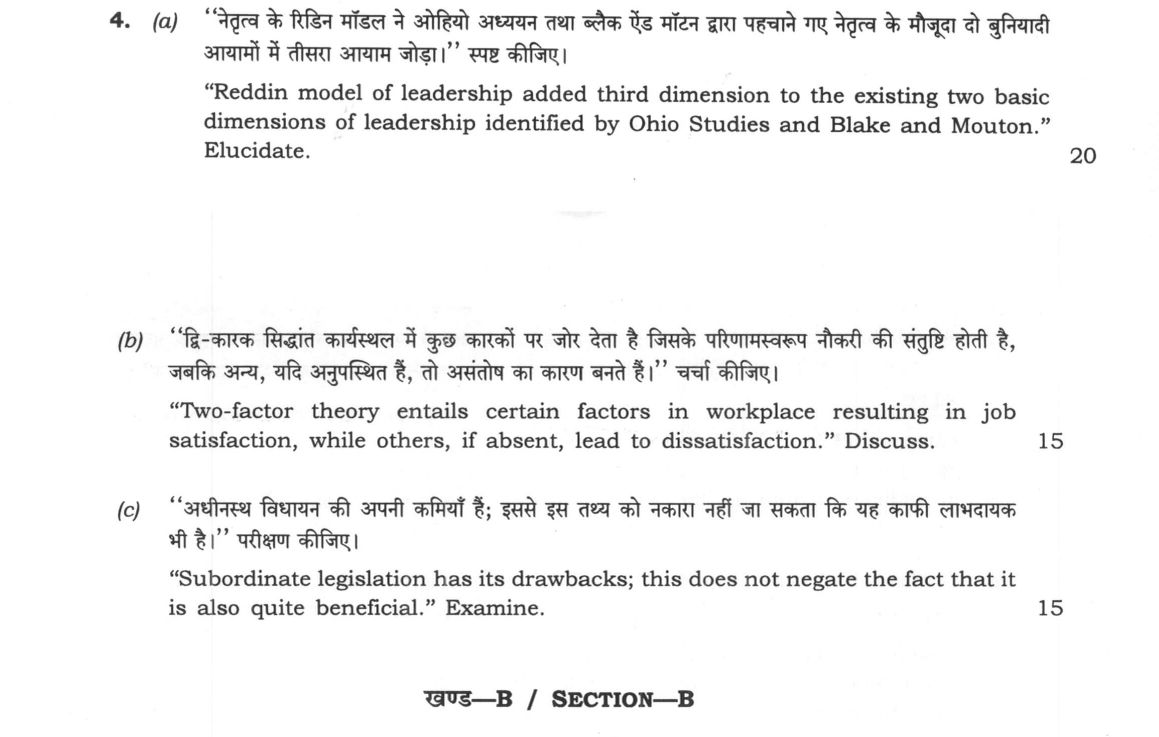
"Reddin model of leadership added third dimension to the existing two basic dimensions of leadership identified by Ohio Studies and Blake and Mouton." Elucidate. 20 marks
"Two-factor theory entails certain factors in workplace resulting in job satisfaction, while others, if absent, lead to dissatisfaction." Discuss. 15 marks
"Subordinate legislation has its drawbacks; this does not negate the fact that it is also quite beneficial." Examine. 15 marks
हिंदी में प्रश्न पढ़ें
"नेतृत्व के रेड्डिन मॉडल ने ओहियो अध्ययन तथा ब्लेक एंड मॉटन द्वारा पहचाने गए नेतृत्व के मौजूदा दो बुनियादी आयामों में तीसरा आयाम जोड़ा।" स्पष्ट कीजिए। (20 अंक)
"द्वि-कारक सिद्धांत कार्यस्थल में कुछ कारकों पर जोर देता है जिसके परिणामस्वरूप नौकरी की संतुष्टि होती है, जबकि अन्य, यदि अनुपस्थित हैं, तो असंतोष का कारण बनते हैं।" चर्चा कीजिए। (15 अंक)
"अधीनस्थ विधायन की अपनी कमियाँ हैं; इससे इस तथ्य को नकारा नहीं जा सकता कि यह काफी लाभदायक भी है।" परीक्षण कीजिए। (15 अंक)
Model answer
Written by UPSC Answer Check against this question's marking rubric, to the expected length. UPSC does not publish answers for Mains — this is one way to score well, not an official key.
Reddin’s 3-D Leadership Model: Integrating Effectiveness
Early behavioral leadership theories, notably the Ohio State Studies and Blake and Mouton’s Managerial Grid, conceptualized leadership along two primary axes: task orientation (Initiating Structure / Concern for Production) and relationship orientation (Consideration / Concern for People). While Blake and Mouton posited the (9,9) "Team Management" style as universally ideal, William J. Reddin recognized that no single style guarantees success across varied administrative environments. Reddin introduced a crucial third dimension: Effectiveness, defined as the degree to which a leader adapts their style to the situational demands to achieve objectives.
By superimposing effectiveness onto the four basic quadrants—Integrated, Dedicated, Related, and Separated—Reddin generated eight distinct operational styles. In effective manifestations:
- An Integrated manager becomes an Executive (high task, high relationship, adaptive motivator).
- A Dedicated manager becomes an Autocrat with benevolence or Benevolent Autocrat (high task, low relationship, decisive).
- A Related manager acts as a Developer (low task, high relationship, building human capacity).
- A Separated manager acts as a Bureaucrat (low task, low relationship, adhering conscientiously to rules and procedures).
Conversely, when mismatched with the situation, these same styles become ineffective: Compromiser, Autocrat, Missionary, and Deserter respectively. Reddin thus moved organizational theory from a normative, static grid to a dynamic, contingency-based framework. In Indian public administration, this model underpins executive leadership pedagogy at institutions like the Lal Bahadur Shastri National Academy of Administration (LBSNAA), training civil servants to transition flexibly from rule-bound "Bureaucrats" in regulatory tasks to "Developers" or "Executives" in participatory rural development.
Herzberg’s Two-Factor Theory: Dynamics of Workplace Motivation
Frederick Herzberg’s Motivation-Hygiene Theory posits that job satisfaction and dissatisfaction are not opposite ends of a single continuum, but separate, independent dimensions governed by distinct factors.
Hygiene (extrinsic) factors—such as organizational policy, working conditions, salary, job security, and supervision—do not motivate individuals toward higher performance. Instead, their presence merely prevents dissatisfaction, operating on a continuum from dissatisfaction to no dissatisfaction. In contrast, Motivator (intrinsic) factors—including achievement, recognition, challenging work itself, responsibility, and opportunities for growth—actively generate psychological fulfillment, operating from no satisfaction to satisfaction.
This distinction holds deep relevance for Indian governance and civil service reforms. The debates surrounding the 7th Central Pay Commission (7th CPC) highlighted that while pay hikes and standardized allowances address hygiene needs (preventing brain drain and disaffection), they do not automatically induce bureaucratic dynamism. True performance enhancement in public systems requires intrinsic motivators: introducing domain-based postings, mission-mode autonomy like Mission Karmayogi, and institutional recognition for administrative innovation.
Subordinate Legislation: Balances, Drawbacks, and Administrative Utility
Subordinate (or delegated) legislation refers to the rule-making power conferred by the legislature upon the executive. While an indispensable tool of modern welfare governance, it embodies an inherent constitutional tension between administrative efficacy and democratic accountability.
Its benefits are profound. Modern governance demands rapid technical expertise and procedural flexibility that generalist legislatures lack. Delegated legislation conserves parliamentary time, allowing apex bodies to focus on broad policy principles while administrators frame technical rules. Crucially, it provides vital agility during crises, as demonstrated by administrative notifications issued under the Epidemic Diseases Act, 1897, and the Disaster Management Act, 2005, during the COVID-19 pandemic, as well as executive rule-making under Article 357 during President’s Rule.
However, its drawbacks present serious challenges. Unchecked delegation leads to a "democratic deficit," bypassing rigorous parliamentary scrutiny and public debate. Vague parent statutes risk executive overreach, bureaucratic opacity, and sub-delegation that compromises individual liberties and the rule of law.
To reconcile administrative necessity with constitutionalism, robust institutional safeguards are essential. Committees on Subordinate Legislation in both Houses of Parliament must rigorously scrutinize statutory instruments against excessive delegation. Systematic codification, pre-legislative consultative protocols, and proactive judicial review ensure subordinate legislation remains an instrument of agile governance without subverting constitutional supremacy.
What "Elucidate" is asking you to do
Make a stated proposition plain and then prove it with instances. Elucidate stems almost always carry a claim or a named concept, and very often the words “with examples” or “with suitable diagrams” — the illustration is part of the directive, not decoration.
Structure that answers it
Plain-language statement of what the proposition means → the part that is obscure, resolved → first illustration → second illustration → why the proposition holds
Where marks are lost
Adding terminology; elucidate rewards removing it. The commoner loss is a clean explanation with no example, when the stem asked for examples.
How this answer will be evaluated
Approach
Framework: Public Administration Theory & Indian Administrative Practice. (a) explain: definition/context > points in order > small example > short close | (b) discuss: intro > 3-4 dimensions > example > balanced close | (c) discuss: intro > 3-4 dimensions > example > balanced close Full marks: Precise definitions, clear distinction of dimensions/factors, strong Indian examples, balanced analysis.
Key points expected
- Reddin's 3rd dimension (Effectiveness)
- Herzberg's Hygiene vs Motivators
- Delegated Legislation pros/cons
- Indian administrative examples for all three
Evaluation rubric
Each sub-part is marked on its own, against the marks and word limit printed on the paper.
- (a) Elucidate Reddin's 3D model and its addition to Ohio/Blake-Mouton dimensions. 20 marks
explain— definition/context → points in order → small example → short close
Must cover
- Define Ohio Study dimensions (Initiating Structure, Consideration)
- Define Blake & Mouton dimensions (Concern for People, Production)
- Identify Reddin's third dimension (Effectiveness/Context)
- Explain the 8 leadership styles in Reddin's cube
Loses marks
- Confusing Reddin's model with Fiedler's Contingency Model
- Failing to distinguish the 'third dimension' clearly
- Generic leadership theory without specific model names
Earns more
- Mention 'Fool' vs 'Sage' vs 'Sycophant' styles
- Link to Indian bureaucratic context (e.g., IAS officer adaptability)
- Contrast task-oriented vs relationship-oriented leadership
- Mention situational nature of Reddin's model
Extra mark
- Reference 2nd ARC on leadership development
- Mention specific Indian leadership training (LBSNAA)
- (b) Discuss Herzberg's Two-Factor Theory: Hygiene vs Motivators and their impact. 15 marks
discuss— intro → 3-4 dimensions → example → balanced close
Must cover
- Define Hygiene Factors (Salary, Policy, Supervision)
- Define Motivators (Recognition, Responsibility, Growth)
- Explain 'Absence of hygiene = Dissatisfaction'
- Explain 'Presence of motivators = Satisfaction'
Loses marks
- Treating hygiene factors as motivators
- Ignoring the 'dissatisfaction' aspect of the question
- Vague discussion without naming the specific factors
Earns more
- Apply to Indian civil services (e.g., pay commission vs job satisfaction)
- Mention 'Job Enrichment' as a solution
- Critique the theory (e.g., cultural differences)
- Link to modern HR practices in India
Extra mark
- Reference 7th Pay Commission (Hygiene factor)
- Mention specific Indian workplace reform (e.g., performance linked incentives)
- (c) Examine the drawbacks and benefits of Subordinate Legislation (Delegated Legislation). 15 marks
discuss— intro → 3-4 dimensions → example → balanced close
Must cover
- Define Subordinate/Delegated Legislation
- List Drawbacks (e.g., lack of debate, over-delegation)
- List Benefits (e.g., flexibility, technical expertise)
- Mention Constitutional basis (Article 129/246)
Loses marks
- Confusing with 'Ordinance' power
- Ignoring the 'benefits' side (one-sided answer)
- Failing to mention the Constitutional validity
Earns more
- Cite specific Indian examples (e.g., GST Rules, MISA)
- Mention Judicial Review as a check
- Discuss 'Legislative Control' mechanisms
- Reference specific Acts (e.g., Essential Commodities Act)
Extra mark
- Reference specific Supreme Court judgment on delegation
- Mention recent controversial delegated legislation (e.g., CAA rules)
Practice this exact question
Write your answer and it is marked point by point against the model answer above — what you covered, what you missed, what you got wrong.
Evaluate my answer →More from Public Administration 2023 Paper I
- Q1 Answer the following in about 150 words each: (a) Public administration horizons have bee…
- Q2 (a) Follett firmly advocated for cultivating interdependence and collaboration among indi…
- Q3 (a) "Organization theory is not a single theory with a loosely knit of many approaches to…
- Q4 (a) "Reddin model of leadership added third dimension to the existing two basic dimension…
- Q5 Answer the following in about 150 words each: (a) "The Constitution of French Republic do…
- Q6 (a) "The studies in Comparative Public Administration (CPA) got momentum in 1980's and 19…
- Q7 (a) "Public policy-making is an effort to apply the methods of political analysis to poli…