Paper I — Q5
Answer the following in about 150 words each: (a) "The Constitution of French Republic does not prohibit ministers from being…
Answer the following in about 150 words each:
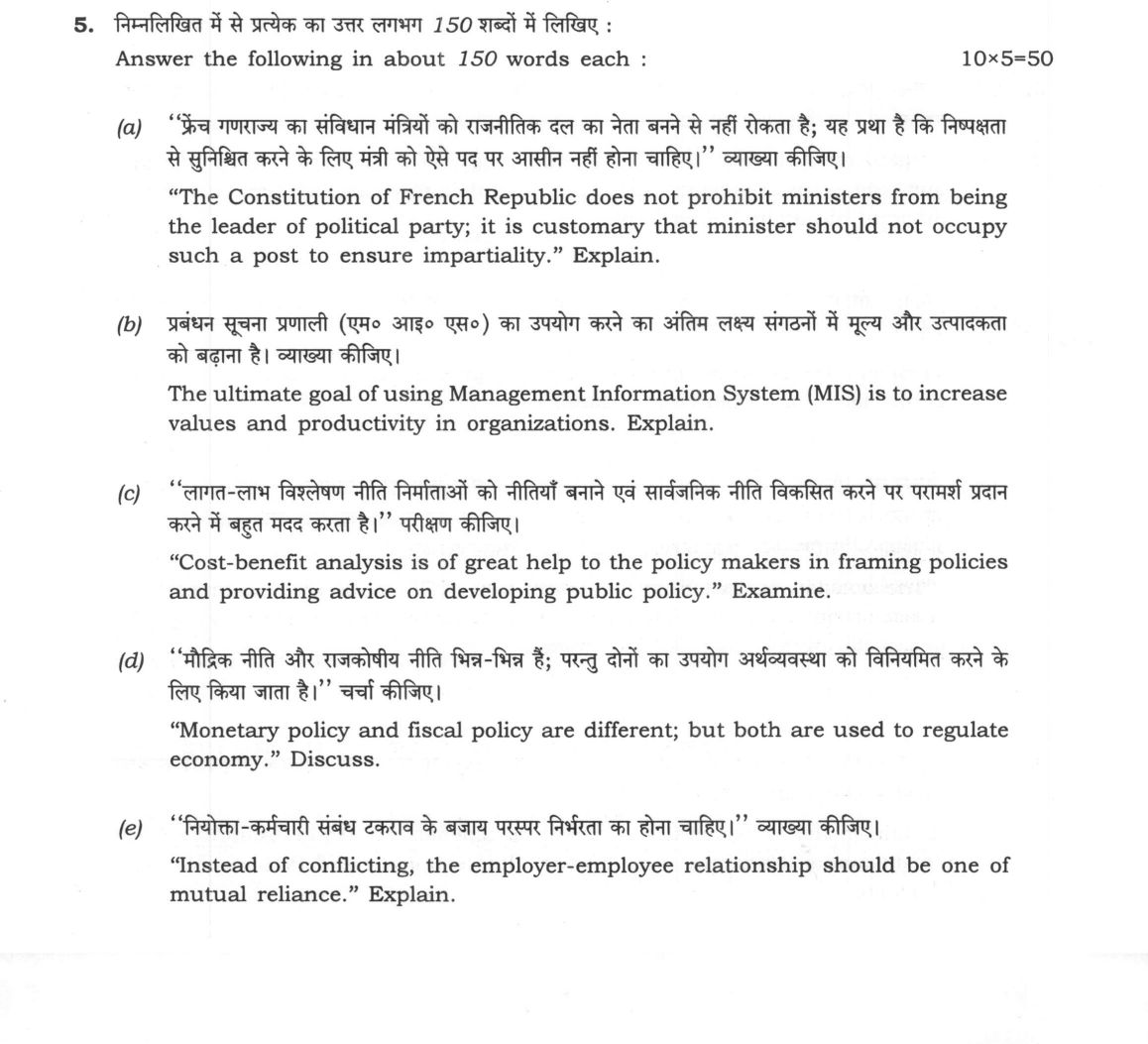
"The Constitution of French Republic does not prohibit ministers from being the leader of political party; it is customary that minister should not occupy such a post to ensure impartiality." Explain. 10 marks
The ultimate goal of using Management Information System (MIS) is to increase values and productivity in organizations. Explain. 10 marks
"Cost-benefit analysis is of great help to the policy makers in framing policies and providing advice on developing public policy." Examine. 10 marks
"Monetary policy and fiscal policy are different; but both are used to regulate economy." Discuss. 10 marks
"Instead of conflicting, the employer-employee relationship should be one of mutual reliance." Explain. 10 marks
हिंदी में प्रश्न पढ़ें
निम्नलिखित में से प्रत्येक का उत्तर लगभग 150 शब्दों में लिखिए :
"फ्रेंच गणराज्य का संविधान मंत्रियों को राजनीतिक दल का नेता बनने से नहीं रोकता है; यह प्रथा है कि निष्पक्षता से सुनिश्चित करने के लिए मंत्री को ऐसे पद पर आसीन नहीं होना चाहिए।" व्याख्या कीजिए। (10 अंक)
प्रबंधन सूचना प्रणाली (एम० आई० एस०) का उपयोग करने का अंतिम लक्ष्य संगठनों में मूल्य और उत्पादकता को बढ़ाना है। व्याख्या कीजिए। (10 अंक)
"लागत-लाभ विश्लेषण नीति निर्माताओं को नीतियाँ बनाने एवं सार्वजनिक नीति विकसित करने पर परामर्श प्रदान करने में बहुत मदद करता है।" परीक्षण कीजिए। (10 अंक)
"मौद्रिक नीति और राजकोषीय नीति भिन्न-भिन्न हैं; परंतु दोनों का उपयोग अर्थव्यवस्था को विनियमित करने के लिए किया जाता है।" चर्चा कीजिए। (10 अंक)
"नियोक्ता-कर्मचारी संबंध टकराव के बजाय परस्पर निर्भरता का होना चाहिए।" व्याख्या कीजिए। (10 अंक)
Model answer
Written by UPSC Answer Check against this question's marking rubric, to the 150-word length. UPSC does not publish answers for Mains — this is one way to score well, not an official key.
(a) French Constitution and Ministerial Neutrality
The Constitution of the French Fifth Republic (1958) establishes an incompatibility rule under Article 23, barring ministers from simultaneously holding parliamentary seats, yet it does not textually prohibit ministers from holding party leadership posts. However, established convention dictates that a minister relinquishes active partisan leadership upon entering the Council of Ministers. Rooted in Charles de Gaulle’s constitutional philosophy of a strong, rationalized executive elevated above the factionalism of political parties (le régime des partis), this custom safeguards administrative impartiality and public trust in state action.
In contrast to the British Westminster system—where the Prime Minister and cabinet ministers openly lead their political party while relying on permanent civil service neutrality and individual ministerial responsibility—the French practice reinforces the non-partisan dignity of ministerial office. By insulating the executive from overt party-political machinery, the convention ensures that policy execution remains oriented toward the general will (l'intérêt général) rather than partisan mobilization.
(b) Management Information System (MIS) and Organizational Productivity
A Management Information System (MIS) is an integrated, user-machine system providing data collection, processing, storage, and retrieval to optimize managerial decision-making, coordination, and operational control. In the framework of Herbert Simon’s decision-making theory, MIS expands the limits of administrative rationality by improving data quality during the intelligence and design phases, thereby enabling more optimal choices.
Applying Robert Anthony’s operational framework, MIS enhances productivity across all three managerial tiers: providing transaction-level metrics for operational control, aggregated analytical feedback for management control, and predictive insights for strategic planning. By eliminating informational asymmetries, automating routine reporting, and streamlining cross-departmental communication, MIS reduces administrative transaction costs and shortens decision cycles. Consequently, it directly enhances organizational responsiveness, optimizes resource allocation, and generates public value in contemporary administrative architectures.
(c) Cost-Benefit Analysis (CBA) in Public Policy
Cost-Benefit Analysis (CBA) is a formal quantitative technique used to appraise the economic and social viability of public policies by systematically comparing total anticipated societal costs against aggregate benefits. Methodologically rooted in welfare economics, CBA relies on the Kaldor-Hicks compensation criterion, which posits that a policy intervention is socially desirable if the gainers theoretically generate sufficient surplus to compensate the losers, yielding a net positive societal gain.
CBA aids policymakers in prioritizing scarce public capital among competing infrastructure, energy, and developmental programs. However, its application reveals severe structural limitations in the realm of social and environmental policies. Valuing intangible goods—such as human life, social equity, biodiversity conservation, and intergenerational justice—presents severe measurement challenges. When applied without qualitative safeguards, CBA risks converting normative democratic decisions into reductionist economic calculus, overlooking distributional impacts on marginalized groups.
(d) Monetary Policy and Fiscal Policy in Macroeconomic Regulation
Monetary policy and fiscal policy serve as the twin pillars of macroeconomic management, operating through distinct instruments and institutional jurisdictions to achieve growth, price stability, and full employment. Monetary policy, managed by the central bank (the Reserve Bank of India), controls the availability, cost, and supply of money through instruments such as the repo rate, Cash Reserve Ratio (CRR), Statutory Liquidity Ratio (SLR), and open market operations under a flexible inflation-targeting framework.
Conversely, fiscal policy is formulated by the executive (Ministry of Finance) and uses budgetary tools, including progressive taxation, public capital expenditure, and deficit financing, to directly alter aggregate demand and address socio-economic inequalities. While monetary tools act indirectly via credit channels and liquidity conditions, fiscal policy directly injects or withdraws purchasing power from the real economy. Harmonious macroeconomic management requires systematic institutional coordination between both arms—exemplified by statutory frameworks like the Fiscal Responsibility and Budget Management (FRBM) Act—to avert fiscal dominance and ensure stable economic expansion.
(e) Employer-Employee Relationship and Mutual Reliance
The conceptualization of industrial relations has witnessed a structural shift from the classical paradigm of Frederick Taylor’s Scientific Management—which treated labour mechanistically and viewed employer-employee relations as inherently adversarial and transactional—to Elton Mayo’s Human Relations Theory, which demonstrated that productivity depends on social cohesion, recognition, and workplace morale.
Contemporary industrial relations operate on the mutual gains theory, recognizing that capital and labour are interdependently linked in a non-zero-sum dynamic. Sustainable organizational performance relies on aligning managerial objectives with worker welfare. In India, this cooperative philosophy is reflected in the constitutional commitment to workers' participation in management under Article 43A of the Directive Principles of State Policy, alongside organizational mechanisms like Quality Circles, Joint Management Councils, and Employee Stock Ownership Plans (ESOPs). By substituting industrial conflict with institutionalized collaboration, mutual reliance enhances employee commitment, minimizes industrial disputes, and sustains long-term organizational productivity.
What "Explain" is asking you to do
Make the working of something clear — what sets it off, what follows from what, and what it produces. Explain is the Commission's mechanism word: it dominates the technical papers and the “explain why” stems, where the marks sit in the causal chain and not in the label.
Structure that answers it
State what it is → the initiating condition → the chain of cause, step by step → an instance where it plays out → what the chain produces
Where marks are lost
Describing what something looks like instead of why it works that way. Naming the stages without linking them reads as description too.
How this answer will be evaluated
Approach
Framework: UPSC Public Administration Paper 1. (a) explain: definition/context > points in order > small example > short close | (b) explain: definition/context > points in order > small example > short close | (c) examine: intro > how/why with reasoning > evidence > conclusion | (d) discuss: intro > 3-4 dimensions > example > balanced close | (e) explain: definition/context > points in order > small example > short close Full marks: Precise definitions, clear distinction between concepts, strong Indian administrative examples, balanced analysis.
Key points expected
- Constitution allows ministers to be party leaders
- Customary practice discourages this role
- Reason: ensuring impartiality of the office
- Distinction between legal prohibition and convention
- Definition of MIS in organizational context
- Mechanism: data processing to decision support
- Link to productivity (efficiency/speed)
- Link to value (strategic advantage/quality)
Evaluation rubric
Each sub-part is marked on its own, against the marks and word limit printed on the paper.
- (a) Explain the constitutional vs customary distinction regarding French ministers and party leadership. · 150 words
explain— definition/context → points in order → small example → short close
Must cover
- Constitution allows ministers to be party leaders
- Customary practice discourages this role
- Reason: ensuring impartiality of the office
- Distinction between legal prohibition and convention
Loses marks
- Confusing constitutional law with political convention
- Failing to explain the 'impartiality' rationale
Earns more
- Reference to French Fifth Republic structure
- Comparison with Indian practice (PM as party leader)
Extra mark
- Mention of specific French constitutional articles
- (b) Explain how MIS usage leads to increased value and productivity in organizations. · 150 words
explain— definition/context → points in order → small example → short close
Must cover
- Definition of MIS in organizational context
- Mechanism: data processing to decision support
- Link to productivity (efficiency/speed)
- Link to value (strategic advantage/quality)
Loses marks
- Treating MIS as just 'computer hardware'
- No link between information and productivity
Earns more
- Example of Indian administrative MIS (e.g., e-Governance)
- Mention of specific MIS components (DSS, TPS)
Extra mark
- Reference to specific Indian IT initiatives (e.g., NIC)
- (c) Examine the utility of Cost-Benefit Analysis (CBA) in public policy formulation. · 150 words
examine— intro → how/why with reasoning → evidence → conclusion
Must cover
- Definition of CBA in policy context
- How it aids policy framing (quantifying outcomes)
- Role in advising on public policy development
- Assessment of its 'great help' (utility)
Loses marks
- Ignoring the 'advice' aspect of the prompt
- Treating CBA as purely financial accounting
Earns more
- Mention of monetizing social benefits
- Reference to Indian planning bodies (e.g., NITI Aayog)
Extra mark
- Specific example of a policy evaluated via CBA
- (d) Discuss the differences between monetary and fiscal policy and their shared regulatory role. · 150 words
discuss— intro → 3-4 dimensions → example → balanced close
Must cover
- Definition of Monetary Policy (RBI)
- Definition of Fiscal Policy (Govt of India)
- Key differences (instruments, authority)
- Shared goal: regulating the economy (stability/growth)
Loses marks
- Failing to distinguish the two policies
- Ignoring the 'regulation' aspect
Earns more
- Mention of specific instruments (Repo rate vs Taxation)
- Reference to coordination between RBI and Finance Ministry
Extra mark
- Reference to specific economic events (e.g., 2016 demonetization)
- (e) Explain the argument for mutual reliance over conflict in employer-employee relations. · 150 words
explain— definition/context → points in order → small example → short close
Must cover
- Definition of the relationship (Industrial Relations)
- Argument for 'mutual reliance' (interdependence)
- Critique of 'conflict' approach
- Benefits of cooperative relations (productivity/peace)
Loses marks
- One-sided view (only employer or only employee)
- Ignoring the 'conflict' aspect of the prompt
Earns more
- Reference to Indian labor laws (e.g., Industrial Disputes Act)
- Mention of Joint Consultative Committees
Extra mark
- Reference to 2nd ARC recommendations on labor
Practice this exact question
Write your answer and it is marked point by point against the model answer above — what you covered, what you missed, what you got wrong.
Evaluate my answer →More from Public Administration 2023 Paper I
- Q2 (a) Follett firmly advocated for cultivating interdependence and collaboration among indi…
- Q3 (a) "Organization theory is not a single theory with a loosely knit of many approaches to…
- Q4 (a) "Reddin model of leadership added third dimension to the existing two basic dimension…
- Q5 Answer the following in about 150 words each: (a) "The Constitution of French Republic do…
- Q6 (a) "The studies in Comparative Public Administration (CPA) got momentum in 1980's and 19…
- Q7 (a) "Public policy-making is an effort to apply the methods of political analysis to poli…
- Q8 (a) "The management of sound public finances used to be the backbone of administrative sy…