Paper I — Q2
(a) Follett firmly advocated for cultivating interdependence and collaboration among individuals as the key to resolving…
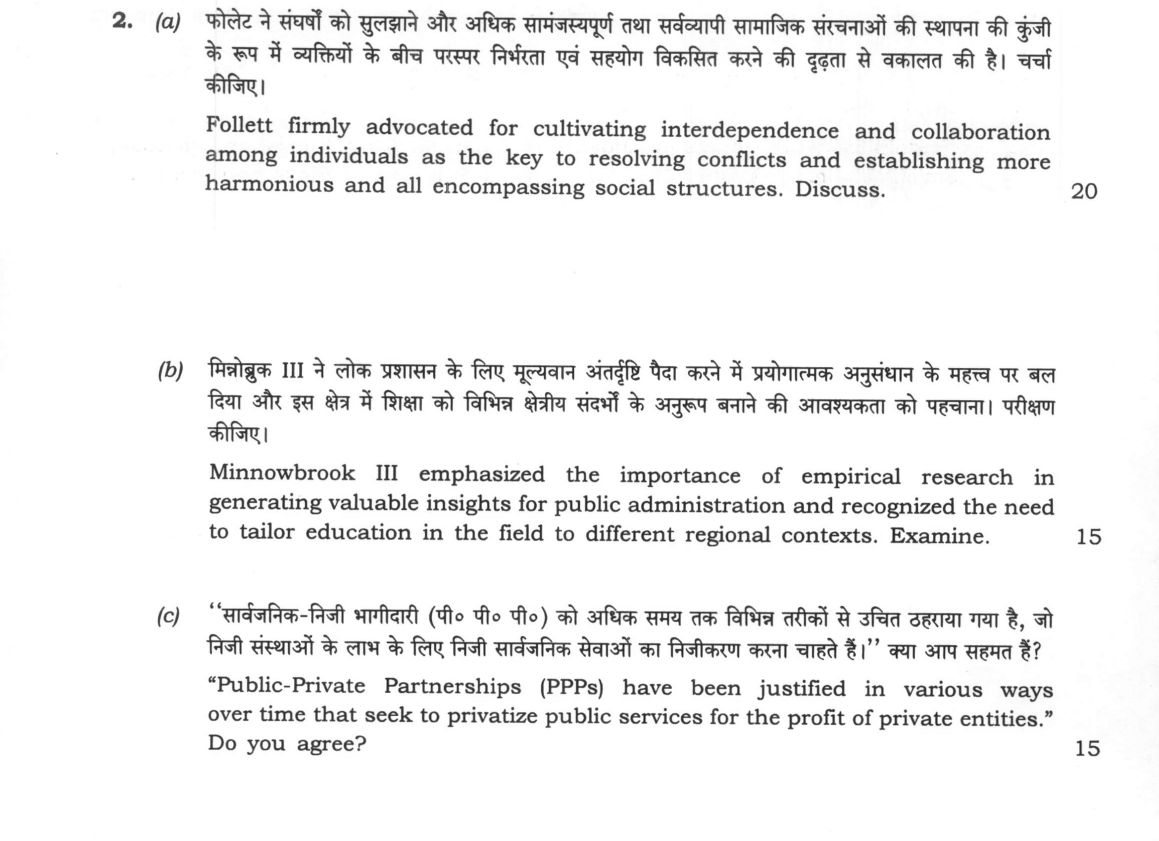
Follett firmly advocated for cultivating interdependence and collaboration among individuals as the key to resolving conflicts and establishing more harmonious and all encompassing social structures. Discuss. 20 marks
Minnowbrook III emphasized the importance of empirical research in generating valuable insights for public administration and recognized the need to tailor education in the field to different regional contexts. Examine. 15 marks
"Public-Private Partnerships (PPPs) have been justified in various ways over time that seek to privatize public services for the profit of private entities." Do you agree? 15 marks
हिंदी में प्रश्न पढ़ें
फोलेट ने संघर्षों को सुलझाने और अधिक सामंजस्यपूर्ण तथा सर्वव्यापी सामाजिक संरचनाओं की स्थापना की कुंजी के रूप में व्यक्तियों के बीच परस्पर निर्भरता एवं सहयोग विकसित करने की दृढ़ता से वकालत की है। चर्चा कीजिए। (20 अंक)
मिनोब्रुक III ने लोक प्रशासन के लिए मूल्यवान अंतर्दृष्टि पैदा करने में प्रयोगात्मक अनुसंधान के महत्व पर बल दिया और इस क्षेत्र में शिक्षा को विभिन्न क्षेत्रीय संदर्भों के अनुरूप बनाने की आवश्यकता को पहचाना। परीक्षण कीजिए। (15 अंक)
"सार्वजनिक-निजी भागीदारी (पी. पी. पी.) को अधिक समय तक विभिन्न तरीकों से उचित ठहराया गया है, जो निजी संस्थाओं के लाभ के लिए निजी सार्वजनिक सेवाओं का निजीकरण करना चाहते हैं।" क्या आप सहमत हैं? (15 अंक)
Model answer
Written by UPSC Answer Check against this question's marking rubric, to the expected length. UPSC does not publish answers for Mains — this is one way to score well, not an official key.
Administrative thought has progressively evolved from structural dogmatism toward relational dynamics, evidence-based inquiry, and hybrid service delivery models. Mary Parker Follett’s humanistic philosophy, the empirical-contextual paradigm of Minnowbrook III, and contemporary debates on Public-Private Partnerships (PPPs) collectively mirror this transformation toward adaptive, multi-stakeholder governance.
Follett’s Collaborative Philosophy and Conflict Resolution
Follett rejected domination and compromise as sub-optimal methods of resolving conflict, arguing that domination breeds resentment while compromise requires parties to sacrifice vital interests. Instead, she posited integration, wherein conflicting desires are creatively re-examined and unified into a new solution where neither party surrenders their essential claims. Underpinning this is the conceptual transition from coercive "power-over" to co-active "power-with", establishing interdependence within organizational and social matrices.
This integration operates through circular response and reciprocal influence, recognizing that human interaction is dynamic, continuous, and mutually transformative rather than a one-way stimulus-response chain. Through circular behavior, stakeholders develop a collective will rather than an aggregated compromise.
In contemporary public administration, Follett’s constructs form the bedrock of participative management and collaborative governance. Her emphasis on situational authority—"the law of the situation"—informs modern decentralized networks, joint conflict-resolution platforms, and community-driven initiatives (such as India's Kudumbashree), demonstrating that sustainable institutional harmony relies on inter-agency collaboration rather than bureaucratic hierarchy.
Minnowbrook III: Empirical Rigour and Contextual Administration
Convened in 2008 amid the Global Financial Crisis and complex post-9/11 global dynamics, Minnowbrook III marked a decisive methodological shift from the normative, value-laden orientations of Minnowbrook I (1968) and II (1988). It underscored the necessity of rigorous empirical research to generate actionable, evidence-based insights for complex public problems, advocating for methodological pluralism over speculative theorizing.
Crucially, the conference rejected universalist, Eurocentric administrative models, calling for administrative education and practice tailored to specific regional contexts, thereby revitalizing Comparative Public Administration.
However, this pronounced focus on localized empirical research has drawn criticism for fragmenting the discipline and hindering the formulation of overarching, universal administrative theories. In India, Minnowbrook III’s ethos has influenced administrative scholarship and policy design, accelerating the adoption of evidence-based policymaking, randomized evaluations, and localized implementation frameworks seen in initiatives like NITI Aayog’s Aspirational Districts Programme.
Public-Private Partnerships: Efficiency versus Privatization
The narrative justifying PPPs has evolved from initial arguments centered on bridging sovereign fiscal deficits to sophisticated rationales emphasizing lifecycle cost optimization, technological innovation, and optimal risk allocation between public and private partners.
Nonetheless, there is valid criticism that PPPs can act as "privatization by stealth." In practice, poorly structured contracts frequently socialize commercial risks onto the state while privatizing returns through sovereign guarantees, viability gap funding, and user fees, turning essential public services into avenues for private rent extraction.
The Indian experience reflects this duality. Capital-intensive infrastructure exhibits notable successes, such as the modernization of the Delhi Airport (DIAL) and various metro rail projects, which delivered world-class assets through private capital and operational efficiency. Conversely, PPPs in social sectors like healthcare and secondary education have faced severe backlash for exacerbating inequities and neglecting non-remunerative public obligations. Furthermore, numerous National Highways Authority of India (NHAI) road concessions experienced contract terminations and renegotiation demands due to aggressive private bidding, flawed traffic estimation, and inadequate regulatory frameworks, reinforcing concerns over private profit extraction at public expense.
Bridging these dimensions requires embedding Follett’s collaborative ethos into institutional designs, using Minnowbrook III’s empirical and contextual rigor to ensure that hybrid delivery mechanisms like PPPs remain accountable to public interest rather than unconstrained private profit.
What "Discuss" is asking you to do
Lay the issue out from more than one side — how it arose, what is claimed for it, what is held against it, and where it now stands. UPSC attaches discuss to broad topics with several live dimensions, so coverage of the dimensions earns more than the strength of your opinion.
Structure that answers it
Set the issue up → the case as it is made → the case against → the dimension both sides leave out → where the balance now lies
Where marks are lost
Listing facts with no thread between them, or arguing one side throughout and calling it a discussion.
How this answer will be evaluated
Approach
Framework: Public Administration, Paper 1. (a) discuss: intro > 3-4 dimensions > example > balanced close | (b) examine: intro > how/why with reasoning > evidence > conclusion | (c) comment: context > arguments both sides > judgment > close Full marks: Precise theory + Indian anchor + balanced judgment + specific examples
Key points expected
- Define Follett's 'integration' vs 'compromise' in conflict resolution
- Explain 'interdependence' as a structural mechanism for harmony
- Link theory to Indian administrative practice (e.g., Panchayati Raj, NITI Aayog)
- Balanced close on limitations of the theory in Indian context
- Identify Minnowbrook III's core argument on empirical research
- Explain the need for regional context in PA education
- Provide evidence of how this applies to Indian PA education
- Conclusion on the current state of PA research in India
Evaluation rubric
Each sub-part is marked on its own, against the marks and word limit printed on the paper.
- (a) Follett's interdependence/collaboration theory applied to conflict resolution and social structure. 20 marks
discuss— intro → 3-4 dimensions → example → balanced close
Must cover
- Define Follett's 'integration' vs 'compromise' in conflict resolution
- Explain 'interdependence' as a structural mechanism for harmony
- Link theory to Indian administrative practice (e.g., Panchayati Raj, NITI Aayog)
- Balanced close on limitations of the theory in Indian context
Loses marks
- Generic discussion of conflict without Follett's specific terms
- Theory without any Indian administrative anchor
- GS-2 style policy answer without administrative theory
Earns more
- Mention 'constructive conflict' concept
- Reference to 'power with' vs 'power over'
- Comparison with traditional hierarchical administration
- Reference to specific Indian collaborative governance model
Extra mark
- 2nd ARC recommendation on collaborative governance
- Specific recent reform (e.g., One Nation One Election coordination)
- (b) Minnowbrook III's emphasis on empirical research and regionalized PA education. 15 marks
examine— intro → how/why with reasoning → evidence → conclusion
Must cover
- Identify Minnowbrook III's core argument on empirical research
- Explain the need for regional context in PA education
- Provide evidence of how this applies to Indian PA education
- Conclusion on the current state of PA research in India
Loses marks
- Confusing Minnowbrook I (NPA) with Minnowbrook III
- No mention of empirical research methodology
- Generic discussion of education without PA context
Earns more
- Mention specific Indian PA research institutions (e.g., IIMs, LSE)
- Reference to regional variations in Indian administration
- Link to New Public Administration (Minnowbrook I) for context
- Mention specific empirical studies in Indian PA
Extra mark
- Specific Indian PA journal or research center
- Reference to a specific regional PA study
- (c) Judgment on whether PPPs are justified as privatization for private profit. 15 marks
comment— context → arguments both sides → judgment → close
Must cover
- Define PPPs and their stated objectives
- Present arguments for PPPs (efficiency, investment, expertise)
- Present arguments against (profit motive, accountability, equity)
- Clear judgment with balanced reasoning
Loses marks
- One-sided argument without balancing
- No specific Indian PPP examples
- Confusing PPPs with full privatization
Earns more
- Mention specific Indian PPP examples (e.g., highways, metro)
- Reference to PPP policy framework in India
- Discussion of risk allocation in PPPs
- Mention of specific PPP failures or successes in India
Extra mark
- Specific Indian PPP statute or policy document
- Reference to a specific PPP audit or CAG report
Practice this exact question
Write your answer and it is marked point by point against the model answer above — what you covered, what you missed, what you got wrong.
Evaluate my answer →More from Public Administration 2023 Paper I
- Q1 Answer the following in about 150 words each: (a) Public administration horizons have bee…
- Q2 (a) Follett firmly advocated for cultivating interdependence and collaboration among indi…
- Q3 (a) "Organization theory is not a single theory with a loosely knit of many approaches to…
- Q4 (a) "Reddin model of leadership added third dimension to the existing two basic dimension…
- Q5 Answer the following in about 150 words each: (a) "The Constitution of French Republic do…