Paper I — Q6
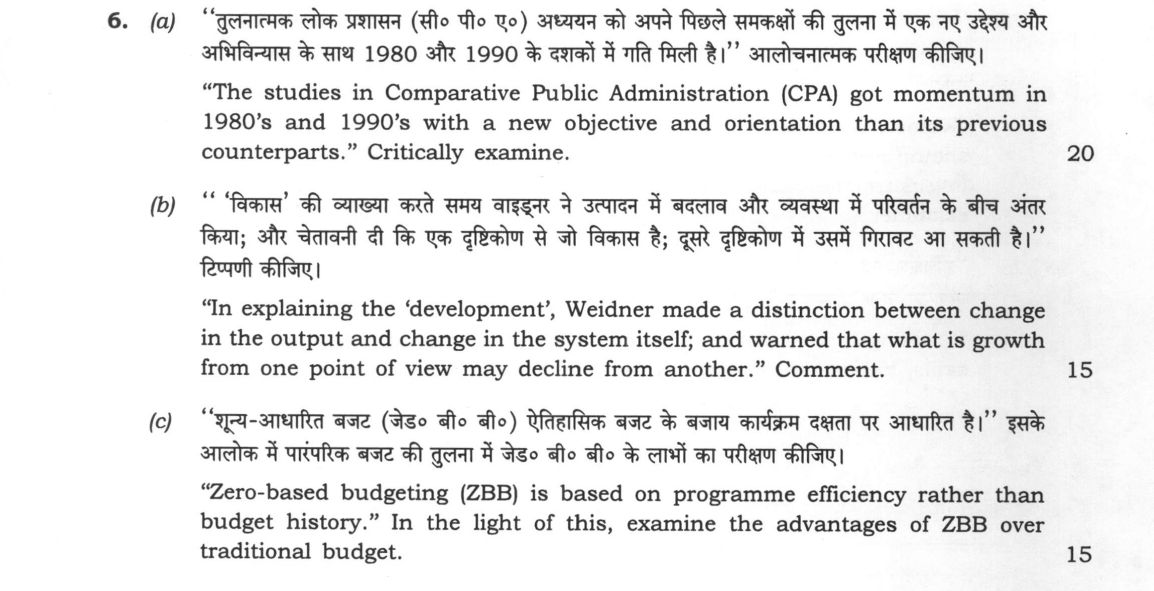
(a) "The studies in Comparative Public Administration (CPA) got momentum in 1980's and 1990's with a new objective and…
"The studies in Comparative Public Administration (CPA) got momentum in 1980's and 1990's with a new objective and orientation than its previous counterparts." Critically examine. 20 marks
"In explaining the 'development', Weidner made a distinction between change in the output and change in the system itself; and warned that what is growth from one point of view may decline from another." Comment. 15 marks
"Zero-based budgeting (ZBB) is based on programme efficiency rather than budget history." In the light of this, examine the advantages of ZBB over traditional budget. 15 marks
हिंदी में प्रश्न पढ़ें
"तुलनात्मक लोक प्रशासन (सी० पी० ए०) अध्ययन को अपने पिछले समकक्षों की तुलना में एक नए उद्देश्य और अभिविन्यास के साथ 1980 और 1990 के दशकों में गति मिली है।" आलोचनात्मक परीक्षण कीजिए। (20 अंक)
"'विकास' की व्याख्या करते समय वाइडनर ने उत्पादन में बदलाव और व्यवस्था में परिवर्तन के बीच अंतर किया; और चेतावनी दी कि एक दृष्टिकोण से जो विकास है; दूसरे दृष्टिकोण में उसमें गिरावट आ सकती है।" टिप्पणी कीजिए। (15 अंक)
"शून्य-आधारित बजट (जेड० बी० बी०) ऐतिहासिक बजट के बजाय कार्यक्रम दक्षता पर आधारित है।" इसके आलोक में पारंपरिक बजट की तुलना में जेड० बी० बी० के लाभों का परीक्षण कीजिए। (15 अंक)
Model answer
Written by UPSC Answer Check against this question's marking rubric, to the expected length. UPSC does not publish answers for Mains — this is one way to score well, not an official key.
Administrative theory has continuously evolved from normative, grand theoretical models toward empirical, performance-driven frameworks, as reflected in the evolution of Comparative Public Administration (CPA), development paradigms, and budgetary reforms like Zero-Based Budgeting (ZBB).
Evolution and Reorientation of Comparative Public Administration
Early CPA under the Comparative Administration Group led by Fred Riggs (1950s–1970s) focused on grand, nomothetic, and structural-functional models, heavily emphasizing ecological contexts and Western-assisted institution-building in newly decolonized states. However, this classical phase suffered from high abstraction, ethnocentric bias, and limited operational utility, leading to its mid-1970s stagnation.
The 1980s and 1990s witnessed a revitalization of CPA, characterized by a fundamental shift in objective and orientation. Driven by the New Public Management (NPM) movement, post-bureaucratic paradigms, and the Good Governance agenda, modern CPA transitioned from grand ecological theorizing to practical, mid-range managerial comparisons. The focus shifted decisively from bureaucratic institution-building to comparative performance measurement, results-oriented administration, privatization, and civil service reforms. Furthermore, globalization expanded comparative inquiry beyond Third World bureaucracies to comparative local governance, public-private partnerships, and regulatory frameworks across both developed and developing polities.
Critically, while this resurgence rescued CPA from academic irrelevance by making it empirically grounded and policy-relevant, it often substituted universal, market-centric NPM prescriptions for the deep socio-cultural sensitivity of earlier ecological studies. Consequently, 1980s–1990s CPA gained operational utility but narrowed its focus on structural and qualitative institutional complexities in diverse developing contexts.
Weidner’s Systemic View of Development
Edward Weidner conceptualized development administration as directional, goal-oriented change, distinguishing between "change in output" (quantitative growth) and "change in the system itself" (qualitative transformation). While output change denotes numerical increases in production, GDP, or physical infrastructure, system change requires enhancing the institutional capacity, structural adaptability, and administrative modernization of state machinery to sustain long-term progress.
Weidner warned that "what is growth from one point of view may decline from another," highlighting that isolated output growth can destabilize systemic equilibria. For instance, the Green Revolution in India produced dramatic output growth in food grain production, yet simultaneously generated regional disparities, groundwater depletion, and socio-economic stratification. Similarly, rapid industrial output achieved through top-down bureaucratic mechanisms often coexists with institutional decay, erosion of local self-governance, and marginalization of vulnerable communities. True development, therefore, requires qualitative systemic capability that harmonizes growth with institutional resilience and social justice.
Zero-Based Budgeting vs. Traditional Incremental Budgeting
Traditional budgeting follows an incremental approach ("base-plus-adjustment"), taking historical expenditure as given and focusing debate only on marginal increases. Conversely, Zero-Based Budgeting (ZBB), introduced by Peter Pyhrr, rejects budget history entirely, requiring each programme to justify its total funding from a zero base based on demonstrated efficiency and cost-benefit utility.
ZBB operates by dividing administrative activities into discrete "decision packages," which are systematically evaluated and ranked against organizational priorities. Its principal advantages over traditional budgeting include:
First, the systematic elimination of obsolete, redundant, or unproductive schemes that otherwise survive via incremental inertia. Second, strategic reallocation of scarce fiscal resources toward high-priority sectors through explicit trade-off analyses. Third, enhanced administrative accountability, as programme managers must directly link input costs to measurable outputs and performance indicators.
However, ZBB is intensely time-consuming, generates voluminous paperwork, and demands advanced administrative and analytical skills. Owing to these constraints, administrative systems—such as India following the Ministry of Finance's 1986 directive—have generally adopted modified, selective ZBB rather than comprehensive annual application.
Conclusion
The revitalization of CPA, Weidner's qualitative development framework, and ZBB collectively demonstrate a decisive paradigm shift in public administration: moving past procedural inertia and uncritical growth metrics toward institutional capability, rigorous programmatic justification, and result-oriented governance.
What "Critically examine" is asking you to do
Test the proposition the question puts to you and return a finding on how far it holds. Examine stems carry a claim, or ask whether something has happened, and expect evidence weighed both ways before the extent is stated — often with remedial measures attached. “Critically” is not a section added at the end: name the yardstick you are judging by — the evidence, the stated objective, a constitutional principle, a rival explanation — and let a verdict close each part of the body. Where the question quotes a claim, that verdict must land on the claim itself, accepted, qualified or rejected, and not on the theme in general.
Structure that answers it
Restate the claim as the question frames it → evidence that supports it → evidence that undercuts it → the conditions under which it holds → verdict on how far it stands
Where marks are lost
Merits in one paragraph, demerits in the next, and a conclusion calling for a balanced and holistic approach. That is a survey with the judgement left out and it holds the answer in the middle band. The opposite error is reading “critically” as permission to attack — and with the odd pairings, critically describe or critically explain, the exposition still carries most of the marks, the judgement being a layer on it rather than a substitute for it.
How this answer will be evaluated
Approach
(a) critique: the claim > its strengths > its weaknesses > your judgment | (b) comment: context > arguments both sides > judgment > close | (c) examine: intro > how/why with reasoning > evidence > conclusion Full marks: Comprehensive, well-structured, with specific Indian examples and critical analysis.
Key points expected
- Define pre-1980s CPA focus (e.g., transferability, modernization)
- Identify 1980s-90s shifts (e.g., New Public Management, globalization)
- Provide Indian administrative examples of these shifts
- Critically evaluate the validity of the 'new' orientation
- Explain Weidner's distinction (output vs. system)
- Illustrate the 'growth vs. decline' paradox
- Apply to Indian development context
- Provide a balanced judgment on the distinction
Evaluation rubric
Each sub-part is marked on its own, against the marks and word limit printed on the paper.
- (a) Assess the shift in CPA objectives and orientation in the 1980s-90s compared to earlier periods. 20 marks
critique— the claim → its strengths → its weaknesses → your judgment
Must cover
- Define pre-1980s CPA focus (e.g., transferability, modernization)
- Identify 1980s-90s shifts (e.g., New Public Management, globalization)
- Provide Indian administrative examples of these shifts
- Critically evaluate the validity of the 'new' orientation
Loses marks
- Generic description of CPA without specific 1980s/90s focus
- Theory without Indian administrative application
- Confusing 'comparative' with 'international' administration
Earns more
- Mention specific scholars (e.g., Heidenreich, Peters)
- Reference Indian reforms (e.g., 1991 LPG, 2nd ARC)
- Distinguish between 'transfer' and 'adaptation' models
- Discuss the role of global institutions (World Bank)
Extra mark
- Cite specific 2nd ARC recommendations on administrative reform
- Reference specific Indian policy documents (e.g., NITI Aayog reports)
- (b) Discuss Weidner's distinction between output change and system change in development. 15 marks
comment— context → arguments both sides → judgment → close
Must cover
- Explain Weidner's distinction (output vs. system)
- Illustrate the 'growth vs. decline' paradox
- Apply to Indian development context
- Provide a balanced judgment on the distinction
Loses marks
- Confusing 'development' with 'growth' without distinction
- Lack of specific reference to Weidner's framework
- Generic discussion of development without system/output focus
Earns more
- Mention specific Indian development indicators (e.g., GDP vs. HDI)
- Reference specific administrative systems (e.g., PDS, MGNREGA)
- Discuss the role of institutional capacity
- Mention specific scholars or works by Weidner
Extra mark
- Cite specific data on Indian development paradoxes
- Reference specific 2nd ARC recommendations on development administration
- (c) Examine the advantages of Zero-Based Budgeting (ZBB) over traditional budgeting. 15 marks
examine— intro → how/why with reasoning → evidence → conclusion
Must cover
- Define ZBB and traditional budgeting
- List specific advantages of ZBB (e.g., efficiency, accountability)
- Provide Indian examples of ZBB implementation
- Conclude with a balanced assessment
Loses marks
- Generic description of ZBB without specific advantages
- Lack of Indian administrative application
- Confusing ZBB with performance-based budgeting
Earns more
- Mention specific Indian states or departments using ZBB
- Reference specific budgetary reforms (e.g., 14th Finance Commission)
- Discuss the role of performance-based budgeting
- Mention specific challenges of ZBB implementation in India
Extra mark
- Cite specific 2nd ARC recommendations on budgetary reforms
- Reference specific Indian policy documents on ZBB
Practice this exact question
Write your answer and it is marked point by point against the model answer above — what you covered, what you missed, what you got wrong.
Evaluate my answer →More from Public Administration 2023 Paper I
- Q3 (a) "Organization theory is not a single theory with a loosely knit of many approaches to…
- Q4 (a) "Reddin model of leadership added third dimension to the existing two basic dimension…
- Q5 Answer the following in about 150 words each: (a) "The Constitution of French Republic do…
- Q6 (a) "The studies in Comparative Public Administration (CPA) got momentum in 1980's and 19…
- Q7 (a) "Public policy-making is an effort to apply the methods of political analysis to poli…
- Q8 (a) "The management of sound public finances used to be the backbone of administrative sy…