Paper I — Q7
(a) "Public policy-making is an effort to apply the methods of political analysis to policy areas but has concerns with processes…
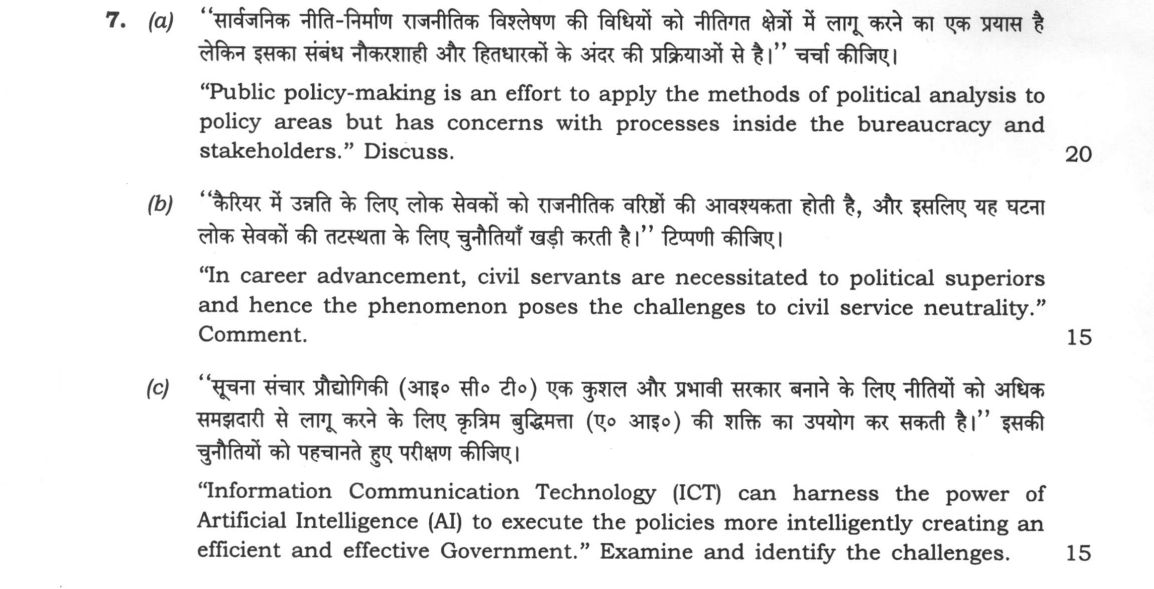
"Public policy-making is an effort to apply the methods of political analysis to policy areas but has concerns with processes inside the bureaucracy and stakeholders." Discuss. 20 marks
"In career advancement, civil servants are necessitated to political superiors and hence the phenomenon poses the challenges to civil service neutrality." Comment. 15 marks
"Information Communication Technology (ICT) can harness the power of Artificial Intelligence (AI) to execute the policies more intelligently creating an efficient and effective Government." Examine and identify the challenges. 15 marks
हिंदी में प्रश्न पढ़ें
"सार्वजनिक नीति-निर्माण राजनीतिक विश्लेषण की विधियों को नीतिगत क्षेत्रों में लागू करने का एक प्रयास है लेकिन इसका संबंध नौकरशाही और हितधारकों के अंदर की प्रक्रियाओं से है।" चर्चा कीजिए। (20 अंक)
"कैरियर में उन्नति के लिए लोक सेवकों को राजनीतिक वरिष्ठों की आवश्यकता होती है, और इसलिए यह घटना लोक सेवकों की तटस्थता के लिए चुनौतियाँ खड़ी करती है।" टिप्पणी कीजिए। (15 अंक)
"सूचना संचार प्रौद्योगिकी (आई० सी० टी०) एक कुशल और प्रभावी सरकार बनाने के लिए नीतियों को अधिक समझदारी से लागू करने के लिए कृत्रिम बुद्धिमत्ता (ए० आई०) की शक्ति का उपयोग कर सकती है।" इसकी चुनौतियों को पहचानते हुए परीक्षण कीजिए। (15 अंक)
Model answer
Written by UPSC Answer Check against this question's marking rubric, to the expected length. UPSC does not publish answers for Mains — this is one way to score well, not an official key.
Public policy formulation operates at the intersection of political imperatives, institutional mechanisms, and societal demands. Modern governance requires reconciling the normative visions of political leadership with the technocratic procedures of administration.
Policy-Making: Political Analysis, Bureaucratic Processes, and Stakeholders
Public policy-making is fundamentally an effort to apply political analysis—factoring in electoral cycles, ruling ideologies, coalition dynamics, and shifting public opinion—to specific sectoral domains. This captures Harold Lasswell’s "politics of policy," determining who gets what, when, and how. However, this political logic frequently collides with internal bureaucratic processes governed by technical rationality, standard operating procedures, and institutional memory. While the formal "stages model" (agenda-setting, formulation, legitimation, implementation) assumes a linear, rational sequence, administrative reality often mirrors the "garbage can model" or Kingdon’s multiple streams, where problems, solutions, and political participants converge haphazardly.
Tensions arise between democratic responsiveness—demanding rapid, popular policy payoffs—and administrative rationality, which emphasizes feasibility, long-term costs, and constitutional propriety. Furthermore, external stakeholders, including market forces, civil society organizations, and vocal pressure groups, exert asymmetric influence. Bureaucracies often struggle to balance these competing interest-group pressures with equity, leading either to regulatory capture or protracted policy paralysis.
Career Advancement and Civil Service Neutrality
The principle of civil service neutrality, rooted in the Weberian ideal of instrumental competence, is challenged by the structural architecture of career advancement. In Westminster systems, the political executive controls sensitive levers: prime postings, empanelment, inter-cadre deputations, extensions, and post-retirement appointments. This structural dependency necessitates proximity to political superiors, fostering systemic pathologies such as "anticipatory obedience" and overt partisan alignment. The traditional ethos of rendering fearless advice is compromised when compliance becomes the primary currency for professional survival and advancement.
To insulate civil servants, systemic safeguards have been institutionalized, such as constitutional protections under Article 311 and the Supreme Court’s mandate in the T.S.R. Subramanian case (2013) for fixed tenures and functional Civil Services Boards. Furthermore, the Second Administrative Reforms Commission (ARC-II) recommended establishing statutory Civil Services Authorities to govern transfers and postings, instituting objective performance appraisal metrics, and introducing cooling-off periods to check the politicization of the civil service without undermining democratic accountability.
Harnessing AI-ICT in Policy Execution: Prospects and Challenges
The transition from basic e-governance to AI-powered governance transforms policy execution through predictive analytics, automated decision-making, and dynamic resource allocation. By leveraging machine learning over vast administrative datasets, governments can pre-empt service delivery failures, detect welfare leakages in real time, and personalize public service delivery.
However, intelligent policy execution faces substantial challenges:
- Algorithmic Bias and Exclusion: Datasets often encode historical inequities, leading to discriminatory automated targeting in welfare schemes.
- Digital Divide and Privacy: Unequal digital access disenfranchises marginalized citizenries, while massive data harvesting raises serious surveillance and privacy concerns under weak data protection architectures.
- Accountability Deficit: The "black-box" nature of AI models obscures administrative accountability, eroding administrative law principles like natural justice and reasoned orders.
- Deskilling Discretion: Over-reliance on automated systems risks eroding empathetic, human administrative discretion in complex socio-economic contexts.
Way Forward
A robust governance framework requires harmonizing political responsiveness with technocratic integrity. While algorithmic decision-making and digital platforms can depersonalize administrative interfaces—reducing rent-seeking and arbitrary political interference—they cannot substitute for ethical administrative judgment. Institutionalizing transparent civil service career pathways alongside robust algorithmic auditing frameworks will ensure that technological efficiency strengthens, rather than undermines, constitutional governance and democratic accountability.
What "Discuss" is asking you to do
Lay the issue out from more than one side — how it arose, what is claimed for it, what is held against it, and where it now stands. UPSC attaches discuss to broad topics with several live dimensions, so coverage of the dimensions earns more than the strength of your opinion.
Structure that answers it
Set the issue up → the case as it is made → the case against → the dimension both sides leave out → where the balance now lies
Where marks are lost
Listing facts with no thread between them, or arguing one side throughout and calling it a discussion.
How this answer will be evaluated
Approach
Framework: Public Administration, Paper 1. (a) discuss: intro > 3-4 dimensions > example > balanced close | (b) comment: context > arguments both sides > judgment > close | (c) challenges: 3-4 challenges > solutions mapped to them > conclusion Full marks: Comprehensive, well-structured, with specific Indian examples and references to 2nd ARC/recent reforms.
Key points expected
- Define public policy-making as a political process
- Explain the role of political analysis methods
- Detail internal bureaucratic processes (e.g., drafting, implementation)
- Analyze the role of stakeholders in the policy cycle
- Explain the structural dependence of civil servants on political masters
- Define the principle of civil service neutrality
- Identify how this dependence challenges neutrality
- Provide a balanced judgment on the phenomenon
Evaluation rubric
Each sub-part is marked on its own, against the marks and word limit printed on the paper.
- (a) Analyze the dual nature of policy-making: political analysis vs. bureaucratic/stakeholder processes. 20 marks
discuss— intro → 3-4 dimensions → example → balanced close
Must cover
- Define public policy-making as a political process
- Explain the role of political analysis methods
- Detail internal bureaucratic processes (e.g., drafting, implementation)
- Analyze the role of stakeholders in the policy cycle
Loses marks
- Treating policy-making as purely administrative
- Ignoring the 'political analysis' aspect of the prompt
- Lack of Indian institutional examples
Earns more
- Reference to the policy cycle (agenda setting to evaluation)
- Distinction between political and administrative roles
- Example of a specific Indian policy (e.g., MGNREGA)
- Mention of the 2nd ARC on policy formulation
Extra mark
- Reference to specific policy committees (e.g., NITI Aayog)
- Citation of a specific Supreme Court judgment on policy
- (b) Critique the tension between career dependence on political superiors and civil service neutrality. 15 marks
comment— context → arguments both sides → judgment → close
Must cover
- Explain the structural dependence of civil servants on political masters
- Define the principle of civil service neutrality
- Identify how this dependence challenges neutrality
- Provide a balanced judgment on the phenomenon
Loses marks
- One-sided argument (only pro or con)
- Ignoring the 'career advancement' aspect of the prompt
- Lack of specific examples of the challenge
Earns more
- Reference to the 2nd ARC on political-administrative interface
- Mention of the All India Services Act
- Example of a specific instance of political interference
- Discussion of the 'master-servant' relationship
Extra mark
- Reference to the 2nd ARC's specific recommendations on this
- Citation of a specific case of political interference
- (c) Examine how ICT/AI can improve governance and identify the specific challenges in implementation. 15 marks
challenges— 3-4 challenges → solutions mapped to them → conclusion
Must cover
- Explain how ICT/AI can make policy execution more intelligent
- Identify at least 3-4 specific challenges (e.g., digital divide, data privacy)
- Map solutions to the identified challenges
- Conclude with the potential for efficient/effective government
Loses marks
- Focusing only on the benefits, ignoring the 'challenges' command
- Vague challenges (e.g., 'lack of technology')
- Lack of specific Indian examples
Earns more
- Reference to the Digital India initiative
- Mention of specific AI applications in governance (e.g., CoWIN)
- Discussion of the 'data privacy' challenge (DPDP Act)
- Reference to the 'digital divide' challenge
Extra mark
- Reference to the 2nd ARC on e-governance
- Citation of a specific AI-driven policy success/failure
Practice this exact question
Write your answer and it is marked point by point against the model answer above — what you covered, what you missed, what you got wrong.
Evaluate my answer →More from Public Administration 2023 Paper I
- Q4 (a) "Reddin model of leadership added third dimension to the existing two basic dimension…
- Q5 Answer the following in about 150 words each: (a) "The Constitution of French Republic do…
- Q6 (a) "The studies in Comparative Public Administration (CPA) got momentum in 1980's and 19…
- Q7 (a) "Public policy-making is an effort to apply the methods of political analysis to poli…
- Q8 (a) "The management of sound public finances used to be the backbone of administrative sy…