Paper I — Q3
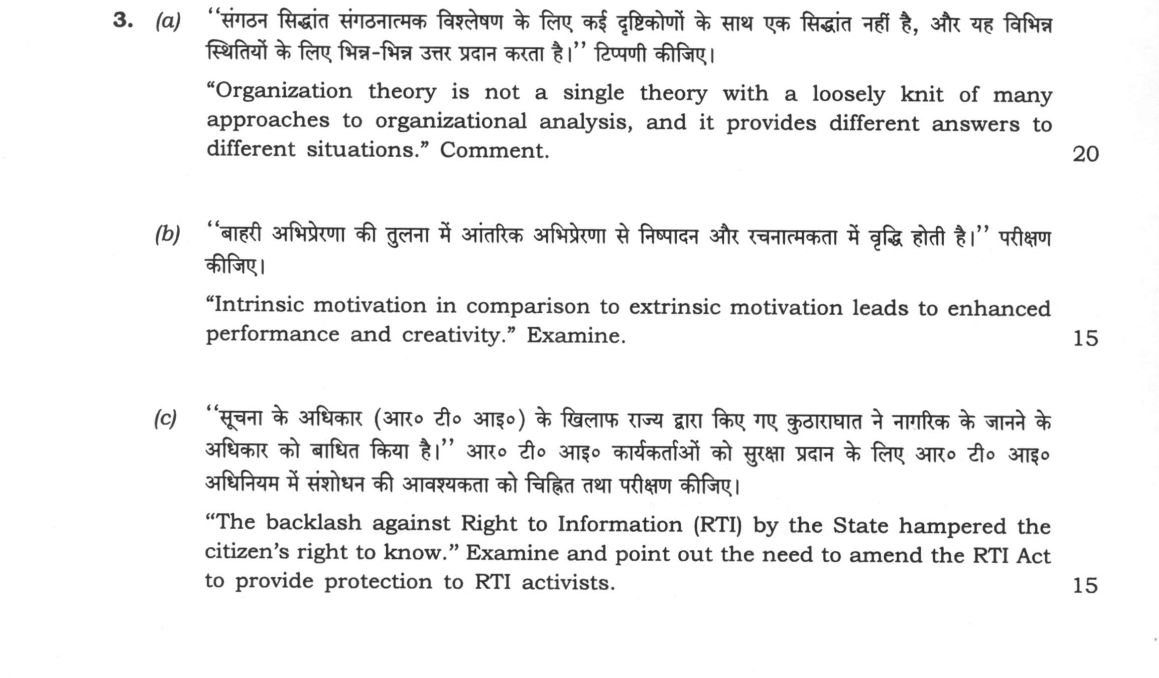
(a) "Organization theory is not a single theory with a loosely knit of many approaches to organizational analysis, and it…
"Organization theory is not a single theory with a loosely knit of many approaches to organizational analysis, and it provides different answers to different situations." Comment. 20 marks
"Intrinsic motivation in comparison to extrinsic motivation leads to enhanced performance and creativity." Examine. 15 marks
"The backlash against Right to Information (RTI) by the State hampered the citizen's right to know." Examine and point out the need to amend the RTI Act to provide protection to RTI activists. 15 marks
हिंदी में प्रश्न पढ़ें
"संगठन सिद्धांत संगठनात्मक विश्लेषण के लिए कई दृष्टिकोणों के साथ एक सिद्धांत नहीं है, और यह विभिन्न स्थितियों के लिए भिन्न-भिन्न उत्तर प्रदान करता है।" टिप्पणी कीजिए। (20 अंक)
"बाहरी अभिप्रेरणा की तुलना में आंतरिक अभिप्रेरणा से निष्पादन और रचनात्मकता में वृद्धि होती है।" परीक्षण कीजिए। (15 अंक)
"सूचना के अधिकार (आर. टी. आई.) के खिलाफ राज्य द्वारा किए गए कुत्सारोपण ने नागरिक के जानने के अधिकार को बाधित किया है।" आर. टी. आई. कार्यकर्ताओं को सुरक्षा प्रदान के लिए आर. टी. आई. अधिनियम में संशोधन की आवश्यकता को चिह्नित तथा परीक्षण कीजिए। (15 अंक)
Model answer
Written by UPSC Answer Check against this question's marking rubric, to the expected length. UPSC does not publish answers for Mains — this is one way to score well, not an official key.
Plurality and Situational Nature of Organization Theory
Organization theory is a pluralistic, multi-paradigm discipline rather than a monolithic doctrine. Classical theorists—Taylor’s Scientific Management, Fayol’s Administrative Management, and Weber’s Bureaucracy—prescribed a rational, closed-system "one best way" grounded in hierarchy, functional specialization, and formal rules. The Neoclassical school, through Elton Mayo’s Human Relations movement and Douglas McGregor’s Theory Y, rejected this mechanistic determinism by demonstrating that informal norms, social satisfaction, and democratic supervision drive organizational behavior.
The Open Systems approach (Katz and Kahn) revolutionized administrative analysis by framing organizations as dynamic, entropy-resisting entities interacting continuously with their external environment. Building upon this, Lawrence and Lorsch’s Contingency Theory discarded universalist prescriptions entirely, proving that structural differentiation and integration must adapt to varying degrees of environmental uncertainty. Modern configurational theory further advances this situational logic by emphasizing the holistic "fit" between internal structure, organizational strategy, and external environmental complexity, while postmodern approaches interrogate power asymmetries, discourse, and fluid boundaries. Organization theory thus provides contextual diagnostic frameworks rather than static blueprints: stable public tasks require mechanistic efficiency, while crisis-laden, volatile policy environments necessitate organic, adaptive networks.
Intrinsic Motivation, Creativity, and Administrative Performance
Extrinsic motivation relies on external inducements such as monetary perks or disciplinary sanctions. In contrast, intrinsic motivation stems from the inherent satisfaction, challenge, and purpose derived from the task itself. Deci and Ryan’s Self-Determination Theory (SDT) posits that optimal human performance and psychological well-being require the fulfillment of three basic needs: autonomy, competence, and relatedness. Under Cognitive Evaluation Theory (a sub-theory of SDT), controlling extrinsic rewards produces an "undermining effect," shifting the perceived locus of causality from internal drive to external control, which diminishes task commitment.
Furthermore, Teresa Amabile’s research on creativity establishes that intrinsic motivation is foundational for complex problem-solving, cognitive flexibility, and innovation, whereas rigid extrinsic constraints foster risk-aversion. In Indian governance, the historical reliance on colonial-era carrot-and-stick administration and periodic pay revisions (such as the 7th Central Pay Commission) has proven inadequate for inspiring dynamic public problem-solving. Consequently, reforms like Mission Karmayogi (National Programme for Civil Services Capacity Building) seek to replace compliance-driven bureaucracy with competency-linked, role-based capacity building that fosters intrinsic public service motivation, administrative autonomy, and creative governance.
RTI Backlash and the Imperative for Activist Protection
The Right to Information (RTI) Act, 2005, designed to operationalize the citizen's fundamental right to know under Article 19(1)(a), has experienced systemic administrative backlash. Bureaucratic resistance manifests through deliberate misinformation, frivolous rejections using expansive interpretations of Section 8 exemptions, prohibitive photocopy and application fees, and chronic non-appointment of Information Commissioners leading to operational paralysis.
Most critically, the backlash has taken the form of physical intimidation, harassment, and targeted violence against citizens exposing corruption, as seen in the murders of activists such as Satish Shetty and Amit Jethwa. To prevent the erosion of democratic accountability, structural amendments to the RTI framework are essential. The RTI Act must incorporate institutionalized protection mechanisms integrated with the Whistle Blowers Protection Act, enforce strict penal liabilities on Public Information Officers who unlawfully disclose applicant identities, and mandate real-time district-level security protocols for threatened applicants. Concurrently, empowering the regime requires mandatory compliance with Section 4 suo motu disclosures, nationwide digitization of RTI portals, and dedicated fast-track adjudicatory mechanisms for transparency defenders.
Modern governance demands that public administration move away from rigid structural dogmatism and transactional incentives toward situational design, intrinsically motivated civil servants, and transparent institutional arrangements that actively protect citizen oversight.
What "Examine" is asking you to do
Test the proposition the question puts to you and return a finding on how far it holds. Examine stems carry a claim, or ask whether something has happened, and expect evidence weighed both ways before the extent is stated — often with remedial measures attached.
Structure that answers it
Restate the claim as the question frames it → evidence that supports it → evidence that undercuts it → the conditions under which it holds → verdict on how far it stands
Where marks are lost
Stopping at description. An examination has to reach a finding, and “examine with justification” means the extent must be stated, not implied.
How this answer will be evaluated
Approach
Framework: Public Administration Paper 1 (UPSC). (a) comment: context > arguments both sides > judgment > close | (b) examine: intro > how/why with reasoning > evidence > conclusion | (c) examine: intro > how/why with reasoning > evidence > conclusion Full marks: Precise definitions, strong Indian anchors, specific 2nd ARC references, and clear logical flow.
Key points expected
- Define 'loosely knit' as a collection of disparate approaches
- Identify 2-3 specific theories (e.g., Classical, Human Relations, Systems)
- Provide an Indian administrative instance for at least one theory
- Conclude with a judgment on the theory's applicability to Indian context
- Define intrinsic vs extrinsic motivation clearly
- Explain the mechanism linking intrinsic motivation to creativity
- Provide an Indian administrative example (e.g., civil service ethos)
- Conclude with a reasoned judgment on the statement's validity
Evaluation rubric
Each sub-part is marked on its own, against the marks and word limit printed on the paper.
- (a) Contextualize the quote and provide a balanced judgment on the pluralistic nature of organizational theory. 20 marks
comment— context → arguments both sides → judgment → close
Must cover
- Define 'loosely knit' as a collection of disparate approaches
- Identify 2-3 specific theories (e.g., Classical, Human Relations, Systems)
- Provide an Indian administrative instance for at least one theory
- Conclude with a judgment on the theory's applicability to Indian context
Loses marks
- Treating the quote as a simple definition rather than a comment
- Listing theories without any Indian administrative anchor
- Ignoring the 'different answers to different situations' aspect
Earns more
- Mention specific thinkers (e.g., Weber, Mayo, Simon)
- Reference the 2nd ARC on organizational behavior
- Distinguish between 'theory' and 'practice' in Indian administration
Extra mark
- Cite a specific 2nd ARC recommendation on organizational reform
- Reference a specific Indian administrative reform (e.g., NITI Aayog structure)
- (b) Analyze the relationship between intrinsic motivation and performance/creativity with reasoning and evidence. 15 marks
examine— intro → how/why with reasoning → evidence → conclusion
Must cover
- Define intrinsic vs extrinsic motivation clearly
- Explain the mechanism linking intrinsic motivation to creativity
- Provide an Indian administrative example (e.g., civil service ethos)
- Conclude with a reasoned judgment on the statement's validity
Loses marks
- Defining terms without examining the 'enhanced performance' claim
- Ignoring the 'creativity' aspect of the statement
- Providing a generic answer without Indian administrative context
Earns more
- Reference specific motivation theories (e.g., Herzberg, Maslow)
- Discuss the role of 'service motive' in Indian bureaucracy
- Mention the impact of extrinsic rewards (pay) on performance
Extra mark
- Cite a specific 2nd ARC recommendation on motivation/rewards
- Reference a specific Indian scheme or reform aimed at motivation
- (c) Examine the state's backlash against RTI and argue for amendments to protect activists. 15 marks
examine— intro → how/why with reasoning → evidence → conclusion
Must cover
- Explain the 'backlash' (e.g., delays, non-compliance, harassment)
- Identify specific instances of state obstruction to RTI
- Argue for the need to amend the RTI Act for protection
- Suggest specific amendments or safeguards for RTI activists
Loses marks
- Focusing only on the 'backlash' without addressing the 'need to amend'
- Ignoring the 'protection to RTI activists' aspect
- Providing a generic answer without specific Indian examples
Earns more
- Reference specific RTI cases or incidents in India
- Discuss the role of the Central Information Commission (CIC)
- Mention the 'Right to Know' as a fundamental right
Extra mark
- Cite a specific 2nd ARC recommendation on transparency/RTI
- Reference a specific amendment or proposed amendment to the RTI Act
Practice this exact question
Write your answer and it is marked point by point against the model answer above — what you covered, what you missed, what you got wrong.
Evaluate my answer →More from Public Administration 2023 Paper I
- Q1 Answer the following in about 150 words each: (a) Public administration horizons have bee…
- Q2 (a) Follett firmly advocated for cultivating interdependence and collaboration among indi…
- Q3 (a) "Organization theory is not a single theory with a loosely knit of many approaches to…
- Q4 (a) "Reddin model of leadership added third dimension to the existing two basic dimension…
- Q5 Answer the following in about 150 words each: (a) "The Constitution of French Republic do…
- Q6 (a) "The studies in Comparative Public Administration (CPA) got momentum in 1980's and 19…