Paper I — Q1
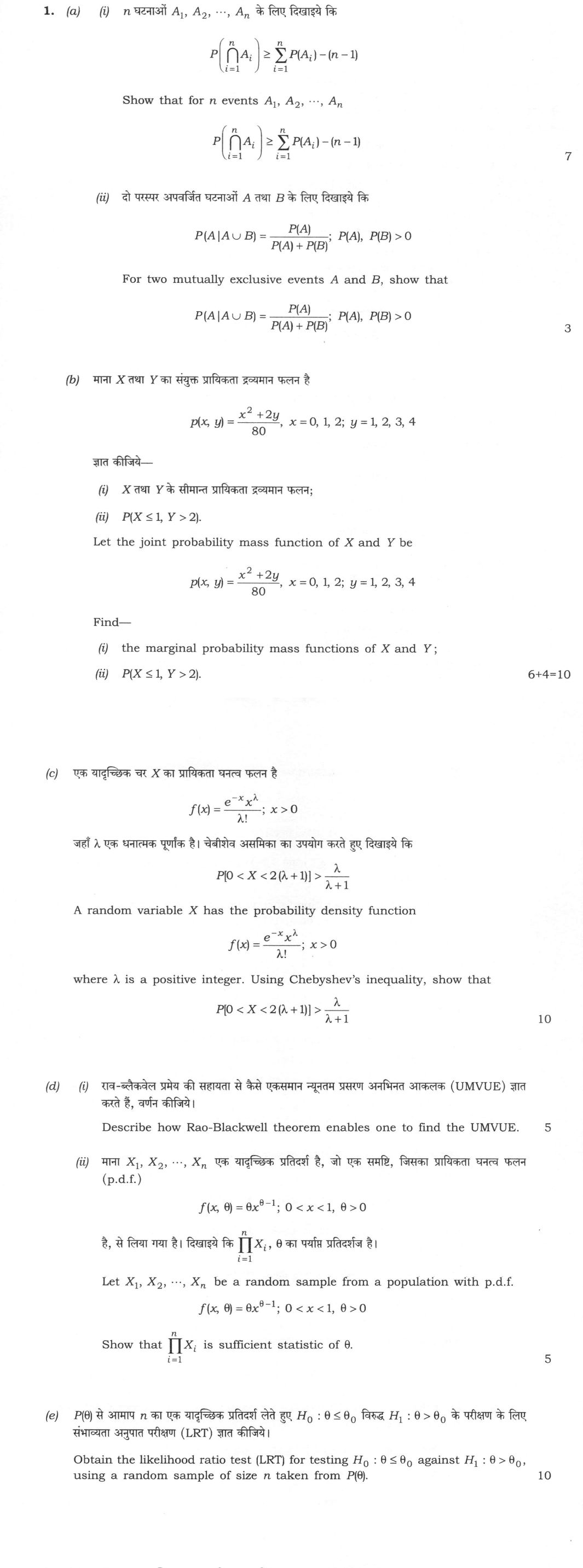
(a) (i) Show that for n events A₁, A₂, ⋯, Aₙ P( ⋂ᵢ₌₁ⁿ Aᵢ ) ≥ Σᵢ₌₁ⁿ P(Aᵢ) − (n − 1) (7 marks) (ii) For two mutually exclusive…
Show that for n events A₁, A₂, ⋯, Aₙ
P( ⋂ᵢ₌₁ⁿ Aᵢ ) ≥ Σᵢ₌₁ⁿ P(Aᵢ) − (n − 1) 7 marks
For two mutually exclusive events A and B, show that
P(A | A ∪ B) = P(A) / (P(A) + P(B)); P(A), P(B) > 0 3 marks
Let the joint probability mass function of X and Y be
p(x, y) = (x² + 2y) / 80, x = 0, 1, 2; y = 1, 2, 3, 4
Find—
the marginal probability mass functions of X and Y;
P(X ≤ 1, Y > 2). 10 marks
A random variable X has the probability density function
f(x) = e^(–x) x^λ / λ! ; x > 0
where λ is a positive integer. Using Chebyshev's inequality, show that
P[0 < X < 2(λ + 1)] > λ / (λ + 1) 10 marks
Describe how Rao-Blackwell theorem enables one to find the UMVUE. 5 marks
Let X₁, X₂, ⋯, Xₙ be a random sample from a population with p.d.f.
f(x, θ) = θ x^(θ–1); 0 < x < 1, θ > 0
Show that ∏ᵢ₌₁ⁿ Xᵢ is sufficient statistic of θ. 5 marks
Obtain the likelihood ratio test (LRT) for testing H₀ : θ ≤ θ₀ against H₁ : θ > θ₀, using a random sample of size n taken from P(θ). 10 marks
हिंदी में प्रश्न पढ़ें
n घटनाओं A₁, A₂, ⋯, Aₙ के लिए दिखाइये कि
P( ⋂ᵢ₌₁ⁿ Aᵢ ) ≥ Σᵢ₌₁ⁿ P(Aᵢ) − (n − 1) (7 अंक)
दो परस्पर अपवर्जित घटनाओं A तथा B के लिए दिखाइये कि
P(A | A ∪ B) = P(A) / (P(A) + P(B)); P(A), P(B) > 0 (3 अंक)
माना X तथा Y का संयुक्त प्रायिकता द्रव्यमान फलन है
p(x, y) = (x² + 2y) / 80, x = 0, 1, 2; y = 1, 2, 3, 4
ज्ञात कीजिये—
X तथा Y के सीमांत प्रायिकता द्रव्यमान फलन;
P(X ≤ 1, Y > 2). (10 अंक)
एक यादृच्छिक चर X का प्रायिकता घनत्व फलन है
f(x) = e^(–x) x^λ / λ! ; x > 0
जहाँ λ एक धनात्मक पूर्णांक है। चेबीशेव असमिका का उपयोग करते हुए दिखाइये कि
P[0 < X < 2(λ + 1)] > λ / (λ + 1) (10 अंक)
राव-ब्लैकवेल प्रमेय की सहायता से कैसे एकसमान न्यूनतम प्रसरण अनभिनत आकलक (UMVUE) ज्ञात करते हैं, वर्णन कीजिये। (5 अंक)
माना X₁, X₂, ⋯, Xₙ एक यादृच्छिक प्रतिदर्श है, जो एक समष्टि, जिसका प्रायिकता घनत्व फलन (p.d.f.)
f(x, θ) = θ x^(θ–1); 0 < x < 1, θ > 0
है, से लिया गया है। दिखाइये कि ∏ᵢ₌₁ⁿ Xᵢ, θ का पर्याप्त प्रतिदर्शज है। (5 अंक)
P(θ) से आमाप n का एक यादृच्छिक प्रतिदर्श लेते हुए H₀ : θ ≤ θ₀ विरुद्ध H₁ : θ > θ₀ के परीक्षण के लिए संभाव्यता अनुपात परीक्षण (LRT) ज्ञात कीजिये। (10 अंक)
Model answer
Drafted with AI by UPSC Answer Check against this question's marking rubric, to the expected length. UPSC does not publish answers for Mains — this is one way to score well, not an official key. How we build rubrics and answers.
(a) (i) Bonferroni inequality
By De Morgan's law, (⋂ᵢ₌₁ⁿ Aᵢ)ᶜ = ⋃ᵢ₌₁ⁿ Aᵢᶜ, so P(⋂Aᵢ) = 1 − P(⋃Aᵢᶜ).
Boole's inequality: P(⋃ᵢ₌₁ⁿ Bᵢ) ≤ Σ P(Bᵢ). It holds for n = 2 because P(B₁ ∪ B₂) = P(B₁) + P(B₂) − P(B₁ ∩ B₂) ≤ P(B₁) + P(B₂), and by induction P(⋃₁ⁿ Bᵢ) ≤ P(⋃₁ⁿ⁻¹ Bᵢ) + P(Bₙ) ≤ Σ₁ⁿ P(Bᵢ).
Taking Bᵢ = Aᵢᶜ and P(Aᵢᶜ) = 1 − P(Aᵢ): P(⋃Aᵢᶜ) ≤ Σ(1 − P(Aᵢ)) = n − Σ P(Aᵢ).
Hence P(⋂ᵢ₌₁ⁿ Aᵢ) ≥ 1 − n + Σ P(Aᵢ) = Σᵢ₌₁ⁿ P(Aᵢ) − (n − 1). The bound is informative only when Σ P(Aᵢ) > n − 1.
(a) (ii) Conditional probability for mutually exclusive events
P(A | A ∪ B) = P(A ∩ (A ∪ B)) / P(A ∪ B). Since A ⊆ A ∪ B, A ∩ (A ∪ B) = A. Since A ∩ B = ∅, P(A ∪ B) = P(A) + P(B) > 0. Therefore P(A | A ∪ B) = P(A) / (P(A) + P(B)).
(b) Marginal p.m.f.s and a joint probability
Check: Σₓ Σᵧ (x² + 2y) = 4(0 + 1 + 4) + 3·2(1 + 2 + 3 + 4) = 20 + 60 = 80, so p(x, y) is a valid p.m.f.
(i) p_X(x) = Σ_y=1⁴ (x² + 2y)/80 = (4x² + 20)/80 = (x² + 5)/20, x = 0, 1, 2; i.e. p_X(0) = 1/4, p_X(1) = 3/10, p_X(2) = 9/20 (sum 1). p_Y(y) = Σₓ₌₀² (x² + 2y)/80 = (5 + 6y)/80, y = 1, 2, 3, 4; i.e. 11/80, 17/80, 23/80, 29/80 (sum 1). Since p(0, 1) = 2/80 ≠ p_X(0)p_Y(1) = 11/320, X and Y are not independent.
(ii) P(X ≤ 1, Y > 2) = p(0, 3) + p(0, 4) + p(1, 3) + p(1, 4) = (6 + 8 + 7 + 9)/80 = 30/80 = 3/8.
(c) Chebyshev bound
f(x) = e^(−x) x^λ / λ!, x > 0, is the Gamma(λ + 1, 1) density. E(X) = Γ(λ + 2)/λ! = λ + 1; E(X²) = Γ(λ + 3)/λ! = (λ + 1)(λ + 2); V(X) = (λ + 1)(λ + 2) − (λ + 1)² = λ + 1. So μ = λ + 1, σ = √(λ + 1).
The event 0 < X < 2(λ + 1) is |X − μ| < λ + 1 = kσ with k = √(λ + 1). Chebyshev: P(|X − μ| < kσ) ≥ 1 − 1/k² = 1 − 1/(λ + 1) = λ/(λ + 1). Equality in Chebyshev needs all the mass at μ and μ ± kσ; X is continuous, so the inequality is strict: P[0 < X < 2(λ + 1)] > λ/(λ + 1).
(d) (i) Rao-Blackwell route to the UMVUE
Let U be any unbiased estimator of g(θ) and T a sufficient statistic. Define U* = E(U | T); sufficiency makes this conditional expectation free of θ, so U* is a statistic. By the tower property E(U*) = E(U) = g(θ), so U* is unbiased, and V(U) = V(U*) + E[V(U | T)] ≥ V(U*), with equality only if U is already a function of T. Conditioning on T therefore never worsens an unbiased estimator. If T is also complete, the Lehmann-Scheffé theorem makes the unbiased function of T unique, so U* is the UMVUE. Recipe: find a complete sufficient T, take any simple unbiased U and compute E(U | T) (e.g. Poisson: E(X₁ | ΣXᵢ) = X̄).
(d) (ii) Sufficiency of ∏Xᵢ
L(θ) = ∏ᵢ₌₁ⁿ θ xᵢ^(θ−1) = θⁿ (∏xᵢ)^(θ−1), 0 < xᵢ < 1. Write L = g(T, θ)·h(x) with T = ∏xᵢ, g(T, θ) = θⁿ T^(θ−1) and h(x) = 1; the support (0, 1) does not involve θ. By the Fisher-Neyman factorisation theorem, T = ∏ᵢ₌₁ⁿ Xᵢ is sufficient for θ (equivalently −Σ ln Xᵢ).
(e) Likelihood ratio test for the Poisson mean
L(θ) = e^(−nθ) θ^T / ∏xᵢ!, T = ΣXᵢ; the unrestricted MLE is θ̂ = x̄. λ(x) = sup_θ≤θ₀ L(θ) / sup_θ L(θ). L is unimodal with its peak at x̄, so: If x̄ ≤ θ₀, the restricted maximum is also at x̄ and λ = 1 (H₀ is never rejected). If x̄ > θ₀, the restricted maximum is at θ₀ and λ = e^(n(x̄−θ₀)) (θ₀/x̄)^(nx̄). For x̄ > θ₀, d(ln λ)/dx̄ = n ln(θ₀/x̄) < 0, so λ decreases as x̄ (i.e. T) increases. Hence λ ≤ c ⇔ T = ΣXᵢ ≥ k. Size is fixed at the boundary θ = θ₀, where T ~ Poisson(nθ₀): choose k with P(T ≥ k | nθ₀) ≤ α (randomise at the boundary point for exact size α). As the Poisson family has monotone likelihood ratio in T, this LRT is also UMP (Karlin-Rubin).
How this answer will be evaluated
Evaluation rubric
Each sub-part is marked on its own, against the marks and word limit printed on the paper.
- (a)(i) 'Show that' = give a complete proof of the general Bonferroni inequality P(A1 ∩ A2 ∩ ... ∩ An) ≥ Σ P(Ai) − (n − 1) for arbitrary (not necessarily independent) events. Only this single result has to be proved; no numerical work is asked. 7 marks
Must cover
- De Morgan's law (∩Ai)^c = ∪Ai^c
- Boole's inequality P(∪Ai) ≤ ΣP(Ai)
- P(A^c) = 1 − P(A)
- Final inequality P(∩Ai) ≥ ΣP(Ai) − (n − 1)
- Name: Bonferroni inequality
Loses marks
- Assuming the events are independent and writing P(∩Ai) = ∏P(Ai) — the result is for arbitrary events
- Proving only the n = 2 case (P(A∩B) ≥ P(A)+P(B)−1) and not extending to general n by induction
- Using P(∪Ai) = ΣP(Ai) (equality) instead of the inequality, i.e. silently assuming disjointness
- Sign slip: ending with ΣP(Ai) − n or n − ΣP(Ai)
- Stating Boole's inequality without any justification when the question asks for a 'show that'
Earns more
- Identifies the result as the Bonferroni inequality and/or notes it is non-trivial only when Σ P(Ai) > n − 1
- (a)(ii) Show, for mutually exclusive A and B with P(A), P(B) > 0, that P(A | A ∪ B) = P(A)/(P(A) + P(B)). A three-line conditional-probability argument is all that is required. 3 marks
Must cover
- Definition of conditional probability P(E|F) = P(E ∩ F)/P(F)
- A ∩ (A ∪ B) = A
- P(A ∪ B) = P(A) + P(B) for mutually exclusive events
- Final result P(A)/(P(A) + P(B))
Loses marks
- Writing the numerator as P(A)P(A∪B) (confusing independence with the intersection rule)
- Using the general addition rule P(A∪B) = P(A)+P(B)−P(A∩B) but forgetting to set P(A∩B) = 0
- Not stating why the conditioning event has positive probability
- Simply quoting the answer without the intermediate identity A ∩ (A∪B) = A
- (b) For the bivariate p.m.f. p(x, y) = (x² + 2y)/80 on x = 0, 1, 2; y = 1, 2, 3, 4, obtain (i) both marginal p.m.f.s of X and of Y, and (ii) the numerical value of P(X ≤ 1, Y > 2). Both sub-parts must be answered. 10 marks
Must cover
- p_X(x) = (x² + 5)/20, x = 0, 1, 2
- p_Y(y) = (5 + 6y)/80, y = 1, 2, 3, 4
- P(X ≤ 1, Y > 2) = 3/8 = 0.375
- Each marginal sums to 1
- X and Y are not independent
Loses marks
- Reading Y > 2 as Y ≥ 2 and including y = 2, giving 39/80 instead of 30/80
- Reading X ≤ 1 as X < 1 and using only x = 0, giving 14/80
- Forgetting that Σ_{x=0}^{2} x² = 0 + 1 + 4 = 5 (using Σx = 0 + 1 + 2 = 3 instead, or miscounting the sum as 6), which corrupts p_Y(y) = (5 + 6y)/80
- Giving the marginals as functions but never tabulating the numerical probabilities
- Asserting independence without the check p(x,y) ≠ p_X(x)p_Y(y)
Earns more
- Correct total-probability check: Σ_x Σ_y (x² + 2y) = 80, confirming p is a valid p.m.f.
- Correctly identifies the event {X ≤ 1, Y > 2} as the four cells (0,3), (0,4), (1,3), (1,4)
- (c) Using Chebyshev's inequality only, establish the bound P[0 < X < 2(λ + 1)] > λ/(λ + 1) when X has density f(x) = e^{−x} x^λ / λ!, x > 0 (λ a positive integer). The mean and variance of the distribution must be computed first. 10 marks
Must cover
- Gamma / Erlang distribution with shape λ+1, scale 1
- E(X) = λ + 1
- V(X) = λ + 1, σ = √(λ+1)
- Chebyshev's inequality P(|X − μ| < kσ) ≥ 1 − 1/k²
- k = √(λ+1) and final bound λ/(λ+1)
Loses marks
- Treating the density as Poisson (it is a continuous Gamma, not a p.m.f. in λ)
- Getting V(X) = (λ+1)² or λ by mishandling Γ(λ+3)/λ! = (λ+1)(λ+2)
- Failing to see that the interval is symmetric about the mean λ+1, and so being unable to fix k
- Using the one-sided or the ≥-form of Chebyshev and arriving at 1 − 1/(λ+1)² or similar
- Attempting to integrate the Gamma density exactly instead of using Chebyshev as instructed
Earns more
- Correct statement of Chebyshev's inequality P(|X − μ| < kσ) ≥ 1 − 1/k²
- Concludes P ≥ 1 − 1/(λ+1) = λ/(λ+1), with a word on why the inequality is strict (X is continuous, so Chebyshev's equality case cannot occur)
- (d)(i) 'Describe how' — explain the mechanism by which the Rao-Blackwell theorem is used to construct a UMVUE: conditioning an unbiased estimator on a sufficient statistic, and the additional role of completeness (Lehmann-Scheffé) in making the result uniformly best and unique. 5 marks
Must cover
- Rao-Blackwell theorem
- U* = E(U | T), T sufficient
- V(U*) ≤ V(U), equality iff U is a function of T
- Completeness / Lehmann-Scheffé theorem
- UMVUE is unique (a.s.) when a complete sufficient statistic exists
Loses marks
- Claiming Rao-Blackwell alone yields the UMVUE — completeness is indispensable
- Forgetting to explain why E(U|T) does not depend on θ (this is precisely sufficiency)
- Omitting the variance-decomposition identity that drives the improvement
- Confusing the conditioning: writing E(T|U) instead of E(U|T)
- Not stating that the improved estimator remains unbiased
Earns more
- Shows E(U*) = E[E(U|T)] = g(θ), so Rao-Blackwellisation preserves unbiasedness
- Shows V(U*) ≤ V(U) using the variance decomposition V(U) = V(E(U|T)) + E(V(U|T)), with equality iff U is already a function of T
- (d)(ii) Show that ∏Xi is sufficient for θ when the sample is i.i.d. from f(x, θ) = θ x^{θ−1}, 0 < x < 1, θ > 0. The expected route is the Fisher-Neyman factorisation theorem applied to the likelihood. 5 marks
Must cover
- Likelihood θ^n (∏xi)^{θ−1}
- Fisher-Neyman factorisation theorem
- T = ∏_{i=1}^{n} Xi, g(T,θ) = θ^n T^{θ−1}, h(x) = 1
- Support 0 < x < 1 is free of θ
- Equivalent sufficient statistic −Σ ln Xi (one-to-one function)
Loses marks
- Writing the likelihood as θ^n ∏x_i^{θ} or θ (∏x_i)^{θ−1} (dropping the power n on θ)
- Claiming sufficiency merely because T appears in L, without invoking the factorisation theorem
- Using the conditional-distribution definition and then not completing the computation
- Confusing sufficiency with completeness or with being the MLE
Earns more
- Correct statement of the Fisher-Neyman factorisation criterion L = g(T, θ)h(x), h free of θ
- Notes the support 0 < x_i < 1 is free of θ, and/or that −Σ ln Xi (a one-to-one function of T) is equally sufficient
- (e) Derive the likelihood ratio test for the one-sided hypotheses H0: θ ≤ θ0 versus H1: θ > θ0 from a random sample of size n from Poisson(θ): construct λ(x), simplify it in both regions, show it is monotone in the sample total, and state the resulting critical region and how its size is fixed. 10 marks
Must cover
- T = ΣXi ~ Poisson(nθ) is the sufficient statistic
- λ(x) = sup_{θ≤θ0} L(θ) / sup_{θ} L(θ)
- λ = 1 if x̄ ≤ θ0; λ = e^{n(x̄−θ0)}(θ0/x̄)^{T} if x̄ > θ0
- Reject H0 when ΣXi ≥ k
- P(T ≥ k | θ = θ0) ≤ α; monotone likelihood ratio / Karlin-Rubin, UMP
Loses marks
- Treating the composite null as simple and never splitting the restricted maximum into the two cases x̄ ≤ θ0 and x̄ > θ0
- Getting the direction of the critical region wrong (rejecting for small ΣXi against a one-sided upper alternative)
- Forgetting that λ ≤ c must be converted into a statement about T by proving monotonicity
- Using a normal/chi-square approximation for λ when an exact Poisson critical value is available
- Not identifying θ0 as the least favourable parameter value at which the size is computed
Earns more
- Poisson likelihood L(θ) = e^{−nθ}θ^{T}/∏xi! with T = ΣXi, and unrestricted MLE θ̂ = x̄
- Fixes k from T ~ Poisson(nθ0) via P(T ≥ k | θ0) ≤ α (randomised test for exact α); notes MLR/Karlin-Rubin so the test is UMP
What "Prove" is asking you to do
Establish that the statement holds for every case it claims, not for one representative case. The argument must be closed: each line follows from a definition, a hypothesis, or a named theorem you are entitled to use.
Structure that answers it
Given and to prove, restated → theorem or construction to be used, named → the argument line by line → conclusion stated as proved
Where marks are lost
Testing one example, which illustrates but proves nothing. On an if and only if claim, proving one direction and stopping forfeits that half outright, and degenerate cases — zero, the empty set, the equality case — have to be disposed of rather than assumed away.
Practice this exact question
Write your answer and it is marked point by point against the model answer above — what you covered, what you missed, what you got wrong.
Evaluate my answer →More from Statistics 2026 Paper I
- Q1 (a) (i) Show that for n events A₁, A₂, ⋯, Aₙ P( ⋂_{i=1}^{n} Aᵢ ) ≥ Σ_{i=1}^{n} P(Aᵢ) − (n…
- Q2 (a) (i) Find the moment generating function (m.g.f.) of a random variable X with probabil…
- Q3 (a) Let the joint probability density function of X and Y be f(x, y) = 3/4 ( xy + x²/2 )…
- Q4 (a) Let X₁, X₂, ⋯, Xₙ be i.i.d. random variables following N(μ, σ²). Find the maximum lik…