Paper I — Q2
(a) (i) Find the moment generating function (m.g.f.) of a random variable X with probability density function (p.d.f.) f(x) = {…
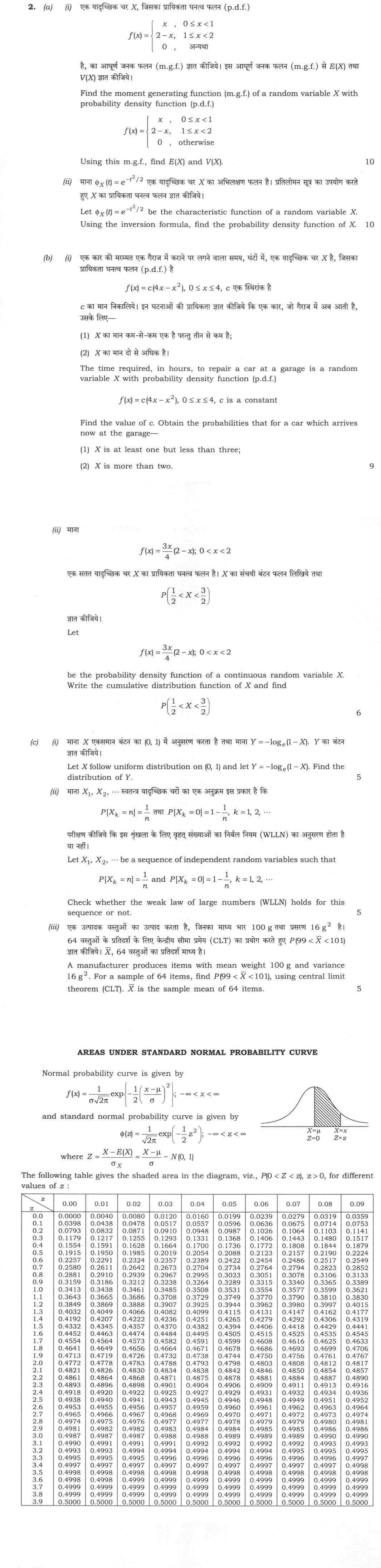
Find the moment generating function (m.g.f.) of a random variable X with probability density function (p.d.f.)
f(x) = { x , 0 ≤ x < 1 2 - x, 1 ≤ x < 2 0 , otherwise
Using this m.g.f., find E(X) and V(X). 10 marks
Let ϕ_X (t) = e^(−t²/2) be the characteristic function of a random variable X. Using the inversion formula, find the probability density function of X. 10 marks
The time required, in hours, to repair a car at a garage is a random variable X with probability density function (p.d.f.)
f(x) = c(4x − x²), 0 ≤ x ≤ 4, c is a constant
Find the value of c. Obtain the probabilities that for a car which arrives now at the garage—
(1) X is at least one but less than three;
(2) X is more than two. 9 marks
Let
f(x) = 3x/4 (2 - x); 0 < x < 2
be the probability density function of a continuous random variable X. Write the cumulative distribution function of X and find
P(1/2 < X < 3/2) 6 marks
Let X follow uniform distribution on (0, 1) and let Y = -log_e(1 - X). Find the distribution of Y. 5 marks
Let X₁, X₂, ⋯ be a sequence of independent random variables such that
P[X_k = n] = 1/n and P[X_k = 0] = 1 - 1/n, k = 1, 2, ⋯
Check whether the weak law of large numbers (WLLN) holds for this sequence or not. 5 marks
A manufacturer produces items with mean weight 100 g and variance 16 g². For a sample of 64 items, find P(99 < X̄ < 101), using central limit theorem (CLT). X̄ is the sample mean of 64 items. 5 marks
हिंदी में प्रश्न पढ़ें
एक यादृच्छिक चर X, जिसका प्रायिकता घनत्व फलन (p.d.f.)
f(x) = { x , 0 ≤ x < 1 2 - x, 1 ≤ x < 2 0 , अन्यथा
है, का आघूर्ण जनक फलन (m.g.f.) ज्ञात कीजिये। इस आघूर्ण जनक फलन (m.g.f.) से E(X) तथा V(X) ज्ञात कीजिये। (10 अंक)
माना ϕ_X (t) = e^(−t²/2) एक यादृच्छिक चर X का अभिलक्षण फलन है। प्रतिलोमन सूत्र का उपयोग करते हुए X का प्रायिकता घनत्व फलन ज्ञात कीजिये। (10 अंक)
एक कार की मरम्मत एक गैराज में कराने पर लगने वाला समय, घंटों में, एक यादृच्छिक चर X है, जिसका प्रायिकता घनत्व फलन (p.d.f.) है
f(x) = c(4x − x²), 0 ≤ x ≤ 4, c एक स्थिरांक है
c का मान निकालिये। इन घटनाओं की प्रायिकता ज्ञात कीजिये कि एक कार, जो गैराज में अब आती है, उसके लिए—
(1) X का मान कम-से-कम एक है परन्तु तीन से कम है;
(2) X का मान दो से अधिक है। (9 अंक)
माना
f(x) = 3x/4 (2 - x); 0 < x < 2
एक सतत यादृच्छिक चर X का प्रायिकता घनत्व फलन है। X का संचयी बंटन फलन लिखिये तथा
P(1/2 < X < 3/2)
ज्ञात कीजिये। (6 अंक)
माना X एकसमान बंटन का (0, 1) में अनुसरण करता है तथा माना Y = -log_e(1 - X). Y का बंटन ज्ञात कीजिये। (5 अंक)
माना X₁, X₂, ⋯ स्वतंत्र यादृच्छिक चरों का एक अनुक्रम इस प्रकार है कि
P[X_k = n] = 1/n तथा P[X_k = 0] = 1 - 1/n, k = 1, 2, ⋯
परीक्षण कीजिये कि इस श्रृंखला के लिए वृहत् संख्याओं का निर्बल नियम (WLLN) का अनुसरण होता है या नहीं। (5 अंक)
एक उत्पादक वस्तुओं का उत्पाद करता है, जिनका माध्य भार 100 g तथा प्रसरण 16 g² है। 64 वस्तुओं के प्रतिदर्श के लिए केन्द्रीय सीमा प्रमेय (CLT) का प्रयोग करते हुए P(99 < X̄ < 101) ज्ञात कीजिये। X̄, 64 वस्तुओं का प्रतिदर्श माध्य है। (5 अंक)
Model answer
Drafted with AI by UPSC Answer Check against this question's marking rubric, to the expected length. UPSC does not publish answers for Mains — this is one way to score well, not an official key. How we build rubrics and answers.
(a) (i) M.g.f., mean and variance of the triangular law
M(t) = E(e^(tX)) = ∫₀¹ x e^(tx) dx + ∫₁² (2 − x) e^(tx) dx. First integral = e^t/t − (e^t − 1)/t²; second integral = (e^(2t) − e^t)/t² − e^t/t. Adding: M(t) = (e^(2t) − 2e^t + 1)/t² = (e^t − 1)²/t², t ≠ 0, with M(0) = 1 by continuity.
Moments: (e^t − 1)/t = 1 + t/2 + t²/6 + …, so M(t) = 1 + t + (7/12)t² + … E(X) = M′(0) = coefficient of t = 1; E(X²) = M″(0) = 2!·(7/12) = 7/6. V(X) = 7/6 − 1² = 1/6. Check: this symmetric triangular law is the law of U₁ + U₂ with Uᵢ ~ U(0, 1) independent, whose m.g.f. is [(e^t − 1)/t]², mean 1 and variance 2·(1/12) = 1/6.
(a) (ii) Density from the characteristic function
Since φ(t) = e^(−t²/2) is absolutely integrable, the inversion formula gives f(x) = (1/2π) ∫_−∞^∞ e^(−itx) e^(−t²/2) dt. Completing the square: −(t²/2 + itx) = −(1/2)(t + ix)² − x²/2. So f(x) = (1/2π) e^(−x²/2) ∫_−∞^∞ e^(−(t + ix)²/2) dt. Shifting the line of integration (the integrand is entire and vanishes at ±∞), the integral equals ∫ e^(−u²/2) du = √(2π). Hence f(x) = (1/√(2π)) e^(−x²/2), −∞ < x < ∞, i.e. X ~ N(0, 1); by the uniqueness theorem this is the only density with this characteristic function.
(b) (i) Repair-time density
∫₀⁴ c(4x − x²) dx = c[2x² − x³/3]₀⁴ = c(32 − 64/3) = c(32/3) = 1, so c = 3/32.
(1) P(1 ≤ X < 3) = (3/32)[2x² − x³/3]₁³ = (3/32)(9 − 5/3) = (3/32)(22/3) = 11/16 = 0.6875.
(2) P(X > 2) = (3/32)[2x² − x³/3]₂⁴ = (3/32)(32/3 − 16/3) = 1/2, as expected since f is symmetric about x = 2 (the mean repair time).
(b) (ii) C.d.f. and a probability
f(x) = (3/4)(2x − x²) on (0, 2); ∫₀² f = (3/4)(4 − 8/3) = 1, so f is valid. F(x) = (3/4)∫₀ˣ (2t − t²) dt = (3/4)(x² − x³/3) = (x²/4)(3 − x). The c.d.f. is F(x) = 0 for x ≤ 0; F(x) = (x²/4)(3 − x) for 0 < x < 2; F(x) = 1 for x ≥ 2. F(3/2) = (9/16)(3/2) = 27/32; F(1/2) = (1/16)(5/2) = 5/32. P(1/2 < X < 3/2) = 27/32 − 5/32 = 22/32 = 11/16 = 0.6875.
(c) (i) Distribution of Y = −logₑ(1 − X)
X ~ U(0, 1), so F_X(x) = x on (0, 1); Y is increasing in X with range (0, ∞). For y > 0: F_Y(y) = P(−logₑ(1 − X) ≤ y) = P(1 − X ≥ e^(−y)) = P(X ≤ 1 − e^(−y)) = 1 − e^(−y). Differentiating, f_Y(y) = e^(−y), y > 0. Y follows the standard exponential distribution (mean 1, variance 1) — the inverse-transform result.
(c) (ii) Weak law of large numbers
E(Xₖ) = n·(1/n) + 0 = 1; E(Xₖ²) = n²·(1/n) = n; V(Xₖ) = n − 1. Chebyshev's sufficient condition for the WLLN is (1/n²) Σₖ₌₁ⁿ V(Xₖ) → 0. Here (1/n²)·n(n − 1) = (n − 1)/n → 1 ≠ 0, so the condition fails. Direct check: X̄ₙ = 0 whenever every Xₖ = 0, so P(X̄ₙ = 0) = (1 − 1/n)ⁿ → e^(−1) ≈ 0.368. Hence P(|X̄ₙ − 1| ≥ 1/2) ≥ 0.368 does not tend to 0, and the WLLN does not hold for this sequence.
(c) (iii) CLT for the mean weight
μ = 100 g, σ² = 16 g² (σ = 4 g), n = 64. By the CLT, X̄ ≈ N(μ, σ²/n) with standard error σ/√n = 4/8 = 0.5 g. z = (99 − 100)/0.5 = −2 and z = (101 − 100)/0.5 = 2. P(99 < X̄ < 101) = P(−2 < Z < 2) = 2 × 0.4772 = 0.9544.
How this answer will be evaluated
Evaluation rubric
Each sub-part is marked on its own, against the marks and word limit printed on the paper.
- (a)(i) Two linked tasks: (a) obtain the m.g.f. of the symmetric triangular density f(x) = x on [0,1), 2 − x on [1,2), and (b) use that m.g.f. (not direct integration of f) to get E(X) and V(X). 10 marks
Must cover
- M(t) = (e^{t} − 1)²/t², t ≠ 0; M(0) = 1
- Symmetric triangular distribution on (0, 2) = sum of two independent U(0,1)
- E(X) = 1
- E(X²) = 7/6
- V(X) = 1/6 ≈ 0.167
Loses marks
- Integrating over (0, 2) with a single expression instead of splitting at x = 1
- Getting M(t) = (e^{t} − 1)/t² or (e^{2t} − 1)/t² through a sign slip in the second integral
- Reporting V(X) = 1/12 (the U(0,1) variance) or 7/6 (forgetting to subtract the squared mean)
- Finding E(X) and V(X) by direct integration of x f(x) when the question explicitly says 'using this m.g.f.'
- Not handling the t = 0 case, where M(t) is 0/0 and must be defined by continuity as 1
Earns more
- Correct set-up M(t) = ∫₀¹ x e^{tx}dx + ∫₁²(2 − x)e^{tx}dx with the two-piece support respected
- (a)(ii) Given the characteristic function φ_X(t) = e^{−t²/2}, recover the density of X by explicit use of the Fourier inversion formula (not by simply quoting the uniqueness theorem for the normal law). 10 marks
Must cover
- Inversion formula f(x) = (1/2π)∫e^{−itx}φ(t)dt
- Completing the square −t²/2 − itx = −(1/2)(t+ix)² − x²/2
- Gaussian integral value √(2π)
- f(x) = (1/√(2π))e^{−x²/2}
- X ~ N(0, 1); uniqueness theorem for characteristic functions
Loses marks
- Using e^{+itx} instead of e^{−itx} in the inversion integral (or dropping the 1/2π)
- Simply asserting 'e^{−t²/2} is the c.f. of N(0,1)' — the question demands the inversion computation
- Sign error while completing the square, producing e^{+x²/2} (not a density)
- Quoting ∫e^{−t²/2}dt = √π instead of √(2π)
- Confusing the m.g.f. e^{t²/2} with the characteristic function e^{−t²/2}
Earns more
- Evaluation of ∫_{−∞}^{∞} e^{−(t+ix)²/2} dt = √(2π) (with a word on shifting the contour)
- (b)(i) Three computations on f(x) = c(4x − x²), 0 ≤ x ≤ 4: find the normalising constant c, then P(1 ≤ X < 3) and P(X > 2). All three answers must be numerical. 9 marks
Must cover
- c = 3/32
- Antiderivative 2x² − x³/3
- P(1 ≤ X < 3) = 11/16 = 0.6875
- P(X > 2) = 1/2 = 0.5
- Symmetry of f(x) about x = 2 (mean repair time 2 hours)
Loses marks
- Integrating over (0, ∞) or (−∞, ∞) instead of the stated support 0 ≤ x ≤ 4, giving a wrong c
- Arithmetic slip 32 − 64/3 = 32/3 done as 64/3 or 96/3, producing c = 3/64 or 1/32
- Fussing over whether the endpoints are included — for a continuous X, P(X = 1) = P(X = 3) = 0, so ≤ and < give the same answer
- Computing P(X > 2) as 1 − F(2) but mis-evaluating F(2) = 1/2
- Leaving answers as unsimplified fractions with no decimal value
Earns more
- Normalisation set up correctly: ∫₀⁴(4x − x²)dx = [2x² − x³/3]₀⁴ = 32/3
- (b)(ii) This is Q.2(b)(ii). For f(x) = (3x/4)(2 − x), 0 < x < 2, write the complete cumulative distribution function F(x) (including the values outside the support) and evaluate P(1/2 < X < 3/2). 6 marks
Must cover
- F(x) = (x²/4)(3 − x) for 0 ≤ x ≤ 2
- F(x) = 0 for x ≤ 0, F(x) = 1 for x ≥ 2
- F(3/2) = 27/32, F(1/2) = 5/32
- P(1/2 < X < 3/2) = 11/16 = 0.6875
- f is symmetric about x = 1 (a Beta(2,2) scaled to (0,2))
Loses marks
- Giving only the middle branch of F and omitting F = 0 and F = 1 outside the support — the question says 'write the cumulative distribution function'
- Dropping the factor 3/4 while integrating, giving F(2) ≠ 1
- Algebra slip producing F(x) = (3x²/4) − (x³/3) which fails the check F(2) = 1
- Computing P as F(3/2) + F(1/2) or as 1 − F(3/2)
- Leaving 22/32 unsimplified and not giving a decimal
Earns more
- Checks/states that ∫₀²(3x/4)(2 − x)dx = 1, so f is a valid p.d.f.
- Writes the c.d.f. as a complete piecewise function: F = 0 for x ≤ 0 and F = 1 for x ≥ 2
- (c)(i) Find the distribution of Y = −log_e(1 − X) when X ~ U(0, 1). Name the resulting distribution and give its density — this is the standard inverse-transform result. 5 marks
Must cover
- F_Y(y) = 1 − e^{−y}, y > 0
- f_Y(y) = e^{−y}, y > 0
- Exponential distribution with mean 1 (rate 1)
- F_X(u) = u for U(0,1)
- Inverse probability integral transform
Loses marks
- Getting the inequality direction wrong at the step P(1 − X ≥ e^{−y}) and ending with e^{−y} as the c.d.f.
- Reporting the density as e^{−y} on the whole real line instead of y > 0
- Forgetting the modulus of the Jacobian when using the transformation formula
- Naming the law 'Gamma' or 'Weibull' without specifying it is Exp(1)
- Using Y = −log X (a different but identically distributed variable) without noting the equivalence 1 − X ~ U(0,1)
Earns more
- Establishes the support of Y as (0, ∞) and notes the transformation is strictly monotone increasing
- Names the law: standard exponential Exp(rate 1) with E(Y) = V(Y) = 1; notes this is the inverse probability integral transform
- (c)(ii) 'Check whether' — test the given sequence of independent variables against the weak law of large numbers: compute the means and variances, apply Chebyshev's sufficient condition n^{−2} Σ V(X_i) → 0, and give a definite verdict. 5 marks
Must cover
- E(X_k) = 1
- V(X_k) = n − 1
- Chebyshev's condition n^{−2} Σ V(X_i) → 0
- (n − 1)/n → 1 ≠ 0
- Conclusion: WLLN does not hold
Loses marks
- Computing E(X_k²) as n × (1/n) = 1 instead of n² × (1/n) = n — i.e. forgetting to square the value n before weighting
- Concluding 'WLLN holds' merely because each X_k has a finite mean (Khinchine needs an i.i.d. sequence with a fixed distribution)
- Treating the failure of Chebyshev's sufficient condition as automatically proving failure of the WLLN without any further argument
- Dividing by n instead of n² in the Chebyshev condition
- Not stating a definite verdict at the end
Earns more
- Correct mean E(X_k) = n(1/n) = 1
- Clear verdict that the WLLN does not hold, ideally supported by the direct check P(X̄_n = 0) = (1 − 1/n)^n → e^{−1} ≈ 0.368 ≠ 0
- (c)(iii) Apply the central limit theorem to the sample mean of 64 items (population mean 100 g, variance 16 g²) and compute P(99 < X̄ < 101) using the standard normal table. 5 marks
Must cover
- Central limit theorem, X̄ ~ N(μ, σ²/n) approximately
- SE = σ/√n = 0.5 g
- z = ±2
- P(0 < Z < 2) = 0.4772 (table value)
- P(99 < X̄ < 101) ≈ 0.9544
Loses marks
- Using σ = 16 instead of σ = 4 (confusing variance with standard deviation), giving z = ±0.5 and P ≈ 0.383
- Forgetting to divide by √n and standardising with σ = 4, giving z = ±0.25
- Reporting 0.4772 (a one-sided area) as the answer instead of doubling it
- Using a continuity correction — unnecessary here since weight is continuous
- Quoting the table value for z = 2 as 0.9772 (that is Φ(2), the area to the left of 2) and then doubling it
Earns more
- States the CLT result X̄ ≈ N(μ, σ²/n) and that no distributional assumption about the individual weights is needed
What "Solve" is asking you to do
Choose the method, then carry it through to a final answer. Identifying what kind of problem this is and why that method applies is the first thing marked; a correct figure arrived at invisibly earns almost nothing.
Structure that answers it
Given data and what is required → method chosen, with the reason it applies → set-up (equation, circuit, free body, trial balance) → working, step by step → answer with units and any condition of validity
Where marks are lost
Doing the middle steps mentally and writing only the result. In mathematics papers, a further loss comes from giving a decimal where the exact value in surds or fractions was wanted, or from skipping the justification a part explicitly asks for.
Practice this exact question
Write your answer and it is marked point by point against the model answer above — what you covered, what you missed, what you got wrong.
Evaluate my answer →More from Statistics 2026 Paper I
- Q1 (a) (i) Show that for n events A₁, A₂, ⋯, Aₙ P( ⋂_{i=1}^{n} Aᵢ ) ≥ Σ_{i=1}^{n} P(Aᵢ) − (n…
- Q2 (a) (i) Find the moment generating function (m.g.f.) of a random variable X with probabil…
- Q3 (a) Let the joint probability density function of X and Y be f(x, y) = 3/4 ( xy + x²/2 )…
- Q4 (a) Let X₁, X₂, ⋯, Xₙ be i.i.d. random variables following N(μ, σ²). Find the maximum lik…
- Q5 (a) Let Y₁, Y₂, ⋯, Yₙ be n independent observations from a population with mean μ and var…