Paper I — Q3
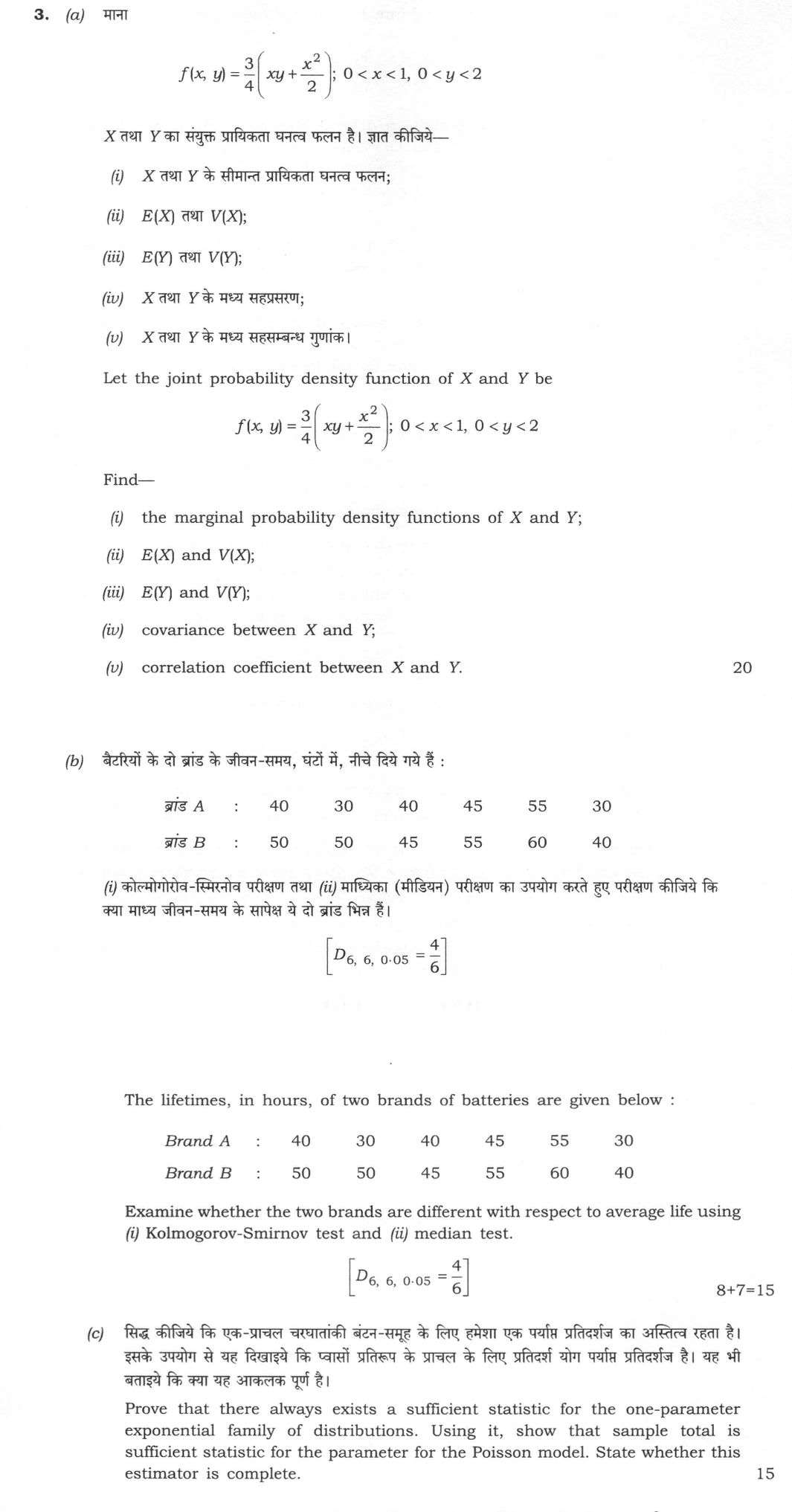
(a) Let the joint probability density function of X and Y be f(x, y) = 3/4 ( xy + x²/2 ) ; 0 < x < 1, 0 < y < 2 Find— (i) the…
Let the joint probability density function of X and Y be
f(x, y) = 3/4 ( xy + x²/2 ) ; 0 < x < 1, 0 < y < 2
Find—
the marginal probability density functions of X and Y;
E(X) and V(X);
E(Y) and V(Y);
covariance between X and Y;
correlation coefficient between X and Y. 20 marks
Life-times, in hours, of two brands of batteries are given below :
Brand A : 40 30 40 45 55 30
Brand B : 50 50 45 55 60 40
Using (i) Kolmogorov-Smirnov test and (ii) Median test, test whether the two brands differ with respect to mean life-time.
[ D₆, ₆, ₀.₀₅ = 4/6 ] The lifetimes, in hours, of two brands of batteries are given below :
Brand A : 40 30 40 45 55 30 Brand B : 50 50 45 55 60 40
Examine whether the two brands are different with respect to average life using (i) Kolmogorov-Smirnov test and (ii) median test.
[D₆, ₆, ₀·₀₅ = 4/6] 15 marks
Prove that there always exists a sufficient statistic for the one-parameter exponential family of distributions. Using it, show that sample total is sufficient statistic for the parameter for the Poisson model. State whether this estimator is complete. 15 marks
हिंदी में प्रश्न पढ़ें
माना
f(x, y) = 3/4 ( xy + x²/2 ) ; 0 < x < 1, 0 < y < 2
X तथा Y का संयुक्त प्रायिकता घनत्व फलन है। ज्ञात कीजिये—
X तथा Y के सीमान्त प्रायिकता घनत्व फलन;
E(X) तथा V(X);
E(Y) तथा V(Y);
X तथा Y के मध्य सहप्रसरण;
X तथा Y के मध्य सहसम्बन्ध गुणांक। (20 अंक)
बैटरियों के दो ब्रांड के जीवन-समय, घंटों में, नीचे दिये गये हैं :
ब्रांड A : 40 30 40 45 55 30
ब्रांड B : 50 50 45 55 60 40
कोल्मोगोरोव-स्मिरनोव परीक्षण तथा (ii) माध्यिका (मीडियन) परीक्षण का उपयोग करते हुए परीक्षण कीजिये कि क्या माध्य जीवन-समय के सापेक्ष ये दो ब्रांड भिन्न हैं।
[ D₆, ₆, ₀.₀₅ = 4/6 ] दो ब्रांडों की बैटरियों की आयु (घंटों में) नीचे दी गई है :
ब्रांड A : 40 30 40 45 55 30 ब्रांड B : 50 50 45 55 60 40
कोलमोगोरोव-स्मिर्नोव परीक्षण तथा (ii) माध्यक परीक्षण का उपयोग करते हुए परीक्षण कीजिये कि औसत आयु के संबंध में दोनों ब्रांड भिन्न हैं या नहीं।
[D₆, ₆, ₀·₀₅ = 4/6] (15 अंक)
सिद्ध कीजिये कि एक-प्राचल चरघातांकी बंटन-समूह के लिये हमेशा एक पर्याप्त प्रतिदर्शज का अस्तित्व रहता है। इसके उपयोग से यह दिखाइये कि प्वासों प्रतिरूप के प्राचल के लिये प्रतिदर्श योग पर्याप्त प्रतिदर्शज है। यह भी बताइये कि क्या यह आकलक पूर्ण है। (15 अंक)
Model answer
Drafted with AI by UPSC Answer Check against this question's marking rubric, to the expected length. UPSC does not publish answers for Mains — this is one way to score well, not an official key. How we build rubrics and answers.
(a) Joint density: marginals, moments, covariance, correlation
Check: ∫₀¹∫₀² (3/4)(xy + x²/2) dy dx = (3/4)∫₀¹ (2x + x²) dx = (3/4)(4/3) = 1.
(i) f_X(x) = ∫₀² (3/4)(xy + x²/2) dy = (3/4)[xy²/2 + x²y/2]₀² = (3/4)(2x + x²) = (3/2)x + (3/4)x², 0 < x < 1. f_Y(y) = ∫₀¹ (3/4)(xy + x²/2) dx = (3/4)[x²y/2 + x³/6]₀¹ = (3/4)(y/2 + 1/6) = (3y + 1)/8, 0 < y < 2.
(ii) E(X) = ∫₀¹ [(3/2)x² + (3/4)x³] dx = 1/2 + 3/16 = 11/16. E(X²) = ∫₀¹ [(3/2)x³ + (3/4)x⁴] dx = 3/8 + 3/20 = 21/40. V(X) = 21/40 − (11/16)² = 21/40 − 121/256 = 67/1280 ≈ 0.0523.
(iii) E(Y) = ∫₀² (3y² + y)/8 dy = [y³/8 + y²/16]₀² = 1 + 1/4 = 5/4. E(Y²) = ∫₀² (3y³ + y²)/8 dy = [3y⁴/32 + y³/24]₀² = 3/2 + 1/3 = 11/6. V(Y) = 11/6 − 25/16 = 13/48 ≈ 0.2708.
(iv) E(XY) = ∫₀¹∫₀² (3/4)(x²y² + x³y/2) dy dx = (3/4)∫₀¹ (8x²/3 + x³) dx = (3/4)(8/9 + 1/4) = 41/48. Cov(X, Y) = 41/48 − (11/16)(5/4) = 41/48 − 55/64 = −1/192 ≈ −0.00521.
(v) ρ = Cov(X, Y)/√[V(X)V(Y)] = (−1/192)/√[(67/1280)(13/48)] = −0.00521/(0.2288 × 0.5204) ≈ −0.0437. X and Y are dependent (f(x, y) ≠ f_X(x)f_Y(y)) but almost uncorrelated.
(b) Kolmogorov-Smirnov and median tests
H₀: the two brands have the same life-time distribution (equal average life); H₁: they differ.
(i) Kolmogorov-Smirnov test. Ordered samples: A = 30, 30, 40, 40, 45, 55; B = 40, 45, 50, 50, 55, 60.
| x | F_A(x) | F_B(x) | \ | F_A − F_B\ | |
|---|---|---|---|---|---|
| 30 | 2/6 | 0 | 2/6 | ||
| 40 | 4/6 | 1/6 | 3/6 | ||
| 45 | 5/6 | 2/6 | 3/6 | ||
| 50 | 5/6 | 4/6 | 1/6 | ||
| 55 | 1 | 5/6 | 1/6 | ||
| 60 | 1 | 1 | 0 |
D = max |F_A − F_B| = 3/6 = 0.5 < D₆,₆,₀.₀₅ = 4/6 ≈ 0.667, so H₀ is not rejected.
(ii) Median test. Pooled ordered values: 30, 30, 40, 40, 40, 45, 45, 50, 50, 55, 55, 60; pooled median = (45 + 45)/2 = 45.
| Above 45 | At or below 45 | Total | |
|---|---|---|---|
| A | 1 | 5 | 6 |
| B | 4 | 2 | 6 |
| Total | 5 | 7 | 12 |
With Yates' correction, χ² = N(|ad − bc| − N/2)² / (R₁R₂C₁C₂) = 12(|2 − 20| − 6)²/(6·6·5·7) = 1728/1260 = 1.37 < χ²₁,₀.₀₅ = 3.841 (uncorrected χ² = 3.09, also < 3.841; since expected counts are only 2.5–3.5, Fisher's exact test gives p ≈ 0.24). H₀ is not rejected.
Both tests show no significant difference between the brands in average life at the 5% level (with n₁ = n₂ = 6 both tests have low power).
(c) Sufficiency in the exponential family; Poisson case; completeness
One-parameter exponential family: f(x; θ) = a(θ) b(x) expc(θ) d(x), with support free of θ. For a random sample, L(θ) = [a(θ)]ⁿ expc(θ) Σd(xᵢ) · ∏b(xᵢ) = g(T, θ)·h(x), where T = Σd(xᵢ) and h(x) = ∏b(xᵢ) is free of θ. By the Fisher-Neyman factorisation theorem T = Σd(Xᵢ) is sufficient, so a sufficient statistic always exists for this family.
Poisson(θ): f(x; θ) = e^(−θ) θˣ/x! = e^(−θ) · (1/x!) · expx ln θ, so a(θ) = e^(−θ), b(x) = 1/x!, c(θ) = ln θ, d(x) = x. Hence T = ΣXᵢ (the sample total) is sufficient for θ, and T ~ Poisson(nθ).
Completeness: if E_θ[g(T)] = e^(−nθ) Σₜ≥0 g(t)(nθ)ᵗ/t! = 0 for all θ > 0, the power series Σ g(t)(nθ)ᵗ/t! vanishes identically, so every coefficient g(t) = 0. Hence T = ΣXᵢ is complete (equivalently, c(θ) = ln θ ranges over an open interval, so the family is of full rank). By Lehmann-Scheffé, X̄ = T/n is the UMVUE of θ.
How this answer will be evaluated
Evaluation rubric
Each sub-part is marked on its own, against the marks and word limit printed on the paper.
- (a) A five-part computation on the joint p.d.f. f(x,y) = (3/4)(xy + x²/2) on 0 < x < 1, 0 < y < 2: (i) both marginal densities, (ii) E(X) and V(X), (iii) E(Y) and V(Y), (iv) Cov(X,Y) and (v) the correlation coefficient. Every sub-part carries marks and none may be skipped. 20 marks
Must cover
- f_X(x) = (3/2)x + (3/4)x², 0 < x < 1
- f_Y(y) = (3y + 1)/8, 0 < y < 2
- E(X) = 11/16, V(X) = 67/1280 ≈ 0.0523
- E(Y) = 5/4, V(Y) = 13/48 ≈ 0.2708
- Cov(X,Y) = −1/192 ≈ −0.00521 and ρ ≈ −0.0437
Loses marks
- Integrating the marginal of X over the wrong limits (using 0 to 1 for y instead of 0 to 2), which destroys every later moment
- Forgetting the constant 3/4 in one of the integrals, so a marginal fails the check ∫f = 1
- Computing Cov as E(XY) − E(X) − E(Y), or forgetting to subtract E(X)E(Y) at all
- Rounding too early: 41/48 and 55/64 differ only in the third decimal, so premature rounding can give Cov = 0 and ρ = 0
- Declaring X and Y independent because ρ is nearly zero — independence must be checked against f(x,y) = f_X(x)f_Y(y)
Earns more
- E(Y) = 5/4 = 1.25 and V(Y) = 11/6 − 25/16 = 13/48 ≈ 0.2708
- E(XY) = 41/48 ≈ 0.8542 by double integration
- ρ(X,Y) = −0.0437 (3 s.f.), with the remark that X and Y are dependent though nearly uncorrelated
- (b) Apply two non-parametric two-sample tests to the six battery lifetimes of each brand: (i) the Kolmogorov-Smirnov two-sample test (critical value D(6,6,0.05) = 4/6 supplied) and (ii) the median test. Both tests must be carried out with the arithmetic shown and a decision stated for each. 15 marks
Must cover
- H0: identical distributions / equal average life
- D = 3/6 = 0.5 versus D(6,6,0.05) = 4/6
- Pooled median = 45
- 2 × 2 median-test table: A (1, 5), B (4, 2)
- Both tests: do not reject H0 at the 5% level
- Chi-square critical value χ²(1, 0.05) = 3.841 (or Fisher's exact test for the small counts)
Loses marks
- Building the empirical c.d.f.s with the wrong denominators or forgetting the tied values (40 appears twice in A, 50 twice in B)
- Reading D as the difference at a single arbitrary point instead of the maximum over all pooled values
- Rejecting H0 because 'the means 40 and 50 look different' — the sample means are irrelevant to these two tests
- Using the one-sample K-S critical value or an asymptotic formula instead of the supplied D(6,6,0.05) = 4/6
- Comparing the median-test χ² with a wrong critical value (e.g. using 2 degrees of freedom instead of 1)
Earns more
- Correct ordering of both samples and correct construction of the two empirical distribution functions at the pooled values 30, 40, 45, 50, 55, 60
- Median-test statistic and decision: χ²(Yates) = 1.37 or χ² = 3.09 or Fisher exact p ≈ 0.24, all below the 5% critical value χ²(1) = 3.841 ⇒ not significant
- Common conclusion plus the caveat that K-S tests the whole distribution and the median test tests location, with very low power at n1 = n2 = 6
- (c) Three linked tasks: prove that a sufficient statistic always exists for the one-parameter exponential family; deduce that ΣXi is sufficient for the Poisson parameter; and state (with reason) whether that statistic is complete. 15 marks
Must cover
- One-parameter exponential family f(x;θ) = a(θ)b(x)exp{c(θ)d(x)}
- Fisher-Neyman factorisation theorem
- T = Σ d(Xi) is sufficient
- Poisson: c(θ) = ln θ, d(x) = x ⇒ T = ΣXi sufficient, T ~ Poisson(nθ)
- T is complete (full-rank exponential family); Lehmann-Scheffé ⇒ X̄ is the UMVUE of θ
Loses marks
- Omitting the requirement that the support of f must not depend on θ (this is what rules out U(0,θ)-type families)
- Writing the likelihood without the exponent n on a(θ)
- Answering 'no' or 'cannot say' on completeness — for Poisson the statistic is complete and this must be justified, not just asserted
- Confusing completeness of the statistic with completeness of the family, or with minimal sufficiency
- Failing to state the Poisson sufficient statistic explicitly as the sample total ΣXi (equivalently X̄)
Earns more
- Correct canonical one-parameter exponential form f(x;θ) = a(θ)b(x)exp{c(θ)d(x)} with support free of θ
- Hence T = ΣXi is sufficient for θ, and T ~ Poisson(nθ)
What "Solve" is asking you to do
Choose the method, then carry it through to a final answer. Identifying what kind of problem this is and why that method applies is the first thing marked; a correct figure arrived at invisibly earns almost nothing.
Structure that answers it
Given data and what is required → method chosen, with the reason it applies → set-up (equation, circuit, free body, trial balance) → working, step by step → answer with units and any condition of validity
Where marks are lost
Doing the middle steps mentally and writing only the result. In mathematics papers, a further loss comes from giving a decimal where the exact value in surds or fractions was wanted, or from skipping the justification a part explicitly asks for.
Practice this exact question
Write your answer and it is marked point by point against the model answer above — what you covered, what you missed, what you got wrong.
Evaluate my answer →More from Statistics 2026 Paper I
- Q1 (a) (i) Show that for n events A₁, A₂, ⋯, Aₙ P( ⋂_{i=1}^{n} Aᵢ ) ≥ Σ_{i=1}^{n} P(Aᵢ) − (n…
- Q2 (a) (i) Find the moment generating function (m.g.f.) of a random variable X with probabil…
- Q3 (a) Let the joint probability density function of X and Y be f(x, y) = 3/4 ( xy + x²/2 )…
- Q4 (a) Let X₁, X₂, ⋯, Xₙ be i.i.d. random variables following N(μ, σ²). Find the maximum lik…
- Q5 (a) Let Y₁, Y₂, ⋯, Yₙ be n independent observations from a population with mean μ and var…
- Q6 (a) Let l′β be any estimable linear function of parameters β₁, β₂, ⋯, β_p. Then prove tha…