Paper II — Q8
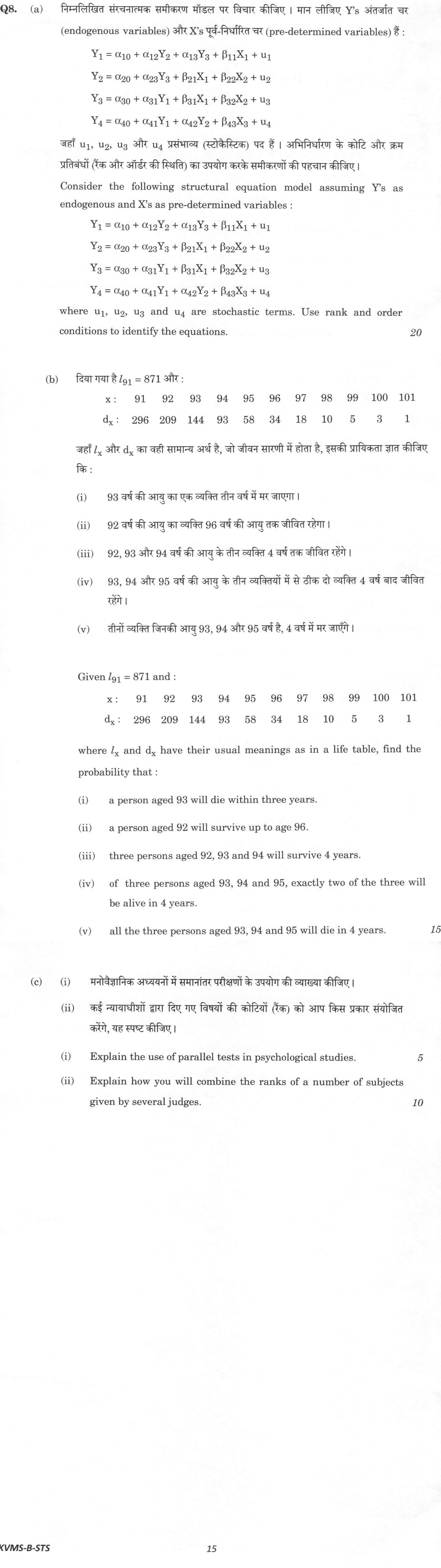
(a) Consider the following structural equation model assuming Y's as endogenous and X's as pre-determined variables : Y₁ = α₁₀ +…
Consider the following structural equation model assuming Y's as endogenous and X's as pre-determined variables :
Y₁ = α₁₀ + α₁₂Y₂ + α₁₃Y₃ + β₁₁X₁ + u₁
Y₂ = α₂₀ + α₂₃Y₃ + β₂₁X₁ + β₂₂X₂ + u₂
Y₃ = α₃₀ + α₃₁Y₁ + β₃₁X₁ + β₃₂X₂ + u₃
Y₄ = α₄₀ + α₄₁Y₁ + α₄₂Y₂ + β₄₃X₃ + u₄
where u₁, u₂, u₃ and u₄ are stochastic terms. Use rank and order conditions to identify the equations. 20 marks
Given l91 = 871 and : x : 91 92 93 94 95 96 97 98 99 100 101 dx : 296 209 144 93 58 34 18 10 5 3 1
where lx and dx have their usual meanings as in a life table, find the probability that :
a person aged 93 will die within three years.
a person aged 92 will survive up to age 96.
three persons aged 92, 93 and 94 will survive 4 years.
of three persons aged 93, 94 and 95, exactly two of the three will be alive in 4 years.
all the three persons aged 93, 94 and 95 will die in 4 years. 15 marks
Explain the use of parallel tests in psychological studies. 5 marks
Explain how you will combine the ranks of a number of subjects given by several judges. 10 marks
हिंदी में प्रश्न पढ़ें
Q8. (a) निम्नलिखित संरचनात्मक समीकरण मॉडल पर विचार कीजिए । मान लीजिए Y's अंतर्जात चर (endogenous variables) और X's पूर्व-निर्धारित चर (pre-determined variables) हैं :
Y₁ = α₁₀ + α₁₂Y₂ + α₁₃Y₃ + β₁₁X₁ + u₁
Y₂ = α₂₀ + α₂₃Y₃ + β₂₁X₁ + β₂₂X₂ + u₂
Y₃ = α₃₀ + α₃₁Y₁ + β₃₁X₁ + β₃₂X₂ + u₃
Y₄ = α₄₀ + α₄₁Y₁ + α₄₂Y₂ + β₄₃X₃ + u₄
जहाँ u₁, u₂, u₃ और u₄ प्रसंभाव्य (स्टोकेस्टिक) पद हैं । अभिनिर्धारण के कोटि और क्रम प्रतिबंधों (रैंक और ऑर्डर की स्थिति) का उपयोग करके समीकरणों की पहचान कीजिए । (20 अंक)
दिया गया है l91 = 871 और : x : 91 92 93 94 95 96 97 98 99 100 101 dx : 296 209 144 93 58 34 18 10 5 3 1
जहाँ lx और dx का वही सामान्य अर्थ है, जो जीवन सारणी में होता है, इसकी प्रायिकता ज्ञात कीजिए कि :
93 वर्ष की आयु का एक व्यक्ति तीन वर्ष में मर जाएगा ।
92 वर्ष की आयु का व्यक्ति 96 वर्ष की आयु तक जीवित रहेगा ।
92, 93 और 94 वर्ष की आयु के तीन व्यक्ति 4 वर्ष तक जीवित रहेंगे ।
93, 94 और 95 वर्ष की आयु के तीन व्यक्तियों में से ठीक दो व्यक्ति 4 वर्ष बाद जीवित रहेंगे ।
तीनों व्यक्ति जिनकी आयु 93, 94 और 95 वर्ष है, 4 वर्ष में मर जाएँगे । (15 अंक)
मनोवैज्ञानिक अध्ययनों में समानांतर परीक्षणों के उपयोग की व्याख्या कीजिए। (5 अंक)
कई न्यायाधीशों द्वारा दिए गए विषयों की कोटियों (रैंक) को आप किस प्रकार संयोजित करेंगे, यह स्पष्ट कीजिए। (10 अंक)
Model answer
Drafted with AI by UPSC Answer Check against this question's marking rubric, to the expected length. UPSC does not publish answers for Mains — this is one way to score well, not an official key. How we build rubrics and answers.
(a) Identification by the order and rank conditions (20 marks)
There are M = 4 endogenous variables (Y₁ to Y₄) and K = 3 predetermined variables (X₁, X₂, X₃). Let Gᵢ be the number of endogenous variables (including the dependent one) and kᵢ the number of predetermined variables in equation i.
Order condition (necessary): K − kᵢ ≥ Gᵢ − 1, that is, the number of predetermined variables excluded from the equation must be at least the number of endogenous variables included minus one; equality gives exact identification, and inequality over-identification.
- Equation 1 includes Y₁, Y₂, Y₃ (G = 3) and X₁ (k = 1): K − k = 2 ≥ 2, so the order condition holds with equality.
- Equation 2 includes Y₂, Y₃ (G = 2) and X₁, X₂ (k = 2): K − k = 1 ≥ 1, equality.
- Equation 3 includes Y₃, Y₁ (G = 2) and X₁, X₂ (k = 2): K − k = 1 ≥ 1, equality.
- Equation 4 includes Y₄, Y₁, Y₂ (G = 3) and X₃ (k = 1): K − k = 2 ≥ 2, equality.
So the order condition shows every equation to be just identified, but this condition is only necessary. The rank condition (necessary and sufficient) requires that the matrix formed from the coefficients of the variables excluded from equation i, taken from the other M − 1 = 3 equations, has rank M − 1 = 3.
Write the coefficient table (columns Y₁, Y₂, Y₃, Y₄, X₁, X₂, X₃; the intercept is in every equation and is ignored):
- Eq. 1: 1, −α₁₂, −α₁₃, 0, −β₁₁, 0, 0
- Eq. 2: 0, 1, −α₂₃, 0, −β₂₁, −β₂₂, 0
- Eq. 3: −α₃₁, 0, 1, 0, −β₃₁, −β₃₂, 0
- Eq. 4: −α₄₁, −α₄₂, 0, 1, 0, 0, −β₄₃
Equation 1: the excluded variables are Y₄, X₂, X₃. From equations 2, 3 and 4 the matrix is rows (0, −β₂₂, 0), (0, −β₃₂, 0), (1, 0, −β₄₃). Its first and third columns are proportional, so the rank is 2 < 3: equation 1 is not identified.
Equation 2: the excluded variables are Y₁, Y₄, X₃. From equations 1, 3 and 4: rows (1, 0, 0), (−α₃₁, 0, 0), (−α₄₁, 1, −β₄₃). The second and third columns are proportional, so the rank is 2 < 3: not identified.
Equation 3: the excluded variables are Y₂, Y₄, X₃. From equations 1, 2 and 4: rows (−α₁₂, 0, 0), (1, 0, 0), (−α₄₂, 1, −β₄₃). Rank is 2 < 3: not identified.
Equation 4: the excluded variables are Y₃, X₁, X₂. From equations 1, 2 and 3: rows (−α₁₃, −β₁₁, 0), (−α₂₃, −β₂₁, −β₂₂), (1, −β₃₁, −β₃₂). The determinant is −α₁₃(β₂₁β₃₂ − β₂₂β₃₁) + β₁₁(α₂₃β₃₂ + β₂₂), which is non-zero in general, so the rank is 3 and equation 4 is exactly identified.
Conclusion: only equation 4 is (exactly) identified; equations 1, 2 and 3 satisfy the order condition but fail the rank condition, and are unidentified. This shows that the order condition alone is not sufficient.
(b) Life table probabilities (15 marks)
Build lₓ from l₉₁ = 871 using lₓ₊₁ = lₓ − dₓ: l₉₁ = 871, l₉₂ = 575, l₉₃ = 366, l₉₄ = 222, l₉₅ = 129, l₉₆ = 71, l₉₇ = 37, l₉₈ = 19, l₉₉ = 9, l₁₀₀ = 4, l₁₀₁ = 1 (and l₁₀₂ = 0, so the d column sums to 871).
(i) A person aged 93 dies within three years: 1 − l₉₆/l₉₃ = 1 − 71/366 = 295/366 = 0.806 (equivalently (144 + 93 + 58)/366).
(ii) A person aged 92 survives to 96: l₉₆/l₉₂ = 71/575 = 0.1235.
(iii) Three persons aged 92, 93, 94 all survive four years, the lives being independent: (l₉₆/l₉₂)(l₉₇/l₉₃)(l₉₈/l₉₄) = (71/575)(37/366)(19/222) = 0.1235 × 0.1011 × 0.0856 = 0.00107.
(iv) Of three aged 93, 94, 95, exactly two alive in 4 years. The survival probabilities are p₁ = l₉₇/l₉₃ = 37/366 = 0.1011, p₂ = l₉₈/l₉₄ = 19/222 = 0.0856, p₃ = l₉₉/l₉₅ = 9/129 = 0.0698, with q's 0.8989, 0.9144, 0.9302. Then
P = p₁p₂q₃ + p₁q₂p₃ + q₁p₂p₃ = 0.1011 × 0.0856 × 0.9302 + 0.1011 × 0.9144 × 0.0698 + 0.8989 × 0.0856 × 0.0698 = 0.00805 + 0.00645 + 0.00537 = 0.0199.
(v) All three die within 4 years: q₁q₂q₃ = 0.8989 × 0.9144 × 0.9302 = 0.7646.
(c)(i) Parallel tests in psychological studies (5 marks)
In classical test theory an observed score is X = T + E. Two tests are parallel if they measure the same true score T for every person and have equal error variances (hence equal means, variances and correlations with any other variable). Then the correlation between their scores is the reliability, ρ_XX′ = σ_T²/σ_X². Uses: estimating reliability by the parallel-forms method without the memory and practice effects of test-retest; providing equivalent forms for pre- and post-testing and for repeated measurement; preventing cheating by using alternate forms; the split-half method, in which halves are treated as parallel and the Spearman-Brown formula raises the half-test reliability to that of the full test; and computing the standard error of measurement, σ_X√(1 − ρ_XX′).
(c)(ii) Combining the rankings given by several judges (10 marks)
Let m judges rank n subjects. First find the rank sum Rᵢ of each subject over the m judges. To test whether the judges agree, compute Kendall's coefficient of concordance:
W = 12 S/[m²(n³ − n)], with S = Σ(Rᵢ − R̄)² and R̄ = m(n + 1)/2.
W lies between 0 (no agreement) and 1 (complete agreement). With ties, average ranks are used and the denominator is corrected to m²(n³ − n) − m ΣT, T = Σ(t³ − t) over each judge's tied groups. To test significance, χ² = m(n − 1)W with n − 1 degrees of freedom (for n > 7; use tables of S for smaller n). It is related to the mean Spearman rank correlation between the judges by r̄ = (mW − 1)/(m − 1). If W is significant, the judges are in substantial agreement, and the combined ranking is obtained by ordering the subjects by their rank sums (smallest sum being rank 1), with ties averaged; this is the Borda-count method. If W is not significant, pooling is not justified.
How this answer will be evaluated
Evaluation rubric
Each sub-part is marked on its own, against the marks and word limit printed on the paper.
- (a) Use the order and rank conditions to identify the four equations (20). 20 marks
Must cover
- Counting: M = 4, K = 3 and each equation's G_i, k_i
- Order condition K − k_i ≥ G_i − 1 satisfied with equality for all four
- Rank condition applied with correct coefficient matrices: equations 1, 2 and 3 have rank 2 < 3 and are not identified
- Equation 4 has a non-zero determinant, rank 3, exactly identified; conclusion that order is necessary, not sufficient
Loses marks
- Concluding all four are exactly identified from the order condition alone.
- Miscounting excluded variables.
- Ignoring the rank condition.
Earns more
- Coefficient table constructed correctly.
- Reasons for rank failure given (proportional columns).
Extra mark
- Statement of the estimation method for identified equations (ILS, 2SLS)
- (b) From l₉₁ = 871 and the d_x column, find five probabilities for ages 91 to 101 (15). 15 marks
Must cover
- Construction of l_x: 871, 575, 366, 222, 129, 71, 37, 19, 9, 4, 1
- (i) 295/366 = 0.806 and (ii) 71/575 = 0.1235
- (iii) 0.00107 using independent survival probabilities
- (iv) exactly two of three = 0.0199 and (v) all die = 0.7646
Loses marks
- Using d_x instead of l_x as denominators.
- Treating (iv) as a single product.
- Mixing up 'die within three years' with 'die in the third year'.
Earns more
- Correct p and q values for each individual in (iv) and (v).
- Independence of lives stated.
Extra mark
- Check that the d column sums to l₉₁
- (c)(i) Explain the use of parallel tests in psychological studies (5). 5 marks
Must cover
- Definition: same true score, equal error variance, X = T + E
- Reliability as correlation between parallel forms
- At least two uses (equivalent forms, avoiding practice effect, split-half with Spearman-Brown, SEM)
Loses marks
- Calling any two tests of the same trait parallel.
- No mention of the error-variance condition.
- Confusing parallel forms with split-half only.
Earns more
- Formula ρ_XX′ = σ_T²/σ_X² and SEM.
- Contrast with test-retest.
Extra mark
- Assumption limits of strict parallelism
- (c)(ii) Explain how to combine the ranks of subjects given by several judges (10). 10 marks
Must cover
- Rank sums R_i and Kendall's W = 12S/[m²(n³−n)] with S = Σ(R_i − R̄)²
- Range of W and its meaning; tie correction
- Significance test χ² = m(n−1)W
- Combined ranking by ordering rank sums, provided W is significant
Loses marks
- Averaging raw scores instead of ranks.
- Omitting the agreement test.
- Wrong formula or missing m² in the denominator.
Earns more
- Relationship r̄ = (mW − 1)/(m − 1).
- Handling of ties by average ranks.
Extra mark
- Borda count named or worked example
What "Identify" is asking you to do
Pick out the particular instances that satisfy the question's test and name them precisely, with just enough against each to show it qualifies. A wrong pick earns nothing however well written, so the selection itself is the exercise.
Structure that answers it
The test an instance has to meet → instance named → the single line showing it meets the test → the same for each further instance
Where marks are lost
Describing the instances at length while never establishing why each one belongs in the set.
Practice this exact question
Write your answer and it is marked point by point against the model answer above — what you covered, what you missed, what you got wrong.
Evaluate my answer →More from Statistics 2026 Paper II
- Q5 (a) Explain the 2-stage least squares (2SLS) method of estimation for the following simul…
- Q6 (a) Define autocorrelation of order k and correlogram. For an infinite series generated b…
- Q7 (a) (i) Define a life table and mention its uses. (5 marks) (ii) The number of persons dy…
- Q8 (a) Consider the following structural equation model assuming Y's as endogenous and X's a…