Paper I — Q1
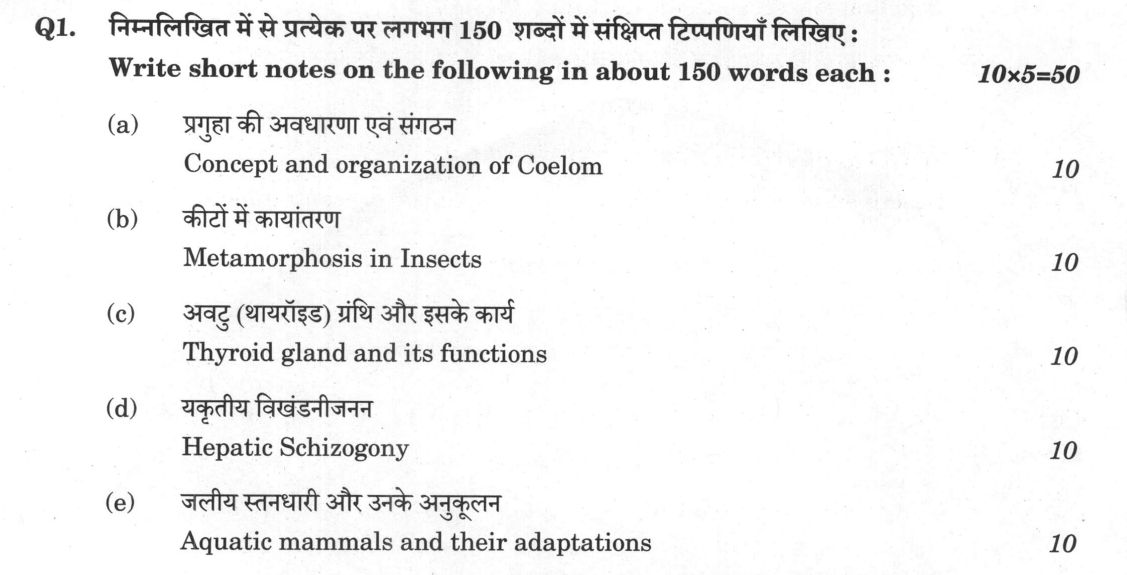
Write short notes on the following in about 150 words each: (a) Concept and organization of Coelom (10 marks) (b) Metamorphosis…
Write short notes on the following in about 150 words each: Concept and organization of Coelom 10 marks
Metamorphosis in Insects 10 marks
Thyroid gland and its functions 10 marks
Hepatic Schizogony 10 marks
Aquatic mammals and their adaptations 10 marks
हिंदी में प्रश्न पढ़ें
निम्नलिखित में से प्रत्येक पर लगभग 150 शब्दों में संक्षिप्त टिप्पणियाँ लिखिए : प्रगुहा की अवधारणा एवं संगठन (10 अंक)
कीटों में कायांतरण (10 अंक)
अवटु (थायरॉइड) ग्रंथि और इसके कार्य (10 अंक)
यकृतीय विखंडनजनन (10 अंक)
जलीय स्तनधारी और उनके अनुकूलन (10 अंक)
Model answer
Written by UPSC Answer Check against this question's marking rubric, to the 150-word length. UPSC does not publish answers for Mains — this is one way to score well, not an official key.
(a) Coelom The coelom is the true secondary body cavity of eucoelomates, completely lined by mesoderm-derived peritoneum, not the primary blastocoel. It lies between the endodermal gut and the body wall, and is organized into a parietal peritoneum against the body wall and a visceral peritoneum around the organs, with coelomic fluid between them. Animals are acoelomate when mesoderm fills the space, as in Platyhelminthes; pseudocoelomate when a persistent blastocoel is not completely mesoderm-lined, as in Nematoda; and eucoelomate when fully mesoderm-lined, as in Annelida, Mollusca, Arthropoda and Chordata. It forms by schizocoely, splitting of mesoderm in protostomes, or enterocoely, outpocketing of the archenteron in deuterostomes. The coelom suspends organs in mesenteries, allows independent movement, acts as a hydrostatic skeleton, and gives space for growth, respiration and circulation. In segmented animals, septa divide it into compartments; in vertebrates it becomes the peritoneal, pleural and pericardial cavities.
(b) Metamorphosis in Insects Metamorphosis is an abrupt, hormone-controlled reorganization of the insect body from one life stage to another, producing distinct forms for feeding, dispersal and reproduction. In holometabolous or complete metamorphosis, the sequence is egg, larva, pupa and adult; the larva is worm-like or grub-like, the pupa is a non-feeding reorganization stage, and the adult usually has wings, reproductive organs and adult mouthparts. Examples include Bombyx mori (silkworm), Drosophila, butterflies, beetles and flies. In hemimetabolous or incomplete metamorphosis, the sequence is egg, nymph and adult; the nymph resembles the adult, lacks functional wings and reproductive maturity, and molts gradually, as in cockroach and grasshopper. PTTH from the brain stimulates prothoracic glands to secrete ecdysone, which triggers moulting; juvenile hormone maintains larval/nymphal traits, while its decline permits pupal and adult differentiation. This separation of juvenile and adult niches reduces competition and increases ecological success. It is a key feature of insect diversity.
(c) Thyroid gland and its functions The thyroid is a bilobed, butterfly-shaped endocrine gland in the neck, connected by the isthmus. Its follicular cells secrete thyroxine (T4) and triiodothyronine (T3), stored in the follicle lumen as colloid; parafollicular C cells secrete calcitonin. T3 and T4 increase basal metabolic rate, oxygen consumption, heat production and tissue growth, and are essential for normal brain development, bone maturation and sexual maturity. Deficiency causes cretinism in children and myxedema in adults; excess causes hyperthyroidism. Calcitonin lowers blood calcium by inhibiting osteoclast activity, complementing parathyroid hormone in calcium homeostasis. Iodine is required for T3/T4 synthesis; its deficiency causes endemic goiter, common in Himalayan and sub-Himalayan regions where soil iodine is low. The gland is regulated by TSH from the pituitary and TRH from the hypothalamus, with negative feedback by thyroid hormones. Thus it links metabolism, development and mineral balance. Its disorders affect energy, growth and calcium regulation and reproduction.
(d) Hepatic Schizogony Hepatic schizogony is the pre-erythrocytic asexual multiplication of Plasmodium in the liver of a vertebrate host, usually humans. After an infected Anopheles bite, sporozoites enter the bloodstream and invade hepatocytes, where they become cryptozoites. The cryptozoite enlarges, replicates its nucleus and cytoplasm, and forms a liver schizont containing many motile cryptomerozoites. In some liver cycles, cryptomerozoites may invade hepatocytes and form metacryptozoites, which undergo further schizogony; this is distinct from hypnozoite dormancy. The released merozoites invade red blood cells, beginning erythrocytic schizogony, which often causes the periodic fevers of human malaria. In P. vivax and P. ovale, some sporozoites may remain dormant in the liver as hypnozoites and reactivate later to cause relapse; hypnozoites are not derived from cryptomerozoites. The pre-erythrocytic phase lasts about 8 days in P. vivax and a comparable period in P. falciparum. Hepatic schizogony is therefore the amplification stage that precedes blood infection and clinical disease.
(e) Aquatic mammals and their adaptations Aquatic mammals are mammals that live permanently or largely in water, mainly Cetacea (whales and dolphins), Sirenia (dugongs and manatees) and Pinnipedia (seals, sea lions and walruses). General adaptations include a streamlined fusiform body, reduced hair, thick blubber for insulation, salt balance by specialized kidneys and, in pinnipeds, salt glands, and diving reflex with bradycardia, oxygen storage in blood and muscle, and countercurrent heat exchange in flippers. Cetaceans and sirenians have blowholes, reduced or absent external hindlimbs, and horizontal caudal flukes for propulsion. Pinnipeds differ: they retain external hindlimbs modified as flippers, have nostrils rather than blowholes, and lack caudal flukes. The Ganges River Dolphin, Platanista gangetica, is an Indian freshwater cetacean with reduced eyes, long rostrum and echolocation, showing adaptation to riverine life. These features show convergent evolution with fish, while retaining mammalian traits such as live birth, lactation and endothermy and air breathing in all aquatic mammal orders.
What "Write short notes" is asking you to do
Five or six self-contained answers, marked separately, typically 10 marks and about 150 words each. Each note must carry its own definition, its two or three defining features and a line on why it matters; a common introduction or conclusion across the notes earns nothing.
Structure that answers it
Per note: one-line definition or identification → two or three features, mechanisms or named examples → one line of significance or Indian application
Where marks are lost
Writing the first two notes at essay length and rationing the rest. Each note is marked on its own, so marks surrendered on a compressed or unattempted note cannot be won back by the long ones.
How this answer will be evaluated
Approach
Framework: Zoology Paper 1: Define > Structure/Mechanism > Diagram > Example. (a) write short notes: define > 3-4 key features > one example > one-line significance | (b) write short notes: define > 3-4 key features > one example > one-line significance | (c) write short notes: define > 3-4 key features > one example > one-line significance | (d) write short notes: define > 3-4 key features > one example > one-line significance | (e) write short notes: define > 3-4 key features > one example > one-line significance Full marks: All must items present, named taxa, labelled diagrams, precise terminology
Key points expected
- Define coelom as body cavity lined by mesoderm
- Distinguish protostomes (schizocoelous) vs deuterostomes (enterocoelous)
- Explain coelomic functions (hydrostatic skeleton, organ protection)
- Provide one example taxon for each origin type
- Define metamorphosis as post-embryonic developmental change
- Distinguish ametabolous, hemimetabolous, holometabolous types
- Explain larval vs adult differences in each type
- Provide one example taxon for each type
Evaluation rubric
Each sub-part is marked on its own, against the marks and word limit printed on the paper.
- (a) Define coelom and explain its developmental origin and organization. 10 marks · 150 words
write short notes— define → 3-4 key features → one example → one-line significance
Must cover
- Define coelom as body cavity lined by mesoderm
- Distinguish protostomes (schizocoelous) vs deuterostomes (enterocoelous)
- Explain coelomic functions (hydrostatic skeleton, organ protection)
- Provide one example taxon for each origin type
Loses marks
- Confusing pseudocoelom with true coelom
- Omitting mesodermal lining in definition
- No example taxa provided
Earns more
- Mention acoelomate, pseudocoelomate, eucoelomate categories
- Reference specific phyla (e.g., Annelida, Mollusca, Chordata)
Extra mark
- Labelled diagram of coelom formation
- Mention coelomic fluid composition
- (b) Describe types of metamorphosis in insects with examples. 10 marks · 150 words
write short notes— define → 3-4 key features → one example → one-line significance
Must cover
- Define metamorphosis as post-embryonic developmental change
- Distinguish ametabolous, hemimetabolous, holometabolous types
- Explain larval vs adult differences in each type
- Provide one example taxon for each type
Loses marks
- Confusing nymph with larva
- Omitting one of the three main types
- No example taxa provided
Earns more
- Mention hormonal control (ecdysone, juvenile hormone)
- Reference specific orders (e.g., Lepidoptera, Coleoptera)
Extra mark
- Labelled life cycle diagram
- Mention ecological significance of larval stage
- (c) Describe thyroid gland structure and its endocrine functions. 10 marks · 150 words
write short notes— define → 3-4 key features → one example → one-line significance
Must cover
- Locate thyroid gland in neck, bilobed structure
- Name hormones: T3, T4, calcitonin
- Explain metabolic regulation function of T3/T4
- Explain calcium regulation by calcitonin
Loses marks
- Omitting calcitonin function
- Confusing T3 and T4 roles
- No mention of feedback mechanism
Earns more
- Mention TSH feedback loop (hypothalamus-pituitary-thyroid axis)
- Reference iodine requirement for hormone synthesis
Extra mark
- Labelled diagram of thyroid gland
- Mention clinical conditions (goiter, hypothyroidism)
- (d) Explain hepatic schizogony in Plasmodium life cycle. 10 marks · 150 words
write short notes— define → 3-4 key features → one example → one-line significance
Must cover
- Define schizogony as asexual multiplication in liver
- Describe merozoite invasion of hepatocytes
- Explain development into trophozoite then schizont
- Mention release of merozoites into blood
Loses marks
- Confusing hepatic with erythrocytic schizogony
- Omitting merozoite release step
- No specific species named
Earns more
- Name specific Plasmodium species (e.g., P. falciparum, P. vivax)
- Mention pre-erythrocytic schizogony duration
Extra mark
- Labelled diagram of hepatic schizogony stages
- Mention hypnozoite in P. vivax
- (e) List aquatic mammals and describe their adaptations to aquatic life. 10 marks · 150 words
write short notes— define → 3-4 key features → one example → one-line significance
Must cover
- Name major aquatic mammal groups (cetaceans, pinnipeds, sirenians)
- Describe hydrodynamic body shape adaptation
- Explain blubber for insulation and buoyancy
- Mention specialized limbs (flippers, flukes)
Loses marks
- Omitting blubber function
- Confusing pinnipeds with cetaceans
- No specific species named
Earns more
- Reference specific species (e.g., Balaenoptera, Otaria, Trichechus)
- Mention diving adaptations (apnea, oxygen storage)
Extra mark
- Labelled diagram of cetacean body plan
- Mention conservation status of threatened species
Practice this exact question
Write your answer and it is marked point by point against the model answer above — what you covered, what you missed, what you got wrong.
Evaluate my answer →More from Zoology 2024 Paper I
- Q1 Write short notes on the following in about 150 words each: (a) Concept and organization…
- Q2 (a) Explain the general features, life cycle and pathogenicity of Fasciola. (20 marks) (b…
- Q3 (a) Describe the different larval forms of Crustaceans with suitable diagrams. (20 marks)…
- Q4 (a) Give an illustrated account of integument and its derivatives in vertebrates with sui…