Paper I — Q4
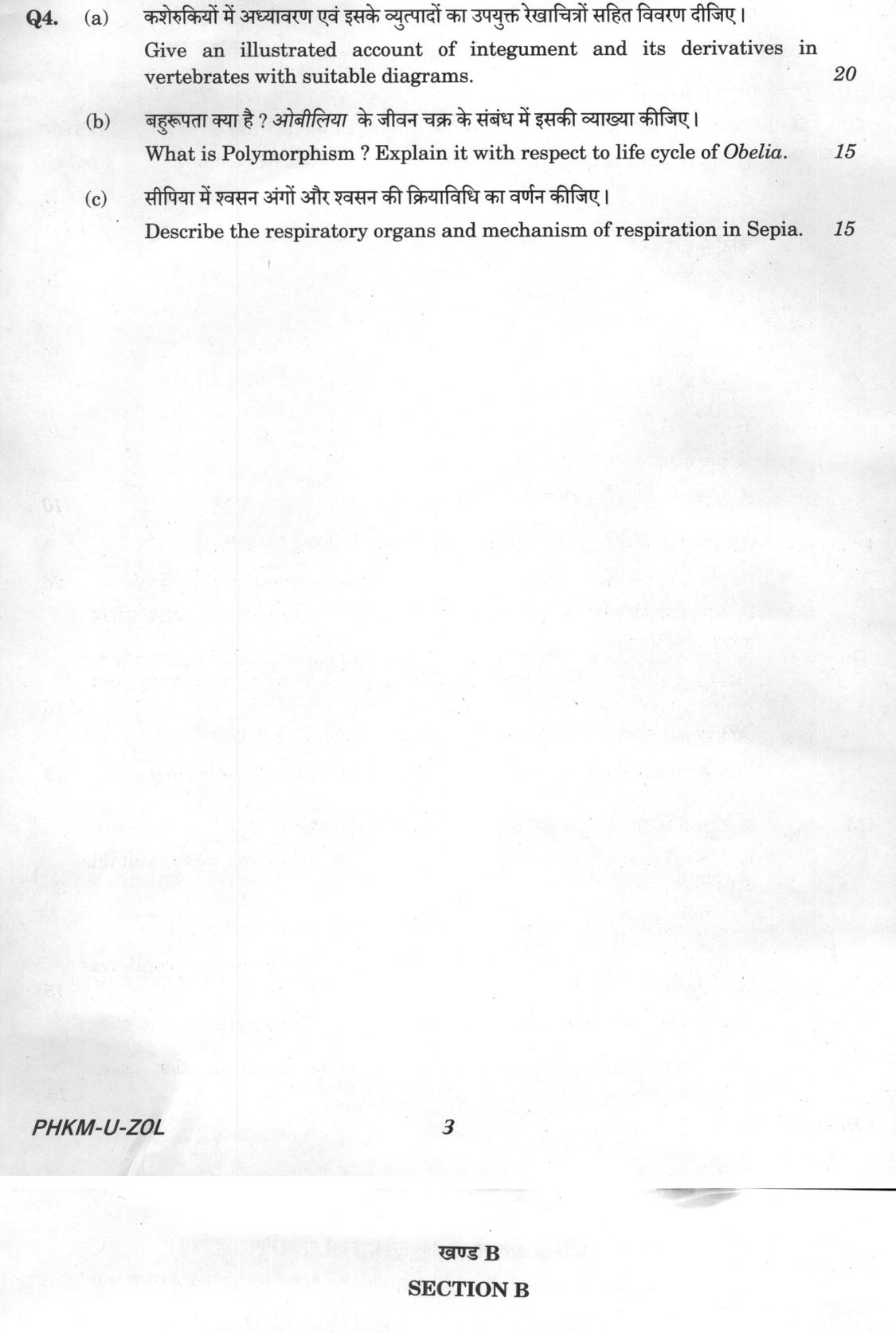
(a) Give an illustrated account of integument and its derivatives in vertebrates with suitable diagrams. (20 marks) (b) What is…
Give an illustrated account of integument and its derivatives in vertebrates with suitable diagrams. 20 marks
What is Polymorphism ? Explain it with respect to life cycle of Obelia. 15 marks
Describe the respiratory organs and mechanism of respiration in Sepia. 15 marks
हिंदी में प्रश्न पढ़ें
कशेरुकियों में अध्यावरण एवं इसके व्युत्पादों का उपयुक्त रेखाचित्रों सहित विवरण दीजिए। (20 अंक)
बहुरूपता क्या है ? ओबीलिया के जीवन चक्र के संबंध में इसकी व्याख्या कीजिए। (15 अंक)
सीपिया में श्वसन अंगों और श्वसन की क्रियाविधि का वर्णन कीजिए। (15 अंक)
Model answer
Written by UPSC Answer Check against this question's marking rubric, to the expected length. UPSC does not publish answers for Mains — this is one way to score well, not an official key.
Integument and its derivatives. Vertebrate integument is a three-layered covering: an ectodermal epidermis, a mesodermal dermis, and a hypodermis of fat and loose connective tissue. In mammals, the hypodermis stores fat and anchors skin to muscle. A diagram of a vertebrate body wall would show the epidermis as a keratinised or mucous epithelium, the dermis with collagen, blood vessels and nerves, and the hypodermis as insulation. Derivatives include ectodermal hair, feathers, glands, claws and keratin sheaths, and mesodermal dermal bone and fish scales. In fish, the epidermis contains mucous cells and the dermis bears scales: placoid scales in elasmobranchs and ctenoid or cycloid scales in teleosts, which reduce drag and protect the body. Amphibians have thin, glandular skin with mucous glands that keep the surface moist for cutaneous respiration. Reptiles have dry, keratinised scales, scutes and claws; the scales are dermal plates covered by epidermal keratin and prevent water loss. Birds have ectodermal feathers, with rachis, barbs and barbules, for flight, insulation and display, plus keratinised scales on the legs. Mammals have hair, sebaceous and sweat glands, nails, hooves and horns; hair insulates, sweat glands cool the body, and horns combine a bony core with a keratin sheath. Functionally, the integument protects, receives touch and temperature, regulates heat and water, and in amphibians assists gas exchange. The dermis contains sensory corpuscles, linking the covering to touch and temperature.
Polymorphism and Obelia. Polymorphism is the occurrence of structurally and functionally distinct forms within one species. It may be genetic, where different morphs are inherited, or environmental, where one genotype produces different forms under different conditions. Environmental polymorphism can be induced by temperature or food, but Obelia’s polyp-medusa alternation is genetically timed. In Obelia, polymorphism is seen both in the dimorphic polyp colony and in metagenesis. A diagram of the colony would show many gastrozooids, feeding polyps with tentacles, and fewer gonozooids, reproductive polyps. Obelia is dimorphic, not trimorphic; dactylozooids are absent. The gonozooid, or blastostyle, is the reproductive zooid; it is enclosed in a protective perisarc capsule called the gonangium, so the gonangium is not the zooid itself. The polyp stage is sessile and asexual, while the medusa stage is free-swimming and sexual. Fertilised eggs develop into planula larvae, which settle and grow into polyp colonies. Gonozooids produce medusae by strobilation within the gonangium; the ephyrae detach, mature, and release gametes. Thus Obelia shows life-cycle polymorphism: genetically programmed polyp and medusa forms, plus colonial dimorphism between gastrozooids and gonozooids.
Respiration in Sepia. Sepia has a paired mantle cavity containing two ctenidia, or gills. Each ctenidium is lamellated, with primary filaments and secondary lamellae that provide a large surface for gas exchange. Water enters through the incurrent aperture, passes over the gills, and leaves through the siphon. A diagram would show the mantle cavity, the two gills, branchial hearts at their bases, accessory branchial hearts, and the siphon. Ventilation is produced by rhythmic contraction and relaxation of the mantle muscles: relaxation draws water in, while contraction expels it through the siphon. The siphon directs the outflow, which also provides jet propulsion. The siphon is a muscular tube that can be pointed to direct jets. Deoxygenated blood rich in haemocyanin is pumped by the branchial hearts, assisted by accessory branchial hearts, through the gill lamellae. Oxygen diffuses into the blood and carbon dioxide out by counter-current exchange, in which water and blood flow in opposite directions, maintaining a diffusion gradient. Counter-current exchange is efficient because the partial pressure of oxygen remains higher in water than in blood along the lamella. The respiratory system is therefore integrated with circulation and locomotion.
What "Illustrate" is asking you to do
Carry the point with concrete cases rather than assert it, so the examples do the work of proving it. In the technical papers illustrate is often literal — a labelled diagram, a map, a graph — and an answer without the figure has not complied with the instruction.
Structure that answers it
The point stated → example 1 with the feature it demonstrates → example 2 → example 3 or the required diagram → what the set of examples establishes
Where marks are lost
Examples named and then abandoned. A case listed without the sentence showing what it demonstrates is marked as recall of information, not as illustration.
How this answer will be evaluated
Approach
(a) account for: state the phenomenon > the causes in order of weight > conclusion | (b) explain: definition/context > points in order > small example > short close | (c) describe: define > structure or process in order > labelled diagram > significance Full marks: Comprehensive, accurate, well-illustrated answers with precise terminology and clear mechanisms.
Key points expected
- Define integument as ectodermal covering
- Describe epidermis and dermis structure
- List derivatives: scales, feathers, hair, claws
- Provide labelled diagrams of vertebrate integument
- Define polymorphism in biological context
- Describe Obelia's life cycle stages
- Identify polyp and medusa forms
- Explain functional differences between forms
Evaluation rubric
Each sub-part is marked on its own, against the marks and word limit printed on the paper.
- (a) Illustrated account of integument and its derivatives in vertebrates. 20 marks
account for— state the phenomenon → the causes in order of weight → conclusion
Must cover
- Define integument as ectodermal covering
- Describe epidermis and dermis structure
- List derivatives: scales, feathers, hair, claws
- Provide labelled diagrams of vertebrate integument
Loses marks
- Diagrams without labels
- Omitting key derivatives like feathers or hair
- Confusing integument with other tissues
Earns more
- Mention specific vertebrate examples (e.g., fish, bird)
- Explain evolutionary significance of derivatives
- Detail keratinization process in epidermis
- Discuss sensory functions of integument
Extra mark
- Reference specific conservation issues related to integument
- Include recent research on integumentary adaptations
- (b) Explain polymorphism in the life cycle of Obelia. 15 marks
explain— definition/context → points in order → small example → short close
Must cover
- Define polymorphism in biological context
- Describe Obelia's life cycle stages
- Identify polyp and medusa forms
- Explain functional differences between forms
Loses marks
- Omitting key life cycle stages
- Confusing polymorphism with other concepts
- Diagrams without clear labels
Earns more
- Include labelled life cycle diagram
- Mention asexual and sexual reproduction
- Describe environmental triggers for form change
- Compare polyp and medusa structures
Extra mark
- Reference specific Obelia species
- Mention ecological significance of polymorphism
- (c) Describe respiratory organs and mechanism in Sepia. 15 marks
describe— define → structure or process in order → labelled diagram → significance
Must cover
- Identify gills as respiratory organs
- Describe gill structure and location
- Explain water flow over gills
- Detail gas exchange mechanism
Loses marks
- Omitting key respiratory structures
- Confusing gill types
- Diagrams without labels
Earns more
- Include labelled diagram of gill structure
- Mention role of mantle cavity
- Describe countercurrent exchange system
- Compare with other cephalopod respiration
Extra mark
- Reference specific Sepia species
- Mention adaptations for deep-sea respiration
Practice this exact question
Write your answer and it is marked point by point against the model answer above — what you covered, what you missed, what you got wrong.
Evaluate my answer →More from Zoology 2024 Paper I
- Q1 Write short notes on the following in about 150 words each: (a) Concept and organization…
- Q2 (a) Explain the general features, life cycle and pathogenicity of Fasciola. (20 marks) (b…
- Q3 (a) Describe the different larval forms of Crustaceans with suitable diagrams. (20 marks)…
- Q4 (a) Give an illustrated account of integument and its derivatives in vertebrates with sui…
- Q5 Write short notes on the following in about 150 words each: (a) Food Web (10 marks) (b) B…
- Q6 (a) What is ecological succession ? Explain the different types and theories of ecologica…
- Q7 (a) Mention the causative agent and means of spread of malaria. Also describe symptoms, d…