Paper I — Q6
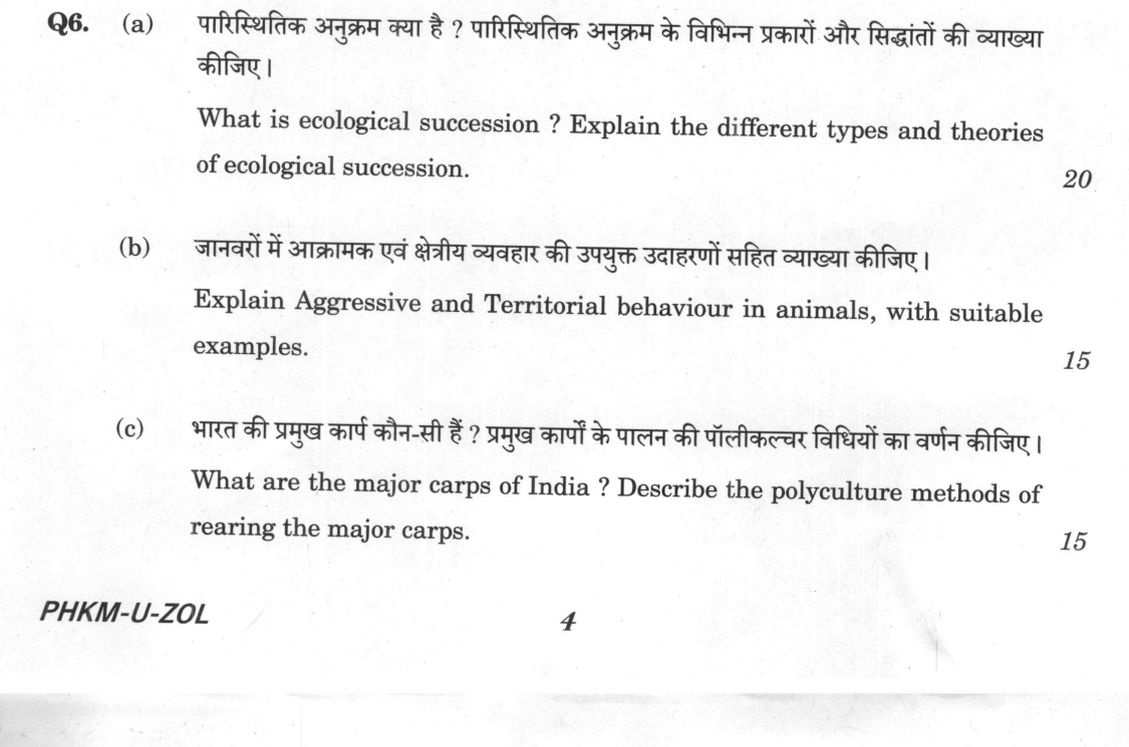
(a) What is ecological succession ? Explain the different types and theories of ecological succession. (20 marks) (b) Explain…
What is ecological succession ? Explain the different types and theories of ecological succession. 20 marks
Explain Aggressive and Territorial behaviour in animals, with suitable examples. 15 marks
What are the major carps of India ? Describe the polyculture methods of rearing the major carps. 15 marks
हिंदी में प्रश्न पढ़ें
पारिस्थितिक अनुक्रम क्या है ? पारिस्थितिक अनुक्रम के विभिन्न प्रकारों और सिद्धांतों की व्याख्या कीजिए। (20 अंक)
जानवरों में आक्रामक एवं क्षेत्रीय व्यवहार की उपयुक्त उदाहरणों सहित व्याख्या कीजिए। (15 अंक)
भारत की प्रमुख कार्प कौन-सी हैं ? प्रमुख कार्पों के पालन की पॉलीकल्चर विधियों का वर्णन कीजिए। (15 अंक)
Model answer
Written by UPSC Answer Check against this question's marking rubric, to the expected length. UPSC does not publish answers for Mains — this is one way to score well, not an official key.
Ecological succession Ecological succession is the directional replacement of one biotic community by another in a habitat until a relatively stable climax is reached. It proceeds through seral stages: pioneer, intermediate, and climax. Diagram: bare substrate → pioneers → herbs/shrubs → forest → climax. Primary succession begins on newly exposed, lifeless substrates such as lava, sand dunes, glacial till, or bare rock; secondary succession follows disturbance that destroys the community but leaves soil, such as fire, flood, or fallow land. Succession is also autogenic (organisms modify their own habitat) or allogenic (external factors such as climate or water level); autotrophic (photosynthetic energy input) or heterotrophic (energy from organic matter); and hydrarch (aquatic to terrestrial, pond → marsh → forest) or xerarch (dry substrate to forest, sand → grassland → forest). Clements’ monoclimax hypothesis treated succession as a predictable, organismic sequence ending in one climactic community determined by climate. Gleason’s individualistic/continuum hypothesis stressed independent species responses to microsite conditions, so communities are mosaics rather than discrete units. Tansley’s climax pattern hypothesis accepted multiple climaxes shaped by soil, moisture, and topography. Mechanisms include facilitation (pioneers make conditions easier for later species), tolerance (later species establish under low resources), and inhibition (established species resist newcomers). Relay floristics holds that each seral stage prepares the site for the next; initial floristics composition holds that the climax is largely determined by the first colonists.
Aggressive and territorial behaviour Aggressive behaviour is a threat, attack, or defensive response directed against conspecifics or other species. It may be offensive, to gain mates, food, or rank, or defensive, to protect self, offspring, or resources. Much aggression is ritualized: stags lock antlers, Siamese fighting fish flare fins and gill covers, and rhesus macaques use postures and vocalizations before contact, reducing injury while deciding dominance. Territoriality is defence of a bounded area. Ethologists distinguish Type A (conspecific defence), Type B (heterospecific defence), Type C (defence against both), and Type D (both, with seasonal or priority variation). Territoriality is maintained by signals such as song, scent, or display; if an intruder crosses the boundary, the resident escalates until retreat or departure. Songbirds defend breeding territories mainly against conspecifics; damselfish defend algal patches against herbivorous fish; langurs defend home ranges against other groups. Benefits are reliable access to food, mates, nesting sites, and reduced competition; costs include energy, injury, predation risk, and lost foraging time.
Indian major carps and polyculture The Indian major carps are Labeo rohita (rohu), Catla catla (catla), and Cirrhinus mrigala (mrigal). They are distinct from exotic carps such as Cyprinus carpio (common carp), Ctenopharyngodon idella (grass carp), and Hypophthalmichthys molitrix/nobilis (silver/bighead carps). Polyculture works because these species occupy compatible feeding niches: Catla is mainly a surface zooplankton feeder, Rohu is a mid-water/column feeder on phytoplankton, detritus and small organisms, Mrigal is a bottom feeder on detritus and benthic algae, and common carp is a bottom detritus feeder. Pond diagram: surface: Catla; mid-water: Rohu; bottom: Mrigal/common carp. ICAR-CIFA-recommended composite culture uses about 5,000 fingerlings/ha, commonly 3 Catla : 4 Rohu : 3 Mrigal, with common carp added at a lower proportion, e.g. 3:4:3:2, adjusted to pond productivity. Operationally, ponds are dried, desilted, limed, manured with farmyard manure and, where permitted, inorganic fertilizer, stocked with graded fingerlings, given supplementary feed such as bran, oil cakes, and formulated pellets, and harvested by partial or full harvest at 8–12 months. Yield advantages arise from better use of the water column and reduced interspecific competition. Disease management requires graded stocking, avoidance of overcrowding, water-quality monitoring, quarantine of new fingerlings, and balanced nutrition; polyculture does not automatically reduce disease and can increase parasite exposure if density is high.
Thus, succession explains how communities reorganize through predictable mechanisms, while aggressive and territorial behaviour shows how individuals secure resources; in aquaculture, the same principle of niche partitioning is applied to raise carp yields sustainably.
What "Explain" is asking you to do
Make the working of something clear — what sets it off, what follows from what, and what it produces. Explain is the Commission's mechanism word: it dominates the technical papers and the “explain why” stems, where the marks sit in the causal chain and not in the label.
Structure that answers it
State what it is → the initiating condition → the chain of cause, step by step → an instance where it plays out → what the chain produces
Where marks are lost
Describing what something looks like instead of why it works that way. Naming the stages without linking them reads as description too.
How this answer will be evaluated
Approach
Framework: Ecological Succession & Ethology. (a) explain: definition/context > points in order > small example > short close | (b) explain: definition/context > points in order > small example > short close | (c) describe: define > structure or process in order > labelled diagram > significance Full marks: Precise definitions, clear distinction of theories, specific examples, and detailed polyculture mechanism.
Key points expected
- Define ecological succession and climax community
- Distinguish primary vs secondary succession
- Explain Clements' monistic theory (analogy to organism)
- Explain Gleason's polycentric theory (individualistic)
- Define aggressive behavior (fighting, threat displays)
- Define territorial behavior (defense of specific area)
- Provide suitable examples (e.g., lions, birds, fish)
- Explain the function (mating, food, nesting)
Evaluation rubric
Each sub-part is marked on its own, against the marks and word limit printed on the paper.
- (a) Define succession, distinguish types, and detail theories of community change. 20 marks
explain— definition/context → points in order → small example → short close
Must cover
- Define ecological succession and climax community
- Distinguish primary vs secondary succession
- Explain Clements' monistic theory (analogy to organism)
- Explain Gleason's polycentric theory (individualistic)
Loses marks
- Confusing succession with evolution
- Failing to distinguish primary from secondary
- Describing only one theory without comparison
Earns more
- Mention hydrosere, xerosere, or halosere
- Reference Tansley's autogenic vs allogenic succession
- Mention Connell & Slatyer's models (facilitation, tolerance, inhibition)
Extra mark
- Reference specific succession stages (e.g., lichen to moss)
- (b) Define aggressive and territorial behaviors, linking them to resource defense. 15 marks
explain— definition/context → points in order → small example → short close
Must cover
- Define aggressive behavior (fighting, threat displays)
- Define territorial behavior (defense of specific area)
- Provide suitable examples (e.g., lions, birds, fish)
- Explain the function (mating, food, nesting)
Loses marks
- Confusing aggression with predation
- Failing to distinguish territory from home range
- Lack of specific animal examples
Earns more
- Mention 'ritualized' aggression or 'suppression' signals
- Reference 'home advantage' or 'invasion' dynamics
- Mention 'scent marking' or 'vocalization' as mechanisms
Extra mark
- Reference specific species like *Lacerta* or *Anolis*
- (c) List major Indian carps and detail the polyculture rearing method. 15 marks
describe— define → structure or process in order → labelled diagram → significance
Must cover
- Name major carps (Catla, Rohu, Mrigal, Grass carp)
- Explain polyculture (mixed culture) concept
- Describe niche partitioning (feeding levels)
- Mention stocking ratios or complementary feeding
Loses marks
- Listing only one or two carp species
- Failing to explain the 'polyculture' mechanism
- Confusing carps with non-carps (e.g., Tilapia)
Earns more
- Mention 'bottom feeders' (Catla) vs 'surface feeders' (Mrigal)
- Reference 'integrated fish farming' (e.g., with poultry)
- Mention 'monoculture' as a contrast
Extra mark
- Reference specific stocking density (e.g., 10,000/ha)
Practice this exact question
Write your answer and it is marked point by point against the model answer above — what you covered, what you missed, what you got wrong.
Evaluate my answer →More from Zoology 2024 Paper I
- Q3 (a) Describe the different larval forms of Crustaceans with suitable diagrams. (20 marks)…
- Q4 (a) Give an illustrated account of integument and its derivatives in vertebrates with sui…
- Q5 Write short notes on the following in about 150 words each: (a) Food Web (10 marks) (b) B…
- Q6 (a) What is ecological succession ? Explain the different types and theories of ecologica…
- Q7 (a) Mention the causative agent and means of spread of malaria. Also describe symptoms, d…
- Q8 (a) Describe the various measures of central tendency of data with suitable examples and…