Paper I — Q7
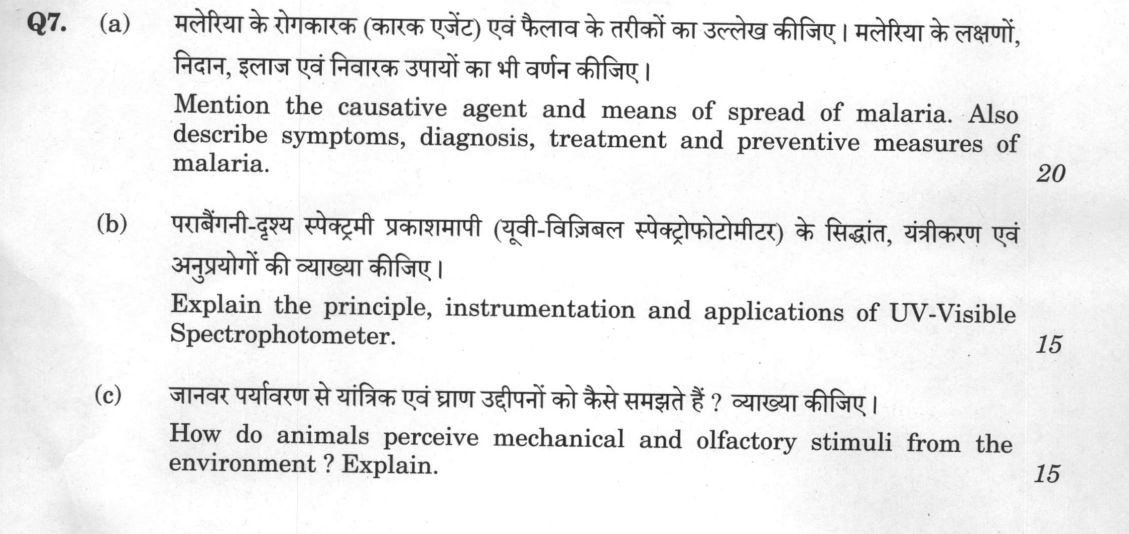
(a) Mention the causative agent and means of spread of malaria. Also describe symptoms, diagnosis, treatment and preventive…
Mention the causative agent and means of spread of malaria. Also describe symptoms, diagnosis, treatment and preventive measures of malaria. 20 marks
Explain the principle, instrumentation and applications of UV-Visible Spectrophotometer. 15 marks
How do animals perceive mechanical and olfactory stimuli from the environment ? Explain. 15 marks
हिंदी में प्रश्न पढ़ें
मलेरिया के रोगकारक (कारक एजेंट) एवं फैलाव के तरीकों का उल्लेख कीजिए। मलेरिया के लक्षणों, निदान, इलाज एवं निवारक उपायों का भी वर्णन कीजिए। (20 अंक)
पराबैंगनी-दृश्य स्पेक्ट्रमी प्रकाशमापी (यूवी-विजिबल स्पेक्ट्रोफोटोमीटर) के सिद्धांत, यंत्रीकरण एवं अनुप्रयोगों की व्याख्या कीजिए। (15 अंक)
जानवर पर्यावरण से यांत्रिक एवं घ्राण उद्दीपनों को कैसे समझते हैं ? व्याख्या कीजिए। (15 अंक)
Model answer
Written by UPSC Answer Check against this question's marking rubric, to the expected length. UPSC does not publish answers for Mains — this is one way to score well, not an official key.
Causative agent and spread. Malaria is caused by Plasmodium species—P. falciparum, P. vivax, P. malariae, P. ovale and P. knowlesi—spread mainly by infected female Anopheles mosquitoes, and also by blood transfusion, congenital transmission, shared needles and organ transplantation. In humans, sporozoites invade hepatocytes, then merozoites infect erythrocytes; asexual replication causes symptoms. Gametocytes taken by the mosquito form zygotes and ookinetes. Sporogony occurs in oocysts on the midgut wall, and sporozoites migrate to the salivary glands. In India, P. vivax and P. falciparum dominate; P. knowlesi is zoonotic in Southeast Asia.
Symptoms, diagnosis, treatment and prevention. Malaria presents with paroxysms of chills, rigors, fever and sweating, headache, anaemia and splenomegaly; fever is tertian in P. vivax/ovale, quartan in P. malariae, and may be severe/irregular in P. falciparum. Complications include cerebral malaria, severe anaemia, acute kidney injury, hypoglycaemia and blackwater fever from massive intravascular haemolysis. Diagnosis uses thick and thin peripheral blood smears; microscopy remains the reference method in endemic settings. Rapid diagnostic tests, PCR and serology are also used, serology showing past exposure rather than active infection. Treatment uses artemisinin-based combination therapies for uncomplicated falciparum malaria, parenteral artesunate for severe disease, and primaquine for hypnozoites and gametocytes after G6PD testing; supportive care manages severe anaemia, hypoglycaemia and organ failure. Chloroquine resistance limits its use. Prevention includes insecticide-treated nets, indoor residual spraying, larvivorous fish, environmental management, chemoprophylaxis and RTS,S/AS01 vaccine; India’s National Malaria Elimination Programme uses surveillance, case detection and vector control.
UV-Visible spectrophotometry. The instrument measures absorption of ultraviolet and visible light, roughly 190–800 nm, by chromophores undergoing electronic transitions. Its principle is the Beer–Lambert law, A = εcl: absorbance is proportional to analyte concentration and path length, while molar absorptivity ε is a constant for a given substance at a given wavelength. Light from a deuterium source for UV or tungsten source for visible light passes through a monochromator or filter, then through a cuvette containing the sample, and is measured by a detector such as a photodiode or photomultiplier tube; a blank corrects background, and data are recorded digitally. Double-beam instruments reduce drift. It is used qualitatively to identify chromophores and quantitatively to estimate proteins at 280 nm, nucleic acids at 260 nm, bilirubin, glucose and other clinical analytes, and to follow enzyme kinetics by measuring product or substrate changes. Calibration curves using standards give concentration. It also supports quality control in pharmaceuticals and clinical biochemistry.
Mechanical and olfactory perception. Animals detect mechanical stimuli through mechanoreceptors: hair sensilla and campaniform sensilla in arthropods, stretch receptors in muscles and skin, Pacinian corpuscles for deep pressure and vibration, and the lateral line system in fish for water movement. Mechanical deformation opens mechanosensitive ion channels, producing receptor potentials that are converted into nerve impulses. Auditory hair cells detect sound pressure, while vestibular receptors sense balance. Mechanoreception also includes tactile receptors in skin and joint proprioceptors. Olfaction differs by group. In insects, odorant binding proteins in antennae deliver odorants to ionotropic odorant and pheromone receptors on olfactory receptor neurons; signals are processed in the antennal lobe. Insects use pheromones for mate finding, colony recognition and alarm. Olfactory cues help locate hosts, food and mates. In vertebrates, odorants bind G-protein coupled receptors in the olfactory epithelium; G_olf activates adenylate cyclase, raising cAMP and opening cyclic nucleotide-gated channels. The olfactory bulb maps odor identity, while the vomeronasal organ detects social pheromones in many mammals. These systems guide feeding, mate choice through pheromone communication, danger avoidance and vector behaviour.
Together, malaria control, spectrophotometric diagnostics and sensory physiology show how biological mechanisms translate into public health action: interrupting transmission, measuring disease markers, and understanding how vectors and hosts detect environmental cues.
What "Describe" is asking you to do
Give a full, ordered account of the thing named — its parts, stages or mechanism — in the sequence in which it actually exists or occurs. Most describe questions come from the science optionals, where the marks sit in correct technical detail and, where the stem says so, a labelled diagram.
Structure that answers it
One-line identification of the subject → the parts or stages in their real order, each with its defining detail → labelled diagram where the subject is structural → closing line on function or significance
Where marks are lost
Loose general prose where the examiner is ticking named parts, correct terminology and their sequence; and in the General Studies papers, turning to evaluation before the description is finished.
How this answer will be evaluated
Approach
Framework: Zoology, Paper 1. (a) describe: define > structure or process in order > labelled diagram > significance | (b) explain: definition/context > points in order > small example > short close | (c) explain: definition/context > points in order > small example > short close Full marks: Precise taxon names, labelled diagrams, specific mechanisms, and clear linkage to vectors or conservation.
Key points expected
- Identify Plasmodium species (e.g., P. falciparum)
- Explain Anopheles mosquito vector transmission
- List clinical symptoms (fever, chills, anemia)
- Detail diagnosis (smear test) and treatment (antimalarials)
- State Beer-Lambert Law as the principle
- List key components (light source, monochromator, cuvette)
- Explain the mechanism of light absorption
- Give at least two specific applications (e.g., protein estimation)
Evaluation rubric
Each sub-part is marked on its own, against the marks and word limit printed on the paper.
- (a) Causative agent, spread, symptoms, diagnosis, treatment, and prevention of malaria. 20 marks
describe— define → structure or process in order → labelled diagram → significance
Must cover
- Identify Plasmodium species (e.g., P. falciparum)
- Explain Anopheles mosquito vector transmission
- List clinical symptoms (fever, chills, anemia)
- Detail diagnosis (smear test) and treatment (antimalarials)
Loses marks
- Confusing malaria with other febrile diseases
- Omitting the vector (Anopheles) in spread
- Vague description of symptoms without clinical terms
Earns more
- Mention specific life cycle stages (sporozoites, merozoites)
- Describe preventive measures (bed nets, DDT spraying)
- Differentiate between P. vivax and P. falciparum
- Mention RDT (Rapid Diagnostic Test) for diagnosis
Extra mark
- Mention specific antimalarial drug names (e.g., Artemisinin)
- Reference WHO guidelines for malaria control
- (b) Principle, instrumentation, and applications of UV-Visible Spectrophotometer. 15 marks
explain— definition/context → points in order → small example → short close
Must cover
- State Beer-Lambert Law as the principle
- List key components (light source, monochromator, cuvette)
- Explain the mechanism of light absorption
- Give at least two specific applications (e.g., protein estimation)
Loses marks
- Confusing UV-Vis with IR or NMR spectroscopy
- Omitting the Beer-Lambert Law
- Listing components without explaining their function
Earns more
- Mention specific light sources (Deuterium, Tungsten)
- Describe the role of the photodetector
- Mention use in DNA/RNA quantification
- Reference specific wavelengths (280nm for protein)
Extra mark
- Mention specific brands or models of spectrophotometers
- Reference specific chemical reactions used in assays
- (c) Mechanism of perception of mechanical and olfactory stimuli in animals. 15 marks
explain— definition/context → points in order → small example → short close
Must cover
- Describe mechanoreceptors (e.g., hair cells, lateral line)
- Explain olfactory receptors (e.g., GPCRs, cilia)
- Link structure to function for both stimuli
- Give specific animal examples for each sense
Loses marks
- Confusing mechanical with thermal or chemical stimuli
- Omitting the transduction mechanism
- Vague description without specific anatomical structures
Earns more
- Mention specific structures (e.g., cochlea, olfactory epithelium)
- Describe the transduction process (mechanical to electrical)
- Mention specific animals (e.g., fish for lateral line, dogs for olfaction)
- Reference specific receptor types (e.g., TMC1 for mechanotransduction)
Extra mark
- Mention specific neural pathways (e.g., olfactory bulb)
- Reference specific evolutionary adaptations for these senses
Practice this exact question
Write your answer and it is marked point by point against the model answer above — what you covered, what you missed, what you got wrong.
Evaluate my answer →More from Zoology 2024 Paper I
- Q4 (a) Give an illustrated account of integument and its derivatives in vertebrates with sui…
- Q5 Write short notes on the following in about 150 words each: (a) Food Web (10 marks) (b) B…
- Q6 (a) What is ecological succession ? Explain the different types and theories of ecologica…
- Q7 (a) Mention the causative agent and means of spread of malaria. Also describe symptoms, d…
- Q8 (a) Describe the various measures of central tendency of data with suitable examples and…