Paper I — Q5
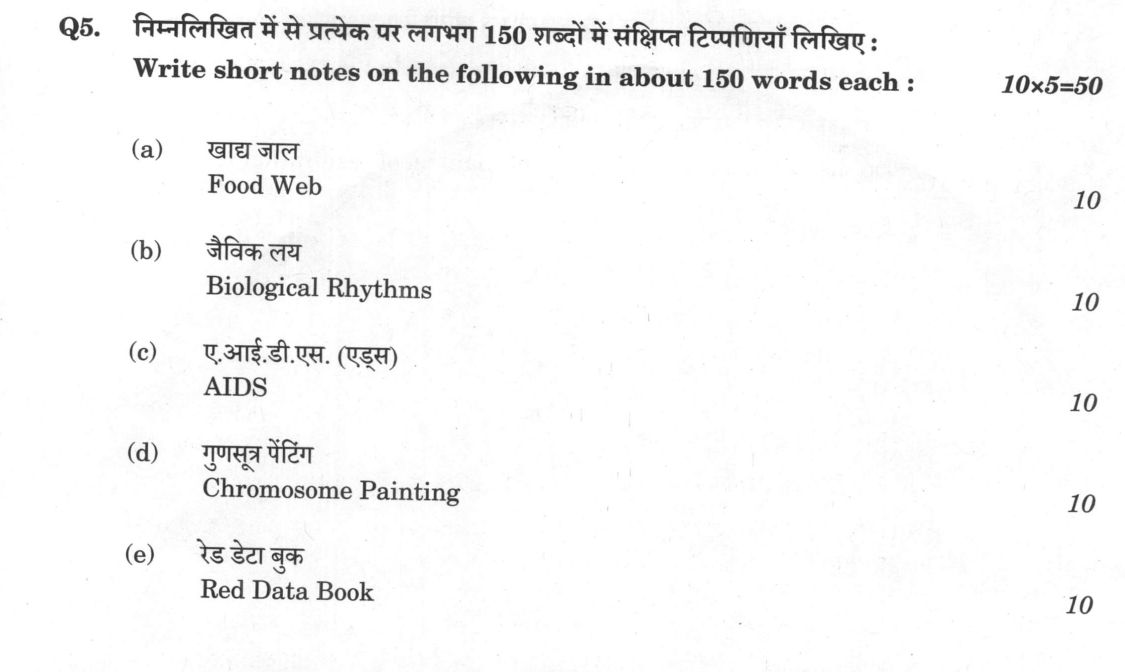
Write short notes on the following in about 150 words each: (a) Food Web (10 marks) (b) Biological Rhythms (10 marks) (c) AIDS…
Write short notes on the following in about 150 words each: Food Web 10 marks
Biological Rhythms 10 marks
AIDS 10 marks
Chromosome Painting 10 marks
Red Data Book 10 marks
हिंदी में प्रश्न पढ़ें
निम्नलिखित में से प्रत्येक पर लगभग 150 शब्दों में संक्षिप्त टिप्पणियाँ लिखिए : खाद्य जाल (10 अंक)
जैविक लय (10 अंक)
ए.आई.डी.एस. (एड्स) (10 अंक)
गुणसूत्र पेंटिंग (10 अंक)
रेड डेटा बुक (10 अंक)
Model answer
Written by UPSC Answer Check against this question's marking rubric, to the 150-word length. UPSC does not publish answers for Mains — this is one way to score well, not an official key.
(a) Food Web
A food web is an interconnected network of multiple food chains operating within an ecological community, reflecting the complex, non-linear trophic interactions among organisms, unlike a single linear food chain. Energy flows through defined trophic levels—primary producers (autotrophs), primary consumers (herbivores), secondary/tertiary consumers (carnivores), and decomposers/detritivores. Within ecosystems, grazing pathways (originating from living autotrophic biomass) and detritus pathways (originating from decaying organic matter) do not function in isolation; rather, they cross-link extensively as generalist predators consume prey from both pathways. This structural complexity provides ecological stability through functional redundancy: if one species population fluctuates or declines, alternative trophic channels buffer the system against sudden collapse and mitigate trophic cascades. For example, in the Sundarbans mangrove ecosystem, mangrove leaf litter feeds detritivorous crabs and molluscs, while phytoplankton supports zooplankton and juvenile fish; both grazing and detrital pathways converge on higher predators like estuarine crocodiles and the Bengal tiger.
(b) Biological Rhythms
Biological rhythms are self-sustaining, periodic physiological and behavioural fluctuations governed by endogenous pacemakers and entrained by environmental cues (zeitgebers) such as light-dark and temperature cycles. These rhythms manifest across various periodicities, including circadian (approximately 24-hour cycles, e.g., sleep-wake cycles), circatidal (approximately 12.4 hours, e.g., fiddler crab foraging), and circannual rhythms (seasonal reproduction, hibernation, and bird migration). In vertebrates, the master anatomical pacemaker is the Suprachiasmatic Nucleus (SCN) of the anterior hypothalamus. At the cellular level, the molecular clock relies on an autoregulatory transcription-translation feedback loop (TTFL), primarily driven by heterodimeric transcription factors CLOCK and BMAL1, which activate the transcription of Period (PER) and Cryptochrome (CRY) genes, whose translated protein complexes subsequently repress their own transcription. These rhythms confer immense adaptive fitness by anticipating daily and seasonal ecological changes, enabling organisms to optimize foraging efficiency, maximize reproductive success, and synchronize predator-avoidance strategies.
(c) AIDS (Acquired Immunodeficiency Syndrome)
Acquired Immunodeficiency Syndrome (AIDS) is a chronic, life-threatening condition caused by the Human Immunodeficiency Virus (HIV), an enveloped lentivirus possessing a single-stranded RNA genome and key enzymes including reverse transcriptase, integrase, and protease. The viral envelope glycoprotein gp120 binds specifically to the CD4 receptor along with chemokine coreceptors (CCR5 or CXCR4) on helper T-lymphocytes, macrophages, and dendritic cells. Following membrane fusion via gp41, viral RNA is reverse-transcribed into proviral DNA and integrated into the host genome. Progressive viral replication results in severe CD4+ T-cell depletion and immune collapse, rendering the host vulnerable to opportunistic pathogens like Mycobacterium tuberculosis and malignancies such as Kaposi's sarcoma. In India, the National AIDS Control Organisation (NACO) spearheads management via targeted interventions among high-risk groups, including female sex workers and intravenous drug users. Implementation of free Antiretroviral Therapy (ART) and the 'Treat All' policy has markedly reduced viral transmission and AIDS-related mortality nationwide.
(d) Chromosome Painting
Chromosome painting is a molecular cytogenetic technique based on Fluorescence In Situ Hybridization (FISH) that uses complex, fluorochrome-labeled probe sets to visualize and differentiate whole individual chromosomes or distinct chromosomal regions under fluorescence microscopy. These whole-chromosome probes (WCPs) are generated by isolating individual metaphase chromosomes using dual-laser flow sorting or microdissection, followed by degenerate oligonucleotide-primed PCR (DOP-PCR) amplification and fluorescent labeling. During hybridization, the probes bind specifically to complementary sequences along the target chromosome, creating a distinctive colour signal. Chromosome painting is invaluable in clinical cytogenetics and oncology for identifying cryptic structural aberrations, complex translocations, marker chromosomes, and aneuploidies in leukemias and solid tumors. Furthermore, comparative cross-species chromosome painting (Zoo-FISH) plays a crucial role in evolutionary biology by elucidating conserved syntenic blocks, reconstructing ancestral mammalian karyotypes, and mapping chromosomal rearrangements that have driven evolutionary divergence.
(e) Red Data Book
The Red Data Book is a foundational conservation documentation initiated in 1966 by the International Union for Conservation of Nature (IUCN) to catalogue the global risk of extinction across plant, animal, and fungal taxa. Species are evaluated against standardized, quantitative criteria—including population size reduction, geographic range fragmentation, and extinction probability models—and categorized into Extinct (EX), Extinct in the Wild (EW), Critically Endangered (CR), Endangered (EN), Vulnerable (VU), Near Threatened (NT), Least Concern (LC), and Data Deficient (DD). In India, state-level assessments and national Red Data Books are compiled by the Zoological Survey of India (ZSI) and Botanical Survey of India (BSI). Prominent Indian species documented include the Critically Endangered Great Indian Bustard (Ardeotis nigriceps) and Gharial (Gavialis gangeticus), as well as the Endangered Lion-tailed Macaque (Macaca silenus). The Red Data Book serves as an essential empirical baseline for guiding statutory protections under the Wildlife (Protection) Act, 1972, identifying Key Biodiversity Areas, and formulating targeted recovery programs.
What "Write short notes" is asking you to do
Five or six self-contained answers, marked separately, typically 10 marks and about 150 words each. Each note must carry its own definition, its two or three defining features and a line on why it matters; a common introduction or conclusion across the notes earns nothing.
Structure that answers it
Per note: one-line definition or identification → two or three features, mechanisms or named examples → one line of significance or Indian application
Where marks are lost
Writing the first two notes at essay length and rationing the rest. Each note is marked on its own, so marks surrendered on a compressed or unattempted note cannot be won back by the long ones.
How this answer will be evaluated
Approach
Framework: Zoology Paper 1: Define > Structure/Mechanism > Diagram > Example. (a) write short notes: define > 3-4 key features > one example > one-line significance | (b) write short notes: define > 3-4 key features > one example > one-line significance | (c) write short notes: define > 3-4 key features > one example > one-line significance | (d) write short notes: define > 3-4 key features > one example > one-line significance | (e) write short notes: define > 3-4 key features > one example > one-line significance Full marks: Precise definitions, clear mechanisms, specific examples, and labelled diagrams where appropriate.
Key points expected
- Definition of food web as interconnected food chains
- Distinction from linear food chain
- Identification of trophic levels (producers, consumers, decomposers)
- One specific example of a food web (e.g., grassland or aquatic)
- Definition of biological rhythms (circadian, circannual, etc.)
- Explanation of the mechanism (e.g., endogenous clock)
- Identification of the suprachiasmatic nucleus (SCN) or equivalent
- One example of a biological rhythm in animals
Evaluation rubric
Each sub-part is marked on its own, against the marks and word limit printed on the paper.
- (a) Define food web and explain its structure and ecological significance. 10 marks · 150 words
write short notes— define → 3-4 key features → one example → one-line significance
Must cover
- Definition of food web as interconnected food chains
- Distinction from linear food chain
- Identification of trophic levels (producers, consumers, decomposers)
- One specific example of a food web (e.g., grassland or aquatic)
Loses marks
- Confusing food web with food chain
- Omitting decomposers or detritus pathway
- No specific example provided
Earns more
- Mention of trophic levels (TL1, TL2, etc.)
- Reference to energy flow or biomass pyramids
- Mention of ecological stability or resilience
Extra mark
- Labelled diagram of a specific food web
- Mention of specific named species in the example
- (b) Define biological rhythms and describe their types and physiological basis. 10 marks · 150 words
write short notes— define → 3-4 key features → one example → one-line significance
Must cover
- Definition of biological rhythms (circadian, circannual, etc.)
- Explanation of the mechanism (e.g., endogenous clock)
- Identification of the suprachiasmatic nucleus (SCN) or equivalent
- One example of a biological rhythm in animals
Loses marks
- Confusing biological rhythms with reflexes
- No mention of the physiological basis (SCN)
- No specific example provided
Earns more
- Mention of circadian vs. circannual rhythms
- Reference to light/dark cycles or temperature cues
- Mention of jet lag or seasonal breeding
Extra mark
- Labelled diagram of the circadian clock mechanism
- Mention of specific gene names (e.g., clock, bmal1)
- (c) Define AIDS and explain its etiology, pathogenesis, and transmission. 10 marks · 150 words
write short notes— define → 3-4 key features → one example → one-line significance
Must cover
- Definition of AIDS as a syndrome caused by HIV
- Explanation of HIV pathogenesis (CD4+ T-cell depletion)
- Identification of transmission routes (sexual, blood, vertical)
- Mention of opportunistic infections or AIDS-defining conditions
Loses marks
- Confusing HIV with AIDS
- No mention of CD4+ T-cell depletion
- No specific transmission routes mentioned
Earns more
- Mention of the HIV life cycle (reverse transcription)
- Reference to antiretroviral therapy (ART)
- Mention of the window period
Extra mark
- Labelled diagram of HIV structure or life cycle
- Mention of specific opportunistic infections (e.g., PCP, Kaposi's sarcoma)
- (d) Define chromosome painting and explain its technique and applications. 10 marks · 150 words
write short notes— define → 3-4 key features → one example → one-line significance
Must cover
- Definition of chromosome painting (FISH-based technique)
- Explanation of the mechanism (fluorescent labelling of chromosomes)
- Identification of the application (karyotyping, detecting translocations)
- One specific example of a chromosomal abnormality detected
Loses marks
- Confusing chromosome painting with G-banding
- No mention of the fluorescent labelling mechanism
- No specific application or example provided
Earns more
- Mention of metaphase vs. interphase FISH
- Reference to specific probes (e.g., centromeric, whole-chromosome)
- Mention of clinical applications (cancer, genetic disorders)
Extra mark
- Labelled diagram of the FISH process
- Mention of specific chromosomal abnormalities (e.g., Philadelphia chromosome)
- (e) Define the Red Data Book and explain its purpose and contents. 10 marks · 150 words
write short notes— define → 3-4 key features → one example → one-line significance
Must cover
- Definition of the Red Data Book (IUCN Red List)
- Explanation of its purpose (conservation status assessment)
- Identification of the categories (Extinct, Endangered, Vulnerable, etc.)
- One specific example of a species listed in the Red Data Book
Loses marks
- Confusing Red Data Book with CITES
- No mention of the conservation categories
- No specific example of a listed species
Earns more
- Mention of the IUCN (International Union for Conservation of Nature)
- Reference to the criteria for assessment (population decline, range, etc.)
- Mention of the global vs. national Red Data Books
Extra mark
- Mention of specific species and their status (e.g., Tiger - Endangered)
- Reference to the year of the latest assessment
Practice this exact question
Write your answer and it is marked point by point against the model answer above — what you covered, what you missed, what you got wrong.
Evaluate my answer →More from Zoology 2024 Paper I
- Q2 (a) Explain the general features, life cycle and pathogenicity of Fasciola. (20 marks) (b…
- Q3 (a) Describe the different larval forms of Crustaceans with suitable diagrams. (20 marks)…
- Q4 (a) Give an illustrated account of integument and its derivatives in vertebrates with sui…
- Q5 Write short notes on the following in about 150 words each: (a) Food Web (10 marks) (b) B…
- Q6 (a) What is ecological succession ? Explain the different types and theories of ecologica…
- Q7 (a) Mention the causative agent and means of spread of malaria. Also describe symptoms, d…
- Q8 (a) Describe the various measures of central tendency of data with suitable examples and…