Paper I — Q2
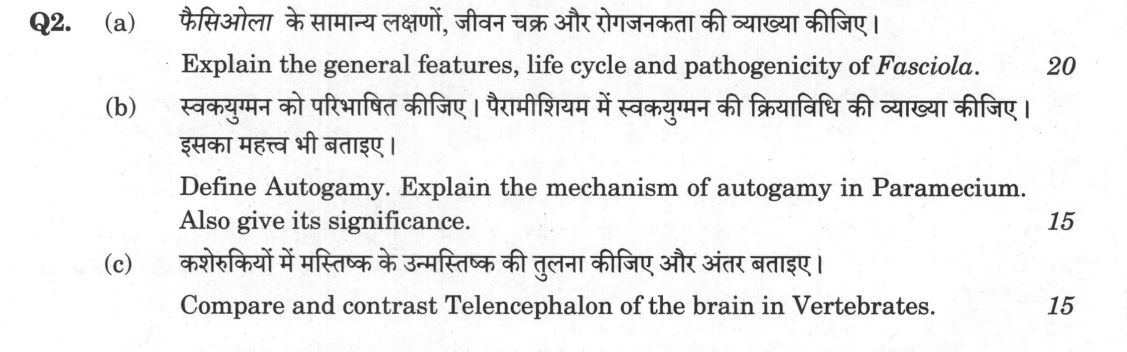
(a) Explain the general features, life cycle and pathogenicity of Fasciola. (20 marks) (b) Define Autogamy. Explain the mechanism…
Explain the general features, life cycle and pathogenicity of Fasciola. 20 marks
Define Autogamy. Explain the mechanism of autogamy in Paramecium. Also give its significance. 15 marks
Compare and contrast Telencephalon of the brain in Vertebrates. 15 marks
हिंदी में प्रश्न पढ़ें
फेसिओला के सामान्य लक्षणों, जीवन चक्र और रोगजनकता की व्याख्या कीजिए। (20 अंक)
स्वक्यूमन को परिभाषित कीजिए। परामीशियम में स्वक्यूमन की क्रियाविधि की व्याख्या कीजिए। इसका महत्व भी बताइए। (15 अंक)
कशेरुकियों में मस्तिष्क के उन्मस्तिष्क की तुलना कीजिए और अंतर बताइए। (15 अंक)
Model answer
Written by UPSC Answer Check against this question's marking rubric, to the expected length. UPSC does not publish answers for Mains — this is one way to score well, not an official key.
(a) Fasciola. Fasciola hepatica and F. gigantica are digenean trematodes, dorsoventrally flattened and leaf-shaped, acoelomate, with a syncytial, non-ciliated tegument bearing proteinaceous/scleroprotein spines or microtriches. They have a small oral sucker, a large subterminal ventral sucker, a blind digestive tract (mouth, pharynx, oesophagus and two intestinal caeca), protonephridia with flame cells, and hermaphroditic reproductive organs producing operculate eggs. F. gigantica, common in Indian ruminants, has larger eggs than F. hepatica; F. hepatica is more common in temperate regions, while F. gigantica predominates in tropical and subtropical India. Adults live in the bile ducts of cattle, buffalo, sheep, goats and humans, causing fascioliasis. Eggs passed in faeces develop in water; the miracidium penetrates a lymnaeid snail (Lymnaea truncatula for F. hepatica; Indoplanorbis/Lymnaea in India for F. gigantica), forming sporocysts and rediae, then free-swimming cercariae. Cercariae encyst on aquatic vegetation as metacercariae, the infective stage. The definitive host ingests metacercariae; they excyst in the duodenum, penetrate the intestinal wall, migrate through the peritoneal cavity and liver parenchyma, enter bile ducts, mature and reproduce. Pathogenicity has an acute hepatic phase, caused by mechanical and toxic damage during parenchymal migration, and a chronic biliary phase, with bile-duct obstruction, cholangitis, hyperplasia, fibrosis, inflammation, anaemia, weight loss and reduced milk yield. In Indian livestock it causes major economic loss. Control combines triclabendazole deworming, pasture rotation, snail control and clean water.
(b) Autogamy. Autogamy is self-fertilization in Paramecium caudatum/aurelia in which the two micronuclei of one cell undergo conjugation without a partner. It is a special case of conjugation, not ordinary binary fission. The two micronuclei undergo meiosis; after disintegration of the excess haploid micronuclei, a haploid micronucleus divides mitotically to form two pronuclei. Because no nuclear exchange occurs, the two pronuclei fuse to form a homozygous diploid synkaryon. The old macronucleus disintegrates, and the synkaryon divides twice to produce two new macronuclei and two micronuclei. The two micronuclei then divide mitotically before cytokinesis, so each daughter cell receives one macronucleus and the normal two micronuclei. The homozygous zygotic nucleus determines the genotype of the new macronucleus. The result is complete homozygosity, exposing recessive lethal alleles and producing genetically uniform clones. Its significance lies in survival when mates are absent, purging deleterious recessives, maintaining genetic stability in asexual lineages, and providing a model for ciliate nuclear genetics.
(c) Telencephalon. The vertebrate telencephalon is the forebrain region derived from the prosencephalon, but its size, evagination and pallial organization vary widely. In cyclostomes it is small, simple and only weakly evaginated, with little distinction between pallium and subpallium and a small corpus striatum. In fishes, paired telencephalic vesicles show clearer evagination; the dorsal/lateral pallium and ventral subpallium are recognizable, and the corpus striatum is a prominent dorsal subpallial mass. Amphibians show true evagination of the telencephalic hemispheres, with an enlarged corpus striatum and olfactory lobes, but no neopallium. Reptiles have larger, more evaginated hemispheres, an expanded pallium, and a well-developed corpus striatum. In reptiles, the pallium can be divided into archipallium, mesopallium and neopallium, but the neopallium is still less dominant than in mammals. In birds, the telencephalon is dominated by pallial structures—hyperpallium (Wulst), mesopallium, archipallium and the dorsal ventricular ridge—rather than by a hyper-developed corpus striatum; the DVR is pallial, not subpallial. The Wulst and DVR support olfactory, learning and sensory integrative functions. Mammals show the greatest development: large, highly evaginated cerebral hemispheres, a dominant neopallium/neocortex, reduced olfactory lobes, and a subpallial corpus striatum differentiated into caudate and putamen. The neocortex underlies higher sensory, motor and cognitive functions. Thus, across vertebrates, telencephalic evolution is a progression from a small, subpallial-dominated organ to a large, pallial/neopallial organ, with corpus striatum modification and hemispheric expansion correlating with increasing sensory integration and behavioral complexity.
What "Explain" is asking you to do
Make the working of something clear — what sets it off, what follows from what, and what it produces. Explain is the Commission's mechanism word: it dominates the technical papers and the “explain why” stems, where the marks sit in the causal chain and not in the label.
Structure that answers it
State what it is → the initiating condition → the chain of cause, step by step → an instance where it plays out → what the chain produces
Where marks are lost
Describing what something looks like instead of why it works that way. Naming the stages without linking them reads as description too.
How this answer will be evaluated
Approach
Framework: Zoology Paper 1: Define > Structure/Mechanism > Diagram > Example. (a) explain: definition/context > points in order > small example > short close | (b) explain: definition/context > points in order > small example > short close | (c) compare: paired headings or table > key differences > significance > conclusion Full marks: Precise taxonomic placement, detailed labelled diagrams, clear mechanisms, and specific examples.
Key points expected
- Classify as Digenea/Trematoda with host specificity
- Labelled life cycle: egg, miracidium, sporocyst, redia, cercaria, metacercaria
- Identify intermediate (snail) and definitive (ruminant) hosts
- Explain pathogenicity: mechanical damage, toxic metabolites, immune response
- Define autogamy as self-fertilization/conjugation
- Describe mechanism: nuclear division, exchange of micronuclei
- Explain significance: genetic recombination, restoration of vitality
- Mention specific stages: pre-conjugation, conjugation, post-conjugation
Evaluation rubric
Each sub-part is marked on its own, against the marks and word limit printed on the paper.
- (a) General features, life cycle, and pathogenicity of Fasciola hepatica. 20 marks
explain— definition/context → points in order → small example → short close
Must cover
- Classify as Digenea/Trematoda with host specificity
- Labelled life cycle: egg, miracidium, sporocyst, redia, cercaria, metacercaria
- Identify intermediate (snail) and definitive (ruminant) hosts
- Explain pathogenicity: mechanical damage, toxic metabolites, immune response
Loses marks
- Unlabelled or missing life cycle diagram
- Confusing Fasciola with Dicrocoelium or other flukes
- Omitting the role of the snail host
Earns more
- Mention specific snail host (Lymnaea)
- Describe haemobilia or liver fluke disease
- Note on metacercariae on vegetation
Extra mark
- Mention specific control measures (e.g., snail control)
- Reference to specific pathology (e.g., bile duct obstruction)
- (b) Definition, mechanism of autogamy in Paramecium, and its significance. 15 marks
explain— definition/context → points in order → small example → short close
Must cover
- Define autogamy as self-fertilization/conjugation
- Describe mechanism: nuclear division, exchange of micronuclei
- Explain significance: genetic recombination, restoration of vitality
- Mention specific stages: pre-conjugation, conjugation, post-conjugation
Loses marks
- Confusing autogamy with binary fission
- Omitting the exchange of micronuclei
- Failing to explain the significance of genetic recombination
Earns more
- Distinguish between macronucleus and micronucleus roles
- Mention specific Paramecium species (e.g., P. caudatum)
- Note on environmental triggers (e.g., starvation)
Extra mark
- Reference to specific genetic studies on Paramecium
- Mention of specific nuclear types (e.g., exconjugant)
- (c) Comparison and contrast of Telencephalon in Vertebrates. 15 marks
compare— paired headings or table → key differences → significance → conclusion
Must cover
- Define Telencephalon as the forebrain region
- Compare structure across vertebrate classes (e.g., fish, amphibians, reptiles, mammals)
- Contrast functional differences (e.g., olfactory vs. cognitive functions)
- Mention specific structures: olfactory lobes, neocortex, hippocampus
Loses marks
- Failing to compare across multiple vertebrate classes
- Confusing Telencephalon with Diencephalon or Mesencephalon
- Omitting functional differences
Earns more
- Note on evolutionary trends (e.g., expansion in mammals)
- Mention specific vertebrate examples (e.g., human, rat, frog)
- Reference to specific brain regions (e.g., pallium, alveus)
Extra mark
- Reference to specific neuroanatomical studies
- Mention of specific evolutionary milestones (e.g., emergence of neocortex)
Practice this exact question
Write your answer and it is marked point by point against the model answer above — what you covered, what you missed, what you got wrong.
Evaluate my answer →More from Zoology 2024 Paper I
- Q1 Write short notes on the following in about 150 words each: (a) Concept and organization…
- Q2 (a) Explain the general features, life cycle and pathogenicity of Fasciola. (20 marks) (b…
- Q3 (a) Describe the different larval forms of Crustaceans with suitable diagrams. (20 marks)…
- Q4 (a) Give an illustrated account of integument and its derivatives in vertebrates with sui…
- Q5 Write short notes on the following in about 150 words each: (a) Food Web (10 marks) (b) B…