Paper I — Q3
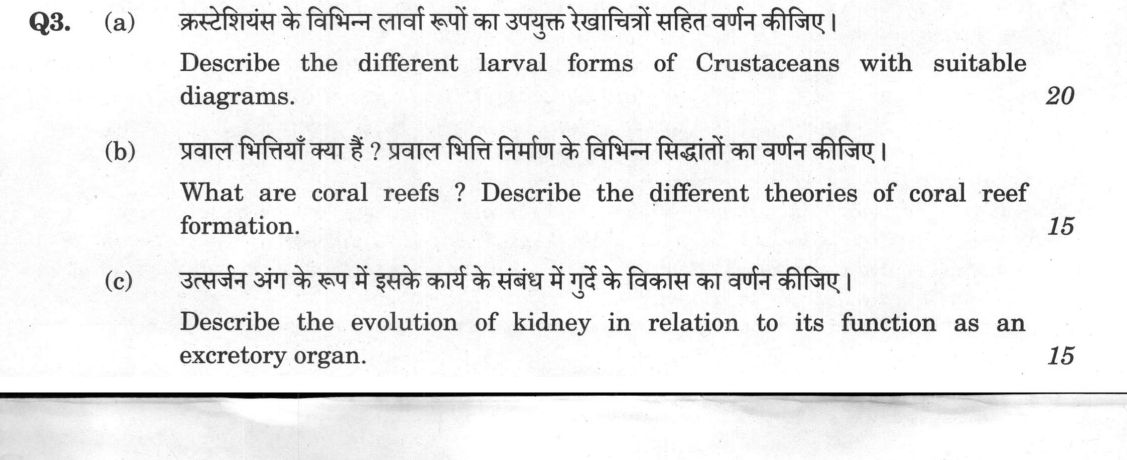
(a) Describe the different larval forms of Crustaceans with suitable diagrams. (20 marks) (b) What are coral reefs ? Describe the…
Describe the different larval forms of Crustaceans with suitable diagrams. 20 marks
What are coral reefs ? Describe the different theories of coral reef formation. 15 marks
Describe the evolution of kidney in relation to its function as an excretory organ. 15 marks
हिंदी में प्रश्न पढ़ें
क्रस्टेशियंस के विभिन्न लार्वा रूपों का उपयुक्त रेखाचित्रों सहित वर्णन कीजिए। (20 अंक)
प्रवाल भित्तियाँ क्या हैं ? प्रवाल भित्ति निर्माण के विभिन्न सिद्धांतों का वर्णन कीजिए। (15 अंक)
उत्सर्जन अंग के रूप में इसके कार्य के संबंध में गुर्दे के विकास का वर्णन कीजिए। (15 अंक)
Model answer
Written by UPSC Answer Check against this question's marking rubric, to the expected length. UPSC does not publish answers for Mains — this is one way to score well, not an official key.
(a) Crustacean larvae Crustacean larvae show graded metamorphosis from a nauplius-like planktonic form to the adult. In a labelled diagram, the nauplius is a small unsegmented body with one median unpaired eye and three pairs of appendages: first antennules, second antennae and mandibles; it lacks thoracic appendages and occurs in Cirripedia and many branchiopods. Metanauplius is a modified nauplius in which, as in the typical Apus, the nauplius appendages are retained and only maxillules/maxillae are added; maxillipeds are not present at this stage. Protozoea is the early decapod larva, with a nauplius head and the first thoracic appendages beginning to differentiate. Zoea, characteristic of Decapoda, has a carapace, well-developed antennules, antennae, maxillipeds and several pairs of thoracic legs; it feeds on plankton. Mysis is a later larval stage in which abdominal segments and pleopods appear, uropods and a tail fan develop, and the body more closely resembles the adult. Megalopa is the transitional decapod stage with adult-like thoracic and abdominal appendages, while cypris is the barnacle larva with a bivalved carapace and long antennules used for attachment before metamorphosis. Metamorphosis to the benthic adult involves loss of larval setae and reorganization of appendages. The sequence is therefore nauplius, metanauplius, protozoea, zoea, mysis, megalopa/cypris, with appendage addition and metamorphic moults marking each transition.
(b) Coral reefs Coral reefs are massive calcareous structures built by colonial anthozoans, mainly scleractinian corals, in shallow tropical waters. Reef zonation reflects light, temperature and salinity. Darwin’s subsidence theory holds that fringing reefs, barrier reefs and atolls form as volcanic islands slowly sink while corals grow upward; evidence includes atolls on subsiding volcanic platforms, deep lagoons and forereefs. Its limitation is that some reefs occur on stable or uplifted platforms. Daly’s glacial-control theory explains reefs by Pleistocene eustatic changes: during glaciation sea level fell by about 60–70 fathoms (110–120 m), corals grew on exposed platforms, and later post-glacial rise drowned the reefs at various depths. It explains reefs at different depths but does not by itself account for all atoll structures. Murray’s offshore-bar theory proposes that reefs develop on offshore sand bars or coral rubble where currents and wave action favour accretion, rather than requiring uniform subsidence. Deep-core drilling supports the importance of basement and biogenic limestone: at Eniwetok basaltic basement was reached under thick biogenic limestone, whereas the Funafuti boring did not reach basement, showing that evidence is locality-specific.
(c) Evolution of kidney Excretory organs evolved from simple excretory cells to tubular organs with filtration and reabsorption. In Platyhelminthes, solenocytes perform ultrafiltration and discharge wastes; in rotifers and annelid larvae, protonephridia with flame cells increase filtration; in adult annelids and arthropods, metanephridia develop coelomic funnels and tubules with selective reabsorption. Insects use Malpighian tubules, and crustaceans use antennal/maxillary glands, often modified for osmoregulation. In vertebrates, the kidney evolves through three stages. The pronephros is the first kidney, seen in embryos and in some fish/amphibian larvae; pronephric tubules open to the coelom and remove nitrogenous wastes, but reabsorption is limited. The mesonephros is the functional kidney of most fish and amphibians; nephrons have a Bowman’s capsule, glomerulus and proximal/distal tubules, allowing ultrafiltration, reabsorption of water and ions, and osmoregulation in freshwater or marine habitats. Freshwater fish excrete dilute urine and reabsorb ions; marine fish conserve water and excrete salts. The metanephros is the permanent kidney of reptiles, birds and mammals; it arises from metanephric blastema and ureteric bud, and its nephrons, especially with the loop of Henle in mammals, produce concentrated urine and conserve water on land. Thus, the kidney’s evolution is a graded adaptation from simple excretion to integrated excretion and osmoregulation.
What "Describe" is asking you to do
Give a full, ordered account of the thing named — its parts, stages or mechanism — in the sequence in which it actually exists or occurs. Most describe questions come from the science optionals, where the marks sit in correct technical detail and, where the stem says so, a labelled diagram.
Structure that answers it
One-line identification of the subject → the parts or stages in their real order, each with its defining detail → labelled diagram where the subject is structural → closing line on function or significance
Where marks are lost
Loose general prose where the examiner is ticking named parts, correct terminology and their sequence; and in the General Studies papers, turning to evaluation before the description is finished.
How this answer will be evaluated
Approach
Framework: Zoology Paper 1: Define > Structure/Mechanism > Diagram > Example. (a) describe: define > structure or process in order > labelled diagram > significance | (b) describe: define > structure or process in order > labelled diagram > significance | (c) describe: define > structure or process in order > labelled diagram > significance Full marks: All musts met, 3+ credits, 1+ bonus, accurate diagrams
Key points expected
- Define Nauplius larva and its key features
- Describe Zoea larva structure and development
- Describe Mysis larva and its relation to Zoea
- Provide labelled diagrams for at least two larval forms
- Define coral reefs and their ecological importance
- Describe Darwin's subsidence theory
- Describe uplift theory of reef formation
- Mention at least one other formation theory
Evaluation rubric
Each sub-part is marked on its own, against the marks and word limit printed on the paper.
- (a) Define larval forms, describe structure/process, provide labelled diagrams, and give taxonomic examples. 20 marks
describe— define → structure or process in order → labelled diagram → significance
Must cover
- Define Nauplius larva and its key features
- Describe Zoea larva structure and development
- Describe Mysis larva and its relation to Zoea
- Provide labelled diagrams for at least two larval forms
Loses marks
- Diagrams without labels or incorrect structures
- Confusing larval stages or missing key features
- No taxonomic examples or common names only
Earns more
- Mention specific crustacean orders for each larva
- Describe metamorphosis stages between larval forms
- Include Cyprid larva for barnacles
- Mention ecological significance of larval stages
Extra mark
- Name specific species for each larval type
- Include recent research on larval development
- (b) Define coral reefs, describe formation theories, and provide examples. 15 marks
describe— define → structure or process in order → labelled diagram → significance
Must cover
- Define coral reefs and their ecological importance
- Describe Darwin's subsidence theory
- Describe uplift theory of reef formation
- Mention at least one other formation theory
Loses marks
- Missing key theories or incomplete definitions
- No examples or common names only
- Diagrams without labels or incorrect structures
Earns more
- Include labelled diagram of reef types
- Mention specific coral species involved
- Describe environmental factors affecting formation
- Link to conservation or climate change impacts
Extra mark
- Name specific reef locations for each theory
- Include recent conservation status of reefs
- (c) Describe kidney evolution in relation to excretory function, with examples. 15 marks
describe— define → structure or process in order → labelled diagram → significance
Must cover
- Describe protonephridia and their function
- Describe metanephridia and their evolution
- Describe pronephros, mesonephros, metanephros stages
- Link structural changes to excretory efficiency
Loses marks
- Missing key evolutionary stages
- No functional link to excretion
- Diagrams without labels or incorrect structures
Earns more
- Include labelled diagrams of kidney types
- Mention specific vertebrate examples for each stage
- Describe osmoregulation adaptations
- Link to evolutionary transitions in vertebrates
Extra mark
- Name specific species for each kidney type
- Include recent research on kidney evolution
Practice this exact question
Write your answer and it is marked point by point against the model answer above — what you covered, what you missed, what you got wrong.
Evaluate my answer →More from Zoology 2024 Paper I
- Q1 Write short notes on the following in about 150 words each: (a) Concept and organization…
- Q2 (a) Explain the general features, life cycle and pathogenicity of Fasciola. (20 marks) (b…
- Q3 (a) Describe the different larval forms of Crustaceans with suitable diagrams. (20 marks)…
- Q4 (a) Give an illustrated account of integument and its derivatives in vertebrates with sui…
- Q5 Write short notes on the following in about 150 words each: (a) Food Web (10 marks) (b) B…
- Q6 (a) What is ecological succession ? Explain the different types and theories of ecologica…