Paper I — Q8
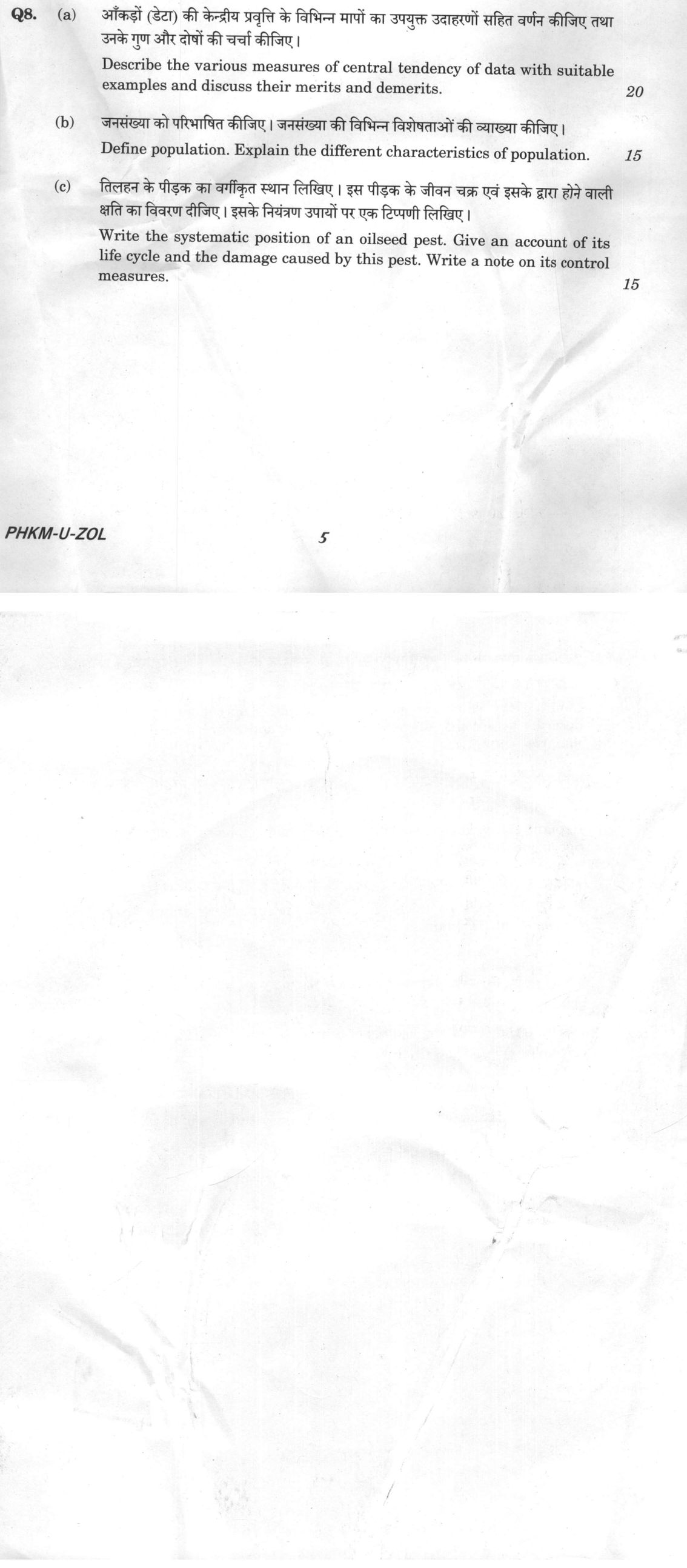
(a) Describe the various measures of central tendency of data with suitable examples and discuss their merits and demerits. (20…
Describe the various measures of central tendency of data with suitable examples and discuss their merits and demerits. 20 marks
Define population. Explain the different characteristics of population. 15 marks
Write the systematic position of an oilseed pest. Give an account of its life cycle and the damage caused by this pest. Write a note on its control measures. 15 marks
हिंदी में प्रश्न पढ़ें
आँकड़ों (डेटा) की केंद्रीय प्रवृत्ति के विभिन्न मापों का उपयुक्त उदाहरणों सहित वर्णन कीजिए तथा उनके गुण और दोषों की चर्चा कीजिए। (20 अंक)
जनसंख्या को परिभाषित कीजिए। जनसंख्या की विभिन्न विशेषताओं की व्याख्या कीजिए। (15 अंक)
तिलहन के पीड़क का वर्गीकृत स्थान लिखिए। इस पीड़क के जीवन चक्र एवं इसके द्वारा होने वाली क्षति का विवरण दीजिए। इसके नियंत्रण उपायों पर एक टिप्पणी लिखिए। (15 अंक)
Model answer
Written by UPSC Answer Check against this question's marking rubric, to the expected length. UPSC does not publish answers for Mains — this is one way to score well, not an official key.
Central tendency, population dynamics, and economic entomology together form the quantitative backbone of applied zoology and pest management.
Measures of Central Tendency
Measures of central tendency represent the single central or typical value around which a biological dataset clusters.
Arithmetic Mean (x̄): Calculated as x̄ = (Σ xᵢ)/N. For interval and ratio scale data, such as insect wing length or mollusc shell height in Pila globosa, it utilizes all observations and is algebraically tractable. However, it is severely distorted by extreme outliers and skewed distributions.
Geometric Mean (GM): Computed as GM = sqrt[N]x₁ · x₂ … x_N or antilog((Σ log xᵢ)/N). It is ideal for rates of change and multiplicative biological phenomena, such as bacterial growth or geometric population growth rates, though it cannot handle zero or negative values.
Harmonic Mean (HM): Defined as HM = N/(Σ 1/(xᵢ)). It is suitable for measuring average rates and velocities, such as animal dispersal speeds, but is heavily influenced by very small values.
Median (M): The positional middle value of an ordered dataset (M = (N+1)/2th value). It serves as the standard measure for ordinal data and highly skewed distributions, such as clutch sizes or parasite loads per host, because it remains unaffected by outliers, though it lacks direct algebraic amenability.
Mode (Z): The value occurring with the greatest frequency. It represents the primary measure for nominal data, such as morph types in polymorphic populations, but can be unstable in small samples and ill-defined in bimodal distributions.
Population and its Characteristics
A population is a biological unit comprising a group of interbreeding individuals of the same species occupying a specific geographical area at a given time, differing from a community (multi-species assemblage) and a taxonomic species (broader evolutionary lineage).
Dynamic Characteristics: Natality represents the birth rate (b = Δ Nₙ / NΔ t), while mortality reflects the death rate (d = Δ N_d / NΔ t), determining net growth alongside dispersal (immigration and emigration), as observed in the seasonal movements of the Nilgiri tahr (Nilgiritragus hylocrius).
Static Characteristics: Population density measures abundance per unit area (crude density) or per unit habitable space (ecological density), quantified in animals like the Gangetic dolphin (Platanista gangetica). Age distribution (pre-reproductive, reproductive, post-reproductive) dictates population growth potential, while sex ratio determines reproductive output.
Dispersion Patterns: Individuals exhibit clumped dispersion due to resource patchiness and sociality, seen in Asiatic lions (Panthera leo persica) around waterholes in Gir; uniform dispersion driven by intense territorial competition, seen in snow leopards (Panthera uncia) in the Himalayas; or random dispersion where environmental resources are homogeneous and interactions are neutral.
**Oilseed Pest: Mustard Aphid (Lipaphis erysimi)**
Systematic Position: Phylum: Arthropoda; Class: Insecta; Order: Hemiptera; Suborder: Sternorrhyncha; Family: Aphididae; Genus: Lipaphis; Species: erysimi. It possesses soft, pear-shaped bodies, piercing-sucking mouthparts, and a pair of posterior abdominal cornicles (siphunculi).
Life Cycle: L. erysimi exhibits cyclical parthenogenesis. In Indian plains, reproduction is predominantly parthenogenetic and viviparous during winter. Females give birth to active nymphs without fertilization. Nymphs pass through four instars over 7 to 10 days before maturing into adults. Depending on population density and host quality, adults develop as wingless (apterous) or winged (alate) forms for dispersal. The pest completes 15 to 45 overlapping generations annually (multivoltine).
Damage Caused: Nymphs and adults feed gregariously, sucking cell sap from tender leaves, inflorescences, and pods of mustard (Brassica campestris). This causes leaf curling, stunted plant growth, and failure of pod formation. They excrete excess sugar as honeydew, which fosters the growth of sooty mould (Capnodium spp.), drastically impairing photosynthesis. They also act as vectors for debilitating plant viruses.
Control Measures (IPM): Cultural control involves early sowing (by mid-October) to escape peak aphid infestation, clean cultivation, and deploying yellow sticky traps. Host-plant resistance utilizes tolerant cultivars such as Pusa Bold and Pusa Jaikisan. Biological control utilizes indigenous predators like the ladybird beetle (Coccinella septempunctata), green lacewing (Chrysoperla carnea), and the endoparasitoid wasp Diaeretiella rapae. Chemical control relies on need-based foliar sprays of systemic insecticides like imidacloprid 17.8 SL or dimethoate 30 EC applied strictly when populations exceed the Economic Threshold Level (ETL).
Statistical measures of central tendency and dispersion provide the quantitative framework for estimating pest density and understanding population dynamics, enabling the determination of accurate Economic Threshold Levels for precision integrated pest management.
What "Describe" is asking you to do
Give a full, ordered account of the thing named — its parts, stages or mechanism — in the sequence in which it actually exists or occurs. Most describe questions come from the science optionals, where the marks sit in correct technical detail and, where the stem says so, a labelled diagram.
Structure that answers it
One-line identification of the subject → the parts or stages in their real order, each with its defining detail → labelled diagram where the subject is structural → closing line on function or significance
Where marks are lost
Loose general prose where the examiner is ticking named parts, correct terminology and their sequence; and in the General Studies papers, turning to evaluation before the description is finished.
How this answer will be evaluated
Approach
(a) discuss: intro > 3-4 dimensions > example > balanced close | (b) explain: definition/context > points in order > small example > short close | (c) explain: definition/context > points in order > small example > short close Full marks: Precise definitions, clear examples, and detailed biological mechanisms.
Key points expected
- Define Mean, Median, and Mode
- Provide suitable numerical examples for each
- List merits of each measure
- List demerits of each measure
- Define population in biological context
- Explain population density and distribution
- Explain natality and mortality rates
- Explain age structure or growth curves
Evaluation rubric
Each sub-part is marked on its own, against the marks and word limit printed on the paper.
- (a) Define and evaluate measures of central tendency with examples. 20 marks
discuss— intro → 3-4 dimensions → example → balanced close
Must cover
- Define Mean, Median, and Mode
- Provide suitable numerical examples for each
- List merits of each measure
- List demerits of each measure
Loses marks
- Defining without examples
- Listing merits without demerits
- Confusing definitions of measures
Earns more
- Mention Geometric or Harmonic Mean
- Compare measures for skewed data
- Mention sensitivity to outliers
Extra mark
- Mention specific statistical applications
- (b) Define population and detail its biological characteristics. 15 marks
explain— definition/context → points in order → small example → short close
Must cover
- Define population in biological context
- Explain population density and distribution
- Explain natality and mortality rates
- Explain age structure or growth curves
Loses marks
- Defining population as a social group
- Omitting key demographic parameters
- Confusing population with species
Earns more
- Mention carrying capacity
- Explain population regulation mechanisms
- Distinguish between population and community
Extra mark
- Reference specific population models (e.g., logistic)
- (c) Describe an oilseed pest's taxonomy, life cycle, damage, and control. 15 marks
explain— definition/context → points in order → small example → short close
Must cover
- Provide systematic position of a specific pest
- Describe the complete life cycle
- Detail the specific damage caused
- List control measures
Loses marks
- Using common names without taxonomy
- Omitting the life cycle stages
- Vague description of damage
Earns more
- Draw a labelled life cycle diagram
- Mention specific host plants
- Distinguish between biological and chemical control
Extra mark
- Name a specific oilseed pest (e.g., Helicoverpa armigera)
Practice this exact question
Write your answer and it is marked point by point against the model answer above — what you covered, what you missed, what you got wrong.
Evaluate my answer →More from Zoology 2024 Paper I
- Q5 Write short notes on the following in about 150 words each: (a) Food Web (10 marks) (b) B…
- Q6 (a) What is ecological succession ? Explain the different types and theories of ecologica…
- Q7 (a) Mention the causative agent and means of spread of malaria. Also describe symptoms, d…
- Q8 (a) Describe the various measures of central tendency of data with suitable examples and…