Paper I — Q1
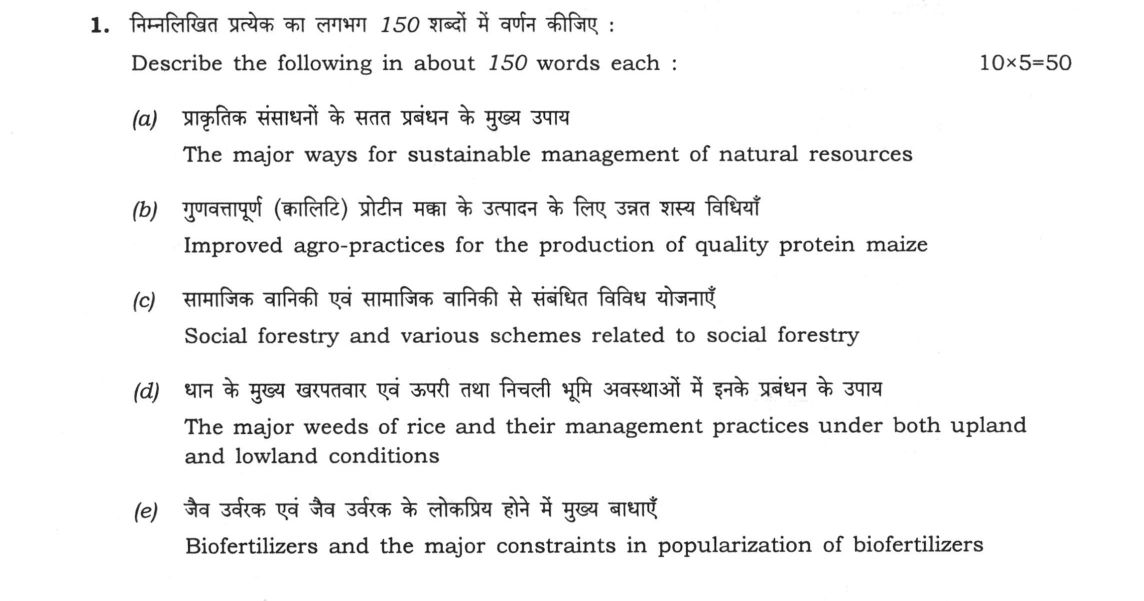
Describe the following in about 150 words each: (a) The major ways for sustainable management of natural resources (10…
Describe the following in about 150 words each:
The major ways for sustainable management of natural resources 10 marks
Improved agro-practices for the production of quality protein maize 10 marks
Social forestry and various schemes related to social forestry 10 marks
The major weeds of rice and their management practices under both upland and lowland conditions 10 marks
Biofertilizers and the major constraints in popularization of biofertilizers 10 marks
हिंदी में प्रश्न पढ़ें
निम्नलिखित प्रत्येक का लगभग 150 शब्दों में वर्णन कीजिए :
प्राकृतिक संसाधनों के सतत प्रबंधन के मुख्य उपाय (10 अंक)
गुणवत्तापूर्ण (क्वालिटी) प्रोटीन मक्का के उत्पादन के लिए उन्नत शस्य विधियाँ (10 अंक)
सामाजिक वानिकी एवं सामाजिक वानिकी से संबंधित विविध योजनाएँ (10 अंक)
धान के मुख्य खरपतवार एवं ऊपरी तथा निचली भूमि अवस्थाओं में इनके प्रबंधन के उपाय (10 अंक)
जैव उर्वरक एवं जैव उर्वरक के लोकप्रिय होने में मुख्य बाधाएँ (10 अंक)
Model answer
Written by UPSC Answer Check against this question's marking rubric, to the 150-word length. UPSC does not publish answers for Mains — this is one way to score well, not an official key.
Sustainable Management of Natural Resources
Sustainable management of natural resources ensures intergenerational equity by balancing current needs with future availability. Major approaches include Conservation Agriculture, which employs zero-tillage, crop residue retention, and crop rotation to enhance soil health and water infiltration. Integrated Nutrient Management (INM) combines organic manures with balanced chemical fertilizers to optimize nutrient use efficiency and reduce environmental load. Integrated Pest Management (IPM) utilizes biological controls, resistant varieties, and judicious pesticide application to minimize ecological disruption. Watershed Management focuses on rainwater harvesting, soil conservation, and afforestation to prevent erosion and recharge groundwater. Agroforestry integrates trees with crops or livestock, promoting biodiversity and long-term soil stability. These methods collectively enhance resource-use efficiency, ensuring that natural capital is preserved while supporting agricultural productivity.
Improved Agro-Practices for Quality Protein Maize
Quality Protein Maize (QPM) is engineered to contain higher levels of lysine and tryptophan, addressing protein malnutrition. Key agro-practices begin with the selection of specific varieties, such as the original opaque-2 mutant or modified opaque-2 lines that balance yield with protein quality. To maintain genetic purity and prevent cross-pollination with normal maize, an isolation distance of 200 to 400 meters is strictly maintained. Proper sowing time is critical to avoid heat stress during grain filling, which can degrade amino acids. Balanced fertilization is essential, with particular attention to sulphur and zinc, as these micronutrients are cofactors for the synthesis of essential amino acids. Irrigation scheduling must ensure consistent moisture, especially during flowering and grain development. Post-harvest handling is equally vital; grains must be dried promptly to safe moisture levels and stored in airtight containers to prevent mold growth and enzymatic degradation of protein quality, ensuring the nutritional benefits are retained until consumption.
Social Forestry and Related Schemes
Social forestry refers to the management of forests for the benefit of the community, integrating tree cultivation with agricultural and pastoral practices. It aims to meet local needs for fuel, fodder, and timber while enhancing environmental sustainability. The National Social Forestry Programme (NSFP), launched in 1985, is the flagship initiative, focusing on afforestation of degraded lands, wastelands, and community forests. Joint Forest Management (JFM), introduced in 1990, formalizes the partnership between the Forest Department and local communities, sharing benefits from forest produce. Other components include Farm Forestry, where trees are grown on private agricultural land, and Community Forestry, which manages public forests for local use. Agroforestry systems integrate trees with crops, providing diversified income. These efforts are further supported by the National Agricultural Development Programme (NAPCC) and the Green India Mission, which aim to increase forest cover and improve livelihoods through sustainable tree-based interventions, fostering a symbiotic relationship between people and nature.
Major Weeds of Rice and Management
Weed management in rice varies significantly between upland and lowland conditions. In lowland or flooded rice, major weeds include Echinochloa crus-galli (barnyard grass), Monochoria vaginalis (water hyacinth), and Marsilea quadrifolia (clover fern). Management relies on maintaining a continuous water layer to suppress germination, followed by the application of pre-emergence herbicides like butachlor or pendimethalin. Post-emergence herbicides such as bispyribac-sodium are used for selective control. In upland or direct-seeded rice, key weeds are Echinochloa colona, Cyperus rotundus (nutgrass), and Eleusine indica (goosegrass). Here, cultural practices like proper land leveling and timely transplanting are crucial. Mechanical weeding is often employed in the early stages. Chemical control involves the use of herbicides effective in dry conditions, often integrated with IPM approaches that include biological control agents and resistant varieties to reduce chemical dependency and ensure sustainable weed control.
Biofertilizers and Constraints in Popularization
Biofertilizers are living microorganisms that enhance plant nutrient availability. Major types include Rhizobium for nitrogen fixation in legumes, Azotobacter and Azospirillum for non-legumes, Phosphate Solubilizing Bacteria (PSB), Potassium Mobilizing Bacteria (KMB), and cyanobacteria like Azolla and Blue Green Algae (BGA). Despite their benefits, several constraints hinder their widespread adoption. A primary issue is the short shelf life of these biological products, which requires a robust cold chain for storage and transport, often lacking in rural India. Contamination during production and the lack of strict quality standards lead to inconsistent field performance. Farmer skepticism persists due to the slow onset of action compared to chemical fertilizers, which provide immediate results. Inadequate extension services mean farmers lack proper training on application methods. Furthermore, incompatibility with certain chemical fertilizers and pesticides can reduce efficacy. Addressing these challenges requires improved packaging, better extension outreach, and integrated nutrient management strategies that combine biofertilizers with chemical inputs for optimal results.
What "Describe" is asking you to do
Give a full, ordered account of the thing named — its parts, stages or mechanism — in the sequence in which it actually exists or occurs. Most describe questions come from the science optionals, where the marks sit in correct technical detail and, where the stem says so, a labelled diagram.
Structure that answers it
One-line identification of the subject → the parts or stages in their real order, each with its defining detail → labelled diagram where the subject is structural → closing line on function or significance
Where marks are lost
Loose general prose where the examiner is ticking named parts, correct terminology and their sequence; and in the General Studies papers, turning to evaluation before the description is finished.
How this answer will be evaluated
Approach
Framework: Concept > Practice or process > Data > Indian application. (a) describe: define > structure or process in order > labelled diagram > significance | (b) describe: define > structure or process in order > labelled diagram > significance | (c) describe: define > structure or process in order > labelled diagram > significance | (d) describe: define > structure or process in order > labelled diagram > significance | (e) describe: define > structure or process in order > labelled diagram > significance Full marks: Precise definitions, specific examples (varieties, schemes, weeds), clear distinction between conditions, and accurate terminology.
Key points expected
- Define sustainable management of natural resources
- List 3-4 major ways (e.g., conservation, recycling, policy)
- Mention specific Indian policy or act (e.g., FRA, Forest Act)
- Briefly explain the mechanism of one way
- Mention specific high-protein varieties (e.g., QPM, DTQPM)
- Specify seed treatment or inoculation (e.g., Rhizobium)
- Detail fertilizer management (NPK balance)
- Mention specific spacing or planting time
Evaluation rubric
Each sub-part is marked on its own, against the marks and word limit printed on the paper.
- (a) Define sustainable management and list major ways to manage natural resources. 10 marks · 150 words
describe— define → structure or process in order → labelled diagram → significance
Must cover
- Define sustainable management of natural resources
- List 3-4 major ways (e.g., conservation, recycling, policy)
- Mention specific Indian policy or act (e.g., FRA, Forest Act)
- Briefly explain the mechanism of one way
Loses marks
- Vague generalities without specific examples
- Ignoring the 'sustainable' aspect (only mentioning extraction)
Earns more
- Mention specific resource (water, soil, forest)
- Reference to 'Sustainable Development Goals' (SDGs)
- Mention of 'Integrated Watershed Management'
Extra mark
- Cite a specific recent government scheme (e.g., Jal Jeevan Mission)
- Mention a specific committee report (e.g., Gadgil Committee)
- (b) List improved agro-practices for producing quality protein maize. 10 marks · 150 words
describe— define → structure or process in order → labelled diagram → significance
Must cover
- Mention specific high-protein varieties (e.g., QPM, DTQPM)
- Specify seed treatment or inoculation (e.g., Rhizobium)
- Detail fertilizer management (NPK balance)
- Mention specific spacing or planting time
Loses marks
- Generic maize advice not specific to protein quality
- Ignoring the 'quality' aspect (only focusing on yield)
Earns more
- Mention of 'Quality Protein Maize' (QPM) technology
- Reference to 'DTQPM' (Drought Tolerant QPM)
- Mention of specific micronutrients (Zinc, Iron)
Extra mark
- Cite a specific research institute (e.g., IARI, ICAR)
- Mention a specific state where QPM is promoted
- (c) Define social forestry and list related schemes. 10 marks · 150 words
describe— define → structure or process in order → labelled diagram → significance
Must cover
- Define social forestry (planting on non-forest land)
- List 2-3 specific schemes (e.g., SFM, NMF)
- Mention the implementing agency (e.g., MoEFCC, State Forest Dept)
- Briefly explain the objective of one scheme
Loses marks
- Confusing social forestry with plantation forestry
- Listing schemes without explaining their relevance to social forestry
Earns more
- Mention of 'Social Forestry Mission'
- Reference to 'National Mission on Bio-energy'
- Mention of 'Community Forestry'
Extra mark
- Cite a specific state's social forestry initiative
- Mention a specific tree species promoted under the scheme
- (d) List major rice weeds and their management in upland/lowland conditions. 10 marks · 150 words
describe— define → structure or process in order → labelled diagram → significance
Must cover
- Name 2-3 major weeds (e.g., Cyperus rotundus, Echinochloa)
- Specify management for upland conditions (e.g., manual weeding)
- Specify management for lowland conditions (e.g., herbicides)
- Mention specific herbicide names (e.g., Pendimethalin)
Loses marks
- Listing weeds without management practices
- Ignoring the distinction between upland and lowland conditions
Earns more
- Mention of 'Integrated Weed Management' (IWM)
- Reference to 'Alternate wetting and drying' (AWD)
- Mention of specific weed species (e.g., Monochoria vaginalis)
Extra mark
- Cite a specific research station's recommendation
- Mention a specific herbicide dosage
- (e) Define biofertilizers and list constraints in their popularization. 10 marks · 150 words
describe— define → structure or process in order → labelled diagram → significance
Must cover
- Define biofertilizers (microorganisms that enhance nutrient availability)
- List 2-3 major constraints (e.g., lack of awareness, poor quality)
- Mention specific biofertilizer types (e.g., Rhizobium, Azospirillum)
- Briefly explain one constraint in detail
Loses marks
- Confusing biofertilizers with organic fertilizers
- Listing constraints without explaining their impact on popularization
Earns more
- Mention of 'Biofertilizer Technology' (BFT)
- Reference to 'National Biofertilizer Development Centre' (NBDC)
- Mention of 'Microbial Inoculants'
Extra mark
- Cite a specific government initiative to promote biofertilizers
- Mention a specific research paper or study on biofertilizer efficacy
Practice this exact question
Write your answer and it is marked point by point against the model answer above — what you covered, what you missed, what you got wrong.
Evaluate my answer →More from Agriculture 2021 Paper I
- Q1 Describe the following in about 150 words each: (a) The major ways for sustainable manage…
- Q2 (a) What is greenhouse effect? Write in detail about various greenhouse gases and their i…
- Q3 (a) What do you understand by agroforestry? Discuss various types of agroforestry systems…
- Q4 (a) What are the factors responsible for declining soil fertility? Discuss various measur…