Paper I — Q3
(a) What do you understand by agroforestry? Discuss various types of agroforestry systems in India with the help of examples. (20…
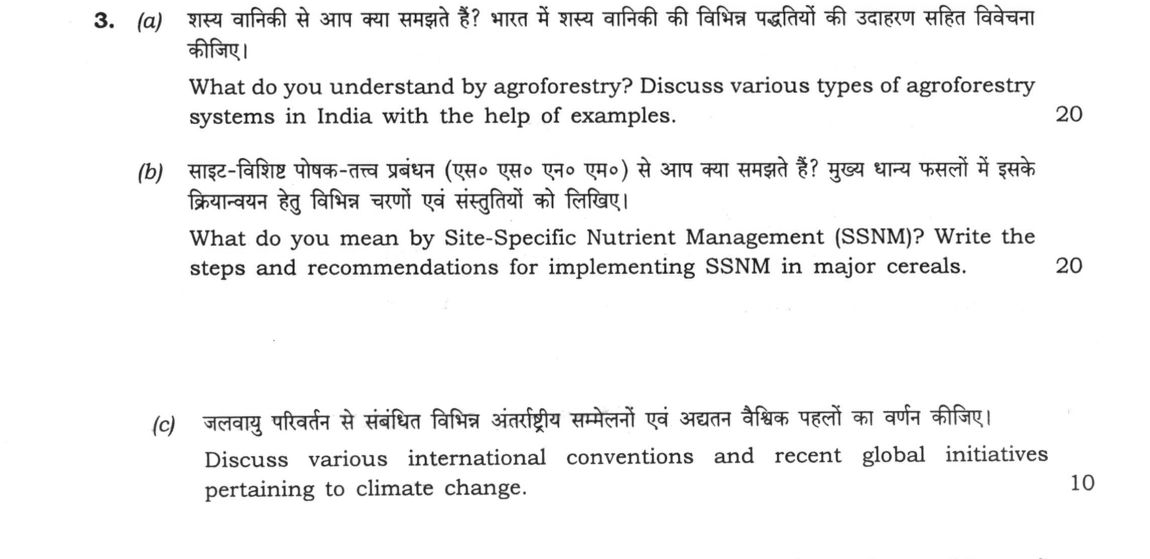
What do you understand by agroforestry? Discuss various types of agroforestry systems in India with the help of examples. 20 marks
What do you mean by Site-Specific Nutrient Management (SSNM)? Write the steps and recommendations for implementing SSNM in major cereals. 20 marks
Discuss various international conventions and recent global initiatives pertaining to climate change. 10 marks
हिंदी में प्रश्न पढ़ें
शस्य वानिकी से आप क्या समझते हैं? भारत में शस्य वानिकी की विभिन्न पद्धतियों की उदाहरण सहित विवेचना कीजिए। (20 अंक)
साइट-विशिष्ट पोषक-तत्व प्रबंधन (एस० एस० एन० एम०) से आप क्या समझते हैं? मुख्य धान्य फसलों में इसके क्रियान्वयन हेतु विभिन्न चरणों एवं संस्तुतियों को लिखिए। (20 अंक)
जलवायु परिवर्तन से संबंधित विभिन्न अंतर्राष्ट्रीय सम्मेलनों एवं अद्यतन वैश्विक पहलों का वर्णन कीजिए। (10 अंक)
Model answer
Written by UPSC Answer Check against this question's marking rubric, to the expected length. UPSC does not publish answers for Mains — this is one way to score well, not an official key.
According to the World Agroforestry Centre (ICRAF), agroforestry is a dynamic, ecologically based natural resource management system that integrates trees on farms and in the agricultural landscape, diversifying and sustaining production. In India, major agroforestry systems include:
Agrisilvicultural systems, which integrate crops with trees, such as commercial Poplar and Eucalyptus intercropped with wheat and sugarcane in Punjab and Haryana.
Silvopastoral systems, combining trees with pasture and livestock, exemplified by Prosopis cineraria (Khejri) sustaining grasses and livestock in arid Rajasthan.
Agrosilvopastoral systems, combining crops, trees, and livestock, notably the multi-tiered homegardens of Kerala and traditional shifting cultivation (jhum) fallows in Northeast India.
Boundary systems, using species like Acacia nilotica and Casuarina as shelterbelts and windbreaks. Historical systems include Taungya in Odisha and Madhya Pradesh, while modern initiatives include agro-afforestation drives like Telangana’s Haritha Haram.
Site-Specific Nutrient Management (SSNM) is a dynamic, field-specific approach that supplies crops with nutrients according to need, eliminating over- or under-fertilization. It operationalizes the 4R Stewardship (Right source, Right rate, Right time, Right place) in contrast to static, blanket fertilizer recommendations.
The implementation steps comprise: first, yield gap analysis to set realistic target yields based on climatic potential; second, assessing indigenous soil nutrient supply using soil testing and GIS-based nutrient mapping; third, utilizing real-time decision-support tools such as the Leaf Colour Chart (LCC), GreenSeeker, and the Nutrient Expert software for dynamic nitrogen and balanced nutrient scheduling; and fourth, applying customized fertilizer formulations tailored to crop demand phases. For the rice-wheat system in the Indo-Gangetic Plains, SSNM recommends basal P and K applications with dynamic, LCC-guided N splits to curb leaching. For rabi maize in Bihar, it utilizes Nutrient Expert-generated schedules, ensuring split N-P-K applications paired with zinc and boron supplements.
Global Climate Conventions and Initiatives are anchored in the United Nations Framework Convention on Climate Change (UNFCCC, 1992), the Kyoto Protocol (1997) with its legally binding emission targets, and the Paris Agreement (2015), which operationalizes global temperature goals through Nationally Determined Contributions (NDCs). Recent multilateral mechanisms include the Glasgow Climate Pact (COP26) and the Koronivia Joint Work on Agriculture (KJWA), which explicitly integrates agricultural vulnerabilities into UNFCCC processes. Domestically, India addresses these through its National Action Plan on Climate Change (NAPCC), notably the National Mission for Sustainable Agriculture (NMSA).
Scaling up agroforestry and SSNM within global and national climate adaptation frameworks provides a vital pathway to achieve land degradation neutrality, reduce carbon emissions, and build climate-resilient farming systems.
What "Discuss" is asking you to do
Lay the issue out from more than one side — how it arose, what is claimed for it, what is held against it, and where it now stands. UPSC attaches discuss to broad topics with several live dimensions, so coverage of the dimensions earns more than the strength of your opinion.
Structure that answers it
Set the issue up → the case as it is made → the case against → the dimension both sides leave out → where the balance now lies
Where marks are lost
Listing facts with no thread between them, or arguing one side throughout and calling it a discussion.
How this answer will be evaluated
Approach
Framework: Concept > Practice or process > Data > Indian application. (a) discuss: intro > 3-4 dimensions > example > balanced close | (b) explain: definition/context > points in order > small example > short close | (c) discuss: intro > 3-4 dimensions > example > balanced close Full marks: Comprehensive, specific, and well-structured with Indian examples and data.
Key points expected
- Define agroforestry as a land-use system
- Classify systems (e.g., Alley, Silvo-arable, Silvo-pastoral)
- Provide specific Indian examples for each type
- Mention benefits (economic, ecological, social)
- Define SSNM (site-specific nutrient management)
- List steps (soil testing, crop response, etc.)
- Give recommendations for major cereals (Rice, Wheat)
- Mention specific nutrient doses or ratios
Evaluation rubric
Each sub-part is marked on its own, against the marks and word limit printed on the paper.
- (a) Define agroforestry and classify Indian systems with specific examples. 20 marks
discuss— intro → 3-4 dimensions → example → balanced close
Must cover
- Define agroforestry as a land-use system
- Classify systems (e.g., Alley, Silvo-arable, Silvo-pastoral)
- Provide specific Indian examples for each type
- Mention benefits (economic, ecological, social)
Loses marks
- Vague definitions without land-use context
- Listing types without specific Indian examples
- Ignoring the 'system' aspect (interaction)
Earns more
- Mention specific tree species (e.g., Casuarina, Eucalyptus)
- Reference specific Indian regions for examples
- Discuss government schemes (e.g., NABARD, ICAR)
Extra mark
- Mention specific spacing or layout diagrams
- Cite specific yield data for mixed systems
- (b) Define SSNM and detail the steps and recommendations for major cereals. 20 marks
explain— definition/context → points in order → small example → short close
Must cover
- Define SSNM (site-specific nutrient management)
- List steps (soil testing, crop response, etc.)
- Give recommendations for major cereals (Rice, Wheat)
- Mention specific nutrient doses or ratios
Loses marks
- Generic advice without site-specific focus
- Ignoring the 'steps' part of the question
- Failing to mention major cereals specifically
Earns more
- Mention specific soil testing methods
- Reference specific cereal varieties
- Discuss economic benefits of SSNM
Extra mark
- Mention specific government initiatives for SSNM
- Provide a table of nutrient recommendations
- (c) List and discuss international conventions and global initiatives on climate change. 10 marks
discuss— intro → 3-4 dimensions → example → balanced close
Must cover
- Name key international conventions (e.g., UNFCCC, Paris Agreement)
- Mention recent global initiatives (e.g., COP26, COP27)
- Briefly explain the purpose of each
- Mention India's role or commitments
Loses marks
- Listing conventions without explaining their purpose
- Ignoring 'recent' initiatives
- Failing to mention India's role
Earns more
- Mention specific targets (e.g., 1.5°C, 2°C)
- Reference specific funding mechanisms (e.g., Green Climate Fund)
- Discuss recent developments (e.g., Loss and Damage Fund)
Extra mark
- Mention specific dates of conventions
- Cite specific Indian commitments (e.g., Panchamrit)
Practice this exact question
Write your answer and it is marked point by point against the model answer above — what you covered, what you missed, what you got wrong.
Evaluate my answer →More from Agriculture 2021 Paper I
- Q1 Describe the following in about 150 words each: (a) The major ways for sustainable manage…
- Q2 (a) What is greenhouse effect? Write in detail about various greenhouse gases and their i…
- Q3 (a) What do you understand by agroforestry? Discuss various types of agroforestry systems…
- Q4 (a) What are the factors responsible for declining soil fertility? Discuss various measur…
- Q5 Describe Q. Nos. 5(a), 5(c), 5(d), 5(e) and answer Q. No. 5(b) (in about 150 words each):…
- Q6 (a) Define soil erosion and its different forms. Explain agronomic and mechanical measure…