Paper I — Q6
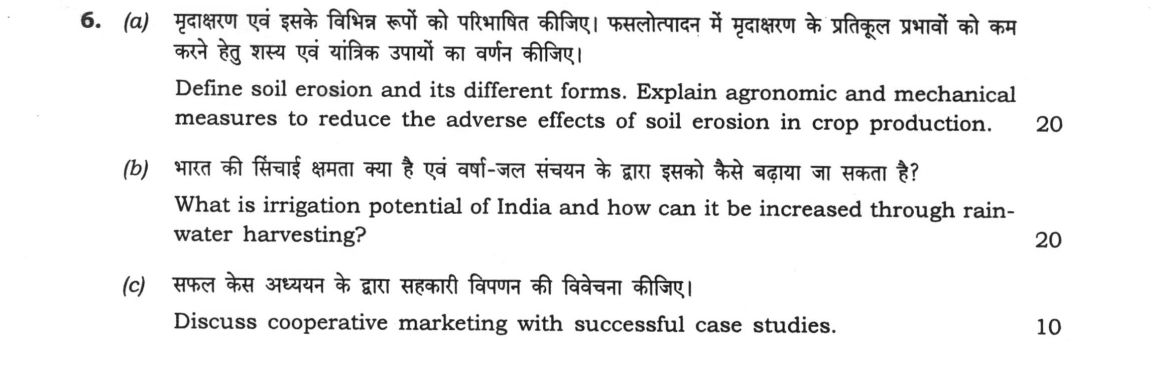
(a) Define soil erosion and its different forms. Explain agronomic and mechanical measures to reduce the adverse effects of soil…
Define soil erosion and its different forms. Explain agronomic and mechanical measures to reduce the adverse effects of soil erosion in crop production. 20 marks
What is irrigation potential of India and how can it be increased through rain-water harvesting? 20 marks
Discuss cooperative marketing with successful case studies. 10 marks
हिंदी में प्रश्न पढ़ें
मृदाक्षरण एवं इसके विभिन्न रूपों को परिभाषित कीजिए। फसलोत्पादन में मृदाक्षरण के प्रतिकूल प्रभावों को कम करने हेतु शस्य एवं यांत्रिक उपायों का वर्णन कीजिए। (20 अंक)
भारत की सिंचाई क्षमता क्या है एवं वर्षा-जल संचयन के द्वारा इसको कैसे बढ़ाया जा सकता है? (20 अंक)
सफल कैस अध्ययन के द्वारा सहकारी विपणन की विवेचना कीजिए। (10 अंक)
Model answer
Written by UPSC Answer Check against this question's marking rubric, to the expected length. UPSC does not publish answers for Mains — this is one way to score well, not an official key.
Soil erosion is the detachment and transport of soil particles by natural agents, distinct from deposition or sedimentation. While geological erosion occurs over millennia, accelerated erosion is a modern crisis driven by anthropogenic pressure, threatening India’s food security. Simultaneously, the gap between irrigation potential and utilization, and the inefficiency of fragmented marketing, hinder agricultural sustainability. Addressing these through conservation, water harvesting, and cooperative strength is imperative.
Soil Erosion: Forms and Mitigation Erosion is classified by agent. Water erosion includes splash (detachment by raindrop impact), sheet (uniform removal of topsoil), rill (concentrated flow forming small channels), and gully (deep, irreversible channels). Wind erosion affects arid zones, while tillage erosion results from machinery compaction.
Agronomic measures focus on biological protection. Contour farming, plowing along the contour, is effective on gentle slopes (<2%) to reduce runoff velocity. For steeper slopes (up to 10–15%), contour strip cropping alternates rows of grass and crops to break wind and water flow. Mulching retains moisture and shields soil from splash, while cover crops and crop rotation maintain root structure and organic matter.
Mechanical measures involve physical structures. Terracing converts slopes into flat steps, ideal for hilly regions. Bunding and check dams slow runoff and promote infiltration, while gully plugging stabilizes eroded channels. However, mechanical solutions are capital-intensive, posing challenges for smallholders who rely more on low-cost agronomic practices.
Irrigation Potential and Rainwater Harvesting India’s gross irrigation potential is approximately 194.5 million hectares (Mha), with a net potential of 142.5 Mha. Currently, only about 55% of the net potential is utilized, leaving a significant gap. Surface water sources contribute roughly 60% of irrigation, while groundwater accounts for the rest, often leading to over-exploitation.
Rainwater harvesting (RWH) is critical to bridging this gap and recharging depleting aquifers. Techniques include farm ponds for micro-irrigation, percolation tanks for groundwater recharge, and rooftop harvesting for domestic use. Large-scale structures like check dams and contour bunds capture runoff in rainfed areas. By integrating RWH with existing irrigation infrastructure, India can enhance water use efficiency, reduce dependence on stressed groundwater, and expand the effective irrigation potential without new reservoirs.
Cooperative Marketing Cooperative marketing differs from cooperative farming; it focuses on the post-harvest stage, aggregating produce to negotiate better prices and reduce middlemen. It involves collective processing, storage, and credit linkage.
The most successful case is AMUL in Gujarat, which transformed dairy farming through a three-tier structure (village societies, district unions, state federation). AMUL ensures farmers receive fair prices, invests in processing, and markets directly to consumers. Similarly, the Karnataka Milk Federation (KMF) and Maharashtra’s Warana cooperative have demonstrated that strong institutional frameworks can empower smallholders. These models show that cooperatives can mitigate market volatility and ensure equitable income distribution.
Conclusion Sustainable agriculture in India requires an integrated approach. Soil conservation through appropriate agronomic and mechanical measures preserves the resource base. Rainwater harvesting maximizes the utility of existing irrigation potential, reducing stress on groundwater. Finally, robust cooperative marketing ensures that farmers capture the value of their produce. Linking soil health, water security, and market access creates a resilient agricultural system capable of sustaining growth and food security.
What "Explain" is asking you to do
Make the working of something clear — what sets it off, what follows from what, and what it produces. Explain is the Commission's mechanism word: it dominates the technical papers and the “explain why” stems, where the marks sit in the causal chain and not in the label.
Structure that answers it
State what it is → the initiating condition → the chain of cause, step by step → an instance where it plays out → what the chain produces
Where marks are lost
Describing what something looks like instead of why it works that way. Naming the stages without linking them reads as description too.
How this answer will be evaluated
Approach
Framework: Concept > Practice or process > Data > Indian application. (a) explain: definition/context > points in order > small example > short close | (b) explain: definition/context > points in order > small example > short close | (c) discuss: intro > 3-4 dimensions > example > balanced close Full marks: Comprehensive, specific, and well-structured answers with clear examples and data.
Key points expected
- Define soil erosion and list forms (sheet, rill, gully, wind).
- Explain agronomic measures (contour ploughing, mulching, crop rotation).
- Explain mechanical measures (terracing, check dams, bunds).
- Link measures to reducing adverse effects in crop production.
- Define irrigation potential (net area irrigated + potential for expansion).
- Explain rainwater harvesting (surface, subsurface, rooftop).
- Link harvesting to increasing irrigation potential.
- Mention specific Indian context (e.g., micro-irrigation, check dams).
Evaluation rubric
Each sub-part is marked on its own, against the marks and word limit printed on the paper.
- (a) Define soil erosion, list forms, and detail agronomic/mechanical control measures. 20 marks
explain— definition/context → points in order → small example → short close
Must cover
- Define soil erosion and list forms (sheet, rill, gully, wind).
- Explain agronomic measures (contour ploughing, mulching, crop rotation).
- Explain mechanical measures (terracing, check dams, bunds).
- Link measures to reducing adverse effects in crop production.
Loses marks
- Vague agronomic advice without specific techniques.
- Confusing erosion with weathering.
Earns more
- Mention specific soil types (e.g., red, black) prone to erosion.
- Reference specific Indian schemes (e.g., NEP, NABARD).
Extra mark
- Mention specific soil conservation structures (e.g., gabion, stone masonry).
- (b) Define irrigation potential and explain rainwater harvesting methods to increase it. 20 marks
explain— definition/context → points in order → small example → short close
Must cover
- Define irrigation potential (net area irrigated + potential for expansion).
- Explain rainwater harvesting (surface, subsurface, rooftop).
- Link harvesting to increasing irrigation potential.
- Mention specific Indian context (e.g., micro-irrigation, check dams).
Loses marks
- Confusing irrigation potential with irrigation coverage.
- Vague description of rainwater harvesting.
Earns more
- Mention specific states (e.g., Rajasthan, Tamil Nadu) with high potential.
- Reference specific schemes (e.g., Jal Jeevan Mission, PMKSY).
Extra mark
- Mention specific rainwater harvesting techniques (e.g., percolation tanks).
- (c) Discuss cooperative marketing with successful case studies. 10 marks
discuss— intro → 3-4 dimensions → example → balanced close
Must cover
- Define cooperative marketing.
- Explain its role in agricultural marketing.
- Provide successful case studies (e.g., Amul, NAFED).
- Mention benefits (e.g., better prices, reduced exploitation).
Loses marks
- Vague description of cooperative marketing.
- Lack of specific case studies.
Earns more
- Mention specific cooperative structures (e.g., primary, secondary, tertiary).
- Reference specific government support (e.g., NABARD, NAFED).
Extra mark
- Mention specific cooperative achievements (e.g., Amul's global reach).
Practice this exact question
Write your answer and it is marked point by point against the model answer above — what you covered, what you missed, what you got wrong.
Evaluate my answer →More from Agriculture 2021 Paper I
- Q3 (a) What do you understand by agroforestry? Discuss various types of agroforestry systems…
- Q4 (a) What are the factors responsible for declining soil fertility? Discuss various measur…
- Q5 Describe Q. Nos. 5(a), 5(c), 5(d), 5(e) and answer Q. No. 5(b) (in about 150 words each):…
- Q6 (a) Define soil erosion and its different forms. Explain agronomic and mechanical measure…
- Q7 (a) Define ecology. Mention its basic concepts and relevance in crop production. (20 mark…
- Q8 (a) Critically examine the major extension programmes of agricultural sector in India. Su…