Paper I — Q5
Describe Q. Nos. 5(a), 5(c), 5(d), 5(e) and answer Q. No. 5(b) (in about 150 words each): (a) Technologies and policies for…
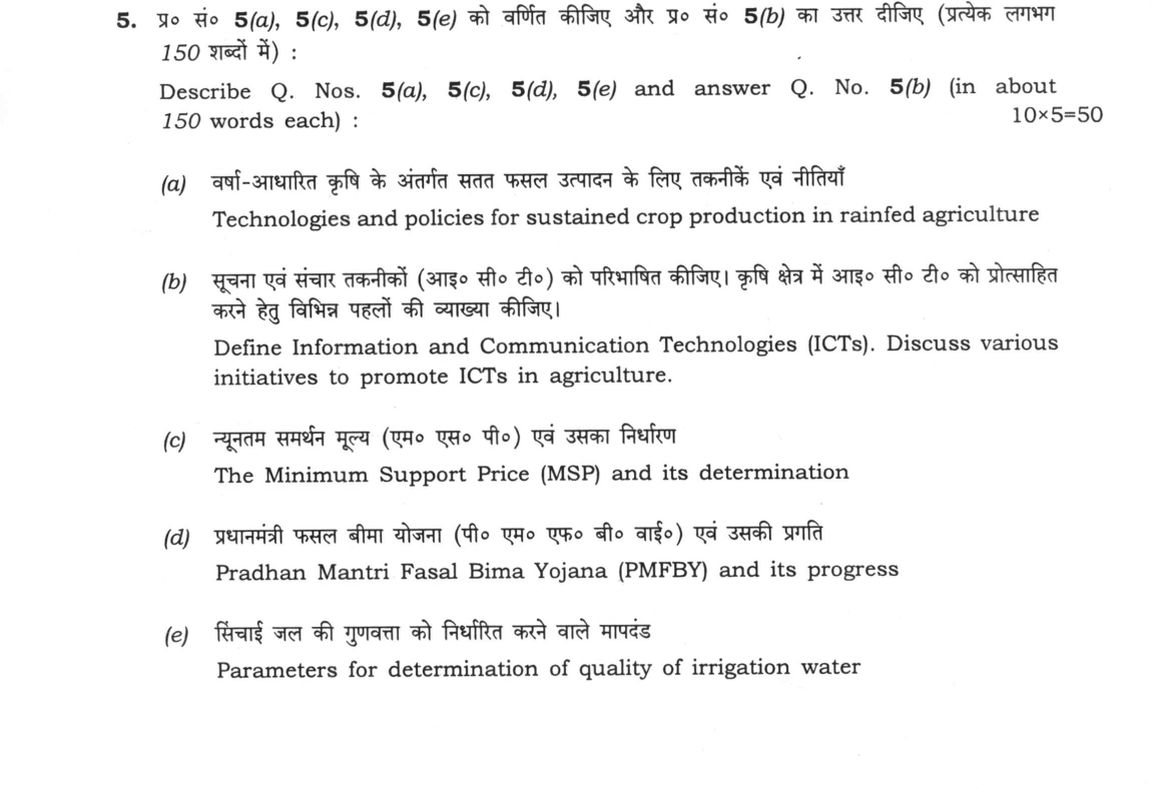
Describe Q. Nos. 5(a), 5(c), 5(d), 5(e) and answer Q. No. 5(b) (in about 150 words each):
Technologies and policies for sustained crop production in rainfed agriculture 10 marks
Define Information and Communication Technologies (ICTs). Discuss various initiatives to promote ICTs in agriculture. 10 marks
The Minimum Support Price (MSP) and its determination 10 marks
Pradhan Mantri Fasal Bima Yojana (PMFBY) and its progress 10 marks
Parameters for determination of quality of irrigation water 10 marks
हिंदी में प्रश्न पढ़ें
प्र० सं० 5(a), 5(c), 5(d), 5(e) को वर्णित कीजिए और प्र० सं० 5(b) का उत्तर दीजिए (प्रत्येक लगभग 150 शब्दों में) :
वर्षा-आधारित कृषि के अंतर्गत सतत फसल उत्पादन के लिए तकनीकें एवं नीतियाँ (10 अंक)
सूचना एवं संचार तकनीकों (आई० सी० टी०) को परिभाषित कीजिए। कृषि क्षेत्र में आई० सी० टी० को प्रोत्साहित करने हेतु विभिन्न पहलों की व्याख्या कीजिए। (10 अंक)
न्यूनतम समर्थन मूल्य (एम० एस० पी०) एवं उसका निर्धारण (10 अंक)
प्रधानमंत्री फसल बीमा योजना (पी० एम० एफ० बी० वाई०) एवं उसकी प्रगति (10 अंक)
सिंचाई जल की गुणवत्ता को निर्धारित करने वाले मापदंड (10 अंक)
Model answer
Written by UPSC Answer Check against this question's marking rubric, to the 150-word length. UPSC does not publish answers for Mains — this is one way to score well, not an official key.
5(a) Technologies and Policies for Rainfed Agriculture Sustained crop production in rainfed areas, which constitute 52% of India’s net sown area, relies on integrated technological and policy interventions. Technologically, the focus is on in-situ moisture conservation and drought resilience. Key practices include contour bunding, terracing, and zero-till farming to reduce evaporation and runoff. The introduction of drought-resistant and early-maturing varieties by institutions like ICRISAT, such as hybrid millets and sorghum, has significantly improved yields. Watershed development under the Watershed Development Component of Pradhan Mantri Krishi Sinchayee Yojana (PMKSY) integrates soil and water conservation with on-farm water management.
Policy support is equally critical. The Mahatma Gandhi National Rural Employment Guarantee Act (MGNREGA) provides labor for water harvesting structures, check dams, and farm ponds, ensuring rural livelihoods while enhancing water security. The establishment of the National Rainfed Area Authority (NRAA) aims to coordinate research, extension, and policy formulation specifically for dryland agriculture. Furthermore, crop insurance schemes like PMFBY mitigate the high risk associated with erratic monsoons. Together, these measures create a resilient framework that balances ecological sustainability with economic viability for smallholder farmers in rainfed zones.
5(b) ICTs in Agriculture: Definition and Initiatives Information and Communication Technologies (ICTs) refer to the digital tools and platforms used for the creation, storage, and exchange of information. In agriculture, ICTs bridge the information gap between research, markets, and farmers. The Indian government has launched several initiatives to promote ICT adoption. The Kisan Call Centres (KCCs) provide toll-free (1551) voice-based advisory services in local languages, reaching remote areas. The mKisan SMS portal sends weather alerts, market prices, and crop advisories directly to registered farmers' mobile phones, enabling timely decision-making.
The National Agriculture Market (eNAM) is a pan-India electronic trading portal that creates a unified national market for agricultural produce, reducing middlemen and ensuring price transparency. The Soil Health Card (SHC) portal digitizes soil test data, providing farmers with specific nutrient recommendations for efficient fertilizer use. Recently, the AgriStack initiative aims to create a unified digital identity for farmers, integrating data from various schemes to streamline service delivery. Additionally, drone-based technology is being promoted for crop health monitoring and precision spraying. These initiatives collectively enhance agricultural productivity by ensuring timely, accurate, and accessible information flow, thereby empowering farmers with data-driven insights.
5(c) Minimum Support Price (MSP) and Determination The Minimum Support Price (MSP) is a price floor announced by the Government of India for 23 notified crops to protect farmers from excessive falls in prices. The determination of MSP is a complex process guided by the Committee of Appropriate Cost and Price (CACP). The CACP recommends MSP based on the cost of production, calculated as A2+FL. A2 represents cash expenses (seeds, fertilizers, pesticides, hired labor), while FL is the imputed value of family labor.
The Swaminathan Commission (2006) recommended that MSP should be at least 50% above the cost of production (C2 cost, which includes imputed rent and interest on owned capital). While the government has not formally adopted the 50% margin as a statutory rule, the CACP considers it a benchmark. Other factors influencing MSP include market price trends, demand-supply balance, international price trends, and the fiscal impact on the government. The final MSP is approved by the Cabinet Committee on Economic Affairs (CCEA). This mechanism ensures that farmers receive a guaranteed price, stabilizing income and encouraging the cultivation of essential crops, though its effectiveness is often debated due to limited procurement infrastructure outside major states.
5(d) Pradhan Mantri Fasal Bima Yojana (PMFBY) Pradhan Mantri Fasal Bima Yojana (PMFBY), launched in 2016, is a comprehensive crop insurance scheme aimed at protecting farmers against natural calamities and yield loss. A key feature is the uniform premium rate: 2% for Kharif, 1.5% for Rabi, and 5% for commercial/horticultural crops. The remaining premium is shared between the Central and State governments. For most states, the sharing is 50:50, but for North-Eastern and Himalayan states, the Centre bears 90% of the premium to account for higher risks and lower fiscal capacity.
PMFBY utilizes modern technology for loss assessment, including remote sensing, drones, and smartphone-based Crop Cut Estimates (CCEs), which reduce delays and disputes in claim settlement. The scheme has seen significant progress in coverage, with millions of farmers enrolled annually. However, challenges persist, particularly in eastern states where penetration is lower due to limited banking infrastructure and awareness. Despite these hurdles, PMFBY has improved claim settlement times and provided financial security to a vast number of small and marginal farmers, thereby stabilizing rural incomes.
5(e) Parameters for Irrigation Water Quality The quality of irrigation water is determined by chemical and physical parameters that affect soil structure and plant health. The primary parameters include Electrical Conductivity (EC), which measures salinity; Sodium Adsorption Ratio (SAR), which indicates sodicity hazard; and Residual Sodium Carbonate (RSC), which assesses alkalinity.
EC is measured in μmhos/cm or dS/m. High EC indicates saline water, which can reduce crop yield. SAR is calculated using sodium, calcium, and magnesium concentrations. High SAR leads to soil dispersion and poor permeability. RSC is used to detect residual carbonate hazard, which can cause sodium accumulation in soil. Additionally, specific ion toxicities, such as boron, chloride, and fluoride, are critical parameters. Boron toxicity is particularly damaging to sensitive crops like citrus and vegetables.
Irrigation water is classified into categories based on these parameters. Salinity is classified as C1 (low), C2 (medium), C3 (high), and C4 (very high). Sodicity is classified as S1 (low), S2 (medium), S3 (high), and S4 (very high). The combination of C and S classes (e.g., C3S1) determines the suitability of water for specific crops and soil types. Proper classification ensures that water is matched with appropriate crops and soil management practices, preventing long-term degradation of agricultural land.
What "Describe" is asking you to do
Give a full, ordered account of the thing named — its parts, stages or mechanism — in the sequence in which it actually exists or occurs. Most describe questions come from the science optionals, where the marks sit in correct technical detail and, where the stem says so, a labelled diagram.
Structure that answers it
One-line identification of the subject → the parts or stages in their real order, each with its defining detail → labelled diagram where the subject is structural → closing line on function or significance
Where marks are lost
Loose general prose where the examiner is ticking named parts, correct terminology and their sequence; and in the General Studies papers, turning to evaluation before the description is finished.
How this answer will be evaluated
Approach
Framework: Concept > Practice or process > Data > Indian application. (a) describe: define > structure or process in order > labelled diagram > significance | (b) discuss: intro > 3-4 dimensions > example > balanced close | (c) describe: define > structure or process in order > labelled diagram > significance | (d) describe: define > structure or process in order > labelled diagram > significance | (e) describe: define > structure or process in order > labelled diagram > significance Full marks: Precise technical terms, named schemes, specific data, balanced analysis
Key points expected
- Conservation technologies (mulching, zero-till)
- Water harvesting (check dams, contour bunds)
- Drought-resistant varieties (e.g., pearl millet)
- Policy support (PMKSY, crop insurance)
- Definition of ICTs in agri context
- Kisan Call Centres (KCCs)
- e-NAM (market linkage)
- Digital extension (mKisan, apps)
Evaluation rubric
Each sub-part is marked on its own, against the marks and word limit printed on the paper.
- (a) Technologies and policies for sustained crop production in rainfed agriculture · 150 words
describe— define → structure or process in order → labelled diagram → significance
Must cover
- Conservation technologies (mulching, zero-till)
- Water harvesting (check dams, contour bunds)
- Drought-resistant varieties (e.g., pearl millet)
- Policy support (PMKSY, crop insurance)
Loses marks
- Irrigation-centric solutions
- Vague agronomic advice
Earns more
- Specific state policy (e.g., Andhra)
- Micro-irrigation linkage
- Soil health card usage
Extra mark
- Specific scheme figure (e.g., PMKSY outlay)
- (b) Define ICTs and discuss initiatives to promote them in agriculture · 150 words
discuss— intro → 3-4 dimensions → example → balanced close
Must cover
- Definition of ICTs in agri context
- Kisan Call Centres (KCCs)
- e-NAM (market linkage)
- Digital extension (mKisan, apps)
Loses marks
- Generic IT definition
- Ignoring rural connectivity issues
Earns more
- AI/Drone usage
- Soil Health Card digitalization
- PM-Kisan digital payments
Extra mark
- Specific app name (e.g., Agmarknet)
- (c) The Minimum Support Price (MSP) and its determination · 150 words
describe— define → structure or process in order → labelled diagram → significance
Must cover
- Definition of MSP
- C&O Commission role
- 1.5x cost of production formula
- Procurement mechanism (FPOs/mandis)
Loses marks
- MSP-only solutions for all crops
- Ignoring C&O Commission
Earns more
- C2 vs C1 cost distinction
- Limitations (wheat/rice bias)
- Fair and Remunerative Price (FRP)
Extra mark
- Specific crop MSP figure (current year)
- (d) Pradhan Mantri Fasal Bima Yojana (PMFBY) and its progress · 150 words
describe— define → structure or process in order → labelled diagram → significance
Must cover
- PMFBY launch (2016) and objective
- Premium structure (2-4%)
- Progress (coverage, claims paid)
- Issues (delay, assessment)
Loses marks
- Ignoring claim delays
- Vague description of coverage
Earns more
- Remote sensing for assessment
- State-wise performance
- Comparison with old schemes
Extra mark
- Specific claim amount (e.g., ₹1 lakh+)
- (e) Parameters for determination of quality of irrigation water · 150 words
describe— define → structure or process in order → labelled diagram → significance
Must cover
- EC (Electrical Conductivity)
- SAR (Sodium Adsorption Ratio)
- pH and salinity
- Bicarbonate and Chloride content
Loses marks
- Ignoring soil interaction
- Vague 'clean water' advice
Earns more
- Permeability index
- Magnesium hazard ratio
- Water quality classification (AWQI)
Extra mark
- Specific limit values (e.g., SAR < 10)
Practice this exact question
Write your answer and it is marked point by point against the model answer above — what you covered, what you missed, what you got wrong.
Evaluate my answer →More from Agriculture 2021 Paper I
- Q2 (a) What is greenhouse effect? Write in detail about various greenhouse gases and their i…
- Q3 (a) What do you understand by agroforestry? Discuss various types of agroforestry systems…
- Q4 (a) What are the factors responsible for declining soil fertility? Discuss various measur…
- Q5 Describe Q. Nos. 5(a), 5(c), 5(d), 5(e) and answer Q. No. 5(b) (in about 150 words each):…
- Q6 (a) Define soil erosion and its different forms. Explain agronomic and mechanical measure…
- Q7 (a) Define ecology. Mention its basic concepts and relevance in crop production. (20 mark…
- Q8 (a) Critically examine the major extension programmes of agricultural sector in India. Su…