Paper I — Q8
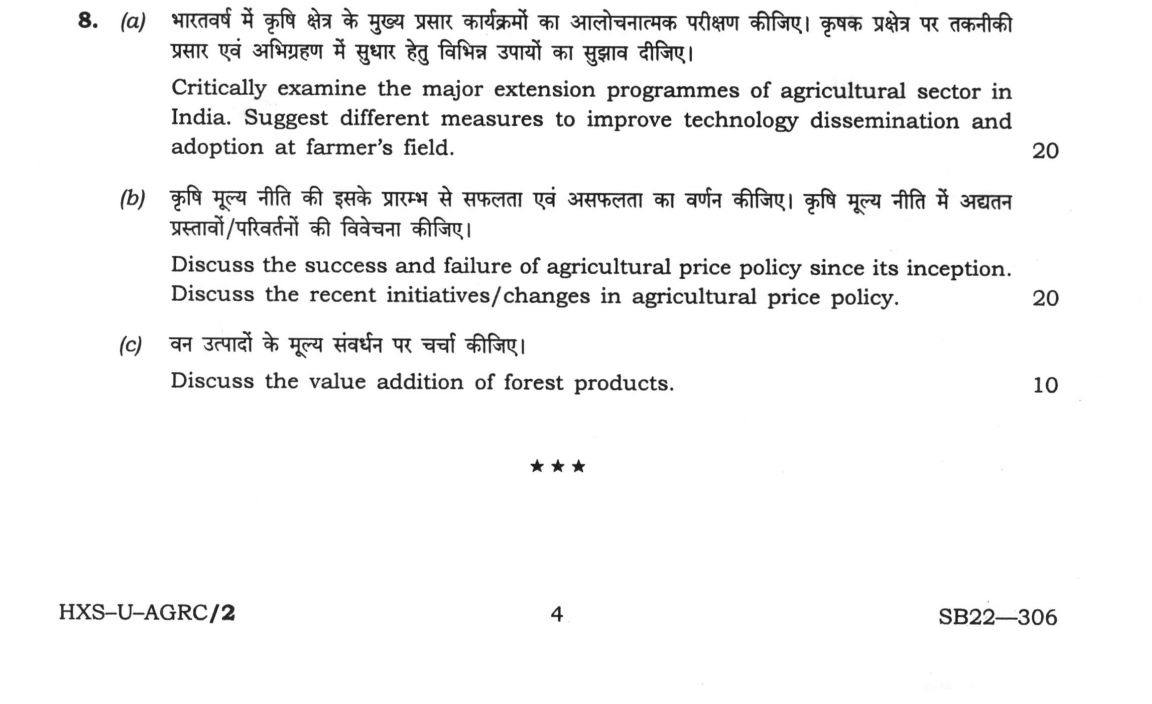
(a) Critically examine the major extension programmes of agricultural sector in India. Suggest different measures to improve…
Critically examine the major extension programmes of agricultural sector in India. Suggest different measures to improve technology dissemination and adoption at farmer's field. 20 marks
Discuss the success and failure of agricultural price policy since its inception. Discuss the recent initiatives/changes in agricultural price policy. 20 marks
Discuss the value addition of forest products. 10 marks
हिंदी में प्रश्न पढ़ें
भारतवर्ष में कृषि क्षेत्र के मुख्य प्रसार कार्यक्रमों का आलोचनात्मक परीक्षण कीजिए। कृषक प्रक्षेत्र पर तकनीकी प्रसार एवं अभिग्रहण में सुधार हेतु विभिन्न उपायों का सुझाव दीजिए। (20 अंक)
कृषि मूल्य नीति की इसके प्रारंभ से सफलता एवं असफलता का वर्णन कीजिए। कृषि मूल्य नीति में अद्यतन प्रस्तावों/परिवर्तनों की विवेचना कीजिए। (20 अंक)
वन उत्पादों के मूल्य संवर्धन पर चर्चा कीजिए। (10 अंक)
Model answer
Written by UPSC Answer Check against this question's marking rubric, to the expected length. UPSC does not publish answers for Mains — this is one way to score well, not an official key.
Agricultural transformation in India hinges on effective technology dissemination, remunerative price architecture, and sustainable value addition to optimize rural livelihoods and farm productivity.
Major Extension Programmes and Measures for Adoption
India's agricultural extension evolved from the centralized, top-down Training and Visit (T&V) system to decentralized models like Krishi Vigyan Kendras (KVKs) and the Agricultural Technology Management Agency (ATMA), alongside privatized tools including Kisan Call Centres and Agri-Clinics. While KVKs enabled critical front-line demonstrations and ATMA fostered inter-departmental convergence, public extension remains constrained by acute manpower shortages, low coverage of marginal holdings, and systemic gender bias that neglects women farmers despite feminization of agriculture. Privatized extension, while agile, primarily serves well-endowed farm ecologies.
To bridge the lab-to-land gap, technology dissemination must shift from target-driven delivery to participatory and digital models. Farmer Producer Organisation (FPO)-led extension can deliver customized, context-specific agronomic advice at scale. Leveraging digital platforms—such as KisanSarathi, AI-enabled diagnostics, and WhatsApp-based advisories—provides hyper-local weather and pest intelligence. Scaling experiential approaches like Farmer Field Schools (FFS) ensures localized validation and sustained adoption.
Successes, Failures, and Recent Shifts in Agricultural Price Policy
Since the Agricultural Prices Commission's inception, Minimum Support Price (MSP) policy served as a vital floor price, insulating farmers from market crashes, fueling Green Revolution adoption, and achieving national food security. Conversely, its operational failures include extreme regional concentration in north-western states, distortion of cropping patterns favoring water-intensive wheat-paddy monocultures, neglected procurement of pulses and coarse grains, and mounting fiscal burdens of open-ended procurement.
Recent policy reflects a structural shift from price distortion to diversified safety nets and direct income support:
- PM-AASHA operationalized alternative safety nets through the Price Support Scheme (PSS), Price Deficiency Payment Scheme (PDPS), and Pilot Private Procurement Stockist Scheme (PPSS).
- Market unification through the electronic National Agriculture Market (e-NAM) enhances transparent price discovery.
- Direct cash transfers under PM-KISAN provide income support without distorting market incentives.
Value Addition of Forest Products
Non-Wood Forest Products (NWFPs) sustain forest-fringe and tribal economies. Shifting from raw harvesting to primary and secondary processing enhances local value realization:
- Bamboo processing into composite lumber, bio-energy, and modern handicrafts.
- Lac processing into refined shellac, sealing wax, and high-value coatings.
- Medicinal and aromatic plant processing through drying, pulverizing, and extraction for standard Ayurvedic supply chains.
Institutional backing through the Van Dhan Vikas Yojana (VDVY) under TRIFED and SFURTI clusters provides the necessary micro-infrastructure, branding, and market linkages, transforming subsistence gathering into viable rural enterprise.
Conclusion
A resilient agricultural ecosystem necessitates integrating participatory, digital extension with decoupled income support and decentralized forest value chains to secure sustainable farm income and ecological stability.
What "Critically examine" is asking you to do
Test the proposition the question puts to you and return a finding on how far it holds. Examine stems carry a claim, or ask whether something has happened, and expect evidence weighed both ways before the extent is stated — often with remedial measures attached. “Critically” is not a section added at the end: name the yardstick you are judging by — the evidence, the stated objective, a constitutional principle, a rival explanation — and let a verdict close each part of the body. Where the question quotes a claim, that verdict must land on the claim itself, accepted, qualified or rejected, and not on the theme in general.
Structure that answers it
Restate the claim as the question frames it → evidence that supports it → evidence that undercuts it → the conditions under which it holds → verdict on how far it stands
Where marks are lost
Merits in one paragraph, demerits in the next, and a conclusion calling for a balanced and holistic approach. That is a survey with the judgement left out and it holds the answer in the middle band. The opposite error is reading “critically” as permission to attack — and with the odd pairings, critically describe or critically explain, the exposition still carries most of the marks, the judgement being a layer on it rather than a substitute for it.
How this answer will be evaluated
Approach
Framework: Concept > Practice or process > Data > Indian application. (a) examine: intro > how/why with reasoning > evidence > conclusion | (b) discuss: intro > 3-4 dimensions > example > balanced close | (c) discuss: intro > 3-4 dimensions > example > balanced close Full marks: Comprehensive, critical, and well-supported with specific examples and data.
Key points expected
- Identify major programmes (e.g., Krishi Vigyan Kendras, PM-KVY).
- Critically evaluate their reach and effectiveness.
- Suggest specific measures for technology dissemination.
- Address barriers to adoption at the farmer's field.
- Discuss the success of agricultural price policy.
- Discuss the failure of agricultural price policy.
- Identify recent initiatives or changes in the policy.
- Provide a balanced view of the policy's impact.
Evaluation rubric
Each sub-part is marked on its own, against the marks and word limit printed on the paper.
- (a) Critical analysis of extension programmes and measures for technology adoption. 20 marks
examine— intro → how/why with reasoning → evidence → conclusion
Must cover
- Identify major programmes (e.g., Krishi Vigyan Kendras, PM-KVY).
- Critically evaluate their reach and effectiveness.
- Suggest specific measures for technology dissemination.
- Address barriers to adoption at the farmer's field.
Loses marks
- Vague agronomic advice without institutional context.
- Listing programmes without critical examination.
Earns more
- Mention specific schemes like PM-KVY or RKVY.
- Reference specific institutions (ICAR, State Agri Universities).
- Discuss digital extension tools (e.g., Kisan Suvidha app).
Extra mark
- Cite specific data on extension worker-to-farmer ratio.
- Mention specific success stories of technology adoption.
- (b) Analysis of agricultural price policy's success, failure, and recent changes. 20 marks
discuss— intro → 3-4 dimensions → example → balanced close
Must cover
- Discuss the success of agricultural price policy.
- Discuss the failure of agricultural price policy.
- Identify recent initiatives or changes in the policy.
- Provide a balanced view of the policy's impact.
Loses marks
- MSP-only solutions without broader policy context.
- Failing to address both success and failure.
Earns more
- Mention MSP (Minimum Support Price) and its role.
- Reference specific recent changes (e.g., e-NAM, market reforms).
- Discuss the impact on different crop categories.
Extra mark
- Cite specific MSP figures for key crops.
- Mention specific market reform acts or policies.
- (c) Discussion on the value addition of forest products. 10 marks
discuss— intro → 3-4 dimensions → example → balanced close
Must cover
- Define value addition in the context of forest products.
- Provide examples of value-added forest products.
- Explain the economic benefits of value addition.
- Discuss the role of value addition in rural development.
Loses marks
- Vague discussion without specific examples.
- Failing to link value addition to economic benefits.
Earns more
- Mention specific forest products (e.g., honey, lac, medicinal plants).
- Reference specific value-addition processes (e.g., processing, packaging).
- Discuss the role of FPOs (Farmer Producer Organizations) in value addition.
Extra mark
- Cite specific examples of successful value-addition initiatives.
- Mention specific government schemes supporting forest product value addition.
Practice this exact question
Write your answer and it is marked point by point against the model answer above — what you covered, what you missed, what you got wrong.
Evaluate my answer →More from Agriculture 2021 Paper I
- Q5 Describe Q. Nos. 5(a), 5(c), 5(d), 5(e) and answer Q. No. 5(b) (in about 150 words each):…
- Q6 (a) Define soil erosion and its different forms. Explain agronomic and mechanical measure…
- Q7 (a) Define ecology. Mention its basic concepts and relevance in crop production. (20 mark…
- Q8 (a) Critically examine the major extension programmes of agricultural sector in India. Su…