Paper I — Q2
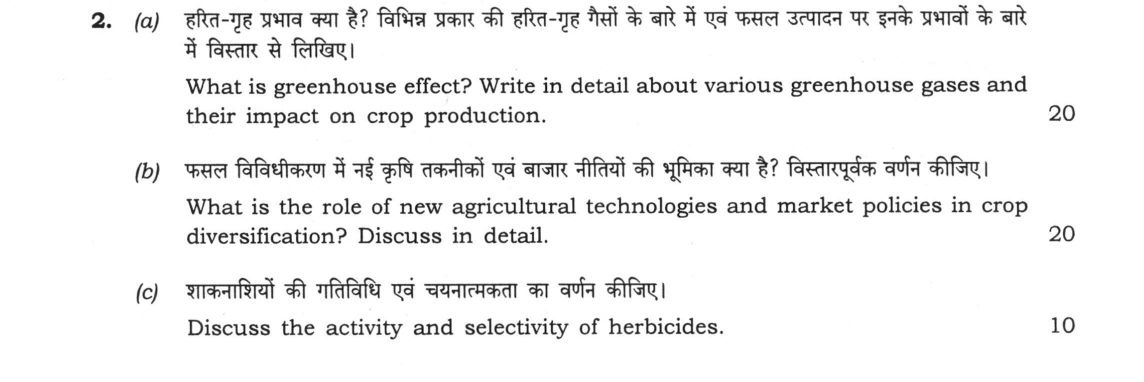
(a) What is greenhouse effect? Write in detail about various greenhouse gases and their impact on crop production. (20 marks) (b)…
What is greenhouse effect? Write in detail about various greenhouse gases and their impact on crop production. 20 marks
What is the role of new agricultural technologies and market policies in crop diversification? Discuss in detail. 20 marks
Discuss the activity and selectivity of herbicides. 10 marks
हिंदी में प्रश्न पढ़ें
हरित-गृह प्रभाव क्या है? विभिन्न प्रकार की हरित-गृह गैसों के बारे में एवं फसल उत्पादन पर इनके प्रभावों के बारे में विस्तार से लिखिए। (20 अंक)
फसल विविधीकरण में नई कृषि तकनीकों एवं बाजार नीतियों की भूमिका क्या है? विस्तारपूर्वक वर्णन कीजिए। (20 अंक)
शाकनाशियों की गतिविधि एवं चयनात्मकता का वर्णन कीजिए। (10 अंक)
Model answer
Written by UPSC Answer Check against this question's marking rubric, to the expected length. UPSC does not publish answers for Mains — this is one way to score well, not an official key.
The greenhouse effect refers to the physical process wherein atmospheric trace gases absorb outgoing long-wave terrestrial infrared radiation and re-radiate it toward Earth, maintaining global thermal equilibrium.
Greenhouse Gases (GHGs) and Crop Production
Anthropogenic emissions have intensified radiative forcing through key GHGs: Carbon Dioxide (CO₂, Global Warming Potential [GWP] = 1), Methane (CH₄, GWP = 28, primarily from flooded rice paddies), Nitrous Oxide (N_2O, GWP = 273, from synthetic nitrogen fertilizers), Tropospheric Ozone (O₃), and Chlorofluorocarbons (CFCs, GWP > 1000).
Elevated CO₂ induces a transient fertilization effect, increasing photosynthetic rates in C3 crops like wheat and rice, but higher temperatures accelerate dark respiration and photorespiration, reducing net biomass. Warming alters crop phenology by shortening the vegetative phase and inducing terminal heat stress, which leads to pollen sterility and poor grain filling. High surface O₃ causes foliar chlorosis and lipid peroxidation. According to ICAR-NICRA projections, an anticipated temperature rise of 1.5–2.0°C by 2050 increases vulnerability across the Indo-Gangetic Plains, threatening a 3–10% yield reduction in irrigated wheat, whereas C4 millets exhibit higher thermal and moisture resilience.
Technologies and Market Policies in Crop Diversification
Agricultural technologies act as primary supply-side enablers of diversification. Precision farming, sensor-based IoT, and micro-irrigation decouple crop choice from local groundwater abundance. Protected cultivation (polyhouses) allows commercial shifts toward high-value floriculture and olericulture. Additionally, marker-assisted breeding has delivered short-duration, drought-tolerant oilseeds and pulses, mitigating climatic risks.
Concurrently, market policies govern farmer adoption. Historically, open-ended Minimum Support Price (MSP) and assured procurement entrenched the ecologically unsustainable paddy-wheat monoculture in Punjab and Haryana. Policy realignments—such as expanding MSP to pulses and oilseeds, mission-mode millet promotion under the National Food Security Mission (NFSM-Shree Anna), and aggregation through Farmer Producer Organisations (FPOs) integrated with e-NAM—lower transaction costs and market risks. Comprehensive risk coverage under PM Fasal Bima Yojana (PMFBY) and targeted import-export tariffs further incentivize farmers to reallocate acreage toward high-value and climate-resilient alternatives.
Herbicide Activity and Selectivity
Herbicide activity describes the mode of action on plant physiology: contact herbicides (e.g., paraquat) destroy only the contacted foliar tissues by disrupting cell membranes, whereas systemic herbicides (e.g., glyphosate) translocate apoplastically through the xylem or symplastically through the phloem to reach subterranean and apical meristems.
Selectivity represents the differential toxicity between the crop and associated weeds, determined by three mechanisms:
- Morphological Selectivity: Differences in plant architecture, leaf angle, and cuticular wax thickness dictate spray retention, protecting narrow, upright cereal leaves from broadleaf sprays.
- Physiological Selectivity: Differential spatial translocation or localized adsorption confines the active compound away from vital metabolic sites.
- Biochemical Selectivity: The ability of the crop to rapidly degrade or conjugate the herbicide into non-toxic metabolites via endogenous enzymes like glutathione S-transferases or cytochrome P450s.
In Indian agro-ecosystems, 2,4-D selectively eliminates dicot weeds in cereal crops, atrazine is safely metabolized by maize while controlling broadleaf competitors, pendimethalin serves as a selective pre-emergence herbicide in pulses and oilseeds, and glyphosate functions as a broad-spectrum, non-selective herbicide for total weed clearance in non-cropped areas.
A policy shift combining climate-resilient crop technologies, calibrated price incentives, and precision weed management is vital for sustainable intensification and long-term food security.
What "Discuss" is asking you to do
Lay the issue out from more than one side — how it arose, what is claimed for it, what is held against it, and where it now stands. UPSC attaches discuss to broad topics with several live dimensions, so coverage of the dimensions earns more than the strength of your opinion.
Structure that answers it
Set the issue up → the case as it is made → the case against → the dimension both sides leave out → where the balance now lies
Where marks are lost
Listing facts with no thread between them, or arguing one side throughout and calling it a discussion.
How this answer will be evaluated
Approach
Framework: Concept > Practice or process > Data > Indian application. (a) explain: definition/context > points in order > small example > short close | (b) discuss: intro > 3-4 dimensions > example > balanced close | (c) discuss: intro > 3-4 dimensions > example > balanced close Full marks: Precise definitions, specific examples, clear linkages between concepts and Indian context.
Key points expected
- Define greenhouse effect mechanism
- List CO2, CH4, N2O, CFCs
- Link gases to specific crop stress
- Mention heat stress or yield loss
- Link tech to diversification (e.g., precision ag)
- Explain market policy role (MSP, subsidies)
- Mention specific Indian schemes
- Discuss economic incentives for farmers
Evaluation rubric
Each sub-part is marked on its own, against the marks and word limit printed on the paper.
- (a) Define greenhouse effect and detail specific gases and their agronomic impacts. 20 marks
explain— definition/context → points in order → small example → short close
Must cover
- Define greenhouse effect mechanism
- List CO2, CH4, N2O, CFCs
- Link gases to specific crop stress
- Mention heat stress or yield loss
Loses marks
- Vague generalities on climate change
- Ignoring specific crop impacts
- Confusing greenhouse gases with pollutants
Earns more
- Mention ozone layer depletion
- Cite specific crop examples
- Discuss soil carbon sequestration
- Reference IPCC reports
Extra mark
- Specific temperature rise data
- Mention specific Indian crop varieties
- (b) Analyze how technology and policy drive the shift from monoculture to diversification. 20 marks
discuss— intro → 3-4 dimensions → example → balanced close
Must cover
- Link tech to diversification (e.g., precision ag)
- Explain market policy role (MSP, subsidies)
- Mention specific Indian schemes
- Discuss economic incentives for farmers
Loses marks
- MSP-only solutions
- Vague agronomic advice
- Ignoring the market policy aspect
Earns more
- Mention PM-KISAN or e-NAM
- Discuss contract farming
- Reference specific high-value crops
- Mention post-harvest technology
Extra mark
- Specific scheme budget figures
- Mention specific state-level policies
- (c) Explain the mechanism of action and the basis of selectivity in herbicides. 10 marks
discuss— intro → 3-4 dimensions → example → balanced close
Must cover
- Define herbicide activity mechanism
- Explain structural selectivity
- Explain physiological selectivity
- Mention differential metabolism
Loses marks
- Confusing herbicides with pesticides
- Ignoring the selectivity aspect
- Vague description of 'killing weeds'
Earns more
- Mention specific enzyme targets
- Discuss translocation differences
- Reference specific herbicide classes
- Mention resistance mechanisms
Extra mark
- Specific chemical structure examples
- Mention specific weed species
Practice this exact question
Write your answer and it is marked point by point against the model answer above — what you covered, what you missed, what you got wrong.
Evaluate my answer →More from Agriculture 2021 Paper I
- Q1 Describe the following in about 150 words each: (a) The major ways for sustainable manage…
- Q2 (a) What is greenhouse effect? Write in detail about various greenhouse gases and their i…
- Q3 (a) What do you understand by agroforestry? Discuss various types of agroforestry systems…
- Q4 (a) What are the factors responsible for declining soil fertility? Discuss various measur…
- Q5 Describe Q. Nos. 5(a), 5(c), 5(d), 5(e) and answer Q. No. 5(b) (in about 150 words each):…