Paper I — Q7
(a) Define ecology. Mention its basic concepts and relevance in crop production. (20 marks) (b) How to improve drainage of…
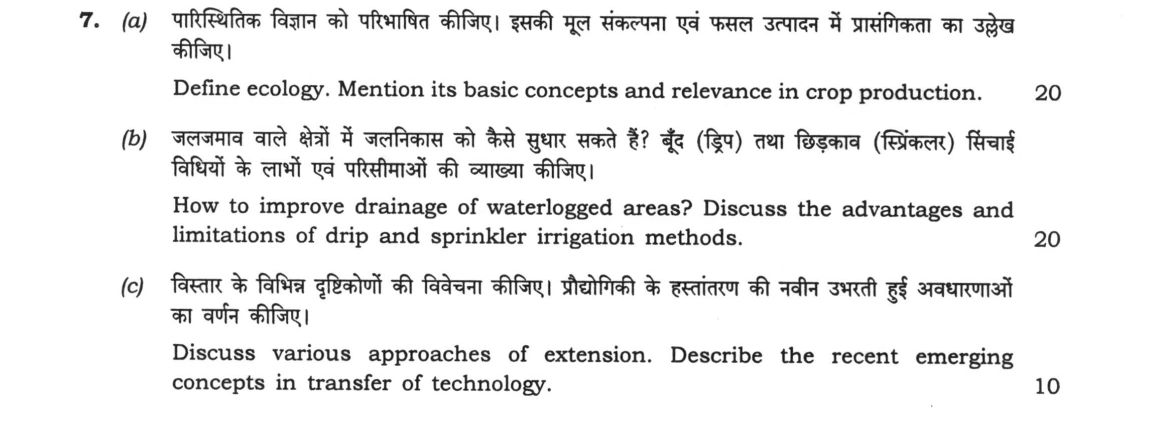
Define ecology. Mention its basic concepts and relevance in crop production. 20 marks
How to improve drainage of waterlogged areas? Discuss the advantages and limitations of drip and sprinkler irrigation methods. 20 marks
Discuss various approaches of extension. Describe the recent emerging concepts in transfer of technology. 10 marks
हिंदी में प्रश्न पढ़ें
पारिस्थितिक विज्ञान को परिभाषित कीजिए। इसकी मूल संकल्पना एवं फसल उत्पादन में प्रासंगिकता का उल्लेख कीजिए। (20 अंक)
जलजमाव वाले क्षेत्रों में जलनिकास को कैसे सुधार सकते हैं? बूंद (ड्रिप) तथा छिड़काव (स्प्रिंकलर) सिंचाई विधियों के लाभों एवं परिसीमाओं की व्याख्या कीजिए। (20 अंक)
विस्तार के विभिन्न दृष्टिकोणों की विवेचना कीजिए। प्रौद्योगिकी के हस्तांतरण की नवीन उभरती हुई अवधारणाओं का वर्णन कीजिए। (10 अंक)
Model answer
Written by UPSC Answer Check against this question's marking rubric, to the expected length. UPSC does not publish answers for Mains — this is one way to score well, not an official key.
Ecology: Definition, Concepts, and Crop Production
Ecology, defined by E.P. Odum as the study of the structure and function of nature, examines the interactions between living organisms and their abiotic environment, organized around A.G. Tansley’s concept of the ecosystem. Its basic concepts include the ecosystem (dynamic complex of plant, animal, and microorganism communities interacting with non-living elements), habitat (physical locality of an organism), ecological niche (functional role and resource utilization of a species), trophic levels, unidirectional energy flow, and biogeochemical nutrient cycling. In crop production, ecological principles are vital for agroecosystem management. They facilitate natural pest-predator balances (biocontrol), sustain essential pollination services via native insect biodiversity, drive organic matter decomposition and nutrient recycling, and enable sustainable yield optimization without degrading the resource base.
Drainage Improvement and Micro-Irrigation Systems
Ameliorating waterlogged soils requires a combination of engineering and biological interventions. Surface drainage removes excess ponded water via shallow open ditches and precision land levelling/grading. Subsurface drainage lowers shallow water tables through perforated corrugated PVC/tile drains—proven effective in the waterlogged, saline tracts of Haryana in the Indo-Gangetic plains—and mole drains in heavy clay soils. Bio-drainage utilizes deep-rooted, high-transpiring tree species such as Eucalyptus tereticornis and Acacia nilotica along canal banks and field boundaries.
For efficient water application:
- Drip Irrigation: Advantages include high water-use efficiency (90–95%), targeted nutrient delivery via fertigation, reduced weed growth, and feasibility with moderately saline water. Limitations include high initial capital costs, emitter clogging from physical/chemical impurities, and plastic lateral degradation under intense solar radiation. Its adoption was accelerated in states like Gujarat through supportive power-water policies (Jyotigram Yojana).
- Sprinkler Irrigation: Advantages include uniform water coverage on undulating topography, suitability for light sandy soils, and frost protection through microclimate moderation. Limitations comprise high operational energy costs, spray distortion under high wind velocities, and increased foliar fungal disease incidence due to prolonged canopy wetting.
Extension Approaches and Emerging ToT Concepts
Agricultural extension has evolved through distinct paradigms: the linear approach (top-down technology transfer and diffusion), the participatory approach (Farming Systems Research and Extension involving farmers as co-innovators), and the pluralistic approach (synergistic delivery by public, private, and NGO agencies, exemplified by Andhra Pradesh’s Rythu Bharosa Kendras). Recent emerging concepts in Transfer of Technology (ToT) encompass precision agriculture advisories, drone-based remote crop surveillance and spraying, KVK digital platforms (e.g., KVK Mobile Apps, Kisan Sarathi), AI/ML-driven predictive pest and weather models, and the establishment of Climate-Smart Villages under ICAR’s National Innovations in Climate Resilient Agriculture (NICRA).
A forward-looking agricultural strategy must systematically integrate ecological agroecosystem management with efficient drainage, modern micro-irrigation, and decentralized digital extension to secure sustainable farm productivity and climate resilience.
What "Define" is asking you to do
Give the precise meaning together with the boundary that separates it from neighbouring concepts. In the optionals a define clause almost always opens a longer part, so it has to be exact and short enough to leave room for what follows.
Structure that answers it
Core definition → essential attributes → what it excludes → example
Where marks are lost
A loose paraphrase. A definition earns its mark by excluding as much as by including.
How this answer will be evaluated
Approach
(a) define: precise definition > the distinguishing feature > one example | (b) discuss: intro > 3-4 dimensions > example > balanced close | (c) discuss: intro > 3-4 dimensions > example > balanced close Full marks: Precise definitions, specific Indian examples, clear distinction between concepts, and balanced discussion of advantages/limitations.
Key points expected
- Precise definition of ecology (study of organisms and environment)
- Basic concepts: ecosystem, food chain, nutrient cycling, biodiversity
- Relevance: soil health, pest management, water conservation
- Indian application: organic farming, IPM, or specific crop example
- Drainage methods: open drains, tile drains, sub-surface drains
- Advantages of drip: water efficiency, reduced evaporation, precision
- Limitations of drip: clogging, high initial cost, maintenance
- Advantages of sprinkler: uniformity, soil aeration, flexibility
Evaluation rubric
Each sub-part is marked on its own, against the marks and word limit printed on the paper.
- (a) Definition of ecology, its basic concepts, and relevance to crop production. 20 marks
define— precise definition → the distinguishing feature → one example
Must cover
- Precise definition of ecology (study of organisms and environment)
- Basic concepts: ecosystem, food chain, nutrient cycling, biodiversity
- Relevance: soil health, pest management, water conservation
- Indian application: organic farming, IPM, or specific crop example
Loses marks
- Vague definition without distinguishing from biology
- Listing concepts without explaining their crop relevance
- Ignoring the 'relevance in crop production' part
Earns more
- Mention of specific ecological principles (e.g., Liebig's law)
- Link to sustainable agriculture or climate change
- Reference to specific Indian ecological zones or crops
Extra mark
- Reference to a specific Indian ecological study or report
- Mention of a specific ecological indicator for crop health
- (b) Methods to improve drainage in waterlogged areas, plus advantages/limitations of drip and sprinkler irrigation. 20 marks
discuss— intro → 3-4 dimensions → example → balanced close
Must cover
- Drainage methods: open drains, tile drains, sub-surface drains
- Advantages of drip: water efficiency, reduced evaporation, precision
- Limitations of drip: clogging, high initial cost, maintenance
- Advantages of sprinkler: uniformity, soil aeration, flexibility
Loses marks
- Confusing drainage with irrigation methods
- Listing advantages without corresponding limitations
- Ignoring the 'waterlogged areas' context for drainage
Earns more
- Limitations of sprinkler: wind drift, water loss, energy cost
- Comparison of water use efficiency between methods
- Mention of specific Indian schemes for micro-irrigation
Extra mark
- Specific data on water savings (e.g., 40-60% for drip)
- Mention of a specific Indian state's micro-irrigation success story
- (c) Various approaches of agricultural extension and recent emerging concepts in technology transfer. 10 marks
discuss— intro → 3-4 dimensions → example → balanced close
Must cover
- Traditional approaches: top-down, demonstration, training
- Participatory approaches: farmer groups, FFS, community-based
- Emerging concepts: digital extension, e-extension, mobile apps
- Technology transfer: diffusion of innovation, adoption models
Loses marks
- Confusing extension with general agricultural education
- Ignoring the 'recent emerging concepts' part
- Listing approaches without explaining their mechanism
Earns more
- Mention of specific Indian extension programs (e.g., Krishi Vigyan Kendras)
- Reference to digital platforms (e.g., Kisan Call Centre, mKisan)
- Discussion of two-way communication in modern extension
Extra mark
- Mention of a specific recent digital extension initiative
- Reference to a specific technology transfer model (e.g., R&D to farm)
Practice this exact question
Write your answer and it is marked point by point against the model answer above — what you covered, what you missed, what you got wrong.
Evaluate my answer →More from Agriculture 2021 Paper I
- Q4 (a) What are the factors responsible for declining soil fertility? Discuss various measur…
- Q5 Describe Q. Nos. 5(a), 5(c), 5(d), 5(e) and answer Q. No. 5(b) (in about 150 words each):…
- Q6 (a) Define soil erosion and its different forms. Explain agronomic and mechanical measure…
- Q7 (a) Define ecology. Mention its basic concepts and relevance in crop production. (20 mark…
- Q8 (a) Critically examine the major extension programmes of agricultural sector in India. Su…