Paper I — Q4
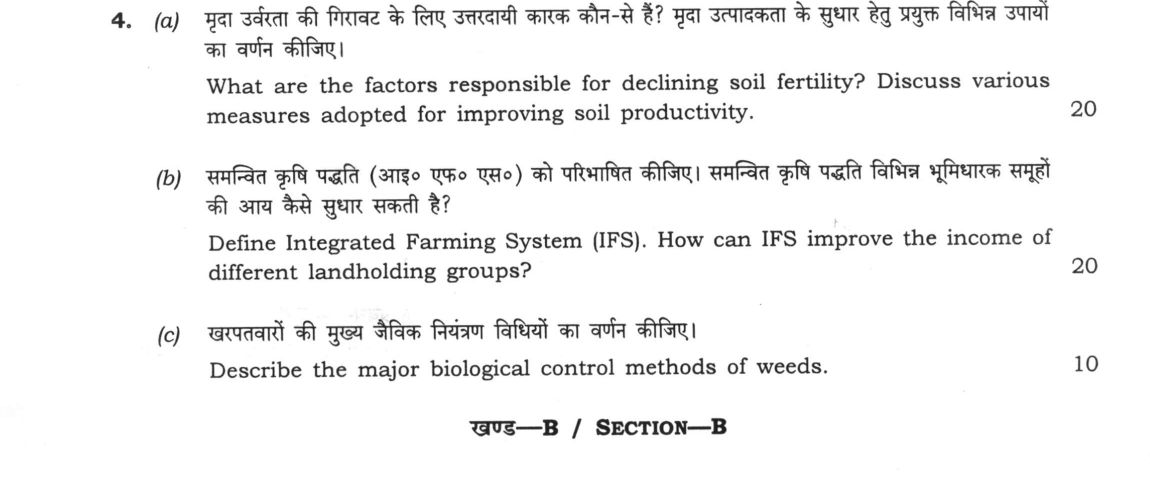
(a) What are the factors responsible for declining soil fertility? Discuss various measures adopted for improving soil…
What are the factors responsible for declining soil fertility? Discuss various measures adopted for improving soil productivity. 20 marks
Define Integrated Farming System (IFS). How can IFS improve the income of different landholding groups? 20 marks
Describe the major biological control methods of weeds. 10 marks
हिंदी में प्रश्न पढ़ें
मृदा उर्वरता की गिरावट के लिए उत्तरदायी कारक कौन-से हैं? मृदा उत्पादकता के सुधार हेतु प्रयुक्त विभिन्न उपायों का वर्णन कीजिए। (20 अंक)
समन्वित कृषि पद्धति (आई० एफ० एस०) को परिभाषित कीजिए। समन्वित कृषि पद्धति विभिन्न भूमिधारक समूहों की आय कैसे सुधार सकती है? (20 अंक)
खरपतवारों की मुख्य जैविक नियंत्रण विधियों का वर्णन कीजिए। (10 अंक)
Model answer
Written by UPSC Answer Check against this question's marking rubric, to the expected length. UPSC does not publish answers for Mains — this is one way to score well, not an official key.
Factors for Declining Soil Fertility and Improvement Measures
Soil fertility depletion stems from natural processes such as intense chemical weathering, nutrient leaching in high-rainfall zones, and topsoil erosion by wind and water. These are accelerated by anthropogenic practices: intensive tillage, cereal-cereal monocropping, crop residue burning, and skewed chemical fertilizer application (imbalanced NPK ratios). Consequently, Indian soils face emerging multi-nutrient deficiencies, particularly secondary and micronutrients such as Sulphur (S), Zinc (Zn), and Boron (B).
Restoring soil productivity requires Integrated Nutrient Management (INM). Deficiencies must be corrected via targeted soil and foliar applications (such as zinc sulphate and borax) based on Soil Health Card recommendations. Improving physical and biological properties necessitates organic amendments (FYM, compost), green manuring with legumes like Sesbania aculeata, and inoculation with biofertilizers (Rhizobium, Azotobacter, Phosphate Solubilizing Bacteria). Precision nutrient management techniques, including Leaf Colour Charts and fertigation, optimize nutrient use efficiency and prevent further degradation.
Integrated Farming System (IFS) and Income across Landholdings
IFS is a holistic, synergistic agricultural system combining crop cultivation with livestock, aquaculture, agroforestry, and allied enterprises, where the waste of one component becomes an input for another, maximizing resource recycling and economic returns.
IFS enhances income and mitigates enterprise risk across distinct farm sizes:
- Marginal farmers (<1 ha): High-density homestead kitchen gardening combined with small ruminants (goatry) and backyard poultry provides steady weekly liquidity and nutritional security from limited spatial footprints.
- Small farmers (1–2 ha): Synergistic models like rice-fish-duckery or Azolla integration utilize standing field water, where ducks and fish feed on pests and weed seeds while their droppings fertilize the crop, eliminating synthetic pesticide costs and yielding high-value supplementary produce.
- Medium and large farmers (>2 ha): Commercial crop-dairy-biogas-vermicomposting integration allows on-farm recycling of heavy biomass and cow dung into bio-energy and vermicompost, slashing commercial input costs while generating diversified revenue streams from milk, biogas slurry, and surplus organic manure.
Biological Control Methods of Weeds
Biological weed management utilizes living organisms to suppress weed densities below economic injury levels through three distinct approaches:
- Classical biological control: Introduction of host-specific exotic bioagents to manage naturalized weeds. Successful Indian interventions include the chrysomelid beetle Zygogramma bicolorata against Parthenium hysterophorus, Teleonemia scrupulosa against Lantana camara, and the rust fungus Puccinia chondrillina against skeleton weed (Chondrilla juncea).
- Inundative control (Bioherbicides): Mass culture and targeted application of native pathogenic organisms, such as Phytophthora palmivora against strangler vine/milkweed, supported domestically through mycoherbicide research at ICAR-National Bureau of Agricultural Insect Resources (NBAIR).
- Competitive suppression and allelopathy: Cultural suppression using fast-growing smother crops (e.g., sunn hemp, cowpea) and allelopathic cover crops that outcompete weeds for light and nutrients while exuding bio-inhibitory phytotoxins.
Synchronizing location-specific IFS models with precision soil stewardship and biological crop protection provides the optimal pathway for sustainable agriculture and long-term farm profitability.
What "Discuss" is asking you to do
Lay the issue out from more than one side — how it arose, what is claimed for it, what is held against it, and where it now stands. UPSC attaches discuss to broad topics with several live dimensions, so coverage of the dimensions earns more than the strength of your opinion.
Structure that answers it
Set the issue up → the case as it is made → the case against → the dimension both sides leave out → where the balance now lies
Where marks are lost
Listing facts with no thread between them, or arguing one side throughout and calling it a discussion.
How this answer will be evaluated
Approach
(a) discuss: intro > 3-4 dimensions > example > balanced close | (b) define: precise definition > the distinguishing feature > one example | (c) describe: define > structure or process in order > labelled diagram > significance Full marks: Comprehensive, specific, and well-structured answers with named examples and schemes.
Key points expected
- Factors: nutrient mining, erosion, salinity, organic matter loss
- Measures: crop rotation, green manuring, composting, mulching
- Measures: balanced fertilization, soil testing, conservation tillage
- Linkage of specific measure to specific fertility factor
- Definition: integration of crop, livestock, fishery, forestry
- Mechanism: recycling of waste (manure, crop residue)
- Application to small/marginal farmers (e.g., poultry, kitchen garden)
- Application to large farmers (e.g., dairy, agroforestry)
Evaluation rubric
Each sub-part is marked on its own, against the marks and word limit printed on the paper.
- (a) Identify causes of soil fertility decline and detail measures to improve productivity. 20 marks
discuss— intro → 3-4 dimensions → example → balanced close
Must cover
- Factors: nutrient mining, erosion, salinity, organic matter loss
- Measures: crop rotation, green manuring, composting, mulching
- Measures: balanced fertilization, soil testing, conservation tillage
- Linkage of specific measure to specific fertility factor
Loses marks
- Vague advice without specific agronomic practices
- Ignoring the 'factors' part of the question
- Listing measures without explaining how they work
Earns more
- Mention of specific soil testing parameters (NPK, pH)
- Reference to specific Indian schemes (e.g., Soil Health Card)
- Mention of specific green manure crops (e.g., Dhaincha)
- Discussion of micro-nutrient management
Extra mark
- Specific data on nutrient depletion rates in India
- Mention of specific biological agents (e.g., Azotobacter)
- (b) Define IFS and explain its income-enhancing mechanisms for different landholding groups. 20 marks
define— precise definition → the distinguishing feature → one example
Must cover
- Definition: integration of crop, livestock, fishery, forestry
- Mechanism: recycling of waste (manure, crop residue)
- Application to small/marginal farmers (e.g., poultry, kitchen garden)
- Application to large farmers (e.g., dairy, agroforestry)
Loses marks
- Defining IFS as just 'mixed farming'
- Ignoring the 'different landholding groups' aspect
- Failing to explain the 'income improvement' mechanism
Earns more
- Mention of specific IFS components (e.g., vermicompost, biogas)
- Reference to specific government schemes (e.g., PM-KSYM)
- Discussion of risk diversification
- Mention of specific income sources (e.g., milk, eggs, fish)
Extra mark
- Specific income figures for IFS vs monoculture
- Mention of specific IFS models (e.g., rice-fish, rice-duck)
- (c) Detail the major biological control methods for weed management. 10 marks
describe— define → structure or process in order → labelled diagram → significance
Must cover
- Method: Allelopathy (use of allelopathic crops/residues)
- Method: Biological control agents (insects, pathogens)
- Method: Bio-herbicides (microbial agents)
- Method: Integrated weed management (IWM) components
Loses marks
- Confusing biological control with chemical control
- Vague description without specific examples
- Ignoring the 'major' methods
Earns more
- Mention of specific allelopathic crops (e.g., Sesbania, Mucuna)
- Mention of specific bio-agents (e.g., Trichoderma, Bacillus)
- Discussion of specific weed species controlled
- Mention of specific bio-herbicides (e.g., Beauveria bassiana)
Extra mark
- Specific examples of successful biological control in India
- Mention of specific research institutions (e.g., IARI, ICAR)
Practice this exact question
Write your answer and it is marked point by point against the model answer above — what you covered, what you missed, what you got wrong.
Evaluate my answer →More from Agriculture 2021 Paper I
- Q1 Describe the following in about 150 words each: (a) The major ways for sustainable manage…
- Q2 (a) What is greenhouse effect? Write in detail about various greenhouse gases and their i…
- Q3 (a) What do you understand by agroforestry? Discuss various types of agroforestry systems…
- Q4 (a) What are the factors responsible for declining soil fertility? Discuss various measur…
- Q5 Describe Q. Nos. 5(a), 5(c), 5(d), 5(e) and answer Q. No. 5(b) (in about 150 words each):…
- Q6 (a) Define soil erosion and its different forms. Explain agronomic and mechanical measure…
- Q7 (a) Define ecology. Mention its basic concepts and relevance in crop production. (20 mark…