Paper II — Q1
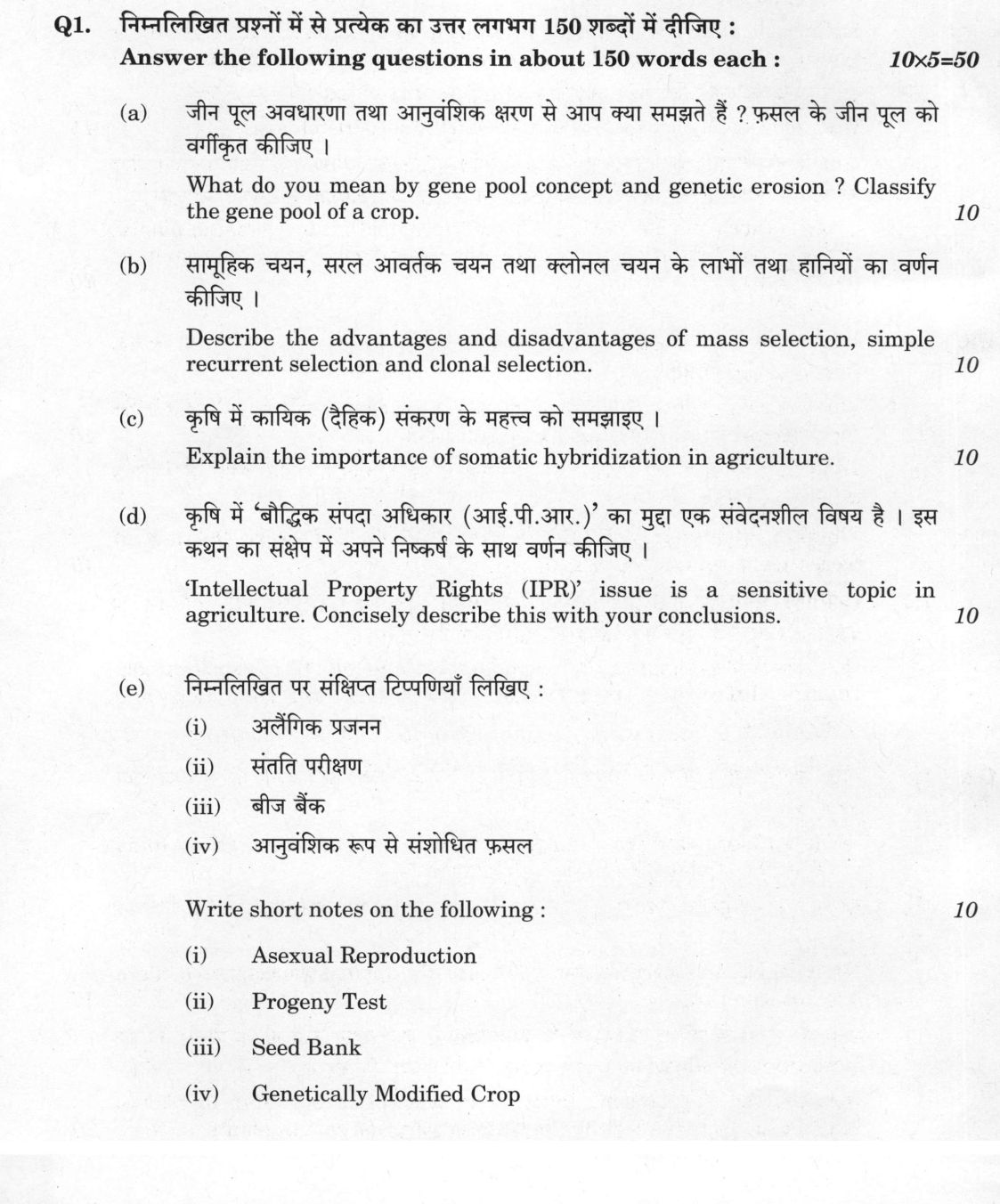
Answer the following questions in about 150 words each : 10×5=50 (a) What do you mean by gene pool concept and genetic erosion ?…
Answer the following questions in about 150 words each : 10×5=50
What do you mean by gene pool concept and genetic erosion ? Classify the gene pool of a crop. 10 marks
Describe the advantages and disadvantages of mass selection, simple recurrent selection and clonal selection. 10 marks
Explain the importance of somatic hybridization in agriculture. 10 marks
'Intellectual Property Rights (IPR)' issue is a sensitive topic in agriculture. Concisely describe this with your conclusions. 10 marks
Write short notes on the following : 10 Asexual Reproduction
Progeny Test
Seed Bank
Genetically Modified Crop
हिंदी में प्रश्न पढ़ें
निम्नलिखित प्रश्नों में से प्रत्येक का उत्तर लगभग 150 शब्दों में दीजिए : 10×5=50
जीन पूल अवधारणा तथा आनुवंशिक क्षरण से आप क्या समझते हैं ? फसल के जीन पूल को वर्गीकृत कीजिए । 10
सामूहिक चयन, सरल आवर्तक चयन तथा क्लोनल चयन के लाभों तथा हानियों का वर्णन कीजिए । 10
कृषि में कायिक (दैहिक) संकरण के महत्व को समझाइए । 10
कृषि में 'बौद्धिक संपदा अधिकार (आई.पी.आर.)' का मुद्दा एक संवेदनशील विषय है । इस कथन का संक्षेप में अपने निष्कर्ष के साथ वर्णन कीजिए । 10
निम्नलिखित पर संक्षिप्त टिप्पणियाँ लिखिए : 10 अलैंगिक प्रजनन
संतति परीक्षण
बीज बैंक
आनुवंशिक रूप से संशोधित फसल
Model answer
Written by UPSC Answer Check against this question's marking rubric, to the 150-word length. UPSC does not publish answers for Mains — this is one way to score well, not an official key.
Gene Pool and Genetic Erosion The gene pool comprises the total genetic diversity of a species, categorized by Harlan and de Wet into three pools based on hybridization barriers. The primary pool includes wild relatives that cross easily with the crop; the secondary pool involves relatives requiring complex breeding techniques for crossability; and the tertiary pool consists of distant relatives with significant chromosomal incompatibilities. Genetic erosion refers to the loss of this diversity, driven by the replacement of landraces with high-yielding varieties, habitat destruction, and urbanization. This erosion reduces the crop’s adaptive potential and resilience to emerging pests and climate stresses.
Selection Methods Mass selection is simple and low-cost, maintaining genetic variation, but it is slow and cannot distinguish between heritable and environmental effects. Simple recurrent selection offers gradual improvement through additive gene action but involves long cycles and is less effective for low-heritability traits. Clonal selection fixes superior genotypes and exploits non-additive gene action, yet it leads to a narrow genetic base and risks virus accumulation in vegetatively propagated crops.
Somatic Hybridization Somatic hybridization involves the fusion of protoplasts to overcome sexual incompatibility. Symmetric hybrids retain genomes from both parents, while asymmetric hybrids retain the nuclear genome of one parent and the cytoplasm of the other, often used to introduce cytoplasmic male sterility. This technique is crucial for introducing disease resistance, such as resistance to Potato Leafroll Virus (PLRV) and blackleg in potatoes, and for creating new Brassica species.
Intellectual Property Rights IPR in agriculture is sensitive due to the conflict between breeder’s rights under the Plant Varieties and Farmers’ Rights (PV&FR) Act, 2001, and farmers’ traditional rights. While the Act protects new varieties, it also safeguards farmers’ rights to save, use, exchange, and sell farm-saved seeds. Biopiracy concerns, highlighted by the Neem and Basmati patent cases, underscore the need to balance innovation incentives with food security and access to germplasm.
Short Notes (i) Asexual Reproduction: This involves apomixis or vegetative propagation, ensuring clonal fidelity. It is vital for crops like banana and sugarcane, where sexual reproduction is difficult or undesirable. (ii) Progeny Test: This evaluates a parent’s genotype by assessing offspring performance. It is essential in clonal and recurrent selection to identify superior genotypes for traits with low heritability. (iii) Seed Bank: These are ex-situ conservation facilities, such as India’s National Bureau of Plant Genetic Resources (NBPGR) and the Svalbard Global Seed Vault, preserving germplasm for future breeding and research. (iv) Genetically Modified Crop: GM crops, like Bt cotton in India, are engineered for pest resistance. The debate centers on biosafety and regulatory oversight by the Genetic Engineering Appraisal Committee (GEAC), balancing yield benefits with ecological concerns.
What "Describe" is asking you to do
Give a full, ordered account of the thing named — its parts, stages or mechanism — in the sequence in which it actually exists or occurs. Most describe questions come from the science optionals, where the marks sit in correct technical detail and, where the stem says so, a labelled diagram.
Structure that answers it
One-line identification of the subject → the parts or stages in their real order, each with its defining detail → labelled diagram where the subject is structural → closing line on function or significance
Where marks are lost
Loose general prose where the examiner is ticking named parts, correct terminology and their sequence; and in the General Studies papers, turning to evaluation before the description is finished.
How this answer will be evaluated
Approach
Framework: Concept > Practice or process > Data > Indian application. (a) explain: definition/context > points in order > small example > short close | (b) describe: define > structure or process in order > labelled diagram > significance | (c) explain: definition/context > points in order > small example > short close | (d) comment: context > arguments both sides > judgment > close | (e) write short notes: define > 3-4 key features > one example > one-line significance Full marks: Precise definitions, clear classification, specific examples, and balanced conclusions.
Key points expected
- Define gene pool as total genetic diversity in a species
- Define genetic erosion as loss of genetic variability
- Classify into primary, secondary, tertiary, and wide gene pools
- Mention causes of erosion like monoculture or habitat loss
- Advantages/disadvantages of mass selection (simple, low cost)
- Advantages/disadvantages of simple recurrent selection (progressive gain)
- Advantages/disadvantages of clonal selection (genetic uniformity)
- Mention specific crop types for each (e.g., wheat vs potato)
Evaluation rubric
Each sub-part is marked on its own, against the marks and word limit printed on the paper.
- (a) Define gene pool and genetic erosion; classify crop gene pool. 10 marks · 150 words
explain— definition/context → points in order → small example → short close
Must cover
- Define gene pool as total genetic diversity in a species
- Define genetic erosion as loss of genetic variability
- Classify into primary, secondary, tertiary, and wide gene pools
- Mention causes of erosion like monoculture or habitat loss
Loses marks
- Confusing gene pool with genotype
- Failing to distinguish primary vs secondary gene pools
Earns more
- Cite specific examples of erosion (e.g., rice varieties)
- Reference the International Rice Research Institute (IRRI)
Extra mark
- Mention the National Bureau of Plant Genetic Resources (NBPGR)
- (b) Advantages and disadvantages of mass, simple recurrent, and clonal selection. 10 marks · 150 words
describe— define → structure or process in order → labelled diagram → significance
Must cover
- Advantages/disadvantages of mass selection (simple, low cost)
- Advantages/disadvantages of simple recurrent selection (progressive gain)
- Advantages/disadvantages of clonal selection (genetic uniformity)
- Mention specific crop types for each (e.g., wheat vs potato)
Loses marks
- Mixing up the definitions of the three methods
- Failing to mention the disadvantage of clonal selection (disease risk)
Earns more
- Mentioning the role of heterosis in recurrent selection
- Comparing the speed of gain for each method
Extra mark
- Reference to specific Indian breeding programs (e.g., IARI)
- (c) Importance of somatic hybridization in agriculture. 10 marks · 150 words
explain— definition/context → points in order → small example → short close
Must cover
- Define somatic hybridization (protoplast fusion)
- Explain overcoming sexual incompatibility barriers
- Mention transfer of cytoplasmic male sterility (CMS)
- Cite a specific example (e.g., Pomato or disease resistance)
Loses marks
- Confusing somatic hybridization with genetic engineering
- Failing to mention the technical difficulty of the process
Earns more
- Mentioning the use of PEG (polyethylene glycol) for fusion
- Discussing the creation of new crop species
Extra mark
- Reference to a specific Indian somatic hybrid (e.g., in banana)
- (d) Describe the IPR issue in agriculture with conclusions. 10 marks · 150 words
comment— context → arguments both sides → judgment → close
Must cover
- Define IPR in the context of plant breeding
- Mention the Plant Variety Protection Act (PVPA) or UPOV
- Discuss the conflict between IPR and farmers' rights
- Provide a balanced conclusion on the sensitivity of the issue
Loses marks
- Failing to mention the impact on small farmers
- Taking a one-sided view without a balanced conclusion
Earns more
- Mentioning the TRIPS agreement
- Discussing the impact on seed sovereignty
Extra mark
- Reference to the Indian Protection of Plant Varieties Act (PPV&PFRA)
- (e) Short notes on asexual reproduction, progeny test, seed bank, and GM crop. 10 marks · 150 words
write short notes— define → 3-4 key features → one example → one-line significance
Must cover
- Define asexual reproduction and its use in crops
- Explain the progeny test for evaluating genotypes
- Define a seed bank and its purpose (conservation)
- Define a GM crop and give one example (e.g., Bt cotton)
Loses marks
- Confusing asexual reproduction with vegetative propagation
- Failing to mention the purpose of a seed bank
Earns more
- Mentioning the National Gene Bank in India
- Discussing the benefits of asexual reproduction (uniformity)
Extra mark
- Reference to a specific GM crop approved in India
Practice this exact question
Write your answer and it is marked point by point against the model answer above — what you covered, what you missed, what you got wrong.
Evaluate my answer →More from Agriculture 2021 Paper II
- Q1 Answer the following questions in about 150 words each : 10×5=50 (a) What do you mean by…
- Q2 (a) Define cell. How is a plant cell different from an animal cell ? Describe a typical c…
- Q3 (a) What is clone ? What do you understand by clonal selection ? Describe the various ste…
- Q4 (a) What is the role and importance of "Seed treatment campaign" in India in the context…