Paper II — Q5
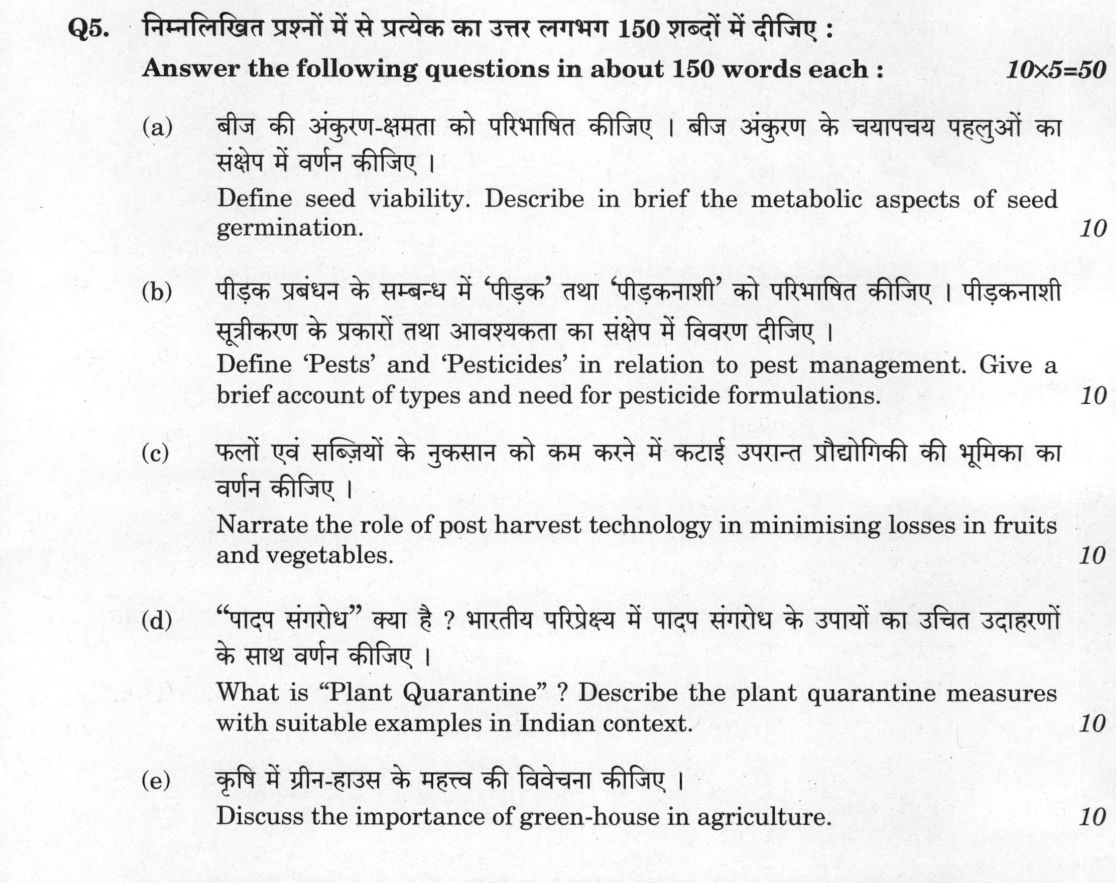
Answer the following questions in about 150 words each : 10×5=50 (a) Define seed viability. Describe in brief the metabolic…
Answer the following questions in about 150 words each : 10×5=50
Define seed viability. Describe in brief the metabolic aspects of seed germination. 10 marks
Define 'Pests' and 'Pesticides' in relation to pest management. Give a brief account of types and need for pesticide formulations. 10 marks
Narrate the role of post harvest technology in minimising losses in fruits and vegetables. 10 marks
What is "Plant Quarantine" ? Describe the plant quarantine measures with suitable examples in Indian context. 10 marks
Discuss the importance of green-house in agriculture. 10 marks
हिंदी में प्रश्न पढ़ें
निम्नलिखित प्रश्नों में से प्रत्येक का उत्तर लगभग 150 शब्दों में दीजिए : 10×5=50
बीज की अंकुरण-क्षमता को परिभाषित कीजिए । बीज अंकुरण के चयापचय पहलुओं का संक्षेप में वर्णन कीजिए । 10
पीड़क प्रबंधन के संबंध में 'पीड़क' तथा 'पीड़कनाशी' को परिभाषित कीजिए । पीड़कनाशी सूत्रीकरण के प्रकारों तथा आवश्यकता का संक्षेप में विवरण दीजिए । 10
फलों एवं सब्जियों के नुकसान को कम करने में कटाई उपरांत प्रौद्योगिकी की भूमिका का वर्णन कीजिए । 10
"पादप संगरोध" क्या है ? भारतीय परिप्रेक्ष्य में पादप संगरोध के उपायों का उचित उदाहरणों के साथ वर्णन कीजिए । 10
कृषि में ग्रीन-हाउस के महत्व की विवेचना कीजिए । 10
Model answer
Written by UPSC Answer Check against this question's marking rubric, to the 150-word length. UPSC does not publish answers for Mains — this is one way to score well, not an official key.
(a) Seed Viability and Metabolic Aspects of Seed Germination
Seed viability denotes the capacity of a seed to remain alive, metabolically active, and capable of producing a normal seedling under favorable environmental conditions of moisture, temperature, and aeration.
The metabolic sequence of germination begins with imbibition, where dry seeds physically absorb water, causing cellular rehydration, membrane reorganization, and structural repair. This triggers basal metabolism, transitioning cellular respiration from an initial anaerobic pathway to aerobic respiration via the Krebs cycle and oxidative phosphorylation for sustained ATP generation. In cereals, endogenous gibberellins secreted by the embryo diffuse to the aleurone layer, initiating the de novo synthesis of hydrolytic enzymes, principally α-amylase, alongside proteases and lipases. These enzymes hydrolyze insoluble stored starches, proteins, and lipids into soluble sugars, amino acids, and fatty acids. These mobilized nutrients are translocated to the embryonic growing axis, providing the requisite energy and metabolic precursors for rapid cell division, elongation, and radicle emergence through the seed coat.
(b) Pests, Pesticides, and Pesticide Formulations
In pest management, a pest is defined as any living organism—such as insects, pathogens, weeds, or vertebrates—whose population exceeds the Economic Threshold Level (ETL), causing measurable economic injury and qualitative or quantitative crop loss. A pesticide is any chemical or biological agent, substance, or mixture formulated to prevent, destroy, repel, attract, or mitigate pest populations.
Technical active ingredients are rarely applied in their pure form due to extreme concentration, high toxicity, low water solubility, or chemical instability. Therefore, they are mixed with inert carriers, surfactants, solvents, and adjuvants to create formulations. Major formulation types include Emulsifiable Concentrates (EC), Wettable Powders (WP), Suspension Concentrates (SC), Granules (GR), and Ultra Low Volume (ULV) liquids. Pesticide formulations are essential to improve shelf-life stability, ensure uniform field dilution and spray coverage, facilitate targeted delivery to the pest, reduce phytotoxicity to host plants, improve operator handling safety, and maximize bio-efficacy in a cost-effective manner.
(c) Role of Post-Harvest Technology in Minimising Losses in Fruits and Vegetables
Fruits and vegetables are highly perishable, exhibiting post-harvest losses up to 25–30% due to continuous respiration, transpiration, and microbial decay. Post-harvest technology (PHT) establishes an integrated handling chain to minimize these quantitative and qualitative losses.
The process begins with rapid pre-cooling to remove field heat immediately after harvest. Subsequent washing, sorting, and grading standardize produce quality. Applying surface waxes creates a protective barrier that reduces transpirational water loss and fruit shriveling. Modern packaging, including Modified Atmosphere Packaging (MAP) and Controlled Atmosphere (CA) cold storage, regulates atmospheric oxygen and carbon dioxide levels. This suppresses respiration rates, inhibits ethylene biosynthesis and action, delays tissue senescence, and controls microbial pathogens causing fungal or bacterial rot. Furthermore, temperature-managed cold chain logistics maintain produce integrity, while minimal processing and value addition convert non-table-grade surplus into shelf-stable processed goods, substantially extending commercial viability and eliminating farm-gate losses.
(d) Plant Quarantine Measures and the Indian Context
Plant quarantine represents the legal, regulatory restriction imposed on the movement of plants, planting materials, seeds, and soil to prevent the introduction, establishment, and geographical spread of foreign exotic pests, weeds, and diseases. In India, these operations are governed by the Directorate of Plant Protection, Quarantine & Storage (DPPQS) under the Destructive Insects and Pests Act (DIPA), 1914 and the Plant Quarantine (Regulation of Import into India) Order, 2003.
Key regulatory measures encompass absolute prohibitions on high-risk plant materials, mandatory requirement of Phytosanitary Certificates from the exporting country, port-of-entry visual and laboratory inspections, post-entry quarantine (PEQ) isolation, and disinfestation treatments including methyl bromide fumigation and vapor heat treatment. In the Indian context, notable measures include the complete ban on cocoa planting material from Ghana to prevent the introduction of Cocoa Swollen Shoot Virus (CSSV), stringent restrictions on coconut germplasm from Sri Lanka to exclude Lethal Yellowing disease, and strict quarantine heat treatment protocols on fruit imports from Southeast Asia to intercept exotic fruit flies (Bactrocera spp.).
(e) Importance of Greenhouse in Agriculture
Greenhouses represent an advanced system of protected cultivation where the internal microclimate—temperature, solar radiation, humidity, and carbon dioxide levels—is manipulated to optimize plant growth and photosynthetic efficiency regardless of external climatic extremes.
Greenhouses allow year-round and off-season crop production, enabling growers to harvest produce during supply deficits and secure premium market prices. They maximize resource efficiency, cutting water and fertilizer consumption by up to 80% through automated micro-irrigation and fertigation systems. Enclosed structures provide a physical barrier against insect vectors, drastically reducing pest incidence and chemical pesticide dependence. Greenhouses enhance yields 5 to 10 times compared to open-field systems and are critical for raising disease-free commercial nurseries, micropropagation acclimatization, and high-purity hybrid seed production. Supported by schemes like the Mission for Integrated Development of Horticulture (MIDH), greenhouses have become indispensable for the intensive, high-value commercial cultivation of exotic vegetables like colored capsicum and parthenocarpic cucumbers, alongside cut flowers such as roses, gerberas, and carnations.
What "Describe" is asking you to do
Give a full, ordered account of the thing named — its parts, stages or mechanism — in the sequence in which it actually exists or occurs. Most describe questions come from the science optionals, where the marks sit in correct technical detail and, where the stem says so, a labelled diagram.
Structure that answers it
One-line identification of the subject → the parts or stages in their real order, each with its defining detail → labelled diagram where the subject is structural → closing line on function or significance
Where marks are lost
Loose general prose where the examiner is ticking named parts, correct terminology and their sequence; and in the General Studies papers, turning to evaluation before the description is finished.
How this answer will be evaluated
Approach
Framework: Concept > Practice or process > Data > Indian application. (a) define: precise definition > the distinguishing feature > one example | (b) define: precise definition > the distinguishing feature > one example | (c) describe: define > structure or process in order > labelled diagram > significance | (d) describe: define > structure or process in order > labelled diagram > significance | (e) discuss: intro > 3-4 dimensions > example > balanced close Full marks: Precise definitions, specific examples, clear structure, Indian context where required.
Key points expected
- Precise definition of seed viability
- Metabolic changes: respiration and water uptake
- Enzymatic activity and mobilization of reserves
- Sequence of metabolic events in germination
- Definition of Pests in management context
- Definition of Pesticides
- Types of pesticide formulations (e.g., EC, WP, SC)
- Need for formulations (stability, application ease)
Evaluation rubric
Each sub-part is marked on its own, against the marks and word limit printed on the paper.
- (a) Define seed viability and describe metabolic aspects of germination. 10 marks · 150 words
define— precise definition → the distinguishing feature → one example
Must cover
- Precise definition of seed viability
- Metabolic changes: respiration and water uptake
- Enzymatic activity and mobilization of reserves
- Sequence of metabolic events in germination
Loses marks
- Confusing viability with germination rate
- Vague description of metabolism without specific processes
Earns more
- Mention of specific enzymes (amylase, protease)
- Reference to Turgor pressure
- Distinction between viability and vigour
Extra mark
- Reference to specific test (TTC test)
- Mention of specific crop example
- (b) Define Pests and Pesticides; account for types and need for formulations. 10 marks · 150 words
define— precise definition → the distinguishing feature → one example
Must cover
- Definition of Pests in management context
- Definition of Pesticides
- Types of pesticide formulations (e.g., EC, WP, SC)
- Need for formulations (stability, application ease)
Loses marks
- Defining pests only as insects
- Listing formulations without explaining the 'need'
Earns more
- Mention of specific formulation types (e.g., Granules)
- Link between formulation and target pest
Extra mark
- Mention of specific active ingredient
- Reference to environmental safety of formulation
- (c) Describe the role of post-harvest technology in minimising losses. 10 marks · 150 words
describe— define → structure or process in order → labelled diagram → significance
Must cover
- Role of pre-cooling and cold storage
- Packaging and handling techniques
- Processing methods (canning, drying, freezing)
- Link to minimising post-harvest losses
Loses marks
- Focusing only on storage, ignoring processing
- Vague generalities without specific technologies
Earns more
- Mention of specific technology (e.g., CA storage)
- Reference to specific fruit/vegetable example
Extra mark
- Mention of specific Indian scheme (e.g., PMKSY)
- Reference to specific loss percentage
- (d) Define Plant Quarantine and describe measures with Indian examples. 10 marks · 150 words
describe— define → structure or process in order → labelled diagram → significance
Must cover
- Definition of Plant Quarantine
- Import/Export inspection measures
- Specific Indian context (e.g., APEDA, Plant Quarantine Act)
- Suitable examples of quarantine measures
Loses marks
- Confusing quarantine with general pest control
- Lack of specific Indian examples
Earns more
- Mention of specific pests (e.g., Fall Armyworm)
- Reference to specific Indian institution (e.g., DAFS)
Extra mark
- Mention of specific international agreement (SPS)
- Reference to specific recent quarantine case
- (e) Discuss the importance of green-house in agriculture. 10 marks · 150 words
discuss— intro → 3-4 dimensions → example → balanced close
Must cover
- Controlled environment for crop production
- Year-round production capability
- Resource efficiency (water, fertilizer)
- Protection from pests and adverse weather
Loses marks
- Vague description without specific benefits
- Ignoring the 'controlled environment' aspect
Earns more
- Mention of specific crops (e.g., tomatoes, flowers)
- Reference to specific Indian region (e.g., Himachal, Punjab)
Extra mark
- Mention of specific technology (e.g., drip irrigation in GH)
- Reference to specific economic benefit
Practice this exact question
Write your answer and it is marked point by point against the model answer above — what you covered, what you missed, what you got wrong.
Evaluate my answer →More from Agriculture 2021 Paper II
- Q2 (a) Define cell. How is a plant cell different from an animal cell ? Describe a typical c…
- Q3 (a) What is clone ? What do you understand by clonal selection ? Describe the various ste…
- Q4 (a) What is the role and importance of "Seed treatment campaign" in India in the context…
- Q5 Answer the following questions in about 150 words each : 10×5=50 (a) Define seed viabilit…
- Q6 (a) What are enzymes ? Describe "Key-lock theory" with respect to mode of enzyme action.…
- Q7 (a) What do you mean by "Economic Injury Level" (EIL) and "Economic Threshold Level" (ETL…
- Q8 (a) What is the food production and consumption pattern of India in the last fifty years…