Paper II — Q8
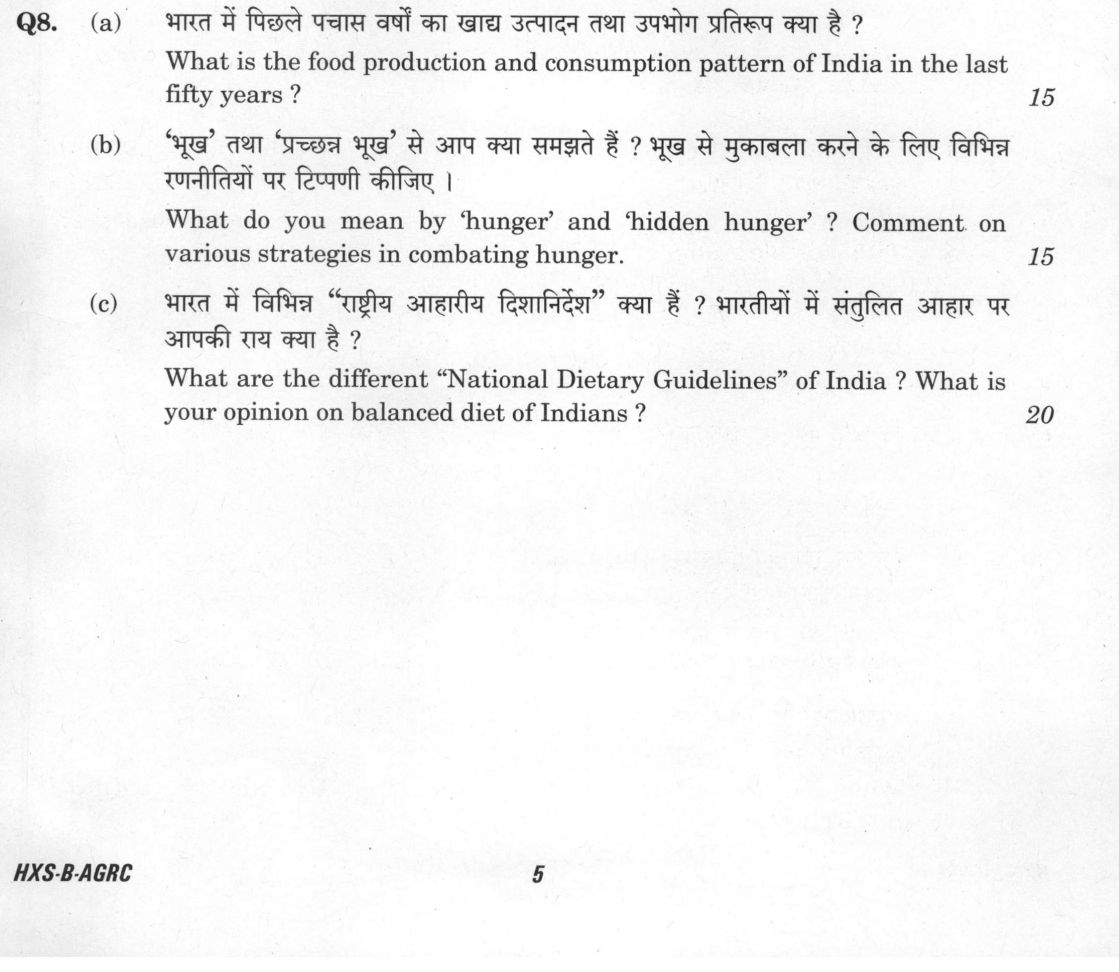
(a) What is the food production and consumption pattern of India in the last fifty years ? 15 (b) What do you mean by 'hunger'…
What is the food production and consumption pattern of India in the last fifty years ? 15 marks
What do you mean by 'hunger' and 'hidden hunger' ? Comment on various strategies in combating hunger. 15 marks
What are the different "National Dietary Guidelines" of India ? What is your opinion on balanced diet of Indians ? 20 marks
हिंदी में प्रश्न पढ़ें
भारत में पिछले पचास वर्षों का खाद्य उत्पादन तथा उपभोग प्रतिरूप क्या है ? 15 marks
'भुख' तथा 'प्रच्छन्न भुख' से आप क्या समझते हैं ? भुख से मुकाबला करने के लिए विभिन्न रणनीतियों पर टिप्पणी कीजिए । 15
भारत में विभिन्न "राष्ट्रीय आहारीय दिशानिर्देश" क्या हैं ? भारतीयों में संतुलित आहार पर आपकी राय क्या है ? 20 marks
Model answer
Written by UPSC Answer Check against this question's marking rubric, to the expected length. UPSC does not publish answers for Mains — this is one way to score well, not an official key.
India’s food journey over the last five decades reflects a complex transition from scarcity to surplus, yet significant nutritional gaps persist.
(a) Production and Consumption Patterns Production dynamics have shifted through distinct phases. The Green Revolution (1960s–1980s) transformed India from a food-deficit nation to a self-sufficient one, primarily through high-yielding varieties of wheat and rice. However, this led to post-Green Revolution stagnation in crop diversity, with cereals dominating the basket. The liberalization of the 1990s introduced market forces, encouraging diversification into horticulture and dairy. Recently, there is a visible trend toward millet revival and organic farming. Consequently, per capita availability has risen, but the composition is changing. Consumption patterns have evolved from a cereal-heavy diet to one with higher protein and fat intake. NSSO data indicates a declining share of cereals in total calorie intake, replaced by milk, eggs, and oils. However, regional disparities remain stark; while urban centers show rising meat and processed food consumption, rural areas still rely heavily on coarse grains and pulses, with per capita pulse intake stagnating or even declining due to price volatility and dietary shifts.
(b) Hunger and Hidden Hunger 'Hunger' refers to the absolute lack of sufficient food to meet basic caloric and protein needs, often measured by FAO’s undernourishment indicators. 'Hidden hunger,' or micronutrient malnutrition, is the deficiency of essential vitamins and minerals like Vitamin A, iron, zinc, and iodine, despite adequate calorie intake. This is prevalent among women and children. Combating these requires multi-pronged strategies. The National Food Security Act (NFSA) 2013 and the Targeted Public Distribution System (TPDS) ensure access to subsidized cereals. The Integrated Child Development Services (ICDS) and Mid-Day Meal Scheme address child nutrition at the grassroots level. Beyond distribution, biofortification is critical; India has successfully deployed iron-rich pearl millet and high-zinc wheat varieties, unlike the unapproved Golden Rice. Food fortification, such as iodized salt and vitamin A capsules, remains a key public health intervention. Finally, promoting dietary diversification through awareness campaigns is essential to break the cycle of hidden hunger.
(c) National Dietary Guidelines and Balanced Diet The term "National Dietary Guidelines" generally refers to the Dietary Guidelines for Indians issued by the Indian Council of Medical Research (ICMR) and the National Institute of Nutrition (NIN). The latest guidelines (2024) emphasize a balanced plate composition. Key recommendations include:
- Variety: Eat a variety of foods from all food groups.
- Cereals and Millets: Consume 45–50% of total energy from cereals and millets, prioritizing whole grains.
- Vegetables and Fruits: Consume plenty of vegetables and fruits (at least 400g/day) for micronutrients.
- Protein Sources: Include adequate pulses, dairy, eggs, and fish/meat (for non-vegetarians) to meet protein needs.
- Fats and Oils: Use moderate amounts of healthy fats (10–20% of energy), preferring unsaturated fats.
- Iodized Salt: Use only iodized salt to prevent deficiency.
- Hydration: Drink plenty of water.
Opinion on Balanced Diet: The current Indian diet is in a state of paradox. While the guidelines advocate for a balanced mix, actual consumption shows a wide gap. There is a persistent protein deficiency in traditional vegetarian diets, which often lack sufficient legume and dairy intake. Simultaneously, the rise of processed foods and sugary beverages has led to an "obesity paradox," where overweight individuals suffer from hidden hunger. The guidelines are largely urban-centric and may not fully account for the agrarian realities of rural India, where access to diverse fresh produce is limited. Therefore, a truly balanced diet for Indians requires not just individual choice but systemic support: affordable pulse and dairy markets, school-based nutrition education, and region-specific dietary adjustments that respect local food cultures while correcting nutritional deficits.
Conclusion India has achieved food security in terms of availability, but nutritional security remains elusive. Bridging the gap between production surpluses and actual dietary quality requires a shift from a "food-first" to a "nutrition-first" policy framework, integrating the NFSA with robust biofortification and dietary diversification strategies.
What "Comment" is asking you to do
Take a position on the statement and support it. Comment usually attaches to a quoted line in the short slots, so the reasoning must be compressed — an opening view, a few load-bearing reasons, and the limit of the claim.
Structure that answers it
Unpack what the statement asserts → your stance → two or three supporting reasons → the qualification that limits it
Where marks are lost
Neutral summary; a comment without a stance has not answered. Equally costly is accepting the quoted line wholesale and never testing where it fails.
How this answer will be evaluated
Approach
(a) trace: start point > the stages in sequence > end point > what changed | (b) comment: context > arguments both sides > judgment > close | (c) evaluate: criteria > evidence > balanced judgment Full marks: Comprehensive, data-driven, specific to Indian context, clear structure.
Key points expected
- Green Revolution impact on cereal production
- Shift in consumption from cereals to pulses/oilseeds
- Post-harvest losses and supply chain issues
- Current status of food security
- Definition of 'hunger' (caloric deficit)
- Definition of 'hidden hunger' (micronutrient deficiency)
- Strategies: Fortification, biofortification, PDS
- Strategies: Nutrition awareness, women's empowerment
Evaluation rubric
Each sub-part is marked on its own, against the marks and word limit printed on the paper.
- (a) Chronological account of India's food production and consumption trends over 50 years. 15 marks
trace— start point → the stages in sequence → end point → what changed
Must cover
- Green Revolution impact on cereal production
- Shift in consumption from cereals to pulses/oilseeds
- Post-harvest losses and supply chain issues
- Current status of food security
Loses marks
- Vague generalities without specific trends
- Ignoring the consumption side of the pattern
- No chronological structure
Earns more
- Specific data points on production growth
- Mention of specific crops (wheat, rice)
- Reference to government schemes (PDS, FCI)
Extra mark
- Specific statistics on per capita consumption
- Reference to specific years (e.g., 1970s vs 2020s)
- (b) Definitions of hunger/hidden hunger and evaluation of strategies to combat them. 15 marks
comment— context → arguments both sides → judgment → close
Must cover
- Definition of 'hunger' (caloric deficit)
- Definition of 'hidden hunger' (micronutrient deficiency)
- Strategies: Fortification, biofortification, PDS
- Strategies: Nutrition awareness, women's empowerment
Loses marks
- Confusing hunger with poverty only
- Listing strategies without explaining how they work
- Ignoring the 'hidden' aspect of hunger
Earns more
- Mention of specific micronutrients (Iron, Iodine, Vit A)
- Reference to specific schemes (ICDS, Mid-day Meal)
- Distinction between acute and chronic hunger
Extra mark
- Reference to specific biofortified varieties (e.g., high-iron wheat)
- Mention of specific government targets (e.g., NIN)
- (c) List National Dietary Guidelines and provide a critical opinion on the balanced diet of Indians. 20 marks
evaluate— criteria → evidence → balanced judgment
Must cover
- List of National Dietary Guidelines (NIN)
- Opinion on current Indian diet (deficiencies/excesses)
- Link between diet and health outcomes (NCDs)
- Recommendations for a balanced diet
Loses marks
- Listing guidelines without context
- Opinion without evidence or specific examples
- Ignoring the 'balanced' aspect of the diet
Earns more
- Specific guidelines (e.g., 3000 kcal/day, protein %)
- Mention of specific deficiencies (Anemia, Stunting)
- Reference to specific food groups (Pulses, Dairy)
Extra mark
- Reference to specific NIN recommendations (e.g., 2020 update)
- Mention of specific health issues (Diabetes, Hypertension)
Practice this exact question
Write your answer and it is marked point by point against the model answer above — what you covered, what you missed, what you got wrong.
Evaluate my answer →More from Agriculture 2021 Paper II
- Q5 Answer the following questions in about 150 words each : 10×5=50 (a) Define seed viabilit…
- Q6 (a) What are enzymes ? Describe "Key-lock theory" with respect to mode of enzyme action.…
- Q7 (a) What do you mean by "Economic Injury Level" (EIL) and "Economic Threshold Level" (ETL…
- Q8 (a) What is the food production and consumption pattern of India in the last fifty years…