Paper II — Q2
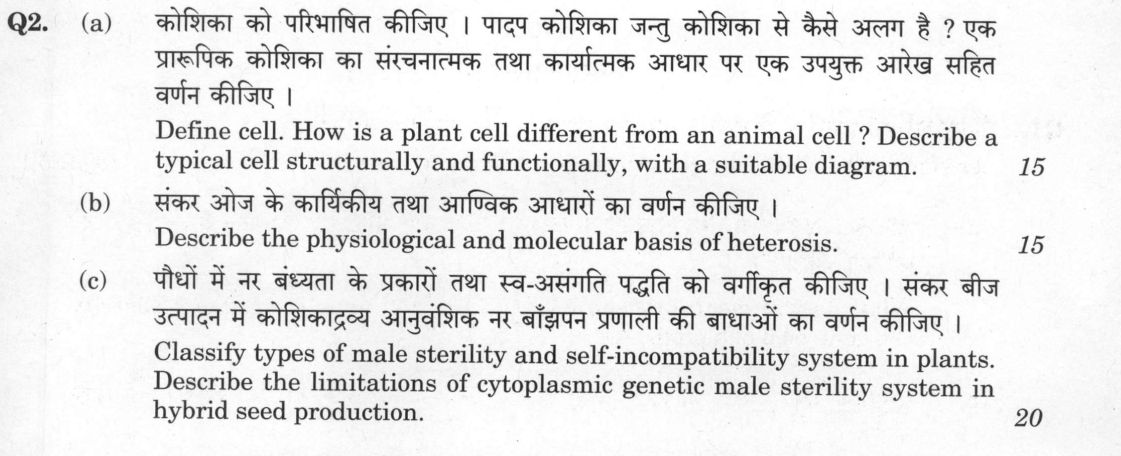
(a) Define cell. How is a plant cell different from an animal cell ? Describe a typical cell structurally and functionally, with…
Define cell. How is a plant cell different from an animal cell ? Describe a typical cell structurally and functionally, with a suitable diagram. 15 marks
Describe the physiological and molecular basis of heterosis. 15 marks
Classify types of male sterility and self-incompatibility system in plants. Describe the limitations of cytoplasmic genetic male sterility system in hybrid seed production. 20 marks
हिंदी में प्रश्न पढ़ें
कोशिका को परिभाषित कीजिए । पादप कोशिका जन्तु कोशिका से कैसे अलग है ? एक प्राकृतिक कोशिका का संरचनात्मक तथा कार्यात्मक आधार पर एक उपयुक्त आरेख सहित वर्णन कीजिए । 15
संकर ओज के कार्यिकीय तथा आणविक आधारों का वर्णन कीजिए । 15
पौधों में नर बंध्यता के प्रकारों तथा स्व-असंगति पद्धति को वर्गीकृत कीजिए । संकर बीज उत्पादन में कोशिकाद्रव्य आनुवंशिक नर बाँझपन प्रणाली की बाधाओं का वर्णन कीजिए । 20
Model answer
Written by UPSC Answer Check against this question's marking rubric, to the expected length. UPSC does not publish answers for Mains — this is one way to score well, not an official key.
Cell Structure and Plant-Animal Distinctions
A cell is the fundamental structural and functional unit of life, enclosed by a plasma membrane that regulates material exchange. While both plant and animal cells share common organelles, distinct structural differences define their biology. Plant cells possess a rigid cell wall composed of cellulose, which provides structural support and protection, absent in animal cells. They contain chloroplasts for photosynthesis, whereas animal cells rely on mitochondria for respiration. A large central vacuole occupies up to 90% of the plant cell volume, maintaining turgor pressure, while animal cells have multiple small vacuoles. Plant cells lack centrioles, organizing spindle fibers differently during mitosis, and utilize plasmodesmata for intercellular communication, unlike the gap junctions in animals. Additionally, plant cells contain glyoxysomes, specialized peroxisomes involved in the glyoxylate cycle for lipid metabolism in germinating seeds, a feature not found in animal cells. Cytokinesis in plants involves the formation of a cell plate, whereas animal cells undergo cleavage furrow formation.
Physiological and Molecular Basis of Heterosis
Heterosis, or hybrid vigor, refers to the superior performance of an F1 hybrid over its parents. Physiologically, this is explained by three hypotheses. The dominance hypothesis posits that hybrids mask deleterious recessive alleles from one parent with dominant favorable alleles from the other. The overdominance hypothesis suggests that heterozygous loci themselves confer superior fitness compared to homozygous states. The epistasis hypothesis attributes vigor to favorable interactions between genes at different loci.
At the molecular level, heterosis arises from non-additive gene action. It involves the upregulation of genes associated with stress tolerance, nutrient uptake, and metabolic efficiency. MicroRNA (miRNA) networks play a crucial role by modulating the expression of key developmental and stress-response genes. The hybrid genome often exhibits balanced expression of conflicting regulatory pathways from the two parents, leading to enhanced physiological robustness and yield potential.
Male Sterility and Self-Incompatibility Systems
Male sterility (MS) is a key tool in hybrid seed production. It is classified into Genetic Male Sterility (GMS), Cytoplasmic Male Sterility (CMS), and Cytoplasmic-Genetic Male Sterility (CGMS). GMS is controlled by nuclear genes, while CMS is governed by mitochondrial cytoplasmic factors. CGMS involves the interaction between specific cytoplasmic factors and nuclear restorer genes. Self-incompatibility (SI) is a genetic mechanism preventing self-fertilization, classified into sporophytic SI (where the pollen phenotype is determined by the sporophytic tissue, e.g., Brassica) and gametophytic SI (where the pollen phenotype is determined by the haploid gametophyte, e.g., Solanaceae).
Limitations of Cytoplasmic Genetic Male Sterility
Despite its utility, the CGMS system faces significant limitations. First, it is genetically vulnerable. The T-cytoplasm in maize, for instance, led to the Southern Corn Leaf Blight epidemic in 1970 when a single fungal pathogen targeted this specific cytoplasm, causing massive crop loss. This highlights the risk of genetic uniformity in cytoplasmic backgrounds. Second, the management of restorer genes is complex. Restorer genes (Rf) must be maintained in the maintainer line to ensure fertility for seed production, but their presence can sometimes negatively affect agronomic traits such as yield or stress tolerance due to pleiotropic effects. Third, CMS systems can be temperature-sensitive; some cytoplasms may exhibit partial fertility under extreme temperatures, compromising seed purity.
In the Indian context, ICAR has successfully exploited CMS in pearl millet using A1, A2, and A3 cytoplasm systems, and in rice through NPT-1 lines. However, the development of hybrids in crops like pigeonpea remains challenging due to the lack of stable, widely adaptable CMS sources. The commercial exploitation of heterosis through CMS has revolutionized agriculture, but the limitations of CGMS necessitate the exploration of alternative systems, such as GMS or chemical induction, to ensure genetic diversity and long-term sustainability in hybrid seed technology.
What "Describe" is asking you to do
Give a full, ordered account of the thing named — its parts, stages or mechanism — in the sequence in which it actually exists or occurs. Most describe questions come from the science optionals, where the marks sit in correct technical detail and, where the stem says so, a labelled diagram.
Structure that answers it
One-line identification of the subject → the parts or stages in their real order, each with its defining detail → labelled diagram where the subject is structural → closing line on function or significance
Where marks are lost
Loose general prose where the examiner is ticking named parts, correct terminology and their sequence; and in the General Studies papers, turning to evaluation before the description is finished.
How this answer will be evaluated
Approach
(a) describe: define > structure or process in order > labelled diagram > significance | (b) describe: define > structure or process in order > labelled diagram > significance | (c) describe: define > structure or process in order > labelled diagram > significance Full marks: Comprehensive, accurate, with diagrams and specific examples
Key points expected
- Precise definition of cell as basic unit of life
- Comparison of plant vs animal cell (cell wall, chloroplasts, vacuole)
- Structural description of typical cell (nucleus, ER, mitochondria)
- Functional description of key organelles
- Definition of heterosis (hybrid vigour)
- Physiological basis (e.g., dominance, over-dominance)
- Molecular basis (e.g., gene expression, epistasis)
- Link between genotype and phenotype in hybrids
Evaluation rubric
Each sub-part is marked on its own, against the marks and word limit printed on the paper.
- (a) Definition of cell, plant vs animal differences, and structural/functional description with diagram. 15 marks
describe— define → structure or process in order → labelled diagram → significance
Must cover
- Precise definition of cell as basic unit of life
- Comparison of plant vs animal cell (cell wall, chloroplasts, vacuole)
- Structural description of typical cell (nucleus, ER, mitochondria)
- Functional description of key organelles
Loses marks
- Confusing plant and animal cell features
- Missing the required diagram
Earns more
- Labelled diagram of a typical cell
- Mention of specific organelle functions (e.g., Golgi, ribosomes)
Extra mark
- Mention of specific plant cell types (e.g., palisade, root hair)
- (b) Explanation of physiological and molecular mechanisms underlying heterosis. 15 marks
describe— define → structure or process in order → labelled diagram → significance
Must cover
- Definition of heterosis (hybrid vigour)
- Physiological basis (e.g., dominance, over-dominance)
- Molecular basis (e.g., gene expression, epistasis)
- Link between genotype and phenotype in hybrids
Loses marks
- Confusing heterosis with inbreeding depression
- Vague description without physiological or molecular detail
Earns more
- Mention of specific examples (e.g., maize, rice)
- Explanation of heterozygote advantage
Extra mark
- Reference to specific molecular markers or genes
- (c) Classification of male sterility and self-incompatibility, plus limitations of cytoplasmic male sterility. 20 marks
describe— define → structure or process in order → labelled diagram → significance
Must cover
- Classification of male sterility types (cytoplasmic, nuclear, cytoplasmic-nuclear)
- Description of self-incompatibility system (S-locus, gametophytic, sporophytic)
- Limitations of cytoplasmic male sterility in hybrid seed production
- Explanation of restorer genes and fertility restoration
Loses marks
- Confusing male sterility with self-incompatibility
- Missing the limitations of CMS in hybrid seed production
Earns more
- Mention of specific examples (e.g., CMS in rice, maize)
- Explanation of S-allele interaction in self-incompatibility
Extra mark
- Reference to specific restorer genes (e.g., Rf genes)
Practice this exact question
Write your answer and it is marked point by point against the model answer above — what you covered, what you missed, what you got wrong.
Evaluate my answer →More from Agriculture 2021 Paper II
- Q1 Answer the following questions in about 150 words each : 10×5=50 (a) What do you mean by…
- Q2 (a) Define cell. How is a plant cell different from an animal cell ? Describe a typical c…
- Q3 (a) What is clone ? What do you understand by clonal selection ? Describe the various ste…
- Q4 (a) What is the role and importance of "Seed treatment campaign" in India in the context…
- Q5 Answer the following questions in about 150 words each : 10×5=50 (a) Define seed viabilit…