Paper II — Q6
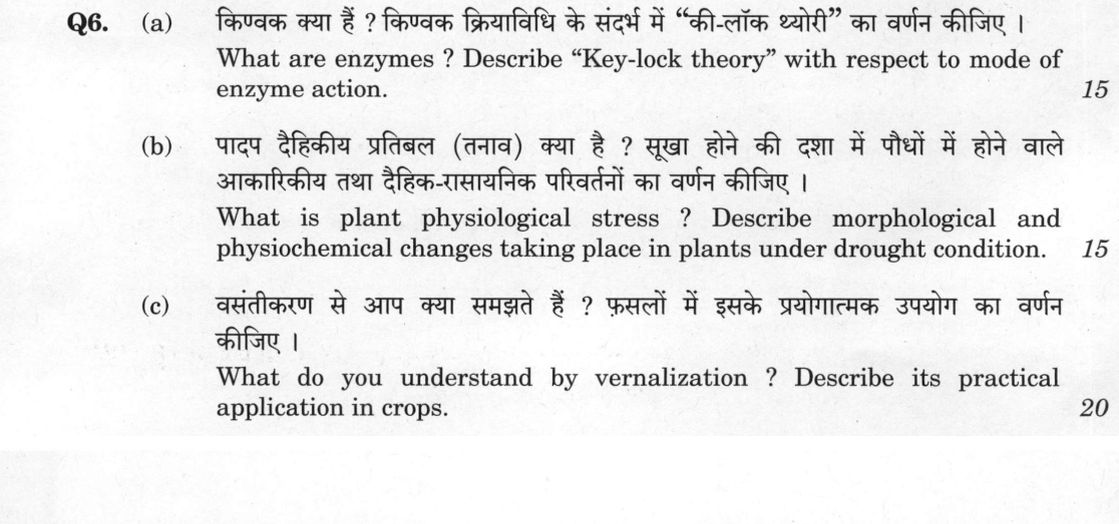
(a) What are enzymes ? Describe "Key-lock theory" with respect to mode of enzyme action. 15 (b) What is plant physiological…
What are enzymes ? Describe "Key-lock theory" with respect to mode of enzyme action. 15 marks
What is plant physiological stress ? Describe morphological and physiochemical changes taking place in plants under drought condition. 15 marks
What do you understand by vernalization ? Describe its practical application in crops. 20 marks
हिंदी में प्रश्न पढ़ें
किण्वक क्या हैं ? किण्वक क्रियाविधि के संदर्भ में "की-लॉक थ्योरी" का वर्णन कीजिए । 15
पादप दैहिकीय प्रतिबल (तनाव) क्या है ? सूखा होने की दशा में पौधों में होने वाले आकारिकीय तथा दैहिक-रासायनिक परिवर्तनों का वर्णन कीजिए । 15
वसंतीकरण से आप क्या समझते हैं ? फसलों में इसके प्रयोगात्मक उपयोग का वर्णन कीजिए । 20
Model answer
Written by UPSC Answer Check against this question's marking rubric, to the expected length. UPSC does not publish answers for Mains — this is one way to score well, not an official key.
Enzymes and Key-Lock Theory
Enzymes are proteinaceous biocatalysts that accelerate biochemical reactions in living organisms without being consumed in the process. They exhibit high specificity, acting only on particular substrates. The "Key-Lock Theory," proposed by Emil Fischer in 1894, describes the mode of enzyme action using a mechanical analogy. In this model, the enzyme’s active site is rigid and complementary in shape to the substrate, much like a lock fits a specific key. The substrate binds to the active site, forming an enzyme-substrate complex, which then converts into products. This theory explains the high specificity of enzymes but has limitations; it assumes a rigid structure, whereas modern understanding suggests the "Induced Fit Model," where the enzyme undergoes a conformational change to better accommodate the substrate. Despite this, the Key-Lock model remains a foundational concept for understanding substrate specificity.
Plant Physiological Stress and Drought Responses
Plant physiological stress refers to any external environmental factor that causes a deviation from optimal metabolic functioning, leading to reduced growth or yield. Drought is a major abiotic stress that triggers distinct morphological and physiochemical adaptations.
Morphologically, plants under drought stress exhibit wilting due to water deficit, leading to turgor loss. To minimize water loss, leaves often roll or fold, reducing the surface area exposed to the sun. There is a significant reduction in leaf area and overall biomass. A key adaptive feature is the increased root-to-shoot ratio; plants allocate more resources to root growth to access deeper water sources. It is important to note that while root systems expand, the specific morphology varies; many crops possess fibrous root systems rather than deep taproots, so "deep taproot proliferation" is not a universal response.
Physiochemically, the primary response is the accumulation of abscisic acid (ABA), a stress hormone that signals stomatal closure to reduce transpiration. This is a physiological response, distinct from the structural morphological changes. To maintain cell turgor, plants undergo osmotic adjustment by accumulating compatible solutes such as proline, glycine betaine, and sugars. These solutes lower the osmotic potential without disrupting cellular metabolism. Additionally, drought induces the production of reactive oxygen species (ROS), which can damage cellular components. Plants counteract this by upregulating antioxidant enzymes like superoxide dismutase and catalase to scavenge ROS. Photosynthetic rates decline due to stomatal limitation and non-stomatal factors, while membrane lipid peroxidation may occur if oxidative stress is severe.
Vernalization and Its Applications
Vernalization is the process by which exposure to prolonged low temperatures (typically 0-10°C) induces the transition from the vegetative to the reproductive phase in plants. This requirement is genetically determined and can be either facultative (where flowering occurs without vernalization but is accelerated by it) or obligate (where flowering is strictly dependent on low-temperature exposure).
The molecular mechanism of vernalization involves the epigenetic silencing of the FLC (FLOWERING LOCUS C) gene, a repressor of flowering. Prolonged cold exposure leads to the expression of the VIN3 gene, which promotes the methylation and silencing of FLC. As FLC levels drop, the expression of the FT (FLOWERING LOCUS T) gene is upregulated, allowing the plant to initiate flowering.
In Indian agriculture, vernalization has significant practical applications, particularly in temperate regions. In the Nilgiris and Kashmir, the cool winter temperatures naturally satisfy the vernalization requirements of temperate vegetables like cabbage, cauliflower, and broccoli, enabling their seed production. This is crucial for the domestic seed industry. In the Indo-Gangetic plains, while winter wheat is a major crop, it is important to clarify that the predominant varieties grown in Punjab, Haryana, and Western UP are spring wheat varieties that do not require vernalization. However, in higher altitude areas or during specific breeding programs, vernalization-sensitive varieties are managed to ensure timely flowering. Understanding vernalization allows breeders to develop early-maturing varieties that can be planted in different seasons, optimizing double-cropping systems. Furthermore, as climate change alters temperature patterns, understanding the vernalization requirements of crops is vital for predicting yield stability and adapting cropping calendars in India.
In conclusion, while enzymes and stress responses highlight the biochemical adaptability of plants, vernalization represents a critical developmental control mechanism. Effective management of these physiological processes is essential for maximizing agricultural productivity in diverse Indian agro-climatic zones.
What "Describe" is asking you to do
Give a full, ordered account of the thing named — its parts, stages or mechanism — in the sequence in which it actually exists or occurs. Most describe questions come from the science optionals, where the marks sit in correct technical detail and, where the stem says so, a labelled diagram.
Structure that answers it
One-line identification of the subject → the parts or stages in their real order, each with its defining detail → labelled diagram where the subject is structural → closing line on function or significance
Where marks are lost
Loose general prose where the examiner is ticking named parts, correct terminology and their sequence; and in the General Studies papers, turning to evaluation before the description is finished.
How this answer will be evaluated
Approach
Framework: Concept > Practice or process > Data > Indian application. (a) describe: define > structure or process in order > labelled diagram > significance | (b) describe: define > structure or process in order > labelled diagram > significance | (c) describe: define > structure or process in order > labelled diagram > significance Full marks: Precise definitions, clear mechanism explanation, specific crop examples, and correct terminology.
Key points expected
- Define enzymes as biological catalysts/proteins
- State Emil Fischer's Key-lock theory
- Explain substrate fits active site like key in lock
- Mention formation of enzyme-substrate complex
- Define plant physiological stress
- Morphological: leaf rolling, wilting, reduced growth
- Physiochemical: stomatal closure, ABA accumulation
- Physiochemical: osmotic adjustment/proline synthesis
Evaluation rubric
Each sub-part is marked on its own, against the marks and word limit printed on the paper.
- (a) Define enzymes and explain the Key-lock theory of enzyme action. 15 marks
describe— define → structure or process in order → labelled diagram → significance
Must cover
- Define enzymes as biological catalysts/proteins
- State Emil Fischer's Key-lock theory
- Explain substrate fits active site like key in lock
- Mention formation of enzyme-substrate complex
Loses marks
- Confusing enzymes with hormones
- Vague description without active site mention
- Ignoring the 'lock' (enzyme) and 'key' (substrate) analogy
Earns more
- Mention specificity of enzyme action
- Reference to induced fit theory as contrast
- Example of a specific enzyme (e.g., amylase)
Extra mark
- Labelled diagram of key-lock mechanism
- Mention of transition state stabilization
- (b) Define physiological stress and detail morphological/physiochemical changes in drought. 15 marks
describe— define → structure or process in order → labelled diagram → significance
Must cover
- Define plant physiological stress
- Morphological: leaf rolling, wilting, reduced growth
- Physiochemical: stomatal closure, ABA accumulation
- Physiochemical: osmotic adjustment/proline synthesis
Loses marks
- Confusing drought with salinity stress
- Listing only morphological changes
- Ignoring the 'physiochemical' aspect of the question
Earns more
- Mention of chlorophyll degradation
- Reference to membrane stability index
- Mention of root:shoot ratio changes
Extra mark
- Specific data on ABA levels
- Reference to specific drought-tolerant cultivar
- (c) Define vernalization and explain its practical application in crops. 20 marks
describe— define → structure or process in order → labelled diagram → significance
Must cover
- Define vernalization (cold treatment for flowering)
- Explain the mechanism (florigen/FT gene)
- Application: forcing flowering in winter crops
- Application: preventing premature flowering in transplants
Loses marks
- Confusing vernalization with photoperiodism
- Failing to link the process to practical crop management
- Vague definition without mentioning cold requirement
Earns more
- Example: Winter wheat or onion
- Mention of 'vernalization' vs 'chilling' distinction
- Reference to photoperiod interaction
Extra mark
- Specific temperature range (e.g., 2-10°C)
- Mention of specific Indian crop application (e.g., wheat in North India)
Practice this exact question
Write your answer and it is marked point by point against the model answer above — what you covered, what you missed, what you got wrong.
Evaluate my answer →More from Agriculture 2021 Paper II
- Q3 (a) What is clone ? What do you understand by clonal selection ? Describe the various ste…
- Q4 (a) What is the role and importance of "Seed treatment campaign" in India in the context…
- Q5 Answer the following questions in about 150 words each : 10×5=50 (a) Define seed viabilit…
- Q6 (a) What are enzymes ? Describe "Key-lock theory" with respect to mode of enzyme action.…
- Q7 (a) What do you mean by "Economic Injury Level" (EIL) and "Economic Threshold Level" (ETL…
- Q8 (a) What is the food production and consumption pattern of India in the last fifty years…