Paper II — Q3
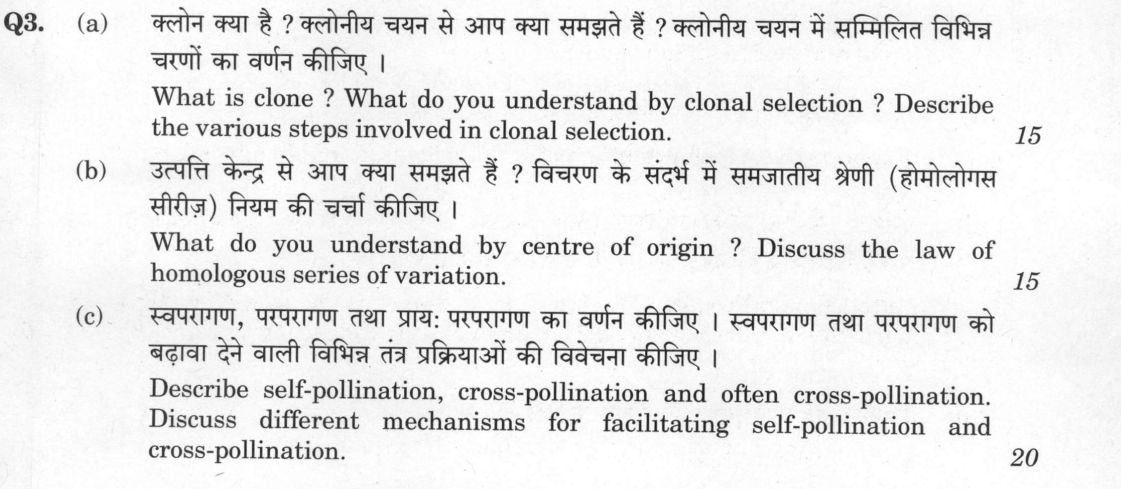
(a) What is clone ? What do you understand by clonal selection ? Describe the various steps involved in clonal selection. 15 (b)…
What is clone ? What do you understand by clonal selection ? Describe the various steps involved in clonal selection. 15 marks
What do you understand by centre of origin ? Discuss the law of homologous series of variation. 15 marks
Describe self-pollination, cross-pollination and often cross-pollination. Discuss different mechanisms for facilitating self-pollination and cross-pollination. 20 marks
हिंदी में प्रश्न पढ़ें
क्लोन क्या है ? क्लोनीय चयन से आप क्या समझते हैं ? क्लोनीय चयन में सम्मिलित विभिन्न चरणों का वर्णन कीजिए । 15
उत्पत्ति केन्द्र से आप क्या समझते हैं ? विचरण के संदर्भ में समजातीय श्रेणी (होमोलोगस सीरीज) नियम की चर्चा कीजिए । 15
स्वपरागण, परपरागण तथा प्रायः परपरागण का वर्णन कीजिए । स्वपरागण तथा परपरागण को बढ़ावा देने वाली विभिन्न तंत्र प्रक्रियाओं की विवेचना कीजिए । 20
Model answer
Written by UPSC Answer Check against this question's marking rubric, to the expected length. UPSC does not publish answers for Mains — this is one way to score well, not an official key.
Part (a): Clonal Selection
A clone is a group of genetically identical individuals derived from a single parent plant through vegetative propagation. Since they arise from somatic cells, clones preserve the exact genetic constitution of the parent, maintaining heterozygosity if the parent was heterozygous, or homozygosity if the parent was homozygous. Clonal selection is the process of identifying and selecting superior individual plants (clones) from a mixed population of vegetatively propagated crops to improve yield, quality, or disease resistance.
The steps involved are:
- Selection of Superior Clones: From a field of mixed clones (e.g., in potato or sugarcane), individual plants exhibiting superior traits like high yield, uniformity, or disease resistance are tagged.
- Clonal Evaluation Trials: The selected clones are grown in replicated trials under controlled conditions to verify their performance against check varieties. This ensures the superiority is genetic and not due to environmental luck.
- Multiplication and Release: Successful clones are multiplied vegetatively (via cuttings, tubers, or tissue culture) and released as improved varieties. This method is crucial for crops like potato, citrus, and sugarcane where sexual reproduction is difficult or undesirable.
Part (b): Centre of Origin and Law of Homologous Series
The Centre of Origin is the geographic region where a plant species first evolved and developed its distinctive properties. Nikolai Vavilov identified eight such centres, including the Hindustan Centre (India), which is the origin of rice (Oryza sativa), cotton, and Saccharum barberi (jaggery cane). Note that Saccharum officinarum (sugar cane) originated in New Guinea/Indo-Malaya. Understanding these centres helps in conserving indigenous crop diversity and finding wild relatives for breeding.
Vavilov’s Law of Homologous Series of Variation states that related species within a genus tend to exhibit similar variations in parallel. For example, if a trait like early maturity appears in one wheat species, similar variations are likely to exist in other wheat species. This law guides breeders to search for specific desirable traits in wild relatives of the same genus, accelerating crop improvement.
Part (c): Pollination Mechanisms
Self-pollination (Autogamy) occurs when pollen from the anther of a flower falls on the stigma of the same flower. Cross-pollination (Allogamy) involves pollen transfer from the anther of one flower to the stigma of another flower on a different plant. Facultative (Often) Cross-pollination occurs in crops that can self-pollinate but are frequently cross-pollinated by insects or wind, such as maize and sorghum.
Mechanisms Facilitating Self-Pollination:
- Cleistogamy: Flowers do not open; pollination occurs within the bud (e.g., Lathyrus sativus).
- Homogamy: Anthers and stigma mature simultaneously within the same flower, ensuring self-fertilization (e.g., rice, wheat).
- Chasmogamy with Adaptations: In some chasmogamous flowers, anthers are positioned close to the stigma, or the stigma is receptive before anthesis (protogyny), facilitating selfing if no cross-pollinators are present.
Mechanisms Facilitating Cross-Pollination:
- Dichogamy: Temporal separation of male and female maturity. Protandry (male first, e.g., cotton) or Protogyny (female first, e.g., Cucumis) prevents selfing.
- Self-Incompatibility: A genetic mechanism where pollen from the same plant fails to fertilize the ovule, enforced by biochemical barriers in the style.
- Male Sterility: Genetic or cytoplasmic factors render anthers sterile, ensuring the plant can only receive foreign pollen (used in hybrid seed production).
- Floral Adaptations: Large, showy flowers with nectar attract insects (entomophily), while light, abundant pollen facilitates wind pollination (anemophily) in crops like maize.
Conclusion
Clonal selection, understanding centres of origin, and manipulating pollination mechanisms are foundational to crop improvement. Clonal selection preserves superior genotypes in vegetatively propagated crops. Vavilov’s concepts guide the exploration of genetic diversity in wild relatives. Finally, understanding pollination systems allows breeders to control mating systems, enabling the production of pure lines or hybrids, thereby enhancing agricultural productivity and food security.
What "Describe" is asking you to do
Give a full, ordered account of the thing named — its parts, stages or mechanism — in the sequence in which it actually exists or occurs. Most describe questions come from the science optionals, where the marks sit in correct technical detail and, where the stem says so, a labelled diagram.
Structure that answers it
One-line identification of the subject → the parts or stages in their real order, each with its defining detail → labelled diagram where the subject is structural → closing line on function or significance
Where marks are lost
Loose general prose where the examiner is ticking named parts, correct terminology and their sequence; and in the General Studies papers, turning to evaluation before the description is finished.
How this answer will be evaluated
Approach
Framework: Concept > Practice or process > Data > Indian application. (a) describe: define > structure or process in order > labelled diagram > significance | (b) discuss: intro > 3-4 dimensions > example > balanced close | (c) describe: define > structure or process in order > labelled diagram > significance Full marks: Precise definitions, clear stepwise processes, specific mechanisms named, and relevant examples.
Key points expected
- Define clone as genetically identical population
- Define clonal selection as selection of superior clones
- Step: Selection of superior individual from population
- Step: Vegetative propagation to maintain genetic identity
- Define centre of origin (Vavilov's concept)
- State law of homologous series of variation
- Explain that variation is predictable and parallel
- Mention that related species show similar variations
Evaluation rubric
Each sub-part is marked on its own, against the marks and word limit printed on the paper.
- (a) Define clone and clonal selection, then detail the stepwise process. 15 marks
describe— define → structure or process in order → labelled diagram → significance
Must cover
- Define clone as genetically identical population
- Define clonal selection as selection of superior clones
- Step: Selection of superior individual from population
- Step: Vegetative propagation to maintain genetic identity
Loses marks
- Confusing clonal selection with mass selection
- Omitting the vegetative propagation step
Earns more
- Mention of 'clonal fidelity' or 'genetic uniformity'
- Reference to specific crop (e.g., potato, banana)
Extra mark
- Mention of 'clonal seedling' vs 'true clone'
- Reference to 'clonal garden' or 'clonal field'
- (b) Define centre of origin and explain the law of homologous series. 15 marks
discuss— intro → 3-4 dimensions → example → balanced close
Must cover
- Define centre of origin (Vavilov's concept)
- State law of homologous series of variation
- Explain that variation is predictable and parallel
- Mention that related species show similar variations
Loses marks
- Confusing centre of origin with centre of domestication
- Failing to link homologous series to parallel variation
Earns more
- Reference to Nikolai Vavilov
- Example of homologous variation in a specific genus
Extra mark
- Mention of 'primary' vs 'secondary' centres of origin
- Reference to 'gene pool' concept
- (c) Define self/cross/often cross-pollination and detail facilitating mechanisms. 20 marks
describe— define → structure or process in order → labelled diagram → significance
Must cover
- Define self-pollination (autogamy/gynomony)
- Define cross-pollination (xenogamy)
- Define often cross-pollination (amphimixis)
- Mechanisms: Dichogamy, herkogamy, self-incompatibility
Loses marks
- Confusing 'often cross' with 'obligate cross'
- Listing mechanisms without explaining how they facilitate the process
Earns more
- Mention of 'protandry' or 'protogyny' as dichogamy types
- Reference to 'cleistogamy' as a self-pollination mechanism
Extra mark
- Example of a specific crop for each type
- Mention of 'apomixis' as an alternative to pollination
Practice this exact question
Write your answer and it is marked point by point against the model answer above — what you covered, what you missed, what you got wrong.
Evaluate my answer →More from Agriculture 2021 Paper II
- Q1 Answer the following questions in about 150 words each : 10×5=50 (a) What do you mean by…
- Q2 (a) Define cell. How is a plant cell different from an animal cell ? Describe a typical c…
- Q3 (a) What is clone ? What do you understand by clonal selection ? Describe the various ste…
- Q4 (a) What is the role and importance of "Seed treatment campaign" in India in the context…
- Q5 Answer the following questions in about 150 words each : 10×5=50 (a) Define seed viabilit…
- Q6 (a) What are enzymes ? Describe "Key-lock theory" with respect to mode of enzyme action.…