Paper II — Q4
(a) What is the role and importance of "Seed treatment campaign" in India in the context of quality crop establishment ? 15 (b)…
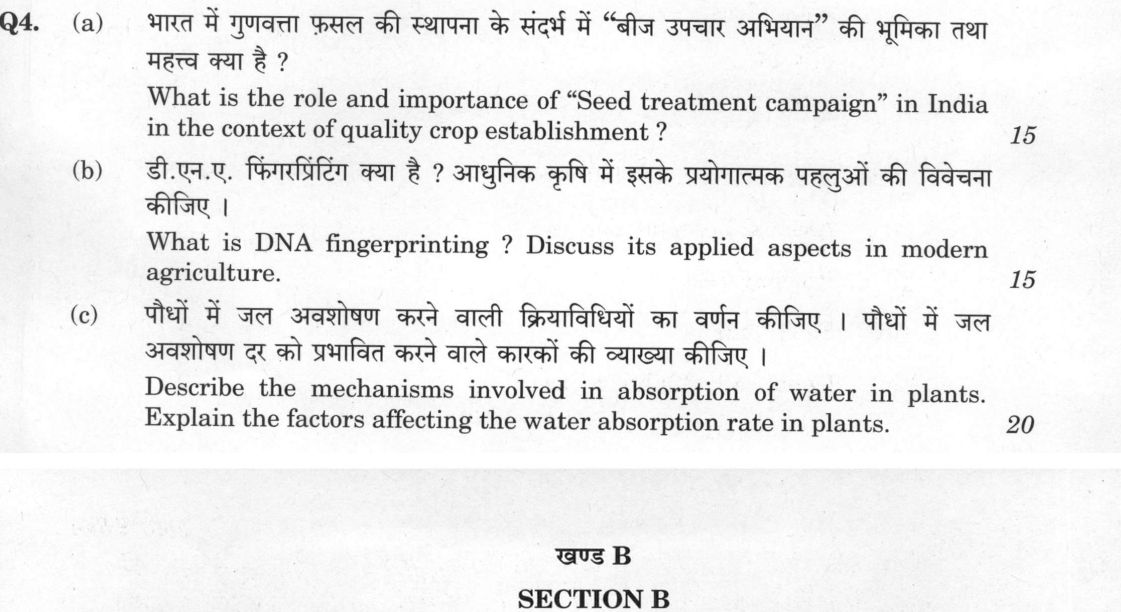
What is the role and importance of "Seed treatment campaign" in India in the context of quality crop establishment ? 15 marks
What is DNA fingerprinting ? Discuss its applied aspects in modern agriculture. 15 marks
Describe the mechanisms involved in absorption of water in plants. Explain the factors affecting the water absorption rate in plants. 20 marks
हिंदी में प्रश्न पढ़ें
भारत में गुणवत्ता फसल की स्थापना के संदर्भ में "बीज उपचार अभियान" की भूमिका तथा महत्व क्या है ? 15 marks
डी.एन.ए. फिंगरप्रिंटिंग क्या है ? आधुनिक कृषि में इसके प्रयोगात्मक पहलुओं की विवेचना कीजिए । 15
पौधों में जल अवशोषण करने वाली क्रियाविधियों का वर्णन कीजिए । पौधों में जल अवशोषण दर को प्रभावित करने वाले कारकों की व्याख्या कीजिए । 20
Model answer
Written by UPSC Answer Check against this question's marking rubric, to the expected length. UPSC does not publish answers for Mains — this is one way to score well, not an official key.
Quality crop establishment is the foundation of sustainable agricultural productivity, relying on the triad of treated seeds, genetic integrity, and efficient physiological water uptake.
Role of Seed Treatment Campaigns The Seed Treatment Campaign (STC) is a government-led initiative aimed at treating seeds with fungicides, insecticides, and biostimulants before sowing. Its primary role is to protect seeds from soil-borne and seed-borne pathogens like Fusarium and Rhizoctonia, as well as pests like Helicoverpa, thereby ensuring high germination percentages and uniform field emergence. By preventing early-stage mortality, STC directly enhances stand establishment, reducing the need for costly replanting. While the National Seed Policy 2002 and the Seed Act 1966 (amended) provide the legal framework for seed quality, STC specifically addresses biological threats. It is crucial to distinguish that STC improves the viability and health of the seed lot, whereas improvements in Seed Replacement Rate (SRR) and Varietal Replacement Rate (VRR) are achieved through the dissemination of certified high-yielding varieties, not through treatment alone. The campaign operates under the National Food Security Mission (NFSM) and State Mission on Agricultural Productivity (SMAP), targeting major food crops to minimize pre-harvest losses and ensure robust initial growth.
DNA Fingerprinting in Agriculture DNA fingerprinting is a molecular technique used to identify and characterize genetic profiles based on polymorphisms in DNA sequences. It relies on markers such as Restriction Fragment Length Polymorphism (RFLP), Random Amplified Polymorphic DNA (RAPD), Simple Sequence Repeats (SSR), and Single Nucleotide Polymorphisms (SNP). Unlike Marker-Assisted Selection (MAS), which uses markers to select breeding lines for specific traits, DNA fingerprinting is primarily a tool for identification and authentication. In modern agriculture, its applications are vast. It is essential for variety identification and protection under the Plant Varieties and Farmers’ Rights (PV&FR) Act, 2001, ensuring that only genuine varieties are released. It facilitates forensic seed certification by detecting adulteration and hybrid purity testing, ensuring that F1 hybrids meet genetic standards. While DUS (Distinctness, Uniformity, Stability) testing for variety registration is predominantly morphological, DNA profiling serves as a critical supplementary tool for rapid and precise genetic characterization, aiding in intellectual property enforcement and maintaining germplasm integrity.
Mechanisms and Factors of Water Absorption Water absorption in plants is a complex physiological process involving both passive and active mechanisms. The primary mechanism is passive absorption, driven by the transpiration pull created by the evaporation of water from leaf surfaces. This generates negative pressure (tension) in the xylem, pulling water up from the roots. The driving force is the difference in water potential between the soil and the plant. Active absorption, though minor, involves root pressure generated by the active transport of ions into the xylem, creating osmotic gradients that draw in water. This is particularly significant in young plants or during high humidity when transpiration is low. Imbibition, the physical adsorption of water onto colloidal surfaces, is crucial for the initial swelling of dry seeds but is not a principal mechanism for continuous water uptake by mature roots. Aquaporins, channel proteins in root cell membranes, facilitate rapid water movement across membranes, enhancing absorption efficiency.
Several factors modulate the rate of water absorption. Soil factors include soil water potential (absorption is maximum near field capacity and declines sharply as soil approaches the permanent wilting point, where available water is negligible), soil texture (affecting aeration and water holding capacity), and soil temperature (influencing root metabolism and membrane fluidity). Aeration is critical; waterlogged soils with low oxygen inhibit root respiration, reducing active transport and overall uptake. Atmospheric factors, particularly transpiration rate, are the dominant drivers; high light intensity, low humidity, and wind speed increase transpiration, thereby enhancing the pull on water. Additionally, the root surface area and root-to-shoot ratio determine the capacity for absorption, while mycorrhizal associations extend the effective root zone, significantly improving water and nutrient uptake in dry conditions.
Conclusion In conclusion, the convergence of these three pillars is vital for Indian agriculture. Quality seed treatment ensures healthy stand establishment, DNA fingerprinting guarantees genetic purity and protects farmer rights, and optimized water absorption mechanisms ensure physiological efficiency. Together, they form the basis for climate-resilient crop production, maximizing yield potential while minimizing resource wastage.
What "Describe" is asking you to do
Give a full, ordered account of the thing named — its parts, stages or mechanism — in the sequence in which it actually exists or occurs. Most describe questions come from the science optionals, where the marks sit in correct technical detail and, where the stem says so, a labelled diagram.
Structure that answers it
One-line identification of the subject → the parts or stages in their real order, each with its defining detail → labelled diagram where the subject is structural → closing line on function or significance
Where marks are lost
Loose general prose where the examiner is ticking named parts, correct terminology and their sequence; and in the General Studies papers, turning to evaluation before the description is finished.
How this answer will be evaluated
Approach
Framework: Concept > Practice or process > Data > Indian application. (a) discuss: intro > 3-4 dimensions > example > balanced close | (b) discuss: intro > 3-4 dimensions > example > balanced close | (c) describe: define > structure or process in order > labelled diagram > significance Full marks: Precise definitions, specific examples (chemicals, markers, pathways), clear structure, and strong Indian context where relevant.
Key points expected
- Define seed treatment (chemical/biological coating)
- Link to quality crop establishment (germination, vigour)
- Mention specific Indian context (e.g., Kisan Sanchay Yojana)
- Explain protection against soil-borne pathogens
- Define DNA fingerprinting (RFLP, RAPD, SSR markers)
- Application in variety identification and purity
- Application in plant breeding (marker-assisted selection)
- Application in germplasm conservation
Evaluation rubric
Each sub-part is marked on its own, against the marks and word limit printed on the paper.
- (a) Role and importance of seed treatment for quality crop establishment in India. 15 marks
discuss— intro → 3-4 dimensions → example → balanced close
Must cover
- Define seed treatment (chemical/biological coating)
- Link to quality crop establishment (germination, vigour)
- Mention specific Indian context (e.g., Kisan Sanchay Yojana)
- Explain protection against soil-borne pathogens
Loses marks
- Confusing seed treatment with seed storage
- Vague generalities without specific chemicals or pathogens
- Ignoring the 'quality crop establishment' aspect
Earns more
- Mention specific fungicides (e.g., Carbendazim, Mancozeb)
- Reference to National Seed Policy
- Mention of bio-priming or nano-seed technology
- Link to reducing crop loss in early stages
Extra mark
- Specific data on germination improvement
- Mention of specific state-level seed treatment initiatives
- (b) Definition of DNA fingerprinting and its applied aspects in modern agriculture. 15 marks
discuss— intro → 3-4 dimensions → example → balanced close
Must cover
- Define DNA fingerprinting (RFLP, RAPD, SSR markers)
- Application in variety identification and purity
- Application in plant breeding (marker-assisted selection)
- Application in germplasm conservation
Loses marks
- Confusing DNA fingerprinting with genetic engineering
- Failing to link to 'modern agriculture' applications
- Vague description of the technique without naming markers
Earns more
- Mention of specific markers (e.g., AFLP, STS)
- Reference to IARI or ICAR's role in DNA banking
- Mention of detecting adulteration in food crops
- Link to intellectual property rights (plant variety protection)
Extra mark
- Specific example of a crop variety identified via DNA
- Mention of the National Gene Bank
- (c) Mechanisms of water absorption in plants and factors affecting the rate. 20 marks
describe— define → structure or process in order → labelled diagram → significance
Must cover
- Describe passive absorption (osmosis, capillarity)
- Describe active absorption (metabolic energy)
- Explain the pathway (apoplastic vs symplastic)
- List factors affecting rate (temperature, O2, root surface area)
Loses marks
- Confusing water absorption with mineral absorption
- Failing to distinguish passive and active mechanisms
- Ignoring the 'factors affecting rate' part of the question
Earns more
- Mention of root pressure
- Explanation of transpiration pull
- Reference to root hair zone
- Mention of soil moisture content impact
Extra mark
- Labelled diagram of water pathway
- Mention of specific plant species with high water uptake
Practice this exact question
Write your answer and it is marked point by point against the model answer above — what you covered, what you missed, what you got wrong.
Evaluate my answer →More from Agriculture 2021 Paper II
- Q1 Answer the following questions in about 150 words each : 10×5=50 (a) What do you mean by…
- Q2 (a) Define cell. How is a plant cell different from an animal cell ? Describe a typical c…
- Q3 (a) What is clone ? What do you understand by clonal selection ? Describe the various ste…
- Q4 (a) What is the role and importance of "Seed treatment campaign" in India in the context…
- Q5 Answer the following questions in about 150 words each : 10×5=50 (a) Define seed viabilit…
- Q6 (a) What are enzymes ? Describe "Key-lock theory" with respect to mode of enzyme action.…
- Q7 (a) What do you mean by "Economic Injury Level" (EIL) and "Economic Threshold Level" (ETL…