Paper II — Q7
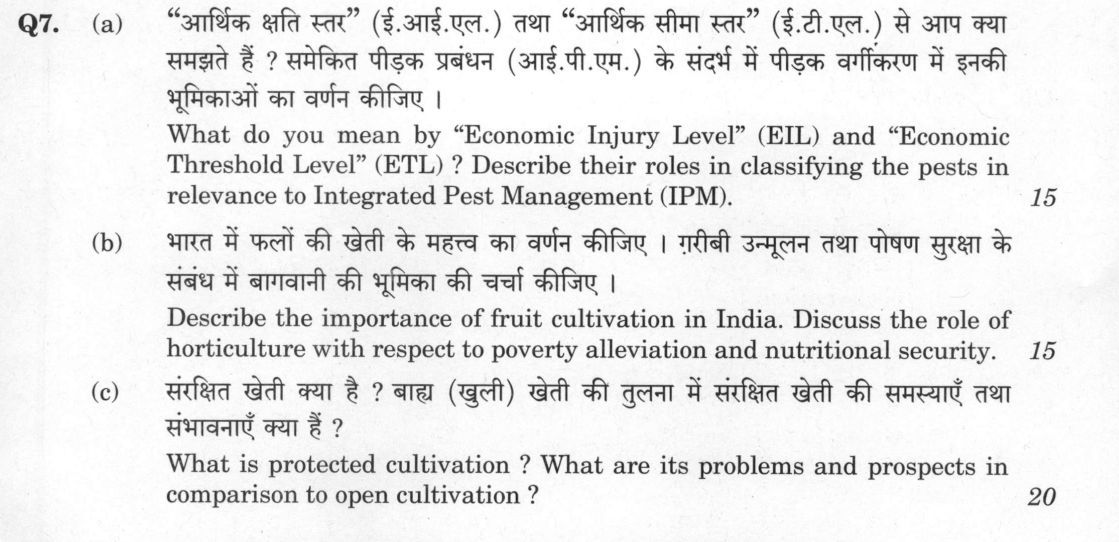
(a) What do you mean by "Economic Injury Level" (EIL) and "Economic Threshold Level" (ETL) ? Describe their roles in classifying…
What do you mean by "Economic Injury Level" (EIL) and "Economic Threshold Level" (ETL) ? Describe their roles in classifying the pests in relevance to Integrated Pest Management (IPM). 15 marks
Describe the importance of fruit cultivation in India. Discuss the role of horticulture with respect to poverty alleviation and nutritional security. 15 marks
What is protected cultivation ? What are its problems and prospects in comparison to open cultivation ? 20 marks
हिंदी में प्रश्न पढ़ें
"आर्थिक क्षति स्तर" (ई.आई.एल.) तथा "आर्थिक सीमा स्तर" (ई.टी.एल.) से आप क्या समझते हैं ? समेकित पीड़क प्रबंधन (आई.पी.एम.) के संदर्भ में पीड़क वर्गीकरण में इनकी भूमिकाओं का वर्णन कीजिए । 15
भारत में फलों की खेती के महत्व का वर्णन कीजिए । गरीबी उन्मूलन तथा पोषण सुरक्षा के संबंध में बागवानी की भूमिका की चर्चा कीजिए । 15
संरक्षित खेती क्या है ? बाह्य (खुली) खेती की तुलना में संरक्षित खेती की समस्याएं तथा संभावनाएं क्या हैं ? 20 marks
Model answer
Written by UPSC Answer Check against this question's marking rubric, to the expected length. UPSC does not publish answers for Mains — this is one way to score well, not an official key.
Economic Injury Level, Economic Threshold Level, and IPM
Economic Injury Level (EIL) is defined as the lowest pest population density that causes economic damage, where the cost of control equals the monetary value of crop yield saved. Economic Threshold Level (ETL) is the operational pest density at which control measures must be initiated to prevent the growing pest population from reaching the EIL. Consequently, ETL is always positioned below EIL to provide a reaction buffer for management interventions.
In Integrated Pest Management (IPM), comparing the pest's General Equilibrium Position (GEP) against ETL and EIL enables the classification of pests:
- Key Pests: GEP is permanently situated above EIL, causing continuous economic damage unless systematically controlled.
- Occasional Pests: GEP lies below ETL, but populations intermittently exceed ETL and EIL due to environmental disturbances.
- Potential Pests: GEP remains below ETL, but can surge past EIL if agroecosystem balances, such as natural enemies, are disrupted.
- Non-Pests: GEP remains permanently far below ETL, posing no economic threat. Determining ETL serves as the critical decision-making threshold for pesticide application timing, thereby avoiding calendar-based spraying and preserving agro-biodiversity.
Fruit Cultivation, Poverty Alleviation, and Nutritional Security
India is the second-largest global producer of fruits, commanding substantial production in mango, banana, papaya, and citrus. Fruit cultivation provides high foreign exchange earnings through fresh and processed exports, enhances supply-chain employment, and supports rural agro-enterprises.
Horticulture drives poverty alleviation by generating significantly higher net returns per unit area than traditional cereals, making it viable for small and marginal landholders. It expands employment for women in harvesting, nursery rearing, and post-harvest grading, and creates rural value addition through processing. For nutritional security, fruits supply essential vitamins, minerals, antioxidants, and dietary fibers, directly targeting micronutrient deficiencies, diversifying dietary baskets, and reducing hidden hunger.
Protected Cultivation: Problems, Prospects, and Open Cultivation Comparison
Protected cultivation involves growing crops under controlled or modified micro-environments using structures such as greenhouses, polyhouses, shade nets, and insect-proof netting to regulate light, temperature, humidity, and airflow.
The primary problems of protected cultivation include high initial capital investment, substantial energy requirements for climate control, shortage of technically skilled farm labor, rapid pest and disease proliferation (such as whiteflies and powdery mildew) in enclosed microclimates, and limited domestic availability of specialized equipment.
Its prospects include off-season, year-round production of high-value vegetables and cut flowers, improved climate resilience against extreme weather, high water-use efficiency through integrated fertigation, and high pesticide reduction, yielding superior, export-grade produce.
In comparison to open cultivation, protected cultivation delivers three to five times higher yield stability and superior input-use efficiency, whereas open cultivation suffers from uncontrolled abiotic stresses and lower yields. While open cultivation requires minimal capital and simple farm practices, protected cultivation offers consistent market access, uniform produce quality, and higher long-term profitability.
Deploying protected cultivation and fruit diversification alongside ETL-guided IPM under the Mission for Integrated Development of Horticulture (MIDH) provides a sustainable framework for climate-resilient agriculture, farmer income enhancement, and national nutritional security.
What "Describe" is asking you to do
Give a full, ordered account of the thing named — its parts, stages or mechanism — in the sequence in which it actually exists or occurs. Most describe questions come from the science optionals, where the marks sit in correct technical detail and, where the stem says so, a labelled diagram.
Structure that answers it
One-line identification of the subject → the parts or stages in their real order, each with its defining detail → labelled diagram where the subject is structural → closing line on function or significance
Where marks are lost
Loose general prose where the examiner is ticking named parts, correct terminology and their sequence; and in the General Studies papers, turning to evaluation before the description is finished.
How this answer will be evaluated
Approach
Framework: Concept > Practice or process > Data > Indian application. (a) describe: define > structure or process in order > labelled diagram > significance | (b) discuss: intro > 3-4 dimensions > example > balanced close | (c) compare: paired headings or table > key differences > significance > conclusion Full marks: Precise definitions, clear distinctions, specific examples, and strong analytical links to IPM, poverty, and cultivation methods.
Key points expected
- Define EIL as pest level causing economic damage
- Define ETL as pest level where control cost equals damage
- Explain ETL is used to trigger control measures
- Link EIL/ETL to IPM decision-making process
- State importance of fruit cultivation in Indian agriculture
- Explain role of horticulture in poverty alleviation
- Explain role of horticulture in nutritional security
- Provide specific examples of fruits or schemes
Evaluation rubric
Each sub-part is marked on its own, against the marks and word limit printed on the paper.
- (a) Define EIL and ETL and explain their role in pest classification for IPM. 15 marks
describe— define → structure or process in order → labelled diagram → significance
Must cover
- Define EIL as pest level causing economic damage
- Define ETL as pest level where control cost equals damage
- Explain ETL is used to trigger control measures
- Link EIL/ETL to IPM decision-making process
Loses marks
- Confusing EIL and ETL definitions
- Ignoring the economic aspect of the terms
- Vague description without linking to IPM
Earns more
- Mention ETL is lower than EIL
- Reference specific pest examples (e.g., bollworm)
- Mention cost-benefit analysis in IPM
- Reference specific crop (e.g., cotton, rice)
Extra mark
- Mention specific ETL values for a named pest
- Reference specific IPM guidelines (e.g., ICAR)
- (b) Describe importance of fruit cultivation in India and its role in poverty/nutrition. 15 marks
discuss— intro → 3-4 dimensions → example → balanced close
Must cover
- State importance of fruit cultivation in Indian agriculture
- Explain role of horticulture in poverty alleviation
- Explain role of horticulture in nutritional security
- Provide specific examples of fruits or schemes
Loses marks
- Vague generalities without specific examples
- Ignoring the poverty alleviation aspect
- Ignoring the nutritional security aspect
Earns more
- Mention specific fruit varieties (e.g., mango, banana)
- Reference specific government schemes (e.g., Mission for Integrated Development of Horticulture)
- Mention nutritional benefits (e.g., vitamins, minerals)
- Reference specific regions (e.g., Maharashtra, Andhra Pradesh)
Extra mark
- Mention specific production statistics for fruits
- Reference specific nutritional deficiency issues (e.g., anemia)
- (c) Define protected cultivation and compare its problems/prospects with open cultivation. 20 marks
compare— paired headings or table → key differences → significance → conclusion
Must cover
- Define protected cultivation (e.g., polyhouse, net house)
- List problems of protected cultivation
- List prospects of protected cultivation
- Compare these with open cultivation
Loses marks
- Failing to define protected cultivation
- Listing problems/prospects without comparison to open cultivation
- Vague description without specific examples
Earns more
- Mention specific types of protected cultivation (e.g., polyhouse, net house)
- Reference specific crops grown under protected cultivation (e.g., vegetables, flowers)
- Mention specific problems (e.g., high cost, maintenance)
- Mention specific prospects (e.g., year-round production, higher yield)
Extra mark
- Mention specific cost-benefit analysis of protected vs open cultivation
- Reference specific government support for protected cultivation
Practice this exact question
Write your answer and it is marked point by point against the model answer above — what you covered, what you missed, what you got wrong.
Evaluate my answer →More from Agriculture 2021 Paper II
- Q4 (a) What is the role and importance of "Seed treatment campaign" in India in the context…
- Q5 Answer the following questions in about 150 words each : 10×5=50 (a) Define seed viabilit…
- Q6 (a) What are enzymes ? Describe "Key-lock theory" with respect to mode of enzyme action.…
- Q7 (a) What do you mean by "Economic Injury Level" (EIL) and "Economic Threshold Level" (ETL…
- Q8 (a) What is the food production and consumption pattern of India in the last fifty years…