Paper I — Q1
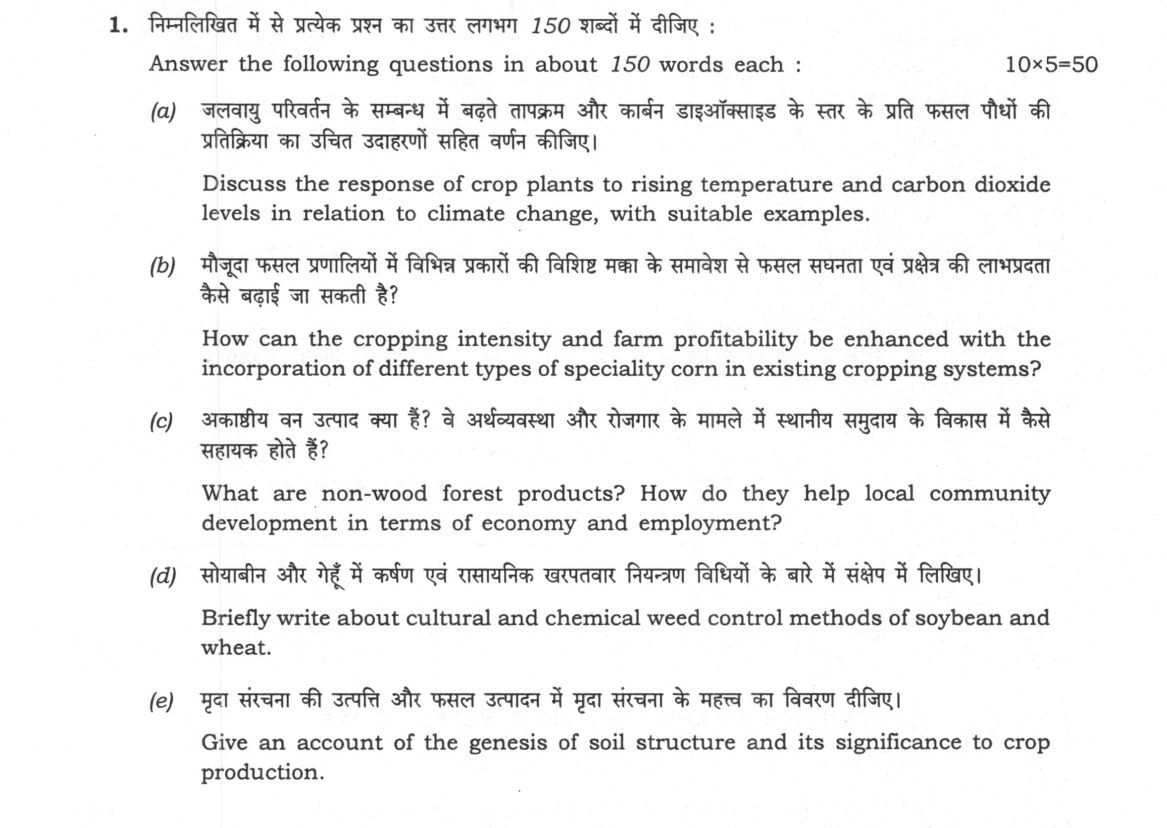
Answer the following questions in about 150 words each: (a) Discuss the response of crop plants to rising temperature and carbon…
Answer the following questions in about 150 words each:
Discuss the response of crop plants to rising temperature and carbon dioxide levels in relation to climate change, with suitable examples. 10 marks
How can the cropping intensity and farm profitability be enhanced with the incorporation of different types of speciality corn in existing cropping systems? 10 marks
What are non-wood forest products? How do they help local community development in terms of economy and employment? 10 marks
Briefly write about cultural and chemical weed control methods of soybean and wheat. 10 marks
Give an account of the genesis of soil structure and its significance to crop production. 10 marks
हिंदी में प्रश्न पढ़ें
निम्नलिखित में से प्रत्येक प्रश्न का उत्तर लगभग 150 शब्दों में दीजिए :
जलवायु परिवर्तन के संबंध में बढ़ते तापक्रम और कार्बन डाइऑक्साइड के स्तर के प्रति फसल पौधों की प्रतिक्रिया का उचित उदाहरणों सहित वर्णन कीजिए। (10 अंक)
मौजूदा फसल प्रणालियों में विभिन्न प्रकारों की विशिष्ट मक्का के समावेश से फसल सघनता एवं प्रक्षेत्र की लाभप्रदता कैसे बढ़ाई जा सकती है? (10 अंक)
अकाष्ठीय वन उत्पाद क्या हैं? वे अर्थव्यवस्था और रोजगार के मामले में स्थानीय समुदाय के विकास में कैसे सहायक होते हैं? (10 अंक)
सोयाबीन और गेहूं में कर्षण एवं रासायनिक खरपतवार नियंत्रण विधियों के बारे में संक्षेप में लिखिए। (10 अंक)
मृदा संरचना की उत्पत्ति और फसल उत्पादन में मृदा संरचना के महत्व का विवरण दीजिए। (10 अंक)
Model answer
Written by UPSC Answer Check against this question's marking rubric, to the 150-word length. UPSC does not publish answers for Mains — this is one way to score well, not an official key.
Crop Responses to Climate Change
Rising atmospheric carbon dioxide (CO₂) and ambient temperatures exert contrasting yet interacting physiological effects on crops. Elevated CO₂ enhances the photosynthetic rate of C3 crops (such as wheat, rice, and pulses) via the CO₂ fertilization effect by suppressing RuBisCO oxygenation (photorespiration) and improving water-use efficiency through partial stomatal closure. Conversely, C4 crops like maize, sorghum, and pearl millet derive negligible photosynthetic benefit from elevated CO₂ because their internal CO₂-concentrating mechanism operates near saturation at ambient levels. Elevated temperatures largely offset potential CO₂ gains by accelerating crop phenology. This accelerates thermal time accumulation, truncating vegetative and grain-filling durations and causing terminal heat stress in rabi wheat. Extreme temperatures during anthesis cause severe reproductive failure, such as spikelet sterility in rice at temperatures exceeding 35°C due to pollen desiccation. Adapting to these climate dynamics necessitates breeding heat-resilient cultivars and developing microclimate-modifying agronomic practices.
Speciality Corn for Cropping Intensity and Profitability
Incorporating speciality corn—such as sweet corn, baby corn, popcorn, and Quality Protein Maize (QPM)—into existing cropping systems significantly intensifies land use and maximizes farm returns. Baby corn and sweet corn have short growth durations (60–75 days), which allows the inclusion of three to four crops per year in intensive systems (e.g., baby corn–potato–mungbean), thereby increasing cropping intensity beyond 250%. These varieties are suited for intercropping and relay cropping with short-duration grain legumes (such as cowpea and greengram), enhancing land-equivalent ratios and maintaining soil fertility. Economically, speciality corns yield three to four times higher net returns than field maize due to growing urban consumer and processing demand. Popcorn and QPM support value-added industrial supply chains and provide nutritional security. Furthermore, harvesting green baby corn and sweet corn generates green stover for dairy feed, lowering livestock rearing costs and diversifying income streams.
Non-Wood Forest Products (NWFPs) and Local Development
Non-Wood Forest Products (NWFPs) comprise biological goods other than timber harvested from natural forests, plantations, and wooded lands. They encompass bamboo, cane, tendu leaves, natural gums, oleo-resins, lac, wild honey, medicinal and aromatic plants, mushrooms, and tree-borne oilseeds. NWFPs provide an economic safety net for tribal and forest-dwelling communities across central and northeastern India, contributing 20 to 40 percent of their annual household income. They generate sustained rural employment during lean agricultural seasons, with collection, grading, and cleaning predominantly carried out by forest-dependent women. Programs like the Van Dhan Vikas Yojana under TRIFED have organized primary gatherers into Self-Help Groups for local processing and value addition, minimizing intermediary exploitation. By combining Minimum Support Price (MSP) mechanisms with decentralized cottage processing, NWFPs reduce distress migration, promote gender empowerment, and support sustainable forest conservation.
Cultural and Chemical Weed Control in Soybean and Wheat
Effective weed management in soybean and wheat combines cultural techniques with selective chemical applications to limit weed competition.
In soybean (Glycine max), cultural control involves stale seedbed preparation, maintaining a 45 cm × 5 cm plant spacing to accelerate canopy closure, and intercropping with maize or pigeonpea to shade out weeds such as Echinochloa colona and Trianthema portulacastrum. Chemical control includes a pre-emergence application of Pendimethalin at 1.0 kg a.i./ha within 48 hours of sowing, followed by a post-emergence application of Imazethapyr at 75–100 g a.i./ha at 15–20 days after sowing to control both grassy and broad-leaved weeds.
In wheat (Triticum aestivum), cultural measures include closer row spacing (18–20 cm), zero-tillage with surface residue mulching using a Happy Seeder, and crop rotation with mustard or chickpea to break Phalaris minor cycles. Chemically, grassy weeds are controlled post-emergence at 30–35 days after sowing with Sulfosulfuron at 25 g a.i./ha or Clodinafop-propargyl at 60 g a.i./ha. Broadleaf weeds (Chenopodium album, Rumex dentatus) are managed using Metsulfuron-methyl at 4 g a.i./ha or 2,4-D ethyl ester at 0.5 kg a.i./ha.
Genesis and Agricultural Significance of Soil Structure
Soil structure develops through the spatial aggregation of primary particles (sand, silt, clay) into distinct peds. Its genesis is driven by physical, chemical, and biological mechanisms:
- Physical forces: Alternate wetting-drying and freezing-thawing cycles cause differential expansion and shrinkage, creating natural structural fissures.
- Chemical mechanisms: Flocculation of colloidal clays by polyvalent cations (such as Ca²⁺ and Mg²⁺) and subsequent cementation by iron and aluminum sesquioxides stabilize peds.
- Biological processes: Penetrating crop roots exert lateral pressure, while fungal hyphae (secreting glomalin) and soil microbes (producing polysaccharide gums) bind micro-aggregates into water-stable macro-aggregates.
- Tillage: Conservation tillage and organic matter incorporation help maintain these structural bonds.
A well-developed, crumb or granular soil structure is central to crop productivity. It creates a balanced distribution of macropores for root aeration and water drainage, alongside micropores for plant-available water storage. It reduces bulk density, lowers soil resistance to root elongation, improves nutrient diffusion, enhances water infiltration, and resists surface crusting and erosion.
What "Discuss" is asking you to do
Lay the issue out from more than one side — how it arose, what is claimed for it, what is held against it, and where it now stands. UPSC attaches discuss to broad topics with several live dimensions, so coverage of the dimensions earns more than the strength of your opinion.
Structure that answers it
Set the issue up → the case as it is made → the case against → the dimension both sides leave out → where the balance now lies
Where marks are lost
Listing facts with no thread between them, or arguing one side throughout and calling it a discussion.
How this answer will be evaluated
Approach
Framework: Concept > Practice or process > Data > Indian application. (a) discuss: intro > 3-4 dimensions > example > balanced close | (b) examine: intro > how/why with reasoning > evidence > conclusion | (c) explain: definition/context > points in order > small example > short close | (d) write short notes: define > 3-4 key features > one example > one-line significance | (e) account for: state the phenomenon > the causes in order of weight > conclusion Full marks: All musts met, specific examples, named varieties/schemes, clear structure
Key points expected
- Physiological response to rising temperature
- Physiological response to elevated CO2
- Suitable examples of crop response
- Link to climate change context
- Definition of speciality corn types
- Mechanism of enhanced cropping intensity
- Mechanism of enhanced farm profitability
- Integration with existing cropping systems
Evaluation rubric
Each sub-part is marked on its own, against the marks and word limit printed on the paper.
- (a) Response of crop plants to rising temperature and CO2 levels with examples. · 150 words
discuss— intro → 3-4 dimensions → example → balanced close
Must cover
- Physiological response to rising temperature
- Physiological response to elevated CO2
- Suitable examples of crop response
- Link to climate change context
Loses marks
- Vague agronomic advice without physiological basis
- Ignoring the CO2 component
- No specific crop examples
Earns more
- Specific crop examples (e.g., wheat, rice)
- Mention of C3 vs C4 response
- Reference to heat stress thresholds
- Mention of CO2 fertilization effect
Extra mark
- Specific temperature threshold for a named crop
- Reference to specific climate change model
- (b) How speciality corn enhances cropping intensity and farm profitability. · 150 words
examine— intro → how/why with reasoning → evidence → conclusion
Must cover
- Definition of speciality corn types
- Mechanism of enhanced cropping intensity
- Mechanism of enhanced farm profitability
- Integration with existing cropping systems
Loses marks
- MSP-only solutions
- Vague agronomic advice
- Ignoring the profitability component
Earns more
- Named speciality corn varieties (e.g., sweet, pop, dent)
- Specific cropping system examples
- Mention of market premium for speciality corn
- Reference to specific Indian schemes
Extra mark
- Specific variety name (e.g., a named sweet corn hybrid)
- Recent scheme figure for corn promotion
- (c) Definition of non-wood forest products and their role in local development. · 150 words
explain— definition/context → points in order → small example → short close
Must cover
- Definition of non-wood forest products
- Examples of non-wood forest products
- Economic contribution to local community
- Employment generation mechanism
Loses marks
- Vague definition without examples
- Ignoring the employment component
- No link to local community development
Earns more
- Specific examples (e.g., honey, lac, medicinal plants)
- Mention of specific local community
- Reference to specific economic activity
- Mention of specific employment type
Extra mark
- Specific economic figure for a named product
- Reference to a specific government scheme for NTFPs
- (d) Cultural and chemical weed control methods for soybean and wheat. · 150 words
write short notes— define → 3-4 key features → one example → one-line significance
Must cover
- Cultural weed control methods for soybean
- Cultural weed control methods for wheat
- Chemical weed control methods for soybean
- Chemical weed control methods for wheat
Loses marks
- Vague agronomic advice
- Ignoring the chemical component
- No specific methods for either crop
Earns more
- Specific cultural practices (e.g., intercultivation, mulching)
- Named herbicides for soybean
- Named herbicides for wheat
- Mention of specific application timing
Extra mark
- Specific herbicide name and dose
- Reference to a specific weed species
- (e) Genesis of soil structure and its significance to crop production. · 150 words
account for— state the phenomenon → the causes in order of weight → conclusion
Must cover
- Process of soil structure genesis
- Factors influencing soil structure
- Significance to crop production
- Link between structure and crop yield
Loses marks
- Vague description without genesis process
- Ignoring the significance to crop production
- No link between structure and yield
Earns more
- Specific soil structure types (e.g., granular, blocky)
- Mention of specific soil properties (e.g., porosity, aeration)
- Reference to specific crop response
- Mention of specific management practice
Extra mark
- Specific soil type example
- Reference to a specific soil science principle
Practice this exact question
Write your answer and it is marked point by point against the model answer above — what you covered, what you missed, what you got wrong.
Evaluate my answer →More from Agriculture 2023 Paper I
- Q1 Answer the following questions in about 150 words each: (a) Discuss the response of crop…
- Q2 (a) What do you understand by agroecology? How does agroecology help in crop distribution…
- Q3 (a) Give the specific features of organic farming and natural farming. Briefly discuss th…
- Q4 (a) Discuss the primary pathways of gaseous nitrogen losses from soil and the factors aff…